
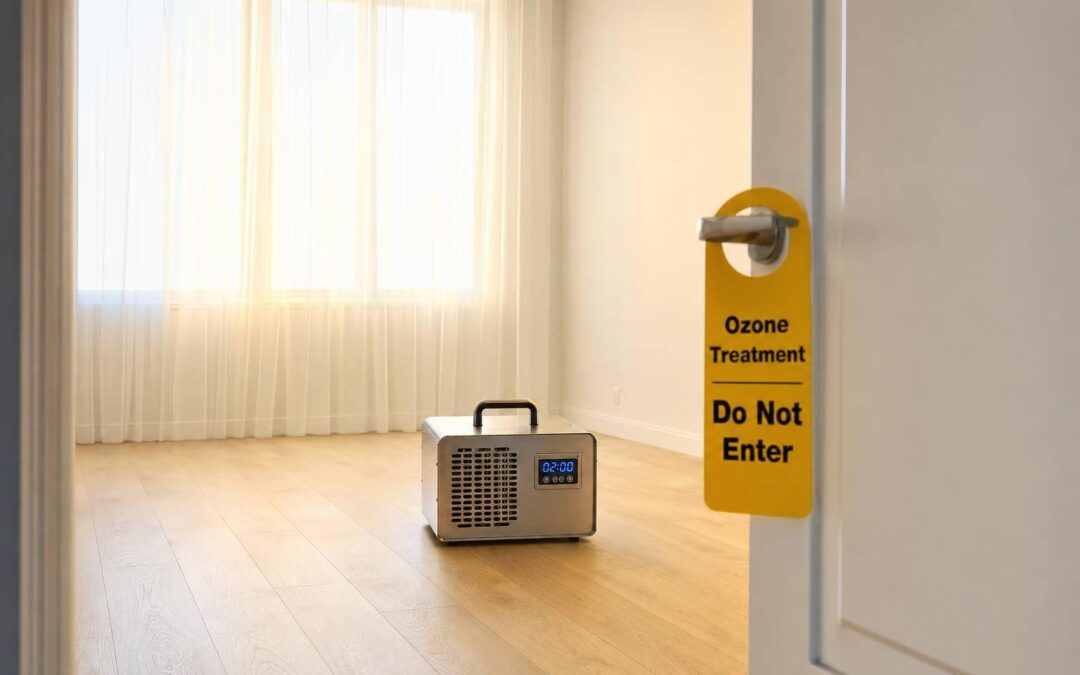
Ozone does not clean air like a filter. It reacts with some pollutants, and that only works in an empty space.
If I had to boil the whole topic down, I’d say this:
- Ozone is a gas, not a filter
- It can change some odor molecules through oxidation
- It may affect some bacteria, fungi, and viruses under tightly controlled conditions
- It does not remove dust, pollen, pet dander, or carbon monoxide
- It can create new pollutants like formaldehyde, aldehydes, organic acids, and ultrafine particles
- The space must be vacant during treatment
- Safe re-entry depends on a meter reading, not on smell
In plain terms: if smoke, moisture damage, moldy material, or another source is still there, ozone will not fix that root issue. Source removal comes first. Ozone, if used at all, is a short-term step for an unoccupied area after cleanup.
A few numbers stand out:
- Some guidance for treatment uses at least 2.5 ppm during the process
- A cautious re-entry target mentioned in the article is below 0.08 ppm
- OSHA’s 8-hour exposure limit is 0.1 ppm
- EPA guidance says ozone generators are not approved for occupied spaces
Here’s the quick version you can scan in seconds:
| Topic | Short answer |
|---|---|
| How ozone works | It oxidizes certain compounds |
| Best use case | Leftover odors in porous materials after source cleanup |
| What it won’t do | It won’t filter particles or fix an active source |
| Main risk | Lung irritation and chemical byproducts |
| Safe to use around people? | No |
| How to know it’s cleared | Use a calibrated ozone monitor |
So when I look at ozone treatment, I don’t see a daily air-cleaning tool. I see a limited, controlled process that may help with some odor and contamination cases, but only with preparation, contact time, ventilation, and measured clearance.
What Is an Ozone Generator? Uses, Risks, and How It Affects Indoor Air Quality
sbb-itb-5fea4da
How Ozone Oxidizes Pollutants
When ozone comes into contact with a susceptible compound, it reacts with reactive sites in the molecule and breaks that compound into smaller reaction products plus oxygen. That sounds simple on paper, but the way it plays out changes from one pollutant to another. That’s why one odor may drop a lot while another barely changes. The main issue is how well that reaction works against different odors, microbes, and materials.
Contact time is the amount of time ozone stays in the space and has a chance to react. Residual ozone is the ozone left after treatment, and it must be cleared before anyone goes back inside. Smell is not a reliable way to judge that.
How Oxidation Affects Odor Compounds and Microorganisms
Ozone can react with some volatile organic compounds (VOCs), which are carbon-based chemicals that evaporate into the air and create strong odors. It targets reactive sites in those molecules and turns them into different substances that may smell less or may have no smell at all. That’s why ozone can reduce some smoke, musty, or organic odors when conditions are controlled.
Ozone can also oxidize cell membranes, proteins, and genetic material in some bacteria, fungi, and viruses. That can weaken or inactivate them. But results vary. The organism itself matters, and so do ozone dose, humidity, and exposure time. At public-health levels, ozone has limited power against indoor microbial contaminants. In many cases, treatment only works well at higher levels in an unoccupied space.
There’s an important catch here: oxidation does not make pollutants disappear. It changes them into other compounds, and some of those can still irritate people, including formaldehyde, aldehydes, and organic acids. A sound treatment plan looks at what ozone creates, not just what it takes away.
Factors That Shape Treatment Results in Real Spaces
These factors decide whether ozone can reach the target and stay there long enough to do useful work.
| Variable | Why it matters |
|---|---|
| Ozone concentration | Higher levels increase oxidation potential but also increase health risk and byproduct formation |
| Exposure (contact) time | More time gives ozone more opportunity to reach and react with the target |
| Relative humidity | It affects reaction rates and microbial inactivation; it needs to be measured, not guessed |
| Temperature (°F) | It affects how fast ozone reacts and how long it remains in the space |
| Airflow and mixing | Ozone has to physically reach the contaminated area; fans can help, but they can also move ozone into nearby rooms |
| Room volume | Ceiling height and connected spaces change the true air volume – floor area in sq ft by itself is not enough |
| Contaminant location | Odors trapped in upholstery, carpet, ductwork, or wall cavities are much harder to reach than airborne molecules |
Treatment results depend on the combined concentration-time exposure, or C × t. More concentration without enough time, or more time without enough concentration, doesn’t automatically mean better treatment. Those limits set the line for what ozone can remove and what it can’t.
What Ozone Can and Cannot Remove
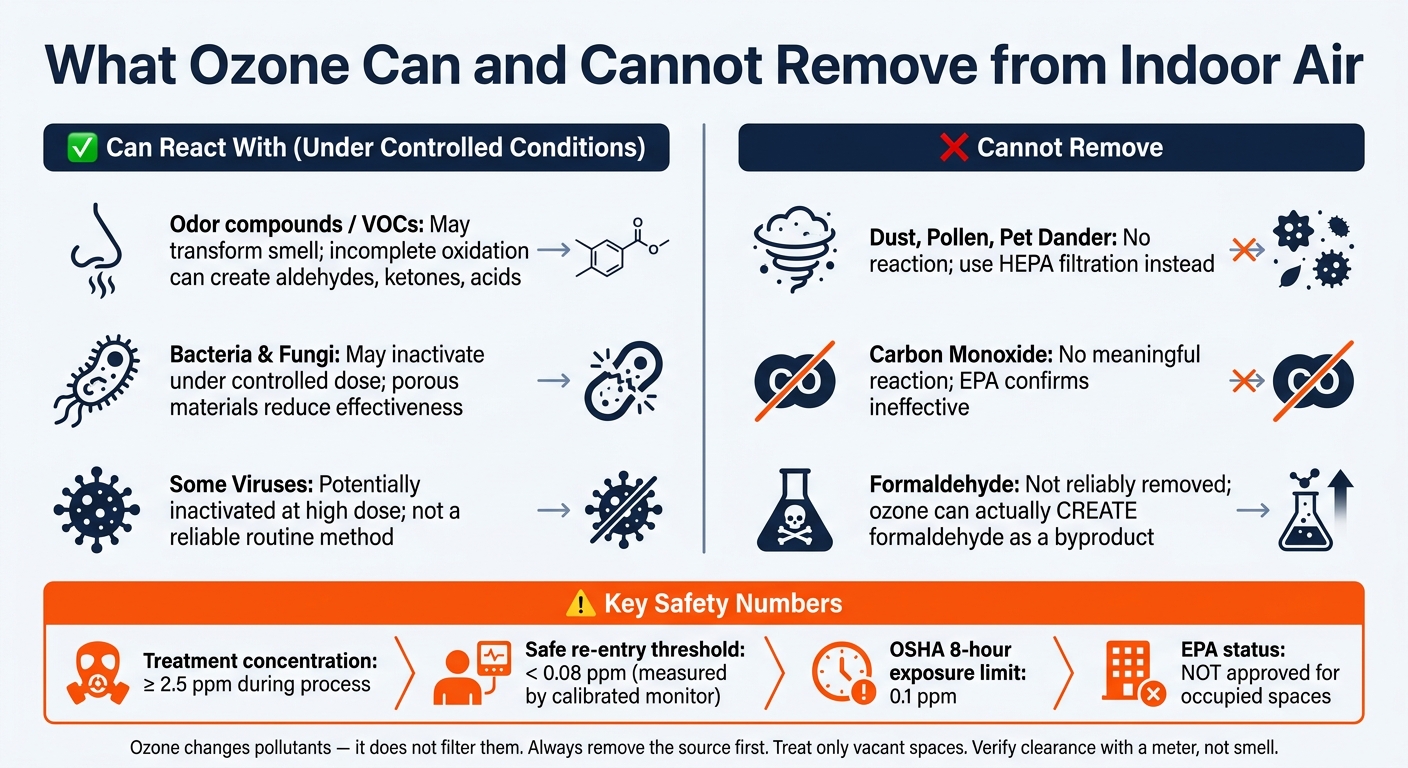
What Ozone Can and Cannot Remove from Indoor Air
Ozone reacts with some pollutants. It does not trap particles the way a filter does. That one difference explains a lot.
In plain English: ozone may help change some odors, but it does not remove dust, pollen, pet dander, or gases that don’t react much with it. And even when it does react, that doesn’t mean the problem is gone.
Comparison Table: How Ozone Handles Common Contaminants
| Contaminant | Can ozone react with it? | Effective at indoor-safe levels? | Effect | Key limitation or possible byproduct |
|---|---|---|---|---|
| Odor compounds | Often, depending on the chemistry | Usually not for routine indoor use; controlled unoccupied treatment may be used | Primarily transformed | Odor source may remain; incomplete oxidation can create aldehydes, ketones, acids, or other compounds |
| Bacteria and fungi | Yes, under suitable exposure conditions | Variable; unreliable in ordinary occupied-space use | May be inactivated, not removed | Porous materials, organic debris, shielding, and inadequate contact time reduce effectiveness |
| Viruses | Ozone may damage some exposed viral particles | Highly dependent on dose and conditions; not a dependable routine-room disinfection method | Potentially inactivated, not filtered out | No standard dose; treat only unoccupied spaces, then ventilate and verify |
| Particles (dust, pollen, pet dander) | No meaningful reaction | No | Not removed | Ozone does not remove particles; use filtration instead |
| Carbon monoxide | No meaningful reaction | No | Not removed | EPA identifies ozone generators as ineffective for carbon monoxide |
| Formaldehyde and other VOCs | Not removed effectively at practical indoor-air-cleaner levels; some VOCs may react but results vary widely | No | Not reliably removed; reactions may generate additional pollutants | EPA identifies ozone generators as ineffective for formaldehyde; ozone can contribute to secondary formaldehyde formation and also produce ultrafine particles, ketones, peroxides, and organic acids when reacting with other indoor chemicals |
Why Byproducts and Incomplete Treatment Matter
Here’s where things get tricky. When ozone reacts with chemicals already in a room – such as cleaning products, air fresheners, paints, wood flooring, or carpets – it can create new pollutants. The EPA lists possible reaction byproducts such as formaldehyde, ketones, organic acids, and ultrafine particles smaller than 0.1 micrometers .
That matters because reaction is not the same as removal. If wet drywall, mold-damaged materials, smoke residue, or decomposing material is still there, ozone may change the smell for a while without fixing the source. It’s a bit like spraying perfume in a room with a leak in the trash bag. The smell shifts, but the mess is still sitting there.
The better approach is simple: remove the source first as part of a home sanitization checklist. Then, if ozone is used at all, use it only in a controlled, unoccupied treatment as a finishing step. After the source is gone, the next move is controlled exposure and ventilation.
How Controlled Ozone Air Treatment Works
Each step matters. Skip one, and you can end up with partial results or a space that isn’t safe to enter yet. Ozone can create byproducts, and it can also miss hidden sources. So control matters just as much as output. That’s why preparation, exposure, and clearance all need close attention.
Assessing and Preparing the Space Before Treatment
Before any equipment is switched on, a professional has to figure out exactly what’s going on. That starts with identifying the contamination source and the treatment goal, whether that’s home odor removal for smoke, fire residue, or mold, or suspected surface contamination. It also means confirming that the source has already been removed. Ozone only works after the source is under control.
The assessment also looks at the space itself: its size, air volume, connected rooms or compartments, HVAC setup, ventilation paths, moisture conditions, sensitive materials, and whether doors, vents, or other openings can be controlled. A small passenger vehicle calls for one approach. A large RV or a multi-compartment boat calls for another. And if airflow is uneven, separate zones may need to be treated on their own.
Before treatment starts, the treatment zone has to be cleared. That includes:
- People
- Pets
- Plants
- Food
- Medications
- Other incompatible items
Sensitive materials also need attention. Natural rubber, some elastomers, latex, certain dyes, artwork, photographs, electronics, oxidizable metals, and delicate finishes should be removed or protected. HVAC systems may also need to be shut down or isolated so ozone doesn’t drift into occupied or unintended areas.
Running the Treatment, Allowing Contact Time, Then Ventilating and Verifying
Equipment settings aren’t one-size-fits-all. They depend on room volume, the type of contamination, the materials in the space, humidity, temperature, and airflow. A U.S. Army public-health guidance document gives example disinfection parameters aimed at at least 2.5 ppm throughout the treatment area, with run times of about 30 minutes to 2 hours based on area size.
Once ozone generation stops, the job isn’t over. Ozone still needs time to react with contaminants. After that, the space has to be ventilated with fresh outdoor air using a controlled plan.
Then comes the part that matters most for re-entry: verification. A calibrated ozone monitor is used after ventilation to confirm that residual ozone levels are below the re-entry threshold. The cited U.S. Army guidance recommends a cautious clearance target of below 0.08 ppm, while OSHA’s permissible exposure limit is 0.1 ppm as an 8-hour time-weighted average. Safe re-entry is based on measured clearance, not on whether the space "smells fine."
When to Use a Professional Ozone Service
Some spaces are harder to manage than they look. Large areas, connected rooms, and tricky airflow can make treatment and clearance checks much harder to control. In those cases, professional service is usually the smart move.
That makes the most sense when the space is large, linked to other rooms or occupied areas, hard to ventilate, filled with sensitive materials, or dealing with severe contamination. The same goes when the source isn’t fully known. It’s also the right move when treatment could affect employees, customers, nearby units, or shared building systems. In those cases, documentation and verified re-entry checks aren’t just nice to have – they matter.
Safety Limits, Requirements, and Key Takeaways
After treatment, clearance – not odor – tells you if the space is safe to reenter.
No federal agency has approved ozone generators for occupied spaces. That means ozone should be used only in vacant spaces (unlike ozone vs hydroxyl comparisons where hydroxyls allow for occupancy), with people, pets, and plants out during generation and contact time.
Safety Table: Required Precautions and How They Affect the Treatment Plan
| Required Precaution | Why It Matters | How It Affects the Treatment Plan |
|---|---|---|
| Keep the treatment area vacant and secured, including connected rooms and shared HVAC pathways. | Ozone can irritate and injure the respiratory system, even at relatively low concentrations. Ozone can also migrate into adjacent spaces; in an EPA test-home example, levels above 0.2 ppm were recorded in rooms next to the generator. | Vacate the full treatment area, lock or secure access, post warning signs, and notify anyone who shares the building or HVAC system. |
| Limit inhalation exposure. | Effects can include coughing, throat and airway irritation, chest discomfort, shortness of breath, reduced lung function, and aggravated asthma. | Treat the space as a hazardous exposure area; do not allow casual entry to check odor or equipment. |
| Remove or protect ozone-sensitive materials and reactive products before treatment. | Ozone can oxidize rubber, elastomers, dyes, coatings, electrical components, natural fibers, and other sensitive materials. It can also react with terpene compounds from pine- or citrus-scented products and form formaldehyde and ultrafine particles. | Remove or protect vulnerable items and fragranced products before generation begins; review manufacturer guidance for appliances and specialty materials. |
| Ventilate with outdoor air until ozone is cleared. | Ozone must decay or be actively removed; a fixed wait time does not work equally well in every space. | Use a planned ventilation procedure with outdoor air. |
| Confirm clearance with a calibrated ozone monitor. | Safe re-entry is based on measured clearance. | Measure ozone in representative locations after ventilation and keep the space vacant if readings are uncertain. |
Conclusion: Core Principles to Remember
Once the space has been ventilated and verified, one rule should guide the whole job: source removal first, ozone second.
Put plainly, ozone has a role only in controlled, vacant-space treatment after source removal, with proper contact time, ventilation, and measured clearance.
For large, hard-to-isolate, or severely contaminated spaces, Ozonated Cleaning LLC can handle preparation, treatment, and clearance checks.
FAQs
Can ozone remove mold permanently?
No. Ozone is not a permanent fix for mold.
It can kill active mold spores and help get rid of the smell that often comes with mold. But it doesn’t remove the mold itself. And it doesn’t solve the moisture issue that caused the problem in the first place.
If that moisture source is still there, mold will probably come back.
For heavy mold growth, ozone treatment should be used as part of a broader remediation plan, not as a stand-alone answer.
How long should I wait before re-entering?
For safety, everyone needs to leave during treatment – that includes people, pets, and plants.
Once the generator stops, wait at least 2 hours for the ozone to break down into oxygen. If you’re doing a more intensive treatment or treating the whole house, wait 12 to 24 hours instead.
Before going back inside, air the space out well by opening windows and doors. If you still notice a sharp, chlorine-like smell, keep ventilating until it disappears.
What materials can ozone damage?
Ozone is highly reactive, so long exposure can damage some materials. In plain terms, it can break down rubber, plastics, and electrical wire coatings over time.
It can also affect fabrics and artwork that use delicate dyes or pigments. To help protect your property, remove sensitive rubber items before treatment.
Recent Comments