
Bad room odors usually do not go away with normal cleaning alone. In these two hotel cases, hydroxyl generators were used after odor problems stayed in place. One case involved cigarette smoke in a smoking room. The other involved musty or mildew odors in resort suites. In both, the reported result was odor removal or clear odor reduction. But the records did not include air testing, control rooms, or long-term follow-up.
Here’s the short version:
- Case 1: A smoking room still smelled after manual cleaning, chemicals, and ozone vs hydroxyl treatments.
- Case 2: Resort suites had musty odors that kept coming back, even after deep cleaning.
- What the reports said: Staff said smoke odor was gone in under 24 hours in one room, and musty odors were removed in resort suites over the following weeks. This was possible because hydroxyl systems are safe for occupied spaces, allowing for continuous treatment.
- What the reports did not show: No VOC data, no mold or moisture data, no odor scoring before and after, and no outside verification.
- Main takeaway: Hydroxyl treatment may help with odor, but it does not fix leaks, remove damaged materials, or prove that all pollutants are gone.
Using a Hydroxyl Generator to Remove Odors
sbb-itb-5fea4da
Quick Comparison
| Case | Odor issue | Space | Reported result | Main limit |
|---|---|---|---|---|
| Smoking room | Cigarette smoke in soft materials | Single hotel room | No detectable smoke odor in under 24 hours | Vendor account only |
| Resort suites | Musty/mildew odor returning after cleaning | Some suites in a 170-suite resort | Odor said to be removed over weeks | No source data or testing |
I’d read this article as a case-based look at where hydroxyl generators can fit in a hotel odor plan: after source checks, cleaning, and reviewing the odor types involved – not as a one-step fix.
Baseline Conditions: The Room Problem Before Treatment
In both cases, the rooms had already been cleaned, but the smell still lingered. The starting point came from what staff and guests noticed, not from instrument testing. No VOC, odor-score, or air-quality measurements were reported. That matters because it shows the issue wasn’t just surface dirt. The next step had to deal with both the source and the odor stuck in the room.
Case 1: Smoking Room With Odor Embedded in Soft Furnishings
A July 2, 2009 report described a hotel smoking room that had been used often by smoking guests. Hotel management said a tobacco odor kept coming back even though the room was already part of a cleaning routine that used manual cleaning, chemicals, and an ozone machine. The odor had also settled into drapes, carpet, and bed linens. In plain terms, this wasn’t the kind of smell that disappears after a standard turnover.
Case 2: Resort Suites With Recurring Musty/Mildew Odor
A 170-suite Caribbean resort reported recurring musty/mildew odors in some suites even after extensive cleaning. The resort sometimes had to pull those suites out of service for remediation, which affected guest experience and premium-rate revenue. The case summary did not name a confirmed source, and it reported no humidity, moisture, or mold data. So the problem was clear, but the exact cause was not. That set the stage for room treatment before the suites could go back into service.
At a glance, the two baselines were different. One had a clearer source; the other did not. But both had the same basic problem: cleaning alone wasn’t enough.
| Baseline condition | Affected space | Materials implicated | Prior treatment | Source type |
|---|---|---|---|---|
| Persistent cigarette-smoke odor | Dedicated hotel smoking room | Drapes, carpet, and bed linens | Manual cleaning, chemicals, and an ozone machine | Hotel testimonial; observational assessment |
| Recurring musty/mildew odor | Certain suites in a 170-suite Caribbean resort | Suite interiors; exact reservoir unconfirmed | Extensive cleaning protocols; periodic suite removal from service | Vendor case summary; staff and guest feedback |
These starting conditions shaped the treatment approach in the next section.
Intervention: How the Hydroxyl Generators Were Used
Documentation is thin, so it helps to separate reported facts from general use guidance. Based on the available source material, here’s how each property used the units.
Equipment Setup, Runtime, and Room Management
In the Caribbean resort case, portable hydroxyl generators were placed in individual suites. The source says odor conditions improved over the following weeks, but it does not name the generator model, spell out exact placement, or say how long the units ran.
In the smoking-room case, an ODOROX XL 3 unit was used. A company testimonial says there was no detectable smoke odor in under 24 hours. That timing comes from a vendor testimonial, not an independent hotel study, so it shows one reported result in one setting, not a promise of what will happen elsewhere.
General operating guidance points to a fairly simple setup:
- Keep exterior openings closed
- Leave interior doors open
- Use HVAC fans or air movers to help treated air circulate
That said, runtime and setup can change from one unit to another, so staff should follow the manufacturer’s instructions. Whether nearby rooms need to be isolated also depends on the HVAC layout and how much area the unit is meant to cover.
Placement and airflow mattered, but the machine was only one part of the job. Cleaning still had to happen afterward.
Cleaning and Remediation Steps Beyond the Machine
In practice, that can mean surface cleaning, vacuuming, laundering linens, and removing items that can’t be saved. Manufacturer operating guidance also stresses removing the odor source before treatment ends.
For musty or mildew odors, the moisture source has to be fixed first. Hydroxyl generators may help neutralize common airborne odor compounds, but they do not dry wet materials, stop leaks, or replace mold remediation.
The next section looks at how those steps shaped room re-entry and whether odors came back.
Results: What Changed After Treatment
Hydroxyl Generator Hotel Odor Cases: Side-by-Side Comparison
Documented Odor Outcomes in the Hotel Cases
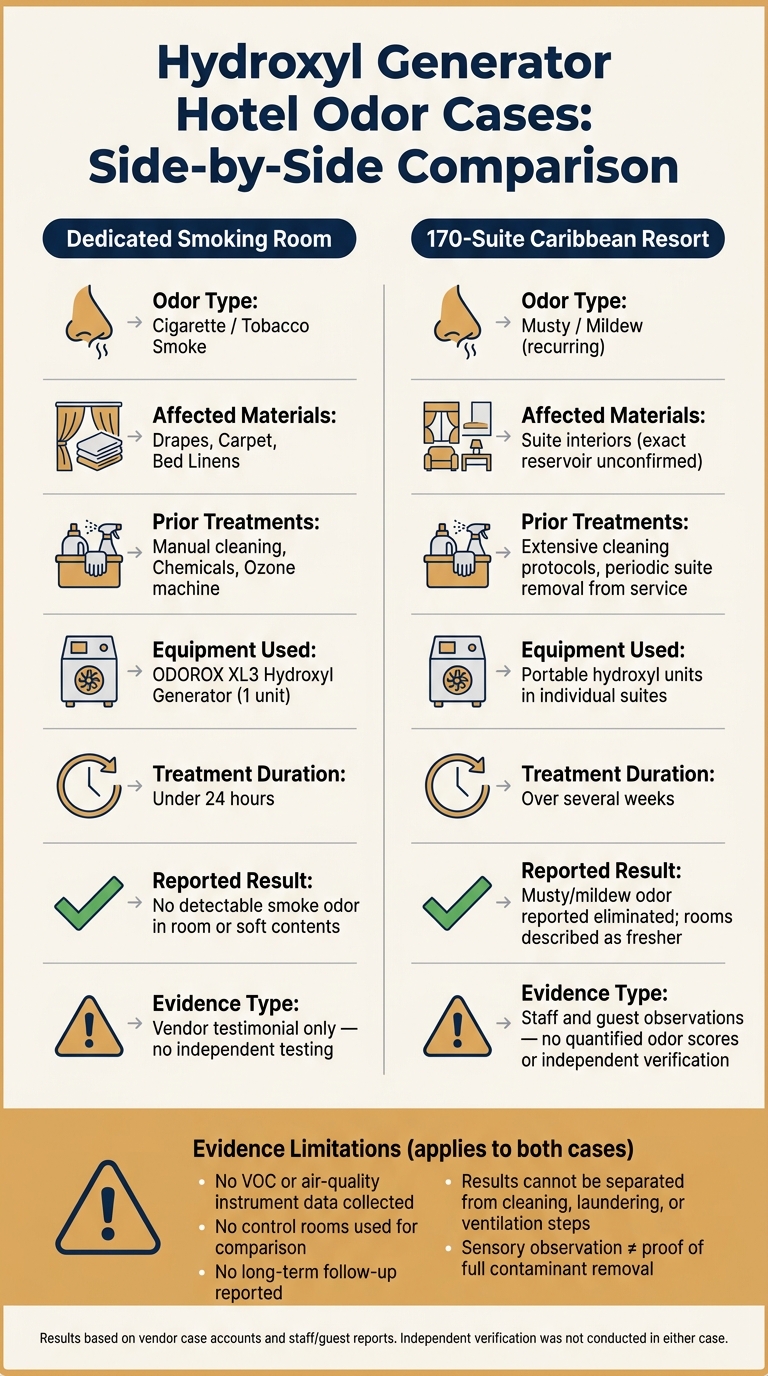
In the smoking-room case, staff said there was no detectable smoke odor within 24 hours of deploying the ODOROX XL3. According to the report, smoke odor could no longer be detected in the drapes, carpet, or bed linens.
In the Caribbean resort case, staff said recurring musty and mildew odors were eliminated after portable hydroxyl units were placed in the suites. Guests also reportedly described the rooms as fresher. That said, these were staff- and guest-reported outcomes, not instrument-based measurements.
The table below sums up the two cases.
Case Comparison Table: Baseline, Treatment, and Evidence Type
| Case | Baseline Condition | Equipment Used | Treatment Duration | Reported Odor Result | Evidence Type |
|---|---|---|---|---|---|
| Dedicated hotel smoking room | Persistent smoke odor in room air and soft contents despite prior cleaning attempts | One ODOROX XL3 hydroxyl unit | Within 24 hours | No detectable smoke odor in the room or soft contents. | Vendor case account; no control room or independent testing |
| 170-suite Caribbean luxury resort | Recurring musty and mildew odors despite existing cleaning protocols; rooms periodically removed from service | Portable hydroxyl units placed in individual suites | Over the following weeks | Musty/mildew odor reported eliminated; rooms described as fresher. | Vendor case material based on staff and guest observations; no quantified odor scores or independent verification |
Limits of the Available Evidence
There’s a clear catch here: neither case includes instrument-based verification, control rooms, or long-term follow-up.
So when a report says "No detectable odor", that’s a sensory observation. It is not proof that all smoke-related particles, mold contamination, or other pollutants were removed. The reports also don’t clearly separate what the hydroxyl generator did from what cleaning, laundering, ventilation, or other remediation steps may have done.
In plain English, these are field reports with limited verification, not controlled proof of performance.
Those limits matter because they shape what hotel operators should document before a room goes back into service.
Practical Lessons for Hotel Operators and Property Managers
The practical takeaway is pretty simple: source control comes first. These cases point to one rule again and again: remove the source before using hydroxyl treatment.
Start with the source. Check mattresses, carpets, upholstery, curtains, drains, HVAC returns, filters, coils, and nearby rooms for smoke residue, leaks, condensation, or water damage. Before any equipment goes in:
- Remove ash and residue; launder or replace absorbent contents
- Fix leaks, condensation sources, or water-damaged materials
- Clean hard surfaces and assess whether carpet padding or upholstered furniture should be replaced
Match the equipment to the space. Room size, ceiling height, airflow direction, and HVAC setup all affect how well a hydroxyl unit works. Keep the room out of service during treatment, and set the unit where air can move freely without blocking supply or return vents. Similar principles apply when using hydroxyl generators for restroom odor control to manage high-traffic sanitation challenges. If the odor has moved into connected spaces or through the HVAC path, inspect those areas before treatment wraps up.
What to Document Before Returning a Room to Service
After treatment, document the room before putting it back into service. At a minimum, record:
- Room number, location, date, and service status
- Odor source, description, intensity, affected materials, and pre-treatment photos
- Moisture findings, visible staining, HVAC observations, and signs of smoke, mold, or water intrusion
- Cleaning, laundering, extraction, disposal, and replacement steps finished before equipment use
- Generator manufacturer, model, rated coverage, placement, start and stop times, and room conditions
- Staff or contractor names, access controls, ventilation steps, and safety checks
Post-inspection should compare odor intensity at the doorway, sleeping area, bathroom, closets, soft furnishings, and HVAC supply and return using the same 0–5 scale throughout (0 = no detectable odor; 5 = very strong odor). That record supports the call to place the room back into service. If odor comes back after the room has been closed or after normal HVAC operation starts again, keep the room out of service until the source is checked again. Recurring musty odors should lead to a building-envelope, plumbing, or moisture investigation, not just another round of air treatment.
Conclusion: Key Findings From This Hotel Case Study
These cases point to the same operating rule for hotel rooms with persistent odor. In most cases, persistent hotel odors come from porous materials or from a source that hasn’t been fixed. The documented cases reported good odor results under those conditions, but neither case included independent air-quality testing. So they do not prove full contaminant removal or that the generator alone caused the result. Hotels using these findings as a reference should pair hydroxyl treatment with source control, physical cleaning, consistent documentation, and structured reinspection before any room goes back into service.
FAQs
Are hydroxyl generators enough on their own?
No. Hydroxyl generators are generally safe for continuous odor neutralization in occupied spaces. But they tend to work slowly, and stubborn odors may take 3 to 5 days of nonstop operation to improve.
They also rely on the basics being done right: correct sizing, proper installation, good airflow, and routine maintenance. And if you’re dealing with heavy surface contamination, like a large mold problem behind walls, the machine won’t solve that on its own. In those cases, physical remediation is still required.
Can hydroxyl treatment permanently remove smoke and musty odors?
Yes – when used the right way, hydroxyl treatment can permanently remove smoke and musty odors. It does this by breaking down the molecules that cause the smell instead of just covering them up.
For heavy or widespread odors, full neutralization usually takes more time. In many cases, it takes 3 to 5 days, and in severe situations, it can take weeks. It also works best when you deal with the source of the odor and clean any affected materials.
What should hotels check before using a hydroxyl generator?
Hotels should make sure the hydroxyl generator is built and certified for occupied spaces. That includes proof that any ozone byproduct stays within OSHA limits and that the unit has FDA certification.
They should also check a few practical details before putting the device into use:
- Make sure the unit is sized correctly for the room’s layout and ventilation
- Confirm the planned operating conditions match the manufacturer’s guidance
- Keep intake and exhaust vents clear
- Follow all safety labels and maintenance schedules
- Review independent safety testing documentation
This isn’t just paperwork. If the unit is too large, blocked, or used outside the maker’s instructions, performance and safety can both take a hit.
Recent Comments