
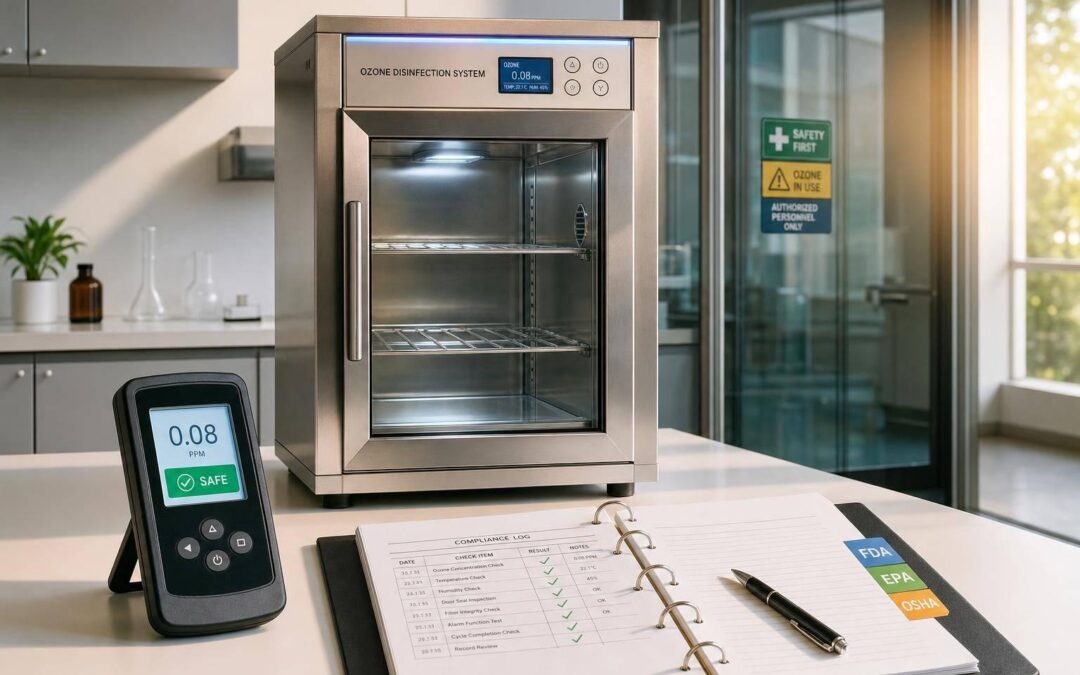
FDA compliance for ozone is not one setting, one machine, or one test. If I want to call an ozone process compliant, I need to prove four things: the use fits FDA rules, the process hits the required kill target, worker exposure stays within OSHA limits, and the records show all of it.
Here’s the short version:
- 21 CFR 173.368 allows ozone in gas or water form for food use under good manufacturing practice.
- That rule does not mean my process is automatically accepted.
- If ozone is used for juice HACCP, I need validation that shows at least a 5-log reduction of the target microorganism. This requires understanding how ozone kills bacteria and viruses through oxidation.
- For worker safety, OSHA’s federal ozone limit is 0.1 ppm as an 8-hour TWA.
- Re-entry should be based on measured ozone levels, not smell or time alone.
- EPA may also matter if the device is sold or used with antimicrobial claims.
In other words: I need to match the use, dose, contact time, monitoring, and claim to the right rule set. Then I need records that show the process stayed within limits every time.
What I’d check first:
- What is ozone touching: food, water, or food-contact surfaces?
- What microbial result am I claiming?
- Where is the worst-case treatment point?
- Which readings are my critical limits?
- What triggers revalidation after a change?
Bottom line: an ozone process is only as strong as its validation, clearance testing, and records.
Beverage Webinar Series Part 3: Ozone for Effective Disinfection & Sanitization
sbb-itb-5fea4da
Define and Document the Ozone Process You Need to Validate
A generator’s nameplate output tells you what the machine might produce under ideal conditions. That’s not the same as knowing what ozone concentration reaches the product, surface, or water at the actual point of treatment.
Once the regulated use is clear, define the process the way it actually runs in production. That’s the line between simply using ozone and running a process you can defend to FDA.
Set the Critical Process Variables
Before you start any challenge testing, write down every condition that determines whether the treatment works.
For gaseous ozone, track:
- concentration at the worst-case location
- flow rate
- exposure time
- temperature
- humidity
- enclosure volume
- ozone decay
- load configuration
- residual ozone before re-entry
For aqueous ozone, you also need to track water temperature, pH, turbidity, dissolved organic matter, and contact time at the point of use, not the injection point.
Each variable should have:
- a defined acceptance range
- a measurement location
- a monitoring method
- a stated frequency
If concentration is measured only at the generator outlet, that does not show that the worst-case location in a room – or the outlet of a contact tank – got the dose you need.
Validate Microbial Performance Under Worst-Case Conditions
Validation should reflect the worst-case conditions that still match normal production. In plain English, test the process where it is most likely to struggle: the lowest ozone concentration, the shortest contact time, the highest expected organic load, the largest load, and the weakest distribution point.
Use the most resistant relevant target microorganism for the product or process. And set the acceptance criteria before testing begins.
For juice processors covered by FDA’s Juice HACCP rules, validation must show at least a 5-log reduction of the pertinent microorganism. One good-looking test run in an empty chamber or at the generator outlet doesn’t meet that bar for a loaded production line.
Understand the Difference Between Validation, Verification, and Calibration
These three activities are connected, but they do different jobs. You can’t swap one for another.
- Validation: Proves the process works.
- Verification: Confirms each run stayed within validated limits.
- Calibration: Confirms the instrument reads accurately.
Every monitored variable needs a limit, a location, and a corrective action. Use this control table for the critical variables:
| Critical Variable | Monitoring Method | Frequency | Acceptance Limit | Corrective Action |
|---|---|---|---|---|
| Ozone concentration at the worst-case location | Calibrated fixed or portable ozone analyzer | Continuous or per batch | Within validated minimum–maximum range | Stop or hold run; investigate distribution, generator output, and sensor status |
| Gas or water flow rate | Calibrated flow meter or pump totalizer | Continuous or per batch | Within validated flow range | Stop or hold product; correct flow; assess whether contact time and delivered dose remained valid |
| Contact time | Timer linked to process sequence | Every run | At least the validated minimum | Hold batch; extend only if approved procedure permits; otherwise evaluate disposition |
| Temperature | Calibrated temperature probe | Continuous or per batch | Within validated range | Hold run; assess whether ozone demand or microbial efficacy changed |
| Relative humidity (gaseous treatment) | Calibrated humidity sensor | Continuous or per run | Within validated humidity range | Stop or hold treatment; restore conditions; assess revalidation need |
| Water quality or organic load | Turbidity, TOC, or defined product-specific test | Before treatment and at validated frequency | At or below validated maximum | Stop or hold; pretreat or replace water; repeat treatment if justified |
| Ozone residual after treatment | Validated residual analyzer or clearance test | Before release, entry, or product transfer | At or below defined residual limit | Restrict access or product release; ventilate; retest and document clearance |
Any process change should be treated as a revalidation trigger. That includes a new generator, a different room volume, a new water source, a product formulation change, or a shift in flow rate.
Control Worker Exposure and Residual Ozone
Once the process is validated, the next job is simple in theory and serious in practice: keep workers out until residual ozone is gone. Ozone is a respiratory hazard. So even if a process hits its microbial-reduction target, it can still harm people if exposure isn’t controlled from start to finish.
Apply OSHA Exposure Limits and Set Measured Re-Entry Criteria
The federal OSHA permissible exposure limit (PEL) for ozone is 0.1 ppm as an 8-hour time-weighted average (TWA), equal to 0.2 mg/m³. Use the strictest release limit that applies under federal rules, any state-plan rule, and your site rule.
Don’t use odor to approve re-entry. Smell is unreliable, and repeated exposure can dull a person’s sensitivity. Re-entry needs to rest on measured concentrations from a calibrated ozone monitor. Test the same worst-case areas used during validation. Your written procedure should spell out the sampling points – breathing zones, doorways, and low-airflow areas – the allowed concentration threshold, and who has authority to release the area. If the meter isn’t available, is out of calibration, or doesn’t pass the clearance reading, the area stays restricted until the problem is fixed.
Use Engineering and Administrative Controls Before Relying on PPE
OSHA requires feasible engineering and administrative controls first. PPE is an extra layer. It is not a stand-in for source control and ventilation.
Engineering controls should stop ozone from reaching workers in the first place. That includes sealed treatment chambers, closed injection systems, local exhaust ventilation, ozone destruct or catalytic residual-control units, interlocked doors, automatic generator shutdowns, and audible or visual alarms. Administrative controls then shape how people work around the hazard: restricted-access zones, written entry authorization, lockout/tagout during generator or destruct-unit maintenance, warning signs reading Ozone Treatment – Do Not Enter, and documented emergency procedures for leaks, alarms, or accidental exposure.
Confined-space rules may also apply if workers need to enter a chamber, tank, or duct. Treat that as a separate review and put in atmospheric testing, an attendant, and a rescue plan where required.
Use the same worst-case locations found during validation as your clearance points. The table below shows how each control layer works and where it can fall short:
| Control Category | Examples | Primary Purpose | Key Limitation |
|---|---|---|---|
| Engineering controls | Sealed equipment, local exhaust, ozone destruct units, interlocked doors, automatic shutdowns, fixed alarms | Prevent ozone release or isolate workers from it | Requires proper design, testing, and ongoing maintenance |
| Administrative controls | Restricted access, written re-entry procedures, lockout/tagout, warning signs, training, emergency plans | Keep people away from the hazard and standardize safe work | Depends on consistent implementation and worker compliance |
| Monitoring controls | Fixed ozone sensors, portable calibrated meters, alarm setpoints, documented clearance measurements | Detect leaks, verify aeration, and support re-entry decisions | Sensor placement, calibration, and response procedures are all critical |
| PPE | Respiratory protection, protective clothing, gloves, eye or face protection | Supplemental protection during approved tasks or emergencies | Does not replace source control, ventilation, or safe re-entry procedures |
Here’s what that looks like on the ground: stop generation, keep the area closed, and run the ventilation and ozone-destruction system for the validated aeration period. Then confirm the monitor is within calibration, test every defined sampling point, compare each reading against the written release criterion, and allow entry only when all locations pass the validated clearance criteria.
If one point fails, that’s not a gray area. It means continued restriction, more aeration, investigation, and retesting – not a gut call based on how much time has passed.
Log every clearance check, alarm, and corrective action in the compliance file.
Build the Records and Compliance File
The validation limits, monitoring checks, and clearance readings above should form the core of this file.
Written records are how you show control. If it isn’t documented, it doesn’t help your compliance case.
Maintain Core FDA, EPA, OSHA, and Operational Records
Start with a written intended-use and regulatory-scope determination. Then build a controlled record index that covers each part of the operation.
The matrix below shows the main records needed for an industrial ozone compliance file:
| Record Category | What to Include |
|---|---|
| Regulatory scope | Intended-use determination, FDA/EPA/OSHA/state applicability assessments |
| Equipment | Generator make, model, serial number, rated output, operating range, manufacturer instructions |
| Process design and flow | Process flow diagram showing generation, application, monitoring, and release; hazard analysis or sanitation risk assessment |
| Validation | Approved protocol, raw data, laboratory reports, final report, approval by qualified personnel |
| Routine monitoring | Ozone concentration, flow, pressure, humidity, temperature, contact time, and residual measurements |
| Instruments | Calibration status and out-of-tolerance actions |
| Worker safety | Exposure sampling and re-entry records |
| Operations | Maintenance logs, training records, SOPs |
| Deviations | Deviation forms, investigations, disposition decisions, corrective and preventive actions |
| Suppliers and change control | Supplier qualifications, certificates of analysis, service reports, approvals, change-control records |
Each record should include the date, time, equipment or process ID, responsible person, units, acceptance criteria, result, and approval. FDA’s juice HACCP guidance explicitly identifies the validation study, HACCP plan, and monitoring records as documents inspectors may request. That’s a good yardstick for the level of detail your file should have.
If an instrument is out of tolerance, document the affected dates, assess prior data, and record any hold, resampling, or corrective action. Don’t leave gaps here. That’s often where trouble starts.
Document EPA Device Status and Antimicrobial Claims Accurately
Record the process first. Then document any claims tied to the equipment.
Ozone-generating equipment can be regulated as a pesticidal device under FIFRA when it is marketed with claims to kill, inactivate, or suppress bacteria, viruses, or fungi. For each antimicrobial claim, record the device status, the basis for the claim, and the test data that supports it.
Keep a device-status memo that identifies the equipment, the claims being made, the test data, and who approved the claim language. A claim can’t drift from "odor reduction" to "disinfection" or "pathogen reduction" without data and legal authorization behind it. Put plainly: specs from the generator maker are not enough on their own.
The matrix below lays out the main compliance areas so ownership and proof are easy to track:
| Regulator | Core Question | Key Records | Important Caution |
|---|---|---|---|
| FDA | Is ozone part of an FDA-regulated operation, and has the process been validated where required? | Intended-use assessment, HACCP or preventive-controls records, validation study, monitoring logs, deviations | Equipment specs alone don’t prove process compliance. |
| EPA/FIFRA | Is the generator a pesticidal device based on antimicrobial claims? | Device-status assessment, approved label or marketing copy, claim substantiation, establishment-number documentation | Device status doesn’t authorize unsupported or misleading claims. |
| OSHA | Are employee exposures controlled and documented? | Exposure sampling, alarm tests, detector calibration, training records, re-entry logs | OSHA lists a 0.1 ppm 8-hour TWA PEL and a 0.30 ppm ceiling value for ozone. |
| State and local | Do state pesticide, occupational-safety, fire, building, air-quality, wastewater, or licensing rules apply? | Permits, registrations, notifications, inspection records, local correspondence | Requirements can vary by jurisdiction and by whether the company sells equipment, performs treatment as a service, or makes antimicrobial claims. |
| Internal/customer | Can you demonstrate repeatable, traceable performance? | SOPs, batch or treatment records, calibration, maintenance, audits, CAPA, change control | Customer specifications may be stricter than the legal minimum and should be incorporated into approved acceptance criteria. |
Review this matrix once a year and after any change in use, claims, equipment, facility, or jurisdiction.
Step-by-Step Compliance Workflow for Industrial Ozone Disinfection
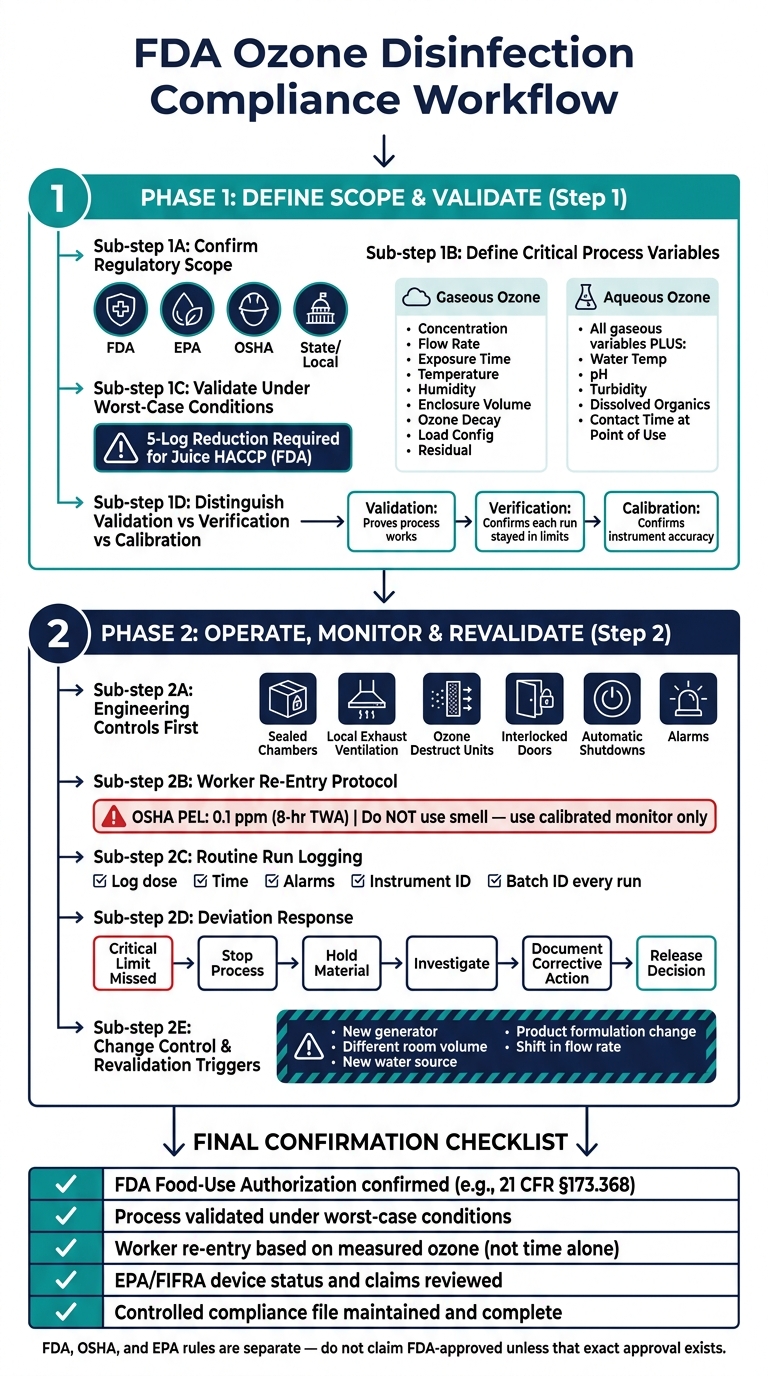
FDA Ozone Disinfection Compliance Workflow: Step-by-Step Guide
This workflow turns scope, validation, monitoring, and revalidation into one controlled process.
Step 1: Define Scope and Run Through Regulatory Requirements Before Validation
Start by locking down the scope, then move straight into regulatory review and process design. Before validation begins, confirm the rules that apply from FDA, EPA, OSHA, and state and local air, wastewater, fire, and building code authorities.
From there, define and validate ONLY the variables that control dose and contact (often using biological indicators): concentration, time, temperature, humidity, flow, load, and chamber setup. Tie acceptance criteria to the exact microbial claim and the process being used. The limits should be validated for your product, your equipment, and worst-case conditions – not a generic setup on paper.
Step 2: Operate, Monitor, Correct, and Revalidate After Changes
Once the process is defined and validated, the focus shifts to controlled operation and clearance monitoring. Before first production, verify that all engineering controls are installed and working as intended. For re-entry, set the level below the applicable exposure limit and confirm clearance with a calibrated monitor. PPE should serve as backup, not the main line of protection, which means containment and ventilation come first.
During routine operation, log each run’s dose, time, alarms, instrument ID, and batch ID. If a critical limit is missed, stop the process, place the affected material on hold, investigate the cause, and document both the corrective action and the disposition decision before release.
Any change that can affect dose, exposure, or distribution calls for revalidation. Use change control to decide whether verification alone is enough or whether partial or full revalidation is needed.
Each run should produce a complete operating record that supports the compliance file. The process stays compliant only when scope, validation, monitoring, and records remain aligned.
Conclusion: What to Confirm Before Calling an Ozone Process FDA-Compliant
Once scope, validation, exposure control, and recordkeeping are set, one last check remains: does the claim line up with the evidence? You should call a process FDA-compliant only when the intended use, the governing rule, the validation work, and the records all match.
Before making that claim, confirm these five points:
| Area | What to confirm |
|---|---|
| FDA food-use authorization | The exact intended use fits the applicable FDA regulation, such as 21 CFR § 173.368 for meat, poultry, and raw agricultural commodities, or 21 CFR § 184.1563 for bottled water |
| Process validation | The ozone process was validated under worst-case operating conditions and achieves its defined microbial objective |
| Worker safety | Re-entry is based on measured ozone, not time alone; OSHA’s ozone PEL is 0.1 ppm as an 8-hour time-weighted average |
| EPA/FIFRA device status | Equipment labeling and antimicrobial or pathogen-control claims have been reviewed; ozone generators making such claims may be regulated as pesticidal devices |
| Records | A controlled compliance file lets an independent reviewer reconstruct what was treated, under which conditions, with what results, and how deviations were handled |
Use precise language. Name the application. Cite the governing FDA provision. List the validated parameters. Keep the records that back up the claim.
One more thing: FDA, OSHA, and EPA rules are separate. Do not say an ozone process is "FDA-approved" unless that exact approval exists.
FAQs
Does FDA approval of ozone cover my exact process?
It depends on how ozone is used in your process.
The FDA recognizes ozone as GRAS for antimicrobial use in both gaseous and aqueous forms. But that doesn’t mean every use falls under the same review. FDA oversight applies to specific cases, such as food-contact surface sanitation or medical device sterilization.
Other agencies can come into play too. The EPA regulates ozone generators as antimicrobial devices. And OSHA limits worker exposure to 0.1 ppm over an 8-hour workday.
When does an ozone system need revalidation?
An ozone system needs revalidation during initial process setup and as part of an ongoing quality assurance program.
Standards such as ANSI/AAMI/ISO 11138 and ISO 14937 help guide how often validation should happen. Just as important, you need clear records of testing dates, exposure conditions, and results. That paperwork matters for regulatory compliance and audit readiness.
How do I prove an area is safe for re-entry?
Use calibrated monitoring equipment to check that ozone has dropped to a safe level. Don’t rely on smell alone. OSHA and NIOSH set an exposure limit of 0.1 ppm over an 8-hour shift, and many protocols aim for below 0.05 ppm before anyone goes back in.
Good ventilation also helps remove leftover ozone. And if you want a clear way to confirm the process worked, biological indicator testing can show both that disinfection was successful and that the area is safe to re-enter.
Recent Comments