
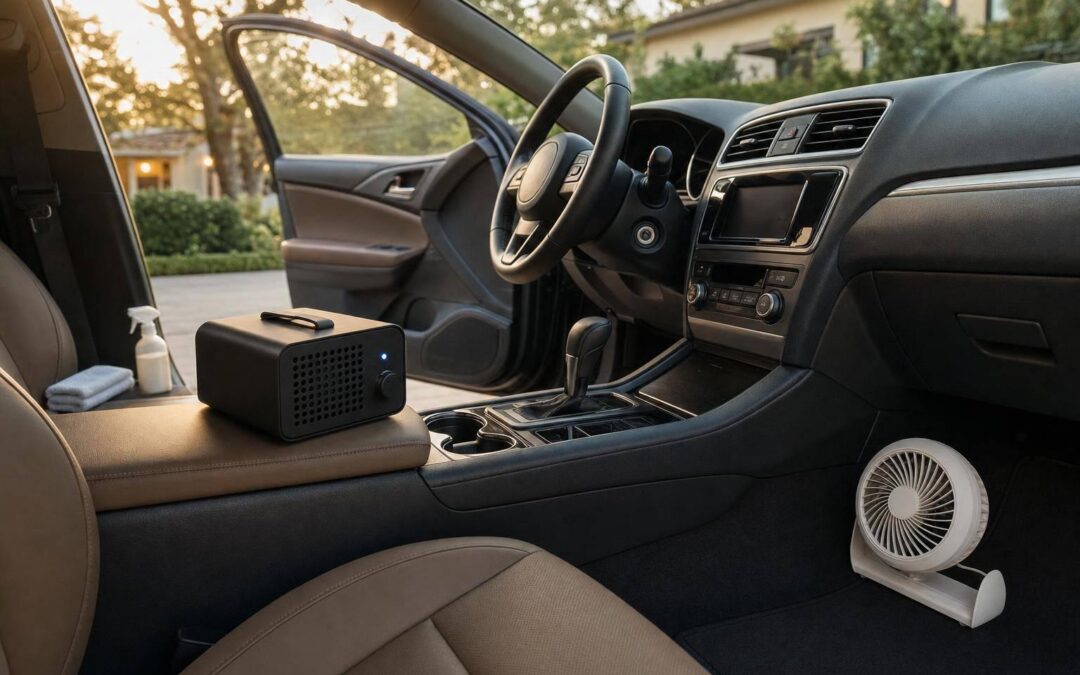
If your car still smells after you clean it, the odor source is probably buried in the materials or moving through the HVAC system. In most cases, sprays only cover it up. Ozone can help after you remove the source, clean the cabin, dry wet areas, and fix leaks or HVAC problems.
Here’s the short version:
- Odors hide deep in seat foam, carpet padding, headliners, trunk liners, and vents.
- Heat brings smells back by releasing trapped residue into the cabin air.
- Wet materials should be dried within 24–48 hours to help reduce mold risk.
- Cabin air filters often need replacement every 12,000–15,000 miles, but a new filter alone will not fix buildup on the evaporator or inside ducts.
- Ozone is a finishing step, not the first step.
- No one should be inside the car during ozone treatment – not people, not pets, not plants.
- Too much ozone can damage materials like rubber, foam, plastics, and adhesives.
- A fuel smell is different: I’d treat that as a mechanical issue, not an odor job.
What I take from this article is simple: clean first, dry second, fix the cause third, then use ozone only for leftover smell. If the source is still there, the odor usually comes back.
| Step | What I’d do | Why it matters |
|---|---|---|
| 1 | Find the source | Odors keep returning when residue, moisture, or HVAC buildup stays in place |
| 2 | Clean and remove contamination | Ozone does not remove spills, smoke film, or pet mess |
| 3 | Dry the interior fully | Damp padding and carpet can keep producing odor |
| 4 | Fix leaks or HVAC issues | A wet or dirty system can keep feeding smell into the cabin |
| 5 | Use ozone in an empty vehicle | It can reach areas surface cleaning may miss |
| 6 | Ventilate the car fully | Ozone is a lung irritant and must clear before reuse |
So if you want a plain answer: ozone can help with stubborn car odors, but only after the root cause is gone and the vehicle is fully aired out after treatment.
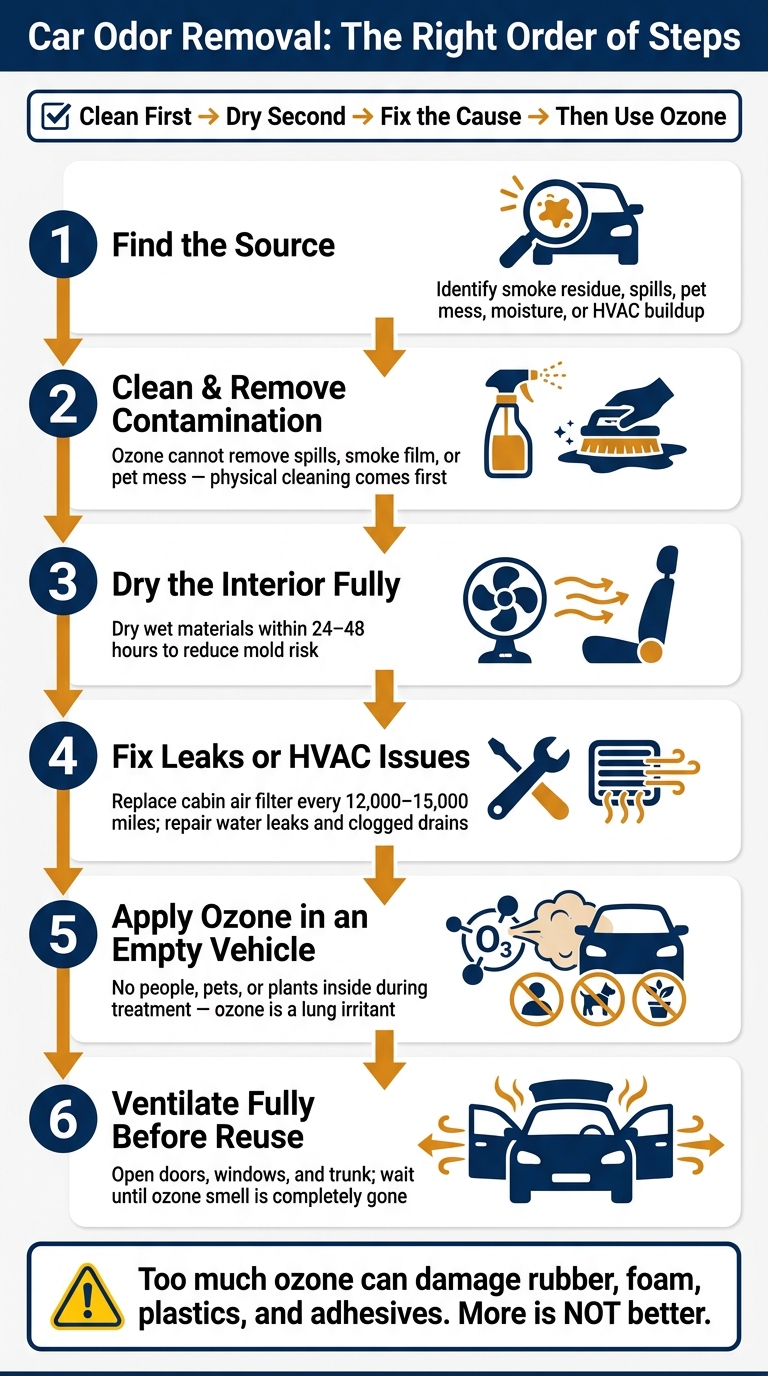
Car Odor Removal: The Right Order of Steps
Ozone Machine for Car Odor Removal (Does It Actually Work?)
sbb-itb-5fea4da
Common Car Odor Problems and Why Basic Fixes Fall Short
Bad car smells usually come from a few familiar places: smoke residue, food spills, pet messes, and trapped moisture. The problem is that each one behaves a little differently. Even so, they all share one thing: they can sink deep into porous materials or get stuck in airflow paths, where a simple surface clean won’t touch them.
Smoke, Food, and Pet Odors in Fabric and Carpet
Tobacco smoke doesn’t just vanish from the cabin air. It leaves residue behind on headliners, seat foam, carpet, and door panels. Those porous surfaces absorb the compounds, then release them again when the cabin heats up.
Food and drink spills do the same kind of damage. They can soak beneath seat cushions, into carpet backing, under floor mats, and down into the padding below. A surface may look clean while the mess underneath is still there. Sugary drinks, milk, sauces, and other organic residue keep producing odor as temperatures rise inside the car. Pet contamination follows the same pattern, especially in seams, carpet, and seat foam.
Musty Smells from Moisture and HVAC Pathways
Moisture-related odors need a different approach because the smell may be coming from both interior surfaces and the ventilation system. A musty odor often points to trapped moisture somewhere it shouldn’t be, although mold isn’t the only possible cause. Common sources include:
- Wet floor mats
- Damp carpet padding
- Water intrusion through door or sunroof seals
- Damp trunk carpeting
- Clogged drains
- A dirty, damp cabin air filter
The EPA recommends drying wet materials within 24–48 hours to help prevent mold growth.
If the smell gets worse when the fan or A/C is on, the source is likely inside the ventilation system. The cabin air filter, evaporator, condensate drain, ductwork, and fresh-air intake can all collect moisture, dust, and biological buildup. The Car Care Council recommends replacing cabin air filters every 12,000–15,000 miles, but even a new filter won’t remove contamination already sitting on the evaporator itself.
Why Masking Odors Does Not Fix the Source
Fragrance sprays and hanging fresheners don’t remove the source of the smell. They just add another scent to compete with it. Smoke residue, food residue, pet contamination, and moisture stay in place.
That’s why the pattern is so common: the fragrance fades, the cabin warms up, and the bad smell comes back. If buildup is hidden below the surface or inside the HVAC system, odor removal usually takes deeper treatment after the source is cleaned.
How Ozone Helps Neutralize Stubborn Vehicle Odors
Once you’ve removed the source and cleaned the interior, ozone treatment for cars can help with the smell that still hangs around. Ozone (O₃) is a reactive form of oxygen that can help break down leftover odor compounds.
Why Gas-Based Treatment Reaches Hidden Interior Areas
Because ozone is a gas, it can move through the cabin and get into places surface cleaning often misses. Think seams, carpet backing, headliners, trunk cavities, and HVAC pathways.
When it’s introduced into a sealed, unoccupied vehicle, ozone moves with the cabin air and can make contact with odor residue in recessed or porous areas. That’s the main appeal. It doesn’t just sit on the surface.
Still, circulation doesn’t mean it reaches every single spot. Results depend on the vehicle’s layout, the materials inside, the ozone concentration, and how long the treatment runs.
What Ozone Can and Cannot Do
Ozone can help cut residual odors from smoke, food, pets, and mildew if the main source has already been handled. But it has limits.
It can’t:
- repair leaks
- dry soaked materials
- replace physical cleaning
If the original problem is still there, the odor will come back no matter what treatment you use.
At safe indoor levels, ozone has limited odor-removal power; higher concentrations increase health risk and require strict ventilation. Ozone can also react with other chemicals and produce other compounds, so controlled application is needed. Controlled use and full ventilation are required before the vehicle is returned to service.
The Professional Ozone Treatment Process and Safety Requirements
After cleaning and fixing the source, ozone can work as a controlled finishing step, not the first move. Once the cause is handled, the job shifts from cleanup to odor neutralization. The aim isn’t just a car that smells better. It’s cleaner cabin air after the contamination is gone.
Inspection, Cleaning, and Source Correction Before Treatment
The first step is figuring out what’s actually causing the odor. Is smoke residue soaked into the headliner? A food spill hiding under the seat? Mold growing in wet carpet padding? A dirty cabin air filter? That answer shapes everything that comes next, long before the ozone generator is switched on.
After the source is found, the interior needs to be cleaned first. That means removing trash and debris, cleaning spills, drying upholstery and carpet, fixing leaks or other moisture problems, and checking the cabin air filter for contamination. If the filter is dirty, replace it.
Ozone doesn’t remove physical contamination. If a wet floor mat or dirty filter is still sitting in the vehicle, the smell can come back no matter how long the treatment runs. Ozone comes after cleaning. It doesn’t replace it.
Ozone Application, Ventilation, and Post-Treatment Review
Once the vehicle is clean and dry, the ozone generator is placed inside the empty car based on the equipment manufacturer’s instructions. Treatment time and output should match the size of the vehicle and how bad the odor is. A compact car with a light smoke smell doesn’t need the same setup as a full-size SUV with heavy pet contamination.
More ozone is not better. Too much ozone can harm some materials, including rubber, foam, plastics, adhesives, and certain finishes.
The vehicle must be completely unoccupied during treatment – no people, no pets, and no plants. Ozone is a lung irritant, and no federal agency has approved ozone-generating devices for use in occupied spaces. When the treatment cycle is done, open the doors, windows, and trunk, where safe and practical, to flush the cabin with fresh outdoor air. Do not get back inside until the cabin has aired out fully and the ozone smell is gone.
Ventilation isn’t a side step. It’s the last safety step. After airing out the vehicle, check whether the odor comes back when the cabin warms up or when the HVAC runs. A technician should look closely at seat seams, carpets, headliners, cargo areas, and vents. If the smell is still there, the next move is usually more cleaning, a cabin air filter replacement, HVAC service, moisture repair, or removal of contaminated materials, not just another ozone cycle.
Masking vs. Cleaning vs. Professional Ozone Treatment
Masking, cleaning, and ozone each do a different job:
| Method | Main purpose | Removes odor source? | Areas it can reach | Main limitation or safety requirement |
|---|---|---|---|---|
| Odor masking | Temporary cover-up | No | Mostly open-air cabin areas | Does not address residue, moisture, or HVAC contamination |
| Physical cleaning | Removes accessible residue | Sometimes, if the source is accessible and fully removed | Seats, carpets, mats, hard surfaces, and some accessible HVAC parts | May not reach deep porous layers or enclosed air pathways |
| Professional ozone treatment | Helps neutralize lingering odor compounds after cleaning | Not by itself; works best after source removal | Cabin air space, upholstery fibers, carpet layers, headliners, trunks, and some vent pathways | Must be used only in an unoccupied vehicle and followed by thorough ventilation |
When Ozone Treatment Makes Sense and What to Expect
Once the vehicle is clean and dry, the next step is figuring out whether ozone is the right final pass. Use ozone only after the source is gone and the cabin is fully dry. At that point, it can help cut lingering odor stuck in foam, carpet, headliners, and HVAC pathways.
That said, ozone should be treated as an odor-reduction step, not a guaranteed permanent fix. The outcome depends on how far the contamination spread and how well the vehicle was cleaned beforehand.
Professional ozone treatment makes sense for smoke-damaged interiors, pet odors, and work vehicles that keep holding onto smells even after deep cleaning and drying. But if a leak, damp padding, mildew, or a dirty filter is still there, the odor will come back after treatment.
Situations Where Professional Service Is a Good Fit
The best candidates have one thing in common: odor that keeps hanging around in porous materials or HVAC pathways after the source has been removed and the interior has been fully cleaned and dried. Skip any part of that process, and the treatment usually falls short.
Local Service Option in Chicagoland
For Chicagoland drivers who want help with that last step, Ozonated Cleaning LLC offers professional vehicle odor removal in Chicagoland for $150 per vehicle.
Conclusion: Source Removal First, Ozone Second, Safety Always
The order matters: source removal first, ozone second. Remove the source, clean and dry the interior, then use ozone for any odor that remains. Keep the vehicle empty during treatment, and ventilate it well before anyone gets back in.
FAQs
How long do ozone results usually last?
Ozone treatment results often last a long time. In fact, nearly 90% of clients report odor control for more than six months after a professional treatment.
That staying power comes from how ozone works. It neutralizes odors and pathogens at the molecular level instead of simply covering them up. So the outcome can be more thorough and longer-lasting.
For vehicles, Ozonated Cleaning LLC recommends repeat treatments every 1 to 3 months, depending on how often the vehicle is used and how much odor exposure it gets.
Can ozone remove cigarette smell completely?
Yes. Ozone treatment can remove cigarette smoke odors completely because it breaks down smoke residue at the source instead of just covering up the smell.
That matters because cigarette smoke doesn’t only sit in the air. It sinks into porous surfaces like upholstery, carpets, headliners, and even HVAC vents. Ozone can reach those hidden spots and neutralize tobacco odors that standard cleaning often misses.
When should I skip ozone and get repairs first?
Get repairs or physical cleaning done first when the smell source is still there. Ozone comes after that. It’s a follow-up step, not a stand-in for source control.
If you have moisture leaks, mold, debris, or mechanical problems like a cracked drain line or foundation issues, deal with those first. If you don’t, the odor will probably come back.
Recent Comments