Ozone disinfection is a powerful method for removing bacteria in healthcare, water treatment, and other settings. Here’s what you need to know:
- How It Works: Ozone (O₃) oxidizes and breaks down microbial cell walls, destroying bacteria without leaving harmful residue.
- Effectiveness: Studies show ozone achieves up to 99% bacterial reduction, even against multidrug-resistant strains like K. pneumoniae. It’s also faster and stronger than chlorine in some cases.
- Applications: Used for disinfecting hospital tools, indoor air, surfaces, water, and even food processing areas.
- Key Factors: Its success depends on ozone concentration, exposure time, humidity, and surface type. Pre-cleaning improves results.
- Safety: High doses are used in unoccupied spaces, with strict adherence to safety guidelines to prevent inhalation risks.
Ozone offers a residue-free, chemical-free solution for reducing bacteria in diverse environments.
Ozone – nature´s own disinfection method
sbb-itb-5fea4da
Research Evidence on Ozone’s Efficacy
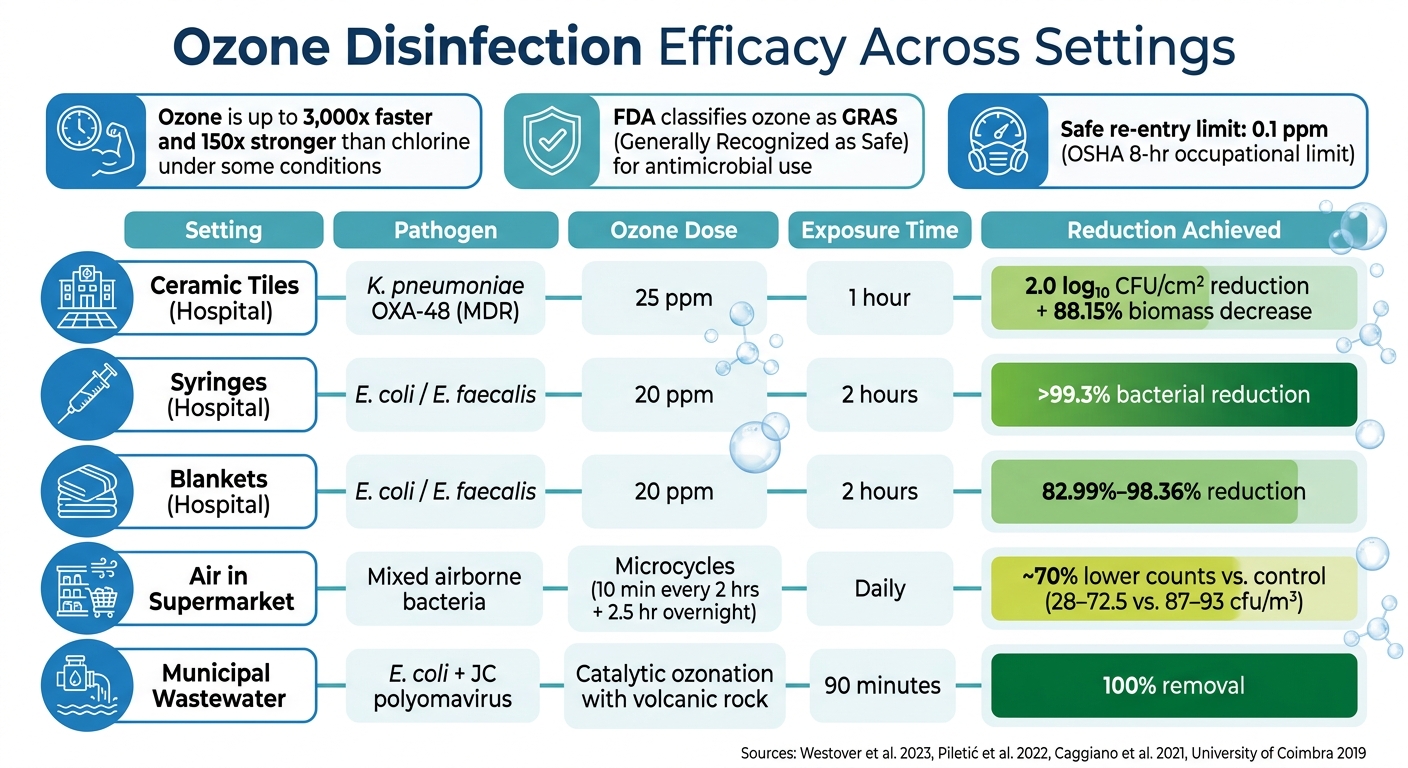
Ozone Disinfection Efficacy by Setting: Key Research Data
Bacterial Inactivation in Healthcare and Indoor Spaces
Ozone has proven itself a powerful tool for disinfection, particularly in environments with high contamination. In January 2023, Craig Westover and his team at Weill Cornell Medical College conducted a study targeting three common hospital pathogens – E. coli, E. faecalis, and B. subtilis. They tested ozone’s impact on items like catheters, blankets, syringes, and remote controls. By using 20 ppm of ozone over a 2-hour cycle, they achieved a 99% reduction in viable bacteria, with syringes showing reductions exceeding 99.3%.
"Ozone is up to 3000 times faster acting and 150 times stronger than chlorine for killing bacteria, fungi, and other pathogens under some conditions." – Craig Westover, Department of Physiology and Biophysics, Weill Cornell Medical College
Ozone also shows promise against multidrug-resistant (MDR) strains. In May 2022, a study at the University of Rijeka examined its effectiveness against OXA-48-producing Klebsiella pneumoniae biofilms on ceramic tiles. This pathogen is notoriously resistant to standard disinfectants. With 25 ppm of ozone for one hour, the study reported a 2.0 log10 CFU/cm² bacterial reduction and an 88.15% decrease in total biomass, highlighting ozone’s potential as a chemical-free solution in clinical settings.
"Ozone gas has great potential to be used as an additional hygiene measure in joint combat against biofilm in hospital environments." – Kaća Piletić, Department of Microbiology and Parasitology, University of Rijeka
Ozone in Water and Wastewater Treatment
Ozone’s effectiveness extends beyond healthcare settings, particularly in water treatment. For instance, an ozone dose of 0.832 mg·min/L at 68°F (21°C) achieves a ≥5-log bacterial reduction in purified water. By comparison, eliminating Giardia cysts requires a Ct of 1.43 mg·min/L with ozone, while free chlorine demands 73–292 mg·min/L to achieve the same 3-log reduction at 50°F (10°C).
In 2019, researchers from the University of Coimbra demonstrated ozone’s potential in wastewater treatment. Using catalytic ozonation with volcanic rock from the Azores Islands, they achieved 100% removal of E. coli and enteric viruses, including the resistant JC polyomavirus, in secondary municipal wastewater. While standard ozonation failed to eliminate the JC virus even after 150 minutes, the catalytic approach succeeded, preventing bacterial regrowth and reinforcing ozone’s role as a contaminant-free treatment method.
Food Processing and Surface Biofilm Control
Ozone’s versatility also makes it a valuable tool in food processing and environmental surface management. The U.S. FDA has classified ozone as Generally Recognized as Safe (GRAS) for antimicrobial use in both gaseous and aqueous forms.
A June 2021 study in Puglia, Italy, compared supermarkets using Ozotek GX ozone generators with those that did not. The ozonated stores ran 10-minute microcycles every 2 hours during the day, plus a 2.5-hour overnight cycle. Results showed air bacterial counts of 28–72.5 cfu/m³ in ozonated stores, compared to 87–93 cfu/m³ in non-ozonated ones. Surface bacterial counts dropped even more significantly, with a median of 0 cfu/swab in ozonated stores versus 8.5–9.5 cfu/swab in the control group. These findings underscore ozone’s effectiveness in reducing bacterial contamination without chemicals.
"Compared to other disinfectants, lower ozone concentrations and shorter contact times are sufficient to inactivate the environmental microbial population." – Giuseppina Caggiano et al., University of Bari Aldo Moro
| Setting | Pathogen | Ozone Dose | Exposure Time | Reduction |
|---|---|---|---|---|
| Ceramic tiles | K. pneumoniae (OXA-48) | 25 ppm | 1 hour | 2.0 log10 CFU/cm² |
| Syringes | E. coli / E. faecalis | 20 ppm | 2 hours | >99.3% |
| Blankets | E. coli / E. faecalis | 20 ppm | 2 hours | 82.99%–98.36% |
| Air (supermarket) | Mixed bacteria | Microcycles | Daily | ~70% lower vs. control |
| Wastewater | E. coli + JC virus | Catalytic ozonation | 90 minutes | 100% removal |
How Ozone Removes Bacteria
Oxidative Damage to Microbial Cells
Ozone takes a direct and multi-faceted approach to eliminating bacteria. It disrupts cell membranes by targeting polyunsaturated fatty acids, initiating lipid peroxidation that causes the membrane to collapse. Simultaneously, ozone generates reactive oxygen species (ROS), which oxidize proteins, enzymes, and genetic material, effectively paralyzing the cell’s essential functions.
In a 2023 study conducted at Niigata University, researchers used Transmission Electron Microscopy (TEM) to examine Streptococcus pneumoniae after exposure to 1 ppm ozone ultrafine bubble water for 1 minute. The TEM images showed the cell wall starting to separate from the cytoplasm, forming a crevice as the wall began peeling away. Once ozone penetrates the cell, it oxidizes proteins, enzymes, and DNA/RNA, shutting down the bacterium’s ability to function or reproduce.
| Microbial Component | How Ozone Affects It | Result |
|---|---|---|
| Cell membrane lipids | Lipid peroxidation | Membrane collapse and rupture |
| Cell wall | Structural disruption | Integrity loss |
| Proteins/enzymes | Oxidative degradation | Metabolic failure |
| DNA/RNA | Genomic oxidation | Replication inhibited |
This multi-pronged attack explains why ozone is effective against multidrug-resistant (MDR) pathogens, such as MRSA. Unlike antibiotics, ozone’s mechanism relies on chemical and physical interactions, leaving bacteria without a resistance pathway.
Ozone’s ability to degrade bacteria is just one part of its broader disinfecting power.
Degradation of Other Contaminants
Ozone doesn’t stop at bacteria – it also disrupts viruses, fungi, and molds using similar oxidative processes. For viruses, ozone damages lipid envelopes and protein capsids, rendering them incapable of infecting hosts. As Bob Banerjee highlights:
"When ozone is used against viruses, it damages their lipid envelopes and protein capsids, rendering them unable to infect hosts."
Fungi and molds are equally vulnerable. Ozone attacks their cell membranes through ROS-driven lipid peroxidation. However, studies on ozone ultrafine bubble water (OUFBW) at concentrations between 6–11 ppm revealed a limitation: while effective, it couldn’t completely remove Candida albicans biofilms formed over 24 hours. The biofilm’s dense structure proved challenging for ozone to fully penetrate. This highlights how factors like exposure time, concentration, and surface conditions can impact ozone’s effectiveness in practical disinfection scenarios.
These wide-ranging oxidative effects make ozone a powerful alternative to chemical disinfection for broad-spectrum use.
Factors That Affect Ozone Disinfection Performance
Concentration, Exposure Time, and Dose
The effectiveness of ozone as a disinfectant hinges on two primary factors: its concentration and the duration of exposure. These two elements combine to form the CT value (concentration × time, measured in ppm×minutes). A higher CT value generally means greater microbial reduction.
Interestingly, research suggests that concentration often plays a bigger role than time. For instance, a University of Illinois study found that aqueous ozone at 4 ppm could reduce bacteria to safe levels (≥5‑log₁₀ reduction) on smooth surfaces in just 2 minutes. Extending the exposure time beyond that provided diminishing returns. However, surfaces with heavy contamination require a higher ozone dose to achieve similar safety standards.
Pre-cleaning surfaces is critical, as organic matter like grease, soil, or biological debris can consume ozone before it can reach and neutralize bacteria. This step ensures ozone can work effectively, especially on heavily soiled areas.
Temperature, Humidity, and Surface Type
Environmental conditions play a big role in ozone’s performance. Higher relative humidity (above 70%) tends to enhance its effectiveness. Moisture helps create reactive radicals and can cause spores to swell, making them more vulnerable to reactive oxygen species.
Temperature, on the other hand, has a more variable impact. Studies show that bacterial reduction is slightly better at colder temperatures (around 40°F/4°C) compared to room temperature. However, results remain consistent within the range of 61°F–77°F (16°C–25°C). Gaseous ozone has been shown to maintain its effectiveness at distances up to 40 feet (12 m) from the generator and at heights of up to 6.5 feet (2 m).
The type of surface being treated also affects ozone’s efficacy:
| Surface Type | Material Examples | Aqueous O₃ Efficacy (4–9 ppm) | Gaseous O₃ Efficacy (9 ppm) |
|---|---|---|---|
| Smooth / Simple | Plastic, Metal | High (≥5‑log₁₀ in 2 min) | Moderate (3.3‑log₁₀ in 4 min) |
| Intermediate | Nylon, Rubber | High (≥5‑log₁₀ in 2–8 min) | Low (1.6‑log₁₀ in 4 min) |
| Complex / Rough | Wood | Low (<5‑log₁₀) | Very Low (0.8‑log₁₀) |
Ozone struggles to disinfect complex or porous surfaces like wood unless pre-cleaning is done. This highlights its role as part of a broader cleaning and disinfection strategy.
Safety Guidelines and Regulatory Limits
While ozone is effective, safety precautions are essential. The U.S. EPA has observed that even low concentrations of ozone (60 ppb) can reduce lung function and cause inflammation after prolonged exposure (6.6 hours). OSHA has set the occupational exposure limit at 0.1 ppm as an average over an 8-hour workday.
For this reason, high-concentration ozone treatments are only performed in unoccupied spaces. Professional equipment often includes catalytic converters or UV‑C systems to break down residual ozone into oxygen before people re-enter the area.
Anne Marcic from the Public Health Department of the State Capital Kiel emphasizes:
"Since ozone is a powerfully oxidizing gas with high inhalation toxicity, the conditions of application and the measures for occupational safety… must be declared by the manufacturer and observed by the staff to exclude toxic long‑term hazard."
A carefully planned treatment schedule can balance both effectiveness and safety. For example, in an Apulian supermarket study, Ozotek GX generators were used in 2.5-hour overnight cycles when the stores were empty. During business hours, shorter 10-minute microcycles were run every 2 hours. This approach led to a statistically significant reduction in airborne bacteria (p = 0.0042) and surface bacteria (p = 0.0101) compared to untreated stores, all while keeping ozone exposure within safe limits. This demonstrates the potential of ozone as a chemical-free disinfectant when applied responsibly.
How Professional Services Apply Ozone Disinfection
Chemical-Free Disinfection for Homes and Businesses
Professional services use insights from research to apply ozone disinfection effectively in homes and businesses. Instead of relying on chemical sprays that leave residues, they utilize gaseous ozone generators to saturate spaces, reaching hidden areas that manual cleaning often misses. One of ozone’s key advantages is that it naturally breaks down into oxygen within about an hour at room temperature. This makes it especially practical for environments like homes with allergy concerns, commercial kitchens, and medical offices where residue-free sanitization is a priority. Ozone’s adaptability also makes it ideal for confined spaces.
For example, a pilot study conducted at a professional fitness studio demonstrated ozone’s effectiveness. Using 0.5 ppm of gaseous ozone for one hour over three consecutive evenings, researchers observed a 2–3 log₁₀ reduction in bacterial counts across all tested surfaces. Scientists from the University of California San Diego noted:
"These findings highlight the potential of low-dose gaseous ozone as a versatile, effective, and hands-free disinfectant for healthcare and other settings."
Companies like Ozonated Cleaning LLC apply these principles, offering odor removal and disinfection services for residential, commercial, and specialty spaces such as vehicles, RVs, and boats in the Chicagoland area. Treatments are carefully scheduled during unoccupied hours to ensure safety. Ozone levels are maintained above the disinfection threshold while adhering to OSHA’s 0.1 ppm safety limit for re-entry.
Disinfection for Vehicles, Boats, and RVs
Ozone’s penetrating ability makes it particularly effective for confined spaces like vehicles, boats, and RVs. These environments often have fabric seats, air ducts, carpets, and tight seams that are difficult to clean thoroughly with manual methods. Gaseous ozone evenly permeates these areas, reaching folds and crevices that liquid disinfectants might miss.
Professional-grade ozone equipment often includes built-in catalysts to speed up the conversion of ozone back into oxygen post-treatment. This feature minimizes downtime, allowing spaces to be safely reoccupied sooner. For example, Ozonated Cleaning LLC offers vehicle deodorizing services starting at $150 per vehicle and semi-truck sanitization at $200 per truck. These treatments effectively address both odors and microbial contamination in a single cycle.
Francesco De Caro from the Department of Medicine at the University of Salerno emphasized the benefits of this approach:
"Ozone provides a cost-effective and environmentally friendly alternative to traditional disinfectants, decomposing naturally into oxygen without producing harmful byproducts."
For boats and RVs, ozone works best in conditions with humidity levels above 60–70%. This natural moisture enhances microbial inactivation, eliminating the need for extensive preparation beyond ensuring the area is unoccupied during treatment. This makes ozone an efficient choice for tackling musty odors and mold in these unique spaces.
Conclusion
Ozone stands out as a powerful, chemical-free antimicrobial agent, effective in diverse settings like healthcare, food processing, water treatment, and even daily indoor environments. Its ability to oxidize microbial cell walls, causing cell lysis, while breaking down into oxygen without leaving harmful residues makes it particularly appealing. For instance, studies reveal that a Ct value of 0.832 mg·min/L at 68°F (21°C) achieves a ≥5-log reduction in pathogens like E. coli, Listeria monocytogenes, and Salmonella enterica. Additionally, ozone ultrafine bubble water has been shown to reduce antibiotic-resistant strains such as S. pneumoniae by over 90% within just 5 minutes. This residue-free quality makes ozone ideal for use in homes, medical offices, commercial kitchens, event spaces, and confined spaces like vehicles and boats.
However, its effectiveness hinges on several factors, including concentration, exposure time, surface type, and humidity levels.
These findings have practical implications, enabling real-world applications of ozone for safe and efficient disinfection. Companies like Ozonated Cleaning LLC in the Chicagoland area apply this research to treat homes, businesses, vehicles, RVs, and boats. Their approach combines calibrated equipment, precise dosing, and strict safety protocols to deliver effective results.
Researchers from the University of Salerno highlight ozone’s key benefits, noting its affordability, ease of use, and residue-free nature:
"The advantages of ozone over traditional disinfectants are related to low costs, easy production and use, no disinfection residues, and its capability as gas to penetrate each part of a room."
With its proven efficiency and eco-friendly profile, ozone has cemented its role as a valuable tool in modern disinfection practices.
FAQs
Is ozone safe to use indoors?
Ozone poses risks indoors because of its powerful oxidizing nature and potential harm when inhaled. To minimize danger, it’s crucial to follow manufacturer instructions and ensure ozone levels stay within safe limits. Research indicates that effective ozone concentrations can come close to permissible exposure thresholds. Therefore, it should never be used indoors around people unless rigorous measures are in place to control exposure.
What ozone dose and time actually work?
Research highlights that ozone’s effectiveness varies based on three key factors: concentration, duration, and the target surface. Findings indicate that surface treatments typically require ozone concentrations between 5 ppm and over 25 ppm, with exposure times ranging from 2 to 45 minutes. For biofilms or airborne bacteria, longer exposure times of 1 to 2 hours are often necessary. Ozonated Cleaning LLC leverages cutting-edge ozone and hydroxyl technology to deliver customized disinfection and odor removal solutions for both residential and commercial properties in the Chicagoland area.
Does ozone work on porous surfaces and biofilms?
Ozone is known to reduce bacteria on many surfaces, but its success on porous materials and biofilms can differ. For instance, porous surfaces like wood or drywall may absorb ozone or provide protection to microorganisms, making it less effective. When it comes to biofilms, ozone tends to work better alongside other agents – such as citric acid. Research has shown that this combination can effectively eliminate biofilms. Companies like Ozonated Cleaning LLC tackle these tough surfaces by using a mix of ozone and hydroxyl technology in a variety of environments.
Recent Comments