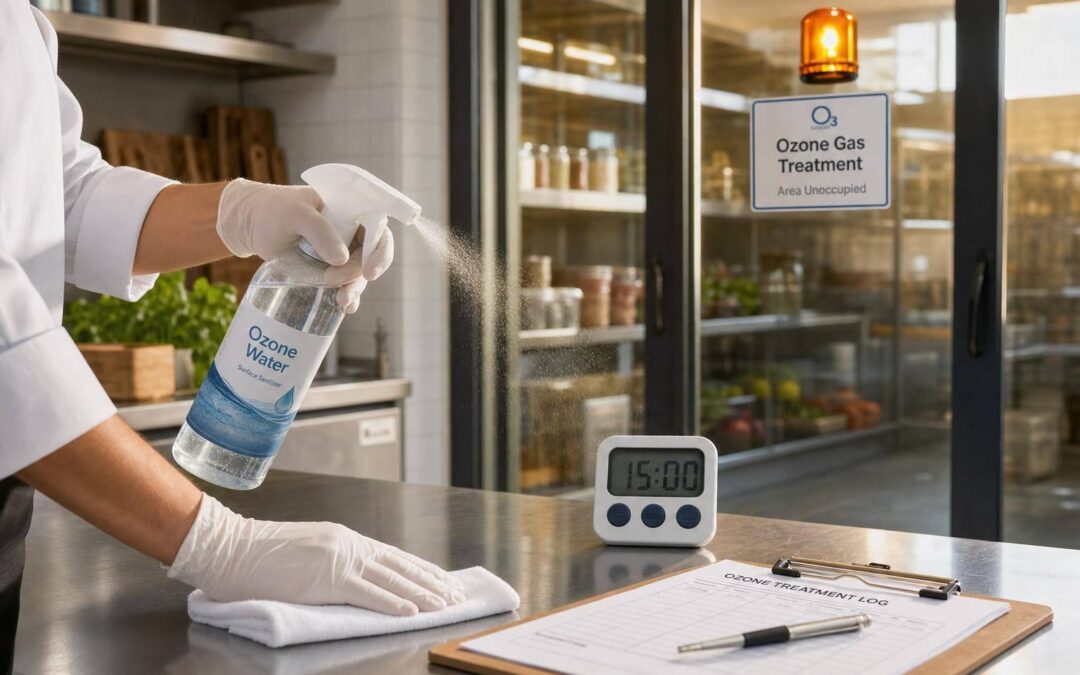
Ozone helps sanitize kitchen surfaces, but it only works well when you use the right form in the right place. If I had to sum it up in one line: use ozonated water on cleaned food-contact surfaces, and use ozone gas only in sealed, empty areas.
Here’s the short version:
- Ozonated water is for prep tables, cutting boards, utensils, and small tools.
- Ozone gas is for ducts, drains, equipment interiors, and other enclosed spots.
- Pre-cleaning comes first because grease, debris, and food soil use up ozone fast.
- Contact time matters: ozonated water often needs about 1 to 9 minutes at 1.0 to 6.0 mg/L for bacteria such as Listeria and Salmonella.
- Gas treatment is not for occupied spaces because ozone can irritate the lungs.
- Material checks matter since repeat exposure can wear down rubber, seals, and some soft plastics.
- Logging each treatment helps with food safety records and staff follow-through.
If you want the plain answer, ozone is a post-clean sanitizing step, not a replacement for washing and scrubbing. It leaves no chemical residue because it breaks down into oxygen, but that does not mean you can skip safety rules.
Quick comparison
| Method | Best use | Safe when people are present? | Common targets | Main caution |
|---|---|---|---|---|
| Ozonated water | Food-contact surfaces | Yes | Prep tables, boards, knives, utensils | Use it soon after it’s made |
| Ozone gas | Enclosed, empty areas | No | Ducts, drains, room treatment, equipment interiors | Ventilate fully before re-entry |
So if you’re setting up ozone use in a commercial kitchen, I’d keep the rule simple: clean first, match the method to the surface, control exposure, and document every treatment.
How Ozone Sanitizes Surfaces and Where It Fits in Kitchen Hygiene
Ozone sanitizes by oxidizing microbial cell structures. In plain English, it damages bacteria, viruses, and biofilms, then breaks down into oxygen. But there’s a catch: ozone only works well after pre-cleaning. Dirt and food soil use it up fast, so ozone supports cleaning rather than replacing it. Use it after cleaning, not instead of cleaning.
Ozone Gas vs. Ozonated Water
Ozonated water is the go-to option for food-contact surfaces. Ozone gas has a different role and should be used only in unoccupied enclosed areas.
| Feature | Ozonated Water | Ozone Gas |
|---|---|---|
| Primary Use | Food-contact surfaces, utensils, and produce rinsing | Air, ducts, and enclosed equipment areas |
| Occupancy | Occupied areas | Unoccupied areas only |
| Application | Spraying, wiping, dipping, or immersion | Controlled release via generator |
| Residue | None; breaks down to oxygen and water | None; breaks down to oxygen |
| Compliance | FDA GRAS for food treatment; USDA surface sanitation | EPA antimicrobial-device oversight; OSHA exposure limits apply |
That choice shapes the workflow in the next section.
What Ozone Can and Cannot Do
Ozone can act against many bacteria, viruses, molds, and biofilms. Still, it’s not a magic wand. Heavy soil, fungi, and some surface materials can limit how well it works. That’s why material checks matter before you set up a regular ozone program. Repeated high-concentration treatments can wear down rubber gaskets and some soft plastics.
U.S. Rules, Exposure Limits, and Sanitation Planning
In the U.S., ozone use sits across a few agencies, and each one covers a different piece of the puzzle: FDA, USDA, EPA, and OSHA.
| Scenario | Method | Key Compliance Point |
|---|---|---|
| Wiping prep tables | Aqueous ozone | FDA/USDA food-contact sanitation |
| Rinsing utensils | Aqueous ozone | Food-contact use and residue-free treatment |
| Treating an unoccupied kitchen zone | Ozone gas | OSHA exposure limits; ventilate before re-entry |
| Sanitizing ventilation ducts | Ozone gas | EPA antimicrobial-device oversight |
With the method and compliance path clear, the next step is the sanitizing workflow.
sbb-itb-5fea4da
Ozone Application Methods for Commercial Kitchen Surfaces
Commercial kitchens use ozone in two main ways: gas for empty, enclosed areas and ozonated water for food-contact surfaces. The right pick comes down to the space, whether staff are nearby, and how fast the area needs to go back into use.
Ozone Gas for Enclosed Kitchen Areas
Use ozone gas only when staff are out of the area and the space can be sealed off fully. It works best in empty, enclosed kitchen zones where ozone can move into spots that are hard to clean by hand, like high walls, ceiling corners, floor drains, and the outside of equipment.
A portable or fixed ozone generator releases the gas into the room, and the gas moves into cracks and crevices. That reach is the big selling point here.
No one may enter during treatment. Keep the space sealed until the treatment is done. Ozone breaks back down into oxygen, but while it is active, it can irritate the respiratory system. That means gas treatment is for empty enclosed areas only, followed by ventilation before anyone goes back in. In most kitchens, this is done overnight or during a planned shutdown.
Ozonated Water for Prep Tables, Boards, and Utensils
For day-to-day sanitation on food-contact surfaces, ozonated water is usually the better fit. Use it on clean prep tables, cutting boards, knives, and small tools. You can apply it with a spray bottle, a tap set up for ozonated water, or a soaking tub.
Timing matters. Use it right after it is made, because ozone strength drops fast after production.
For bacteria such as Listeria and Salmonella on stainless steel, effective contact times are typically 1 to 9 minutes at 1.0 to 6.0 mg/L. That makes ozonated water the standard option for prep surfaces that need to get back into service without much delay.
Surface Fit, Material Limits, and Method Comparison
Standard ozone use works with stainless steel, polyethylene, polypropylene, and ceramic tile at concentrations of 0.5 to 3.5 ppm. Still, keep an eye on rubber gaskets, seals, and soft plastics. Repeated exposure can wear those materials down over time.
| Feature | Ozone Gas | Ozonated Water |
|---|---|---|
| Typical Use | Walls, ceilings, drains, equipment exteriors | Prep tables, cutting boards, utensils |
| Equipment | Portable or fixed ozone generator | Dedicated tap, spray bottle, soak tank |
| Staff Presence | Area must be unoccupied | Safe for use around staff |
| Contact Time | Minutes to hours | Seconds to minutes |
| Surface Compatibility | Hard-to-reach and ambient surfaces | Direct food-contact surfaces |
| Residue | None (reverts to oxygen) | None (reverts to oxygen) |
If you’re dealing with heavier mold loads, you may need a stronger treatment. The key is simple: match the method to the surface, then record the treatment in your cleaning log.
Step-by-Step Ozone Workflows for Kitchen Sanitization
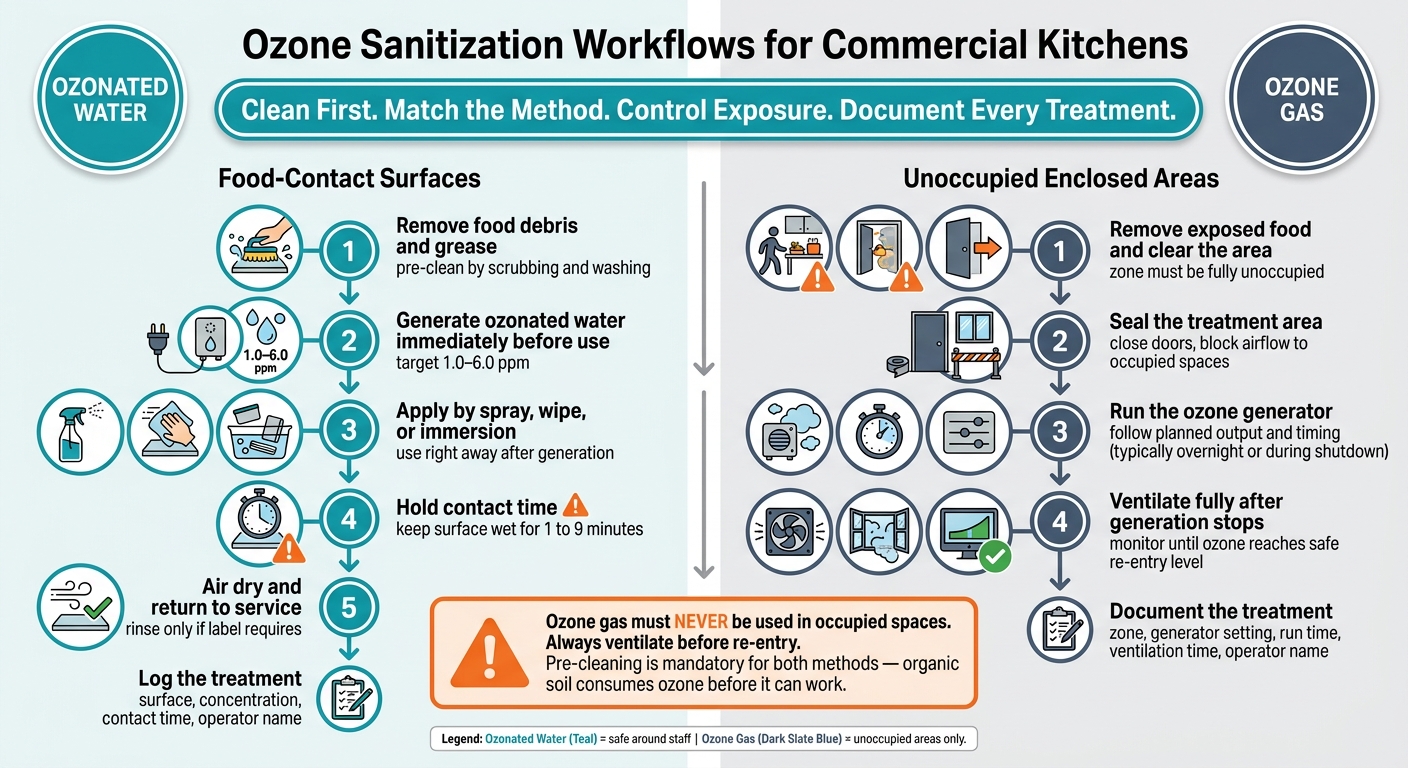
How to Sanitize Kitchen Surfaces with Ozone: Step-by-Step Workflow
Once you’ve picked the right method for the surface, the next job is using it the right way. Both workflows below follow the same rule: clean first, apply second. That matters because organic matter can use up ozone fast and cut down how well it works.
Workflow 1: Sanitizing Surfaces with Ozonated Water
Start by removing food debris and grease. Scrub and wash the surface with your normal pre-cleaning routine. If you skip that step, ozone won’t work as well.
Next, generate ozonated water right before you use it. Follow your equipment’s guidance to reach the working concentration. For bacteria such as Listeria and Salmonella, typical effective levels are 1.0 to 6.0 ppm.
Then apply it by spray, wipe, or immersion. Spray larger flat surfaces and immerse small tools when that makes sense. Use it right away after generation, since ozone levels drop fast in water.
After that, hold the needed contact time. The surface should stay wet for the full time required.
When that’s done, let the surface air dry and put it back into service. Only rinse if the label says you need to. Return the surface to food prep once the ozone has dissipated.
Last, log the treatment. Record the surface treated, the concentration used, the contact time, and the staff member who completed the step.
Use ozonated water for food-contact surfaces. Use ozone gas only in sealed, unoccupied spaces.
Workflow 2: Treating an Unoccupied Kitchen Zone with Ozone Gas
Begin by removing exposed food and clearing the area. The treatment zone must be fully unoccupied before you move ahead.
Then seal the treatment area. Close doors and block airflow into nearby occupied spaces. The area needs to stay sealed for the entire treatment cycle.
Run the generator based on the planned output and timing. Gas treatments are usually done after hours or during planned shutdowns so no one enters the area during use.
Once generation stops, ventilate the area fully. Keep ventilating until the monitor shows ozone has dropped to a safe level for re-entry.
After that, document the treatment and clear the zone for kitchen operations.
How to Document Treatments in a HACCP-Style Cleaning Program
Each treatment should be logged so concentration, contact time, and re-entry clearance can be traced later. Record every ozone treatment in your cleaning log.
| Field | Aqueous Ozone | Gaseous Ozone |
|---|---|---|
| Area/Surface | Specific surface (e.g., cutting board #4) | Room or zone (e.g., cold prep room) |
| Concentration / Setting | Measured concentration (ppm or mg/L) | Generator setting and run time |
| Contact Time | Time surface stayed wet | Total exposure time |
| Date & Time | MM/DD/YYYY, start and stop | MM/DD/YYYY, start and stop |
| Safety Check | Confirm pre-cleaning and no rinse needed unless labeling says otherwise | Ventilation time and re-entry clearance |
| Operator | Name or initials of sanitation lead | Name or initials of authorized technician |
It also helps to keep a Notes field for anything outside the normal routine. That could include a generator that didn’t hit target output, a rerun cycle, or early wear on sensitive materials. If a treatment gets interrupted or the equipment doesn’t perform as expected, record the corrective action taken so the log stays complete.
Every entry should also state that the surface was scrubbed and washed before ozone was applied. If not, organic matter can consume ozone before it has a chance to work.
Best Practices, Risks, and When to Call a Professional
Best Practices and Common Mistakes to Avoid
Once your workflow is in place, the main trouble spots are soil load, material wear, and exposure control.
One mistake shows up again and again: skipping the pre-clean. That’s a bad move. Pre-cleaning is mandatory because scrubbing and washing remove soil that would otherwise use up ozone before it ever reaches microbes.
Material choice matters too. Ozone can wear down rubber, wood, and some metals over time. Before you build ozone into a routine, check compatibility first. For repeat use, stainless steel and ozone-compatible plastics are usually the safer bet.
Strengths, Limitations, and Operating Trade-Offs
These limits help show where ozone makes sense in a kitchen sanitation program.
| Factor | Ozone | Implication for Your Kitchen |
|---|---|---|
| Residue | Leaves no residue | No chemical film on food-contact surfaces |
| Biofilm penetration | Can penetrate biofilms | Helps disrupt biofilm-protected microbes |
| Storage | Must be generated and used immediately | Requires reliable equipment and regular maintenance |
| Material wear | Can degrade rubber, wood, and some metals | Check compatibility before regular use |
| Gas safety | Can irritate the lungs at high levels | Use gas only in unoccupied spaces with ventilation |
When to Bring In a Professional Ozone Service
Bring in a professional when odors keep coming back, when the space is enclosed, or when ductwork is hard to treat without tight control. This becomes more important when the treatment area is large, sealed off, or tough to ventilate well.
For Chicagoland kitchens, Ozonated Cleaning LLC provides professional ozone-based odor removal and disinfection services.
FAQs
Can ozone replace regular cleaning?
No. Ozone does not replace the initial physical cleaning process.
For sanitation to work well, surfaces need to be cleaned first with hot water or other cleaning agents to remove organic matter and biofilms. After that, ozone is applied to sanitize the cleaned surface, because organic matter can reduce how well ozone works.
When should I use ozone gas instead of ozonated water?
Use ozone gas to disinfect large spaces, HVAC systems, and hard-to-reach areas like upholstery, air ducts, and porous materials. Since it’s a gas, it can move into places that sprays and wipes often miss, helping remove odors and pathogens at the source. For safety, gaseous ozone treatments are done only in unoccupied areas.
Use ozonated water for surface sanitation, rinsing tools and equipment, and washing produce.
How do I know if a surface is ozone-safe?
Ozone can sanitize many surfaces, but some materials don’t handle oxidation well. Before treatment, remove or protect items like:
- Rubber
- Certain fabrics
- Wiring
- Artwork
- All plants
If you have delicate or specialized kitchen equipment, Ozonated Cleaning LLC can help secure the area so the disinfection process is safe and effective.
Recent Comments