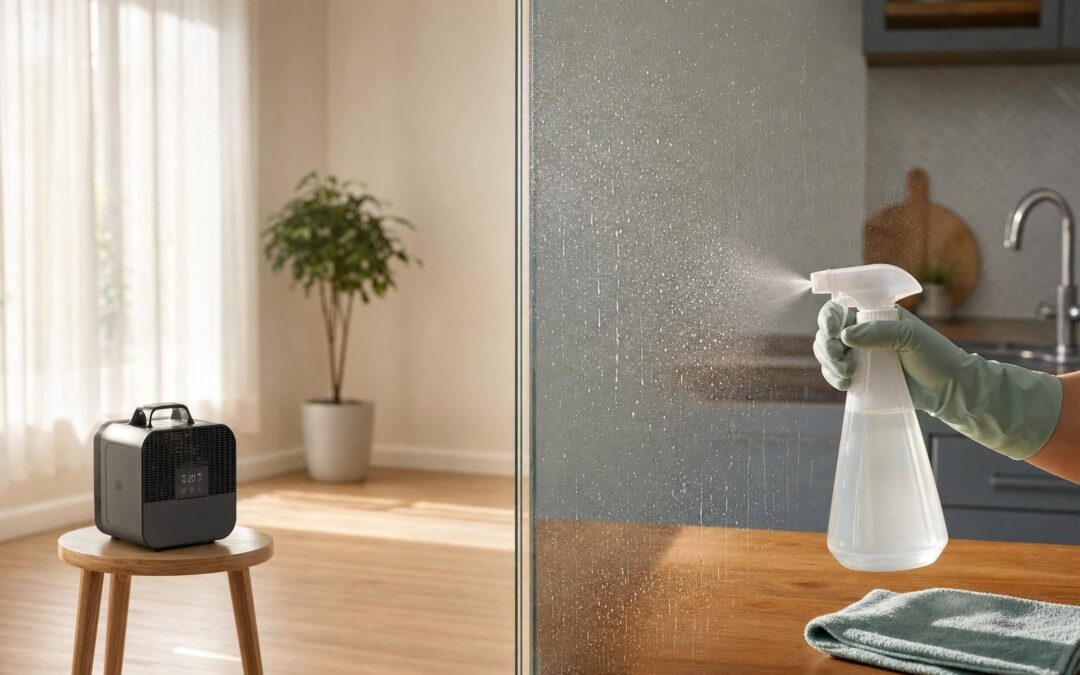
If you need to remove deep odor, ozone is often the better fit. If you need to clean dirt, grease, or touchpoints, chemical cleaners are the better fit.
I’d sum it up like this:
- Ozone works on odor in the whole space, including air, fabric, ducts, and other hard-to-reach spots.
- Chemical cleaners work on surfaces they touch, so they’re used for wiping, scrubbing, and disinfecting.
- Safety is the biggest split: ozone treatment means the space must be 100% empty during use – no people, pets, or plants.
- Residue is another split: ozone leaves no film or added scent, while many cleaners can leave fragrance or surface residue.
- Waste also differs: chemical products often mean bottles, wipes, and rinse-off waste, while ozone is made on-site from oxygen and electricity.
A few key facts stand out. Ozone can move through an enclosed area and reach soft materials and HVAC paths, but it does not remove visible mess. Chemical cleaners can be used for daily cleaning and surface disinfection, but they only work where they are applied. And if an odor source is still there – like trash, mold, or a dead rodent – neither option fixes that until the source is removed.
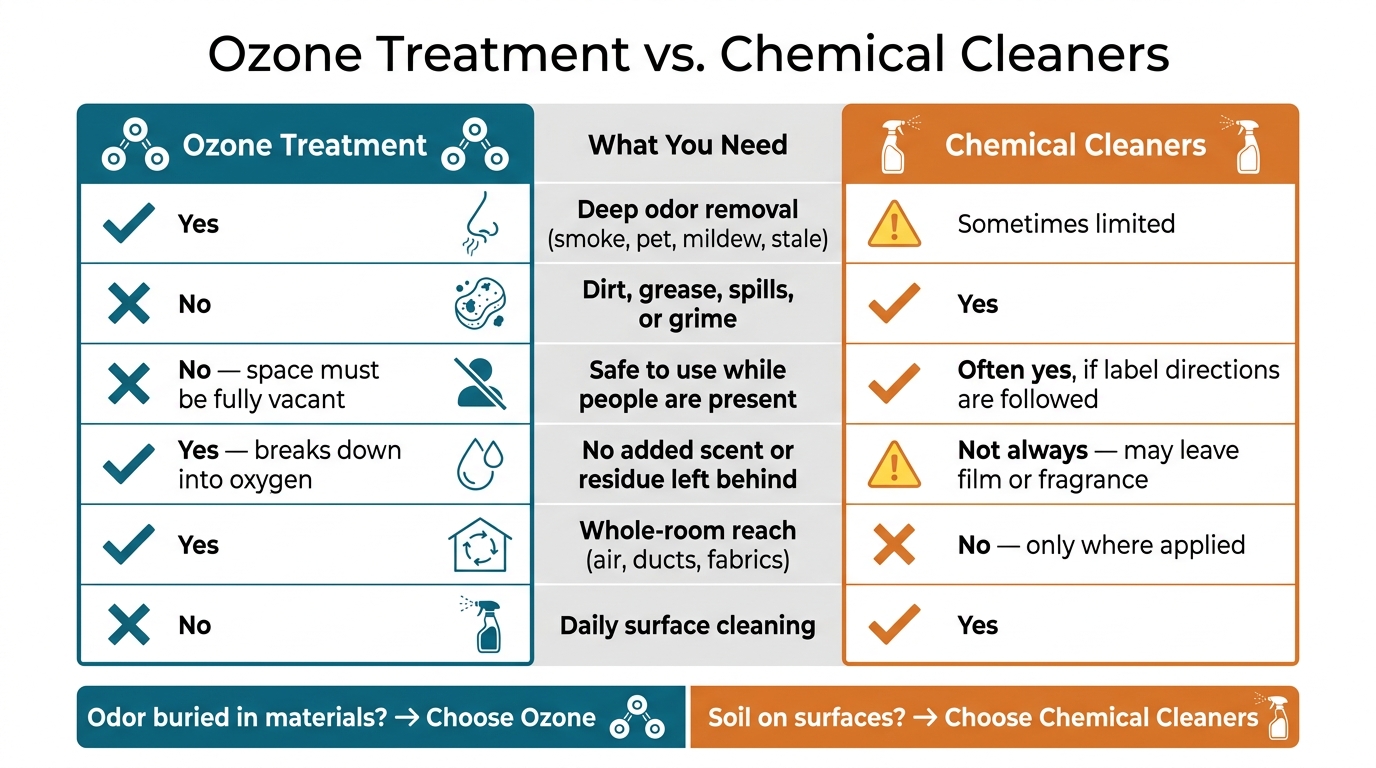
Ozone Treatment vs. Chemical Cleaners: Side-by-Side Comparison
Ozone vs Common Disinfecting Products
sbb-itb-5fea4da
Quick Comparison
| What you need | Ozone treatment | Chemical cleaners |
|---|---|---|
| Deep smoke, pet, mildew, or stale odor | Yes | Sometimes limited |
| Dirt, grease, spills, or grime | No | Yes |
| Use while people are in the space | No | Often yes, if label directions are followed |
| No added scent or film | Yes | Not always |
| Whole-room reach | Yes | No |
| Daily surface cleaning | No | Yes |
If I were choosing between the two, I’d use a simple rule: odor buried in materials points to ozone; soil on surfaces points to chemical cleaning.
Safety and Indoor Use: Exposure, Ventilation, and Residue
This gap shows up most clearly indoors, where reentry timing and residue shape how each method can be used. It affects who can stay in the room, how much airflow you need, and what gets left behind.
When Spaces Must Be Empty
Ozone treatment requires the space to be fully empty before the generator turns on. That means no people, no pets, and no plants. Breathing high levels of ozone is harmful. Professionals manage this with timed treatment cycles and strict reentry rules. After treatment, the space needs to be aired out until the ozone breaks down and it is safe to go back in.
Chemical cleaners work in a different way. Many can be used with people nearby, as long as the product label is followed and the stated drying or dwell time is met. Here, the main risk often shifts to the person doing the work: skin contact, fumes, and mixing products that should never be combined.
Here’s what that trade-off looks like in day-to-day use:
| Safety Factor | Ozone Treatment | Chemical Cleaners |
|---|---|---|
| Occupancy during use | Must be fully vacant (people, pets, plants) | Generally occupied; label compliance required |
| Worker exposure | Minimal if automated; training required | Higher risk from spills, fumes, and mixing |
| Ventilation needed | High; post-treatment airing out required | Moderate; depends on product volatility |
| Handling requirements | No residue disposal | PPE, safe storage, and waste handling |
Residue and Surface Contact Differences
After ozone finishes reacting, it breaks down and leaves no residue, film, or added fragrance behind. That can be a big deal in places where scent or leftover film is a problem, like rental properties, hotel rooms, and vehicle interiors.
Chemical cleaners often leave some trace behind, whether that’s residue, scent, or a film that may need extra rinsing. In a vehicle interior, that leftover film can be hard to miss, especially for people seeking ozone vs. chemical allergy relief.
There’s one simple but important catch: ozone is a sanitizer and odor eliminator, not a physical cleaner. If there’s visible dirt, dust, or debris, someone still has to remove it by hand first. Ozone comes after that step. It deals with odors, not grime.
That brings us to effectiveness: where each method solves the problem, and where it doesn’t.
Effectiveness: Odor Removal, Surface Cleaning, and Pathogen Reduction
Safety sets the limits. Effectiveness decides whether the method fits the job. And the right tool depends on the problem in front of you.
Ozone treats the entire enclosed space. Chemical cleaners only work on the surfaces they actually touch. That difference matters more than most people think.
| Feature | Ozone Treatment | Chemical Cleaners |
|---|---|---|
| Odor Removal | Oxidizes odor compounds | Neutralizing odors on surfaces or masking them |
| Surface Reach | Gas that moves through the whole space; reaches air ducts, soft furnishings, and structural voids | Limited to areas physically touched by liquid or wipe |
| Effectiveness | Depends on concentration and optimal ozone treatment time | Depends on the product label |
| Speed | Slower overall; requires treatment cycle plus ventilation | Faster for immediate, localized spot cleaning |
| Pathogen Reduction | High when concentration is sufficient in an enclosed space | Depends on surface type and how well it is cleaned |
| Physical Soil | Does not remove dirt, grease, or spills | Essential for removing debris and degreasing |
Where Ozone Works Best
Ozone is at its best when the issue is whole-space odor, not isolated dirt or mess. Think about smoke odor after a fire, or years of indoor smoking. Those odor molecules don’t just sit on one table or one wall. They settle into carpets, soft furnishings, and HVAC systems. That’s where ozone has an edge.
It’s also useful for pet odors in rental properties, musty smells in boats and RVs, vehicle interiors with smoke or pet odors, hotel room turnover, and stubborn HVAC odors. In cases like these, wiping one surface at a time just doesn’t get far enough.
The EPA notes that ozone may inhibit some biological agents while present, but full decontamination requires levels that are unsafe for occupied spaces. This is why professional setup and strict vacancy protocols aren’t optional – they’re what make the treatment work safely.
Where Chemical Cleaners Work Best
For visible soil and high-touch surfaces, direct contact still wins. If there’s grease on a kitchen counter, a spill on the floor, fingerprints on a doorknob, or buildup on a bathroom fixture, ozone won’t solve that. It doesn’t remove dirt, grease, or residue.
Chemical cleaners are made for that hands-on work. Use them for:
- Visible soil
- Grease
- Spills
- High-touch surfaces
Put simply, if the problem needs scrubbing, wiping, or degreasing, chemical cleaners are the better fit.
Environmental Impact: Packaging, Runoff, and Air Quality
Once you know both methods can do the job, the next thing to look at is what they leave behind. For repeat cleaning, that matters a lot. The clearest gap shows up in packaging, runoff, and indoor air.
Chemical cleaning creates steady packaging waste from liquids, sprays, and wipes. And when those products are rinsed off, residues can end up in wastewater. Ozone works differently. It’s made on-site from oxygen and electricity, so there’s no bottle, no wipe, and no rinse-off waste tied to the treatment itself.
Indoor air quality is another clear point of difference. Chemical cleaners can add fragrance and VOCs to the air. Ozone doesn’t add scent. Instead, it oxidizes odor molecules directly rather than covering them up with fragrance.
Here’s how that plays out in day-to-day use:
| Environmental Aspect | Chemical Cleaners | Ozone Treatment |
|---|---|---|
| Packaging Waste | Ongoing (plastic bottles, wipes, shipping materials) | Minimal – generated on-site from ambient oxygen and electricity |
| Water Impact | Chemical runoff from rinsing | None – decomposes into oxygen with no harmful byproducts |
| Air Quality | Adds fragrance load; potential VOC release | Removes odors; no synthetic fragrances added |
| Cleanup Waste | Can leave chemical film or buildup requiring additional rinsing | No residue left behind |
How Residue and Waste Differ Between Methods
With chemical cleaning, each cycle usually means more product, more packaging, and often disposable wipes. Ozone is produced right where it’s used, so there’s no product to ship, store, or throw away. After treatment, it breaks back down into oxygen.
"Ozone decomposes back into oxygen, leaving no harmful residues, thus minimizing environmental impact." – Inquivix Technologies
When to Choose Ozone and What to Take Away
Matching the Right Method to Homes, Vehicles, and Commercial Spaces
Once you’ve looked at safety, how well it works, and its effect on the space, the last thing to figure out is simple: is ozone the right fit for the job?
Ozone makes the most sense when the problem is stuck in the air or buried deep in porous materials, not sitting out in the open on a surface.
That’s the big difference. Dirt on a counter is one thing. Odor buried in fabric is another. A smoke-heavy car or rental unit often calls for ozone because the smell has worked its way into upholstery, carpets, and HVAC pathways.
In Chicagoland, Ozonated Cleaning LLC offers ozone and hydroxyl treatment for homes, vehicles, RVs, boats, and commercial spaces.
What to Consider Before Choosing a Method
A simple way to think about it:
| Your Main Problem | Better Method |
|---|---|
| Embedded odor in porous materials | Ozone treatment |
| Visible dirt, grease, or high-touch surfaces | Chemical cleaners |
| Repeated residue and waste | Ozone treatment |
There’s one rule you can’t ignore: the space must be completely empty during ozone treatment. That means no people, pets, or plants.
And if the source of the smell is still there, it has to go first. Garbage, mold, or a dead rodent all need to be removed before treatment starts. Ozone can neutralize odor molecules, but it can’t make up for a smell source that’s still active.
FAQs
Can ozone replace regular cleaning?
Yes – ozone can replace or supplement regular cleaning when you need deep sanitizing or help with stubborn odor removal. It works at the molecular level to neutralize pathogens and odors, and it can reach spots that normal cleaning often misses, like HVAC systems, upholstery, and small cracks.
That said, ozone treatment isn’t something people use casually. Because the space has to be vacated during treatment, it’s often used as a periodic deep-cleaning add-on alongside standard cleaning and maintenance.
How long after ozone treatment is it safe to reenter?
Ozone treatment should only happen in empty spaces. The ozone levels needed for disinfection are not safe for people or pets.
Once the generator is off, ventilate the area for at least 30 minutes. Ozone can break down on its own in about 30 to 60 minutes. Even so, professional services often ask that the space stay empty for 12 to 24 hours to make sure all ozone has cleared and the area is safe to reenter.
What should be removed before ozone treatment?
Before ozone treatment, remove sensitive items or cover them well. High-concentration ozone can damage materials like rubber, some plastics, and certain fabrics.
For safety, all people, pets, and plants must leave the treatment area. That’s because the process uses ozone levels above public health standards.
Ozonated Cleaning LLC follows these protocols to help protect your property and support effective results.
Recent Comments