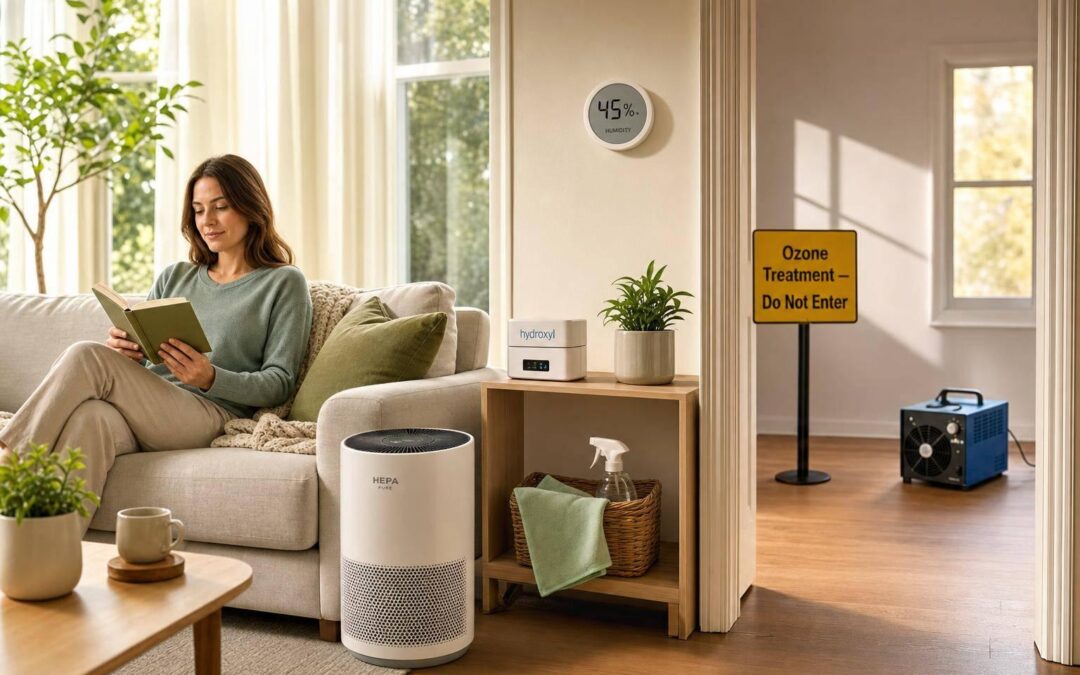
If you want allergy relief, start with cleaning, source removal, humidity control, and HEPA filtration – not hydroxyl or ozone. From the article, my take is simple: hydroxyl may help with leftover odors in lived-in spaces when used with the right device and process, while ozone is for empty spaces only and can irritate the lungs.
Here’s the short version:
- Neither option removes dust, pollen, or pet dander
- Hydroxyl is mainly an odor-treatment add-on
- Ozone should not be used around people, pets, or plants
- People with asthma need extra caution because ozone can worsen breathing symptoms
- Indoor humidity should stay at 30% to 50%
- Wet materials should be dried within 24 to 48 hours
- Ventilation and HEPA filtration still do most of the work
If I were deciding between the two, I’d use this rule: for odors after cleanup, hydroxyl may fit better in occupied homes; for odor treatment in an empty space, ozone may be used only with strict re-entry and ventilation steps. But for allergy symptoms, neither is the main fix.
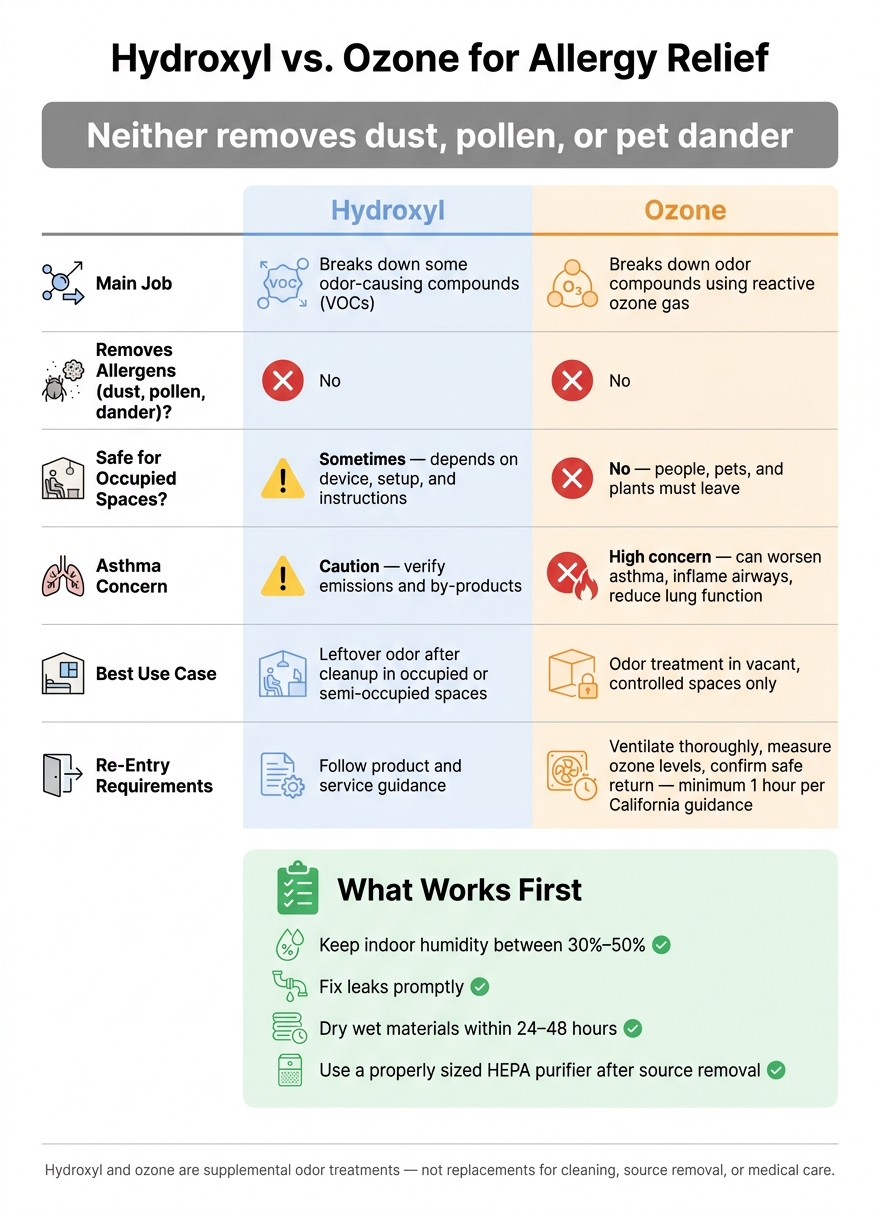
Hydroxyl vs. Ozone for Allergy Relief: Side-by-Side Comparison
670: Charles J. Weschler, PhD – Ozone, Hydroxyl Radicals and Indoor Environments; What Inspection…
sbb-itb-5fea4da
Quick Comparison
| Criteria | Hydroxyl | Ozone |
|---|---|---|
| Main job | Breaks down some odor compounds | Breaks down some odor compounds with ozone gas |
| Removes allergens like dust or pollen | No | No |
| Safe for occupied spaces | Sometimes, depending on the device, setup, and instructions | No |
| Asthma concern | Needs caution and device checks | High concern; can irritate lungs |
| Best use | Leftover odor after cleanup | Odor treatment in vacant spaces |
| Re-entry steps | Follow product and service guidance | Ventilate, measure levels, and confirm safe return |
What I like about this comparison is that it keeps the goal clear: cut odor without adding breathing risk. That’s the right lens for any home where allergies or asthma are part of the picture.
Hydroxyl technology for residential allergy and asthma concerns
Hydroxyl treatment may help cut odor-related triggers, but it does not remove airborne allergens. It uses hydroxyl radicals to break down some odor-causing VOCs and other compounds that can be oxidized. But here’s the key point: it is not a filter, so it doesn’t trap or remove particles.
How hydroxyl treatment works in homes
A hydroxyl generator may help reduce leftover smoke or pet odor after the source is gone. But results can vary a lot. They depend on the machine, room size, humidity, ventilation, the type of contaminant, and how the operator runs the treatment. Peer-reviewed evidence for airborne treatment is still limited.
It also doesn’t remove dust, dander, pollen, or dust-mite debris. That’s still the job of HEPA vacuuming, laundering, humidity control, and routine cleaning. This limit matters even more when people compare hydroxyl to ozone, since ozone comes with much stricter occupancy limits.
Practical uses and limits for allergy relief
Where hydroxyl treatment may help is in narrow, post-cleaning cases. Think of a musty smell that sticks around after water-damaged materials have been dealt with the right way. Or smoke odor that lingers after smoke damage cleanup. Or pet odors that won’t go away even after contaminated padding or fabric has been removed. In those cases, hydroxyl treatment may support cleaner indoor conditions, depending on the equipment and the operator’s process.
Still, don’t expect hydroxyl treatment on its own to ease allergy or asthma symptoms. A more realistic expectation is possible improvement in indoor odor and overall indoor conditions, as noted in our odor removal and disinfection FAQs. If respiratory symptoms stick around or get worse, a qualified healthcare professional should be involved.
Before any treatment, ask for:
- The exact model
- Ozone-emission test data
- Re-entry instructions
- Ventilation instructions
That step matters because some hydroxyl devices can produce ozone or other unintended reaction products as a byproduct. So while hydroxyl can play a part in odor control, it is not a stand-alone fix for allergies.
Ozone treatment for allergy and asthma concerns
If hydroxyl is the occupied-space option, ozone is the vacant-space option. Ozone generators produce ozone, which is a reactive gas, instead of filtering particles. And for allergy or asthma relief, that difference matters a lot. Rather than cutting allergen exposure, ozone can irritate the airways.
Why ozone is not the same as filtration or routine air cleaning
Ozone does not remove allergen particles. The EPA says that at safe indoor levels, ozone does little to remove indoor allergens. Breathing in ozone can lead to coughing, throat irritation, chest tightness, shortness of breath, and reduced lung function. For people with asthma, ozone exposure can make breathing problems worse instead of better. That’s why ozone is not a fit for occupied homes.
This is also why ozone has a much narrower use than filtration or routine air cleaning. It belongs only in short-term, controlled treatments.
When ozone may be used and what precautions are required
For allergy and asthma relief, the main issue isn’t just odor control. It’s safe exposure control. Ozone does have a limited professional use in controlled, vacant spaces for odor removal after the source has been dealt with. That might mean a vacant room or an empty home. That’s a very different setup from using ozone as a day-to-day air-cleaning method in a lived-in space.
Even in those controlled cases, the safety steps are strict:
- All people, pets, and plants must leave before treatment starts.
- That includes anyone in connected areas if ozone could move through doors, ducts, cracks, or ventilation paths.
- Ozone can react with indoor chemicals, so setup and ventilation matter.
- Ventilate well, confirm safe ozone levels, and don’t rely on smell alone before going back inside.
California guidance recommends ventilating for at least one hour before reoccupation. But fixed time windows can be misleading. Room size, humidity, and other conditions can change how treatment behaves, so monitoring is a better way to check when a space is safe to reenter.
Hydroxyl vs. ozone: side-by-side comparison
For allergy relief, the main issue isn’t which option sounds more powerful. It’s which one cuts odors without adding breathing risk.
Here’s the plain-English version: hydroxyl is usually the lower-disruption option for odor control, while ozone is meant for empty spaces and comes with tighter safety limits.
Comparison table: use case, safety, and allergy relevance
| Criterion | Hydroxyl technology | Ozone generators |
|---|---|---|
| Primary mechanism | Uses reactive hydroxyl chemistry to break down some odors and contaminants; results depend on the device and conditions. | Intentionally produces ozone, a reactive gas, through methods such as electrical discharge or ultraviolet light. |
| Typical residential purpose | Odor treatment after cleaning; not a replacement for cleaning or filtration. | Vacant-space odor treatment; EPA does not recommend ozone generators as occupied-space air cleaners. |
| Occupancy rules | Follow the product’s instructions; labeling alone does not prove safe use around people, pets, or sensitive occupants. | People, pets, and plants should be removed during operation, and the area should be isolated and ventilated before re-entry. |
| Allergy relevance | May help with odors after cleaning, but it does not remove dust, pollen, pet dander, or mold in materials; HEPA filtration and cleaning are still required. | Poor choice for routine allergy relief; EPA says ozone has little potential to remove indoor contaminants at concentrations within public-health standards. |
| Asthma considerations | Verify emissions and by-products; do not assume a reactive-air device is automatically appropriate for people with asthma. | Ozone can worsen asthma, inflame airways, and reduce lung function. |
| Ideal application | Supplemental odor treatment in a controlled setting where the equipment has credible safety documentation and the main source has already been addressed. | Vacant-space deodorization by trained professionals, not allergy or asthma relief in occupied homes. |
Advantages and limitations table
Neither option is a clean answer for allergy relief. Each one has a narrow job, and those limits matter even more when breathing issues are part of the picture.
| Technology | Advantages | Limitations |
|---|---|---|
| Hydroxyl | May involve less disruption than ozone in some cases and can work as an add-on for stubborn odors after source removal, especially when less vacancy time is needed. | Does not remove allergen reservoirs, settled dust, or airborne particles; labeling alone does not establish efficacy for asthma or allergy symptoms; product-specific safety data may be limited. |
| Ozone | Can work for hard-to-treat odors in vacant, controlled spaces; chemical oxidation changes odor compounds instead of just covering them up. | It is a respiratory irritant that may worsen asthma, coughing, airway inflammation, and shortness of breath; not appropriate for occupied homes, routine air cleaning, or as an allergy or asthma treatment. |
The next step is matching the treatment to the space, the source, and the people who will reenter it. This process often begins with identifying the odor source to ensure the treatment is effective.
Choosing the right treatment and when to call a professional
When source control or HEPA filtration should come first
Once you stack up hydroxyl and ozone, the next step is simple: decide what to do first in an actual home.
If the main issue is dust, pet dander, pollen, pest debris, or mold-related particles, cleaning and source removal will usually help more than oxidation treatment. Why? Because they cut down the particles and moisture that often set off symptoms. For allergy symptoms, source control should come first.
That usually means:
- Keep indoor humidity between 30% and 50%
- Fix leaks as soon as possible
- Dry wet materials within 24 to 48 hours
- Use a properly sized HEPA purifier after the source has been handled
After that, hydroxyl or ozone may make sense for a specific extra step, such as a stubborn odor that still lingers after the rest of the work is done.
It’s smart to call a professional if odors stick around after cleaning, the affected area is large, smoke or sewage contamination is part of the problem, mold has spread into porous materials, an HVAC system may be contaminated, or people in the space are dealing with respiratory symptoms.
Professional services from Ozonated Cleaning LLC
Sometimes cleaning and filtration get you most of the way there, but not all the way. That’s where professional treatment can step in to deal with the odor that won’t let go.
For Chicagoland property owners dealing with stubborn odors or indoor-air concerns that cleaning alone hasn’t solved, Ozonated Cleaning LLC provides professional odor removal and disinfection using ozone and hydroxyl technology for homes, vehicles, RVs, and boats, with a focus on reducing odor-related triggers and surface disinfection. A professional assessment can help sort out whether the job calls for occupied-space hydroxyl treatment or vacant-space ozone treatment.
If ozone is used, people, pets, and plants should be removed from the area. The space should also be isolated, and no one should go back in until it has been ventilated and cleared under the service protocol.
The bottom line: pick the method based on safety, whether the space is occupied, and the actual source of the problem – not on claims of medical relief. Allergy and asthma symptoms still need clinical care. Environmental treatment may help reduce exposure to some triggers, but it does not replace a doctor’s evaluation.
FAQs
Can hydroxyl help with mold smells?
Yes. Hydroxyl technology can help with mold smells by breaking down the molecules that cause the odor. Over time, it can also cut down mold-related allergens, including spores.
That said, it does not replace fixing the moisture issue or removing heavy mold growth from surfaces. If the moisture or mold is still there, the smell can come back.
How do I know if ozone re-entry is safe?
Make sure the space is completely empty during treatment. Once the generator stops, air the area out well before anyone goes back in.
In most cases, re-entry calls for at least 1–2 hours of ventilation. Some guidance goes further and says the space should stay empty for 12–24 hours after the generator shuts off.
For extra safety, check ozone levels before people return. Referenced limits include OSHA’s 0.10 ppm 8-hour average and the FDA’s 0.05 ppm cap.
When should I choose HEPA over oxidation?
Choose a HEPA filter if your top goal is taking physical particles and allergens out of the air, like dust or pollen.
Oxidation methods such as hydroxyl and ozone can help neutralize odors, VOCs, and biological contaminants. But they do not remove particulate matter from the air. So if particle removal comes first, HEPA is the better fit.
Recent Comments