Here’s the short answer: ozone lowered microbes in sealed indoor spaces, but the results depended on dose, time, humidity, airflow, and full ventilation before people went back in.
I found the same pattern across the home, office, and vehicle examples. In the home case, MRSA was found on 34% of samples before treatment and on 0% after treatment. In the office case, airborne bacteria dropped 95% and fungi dropped 78% after a 10-minute ozone cycle. In the vehicle case, mold and odor were gone after source cleanup, ozone treatment, and ventilation.
If you just want the main takeaways, here they are:
- Ozone worked best in sealed spaces
- Results changed with concentration, exposure time, humidity, and airflow
- It did not fix the source of contamination
- Ventilation after treatment was required before re-entry
- Fungi were harder to reduce than bacteria in the office example
A quick side-by-side view:
| Space | Main issue | Treatment conditions | Reported result |
|---|---|---|---|
| Home | MRSA on surfaces | 30 to 50 mg/m³ for 20 to 30 minutes, high humidity | 34% positive before, all negative after |
| Office | Airborne bacteria and fungi | About 20 ppm for 10 minutes, fan used for air movement | 95% drop in bacteria, 78% drop in fungi |
| Vehicle | Mold in cabin and HVAC-related areas | Source cleanup first, then ozone in sealed cabin with HVAC on recirculation | No mold or odor detected after ventilation |
So, if you’re reading these case studies to answer one question – does ozone help with airborne pathogens in enclosed spaces? – the answer is yes, under the tested conditions. But it was a follow-up step, not a substitute for cleaning, moisture control, or ventilation.
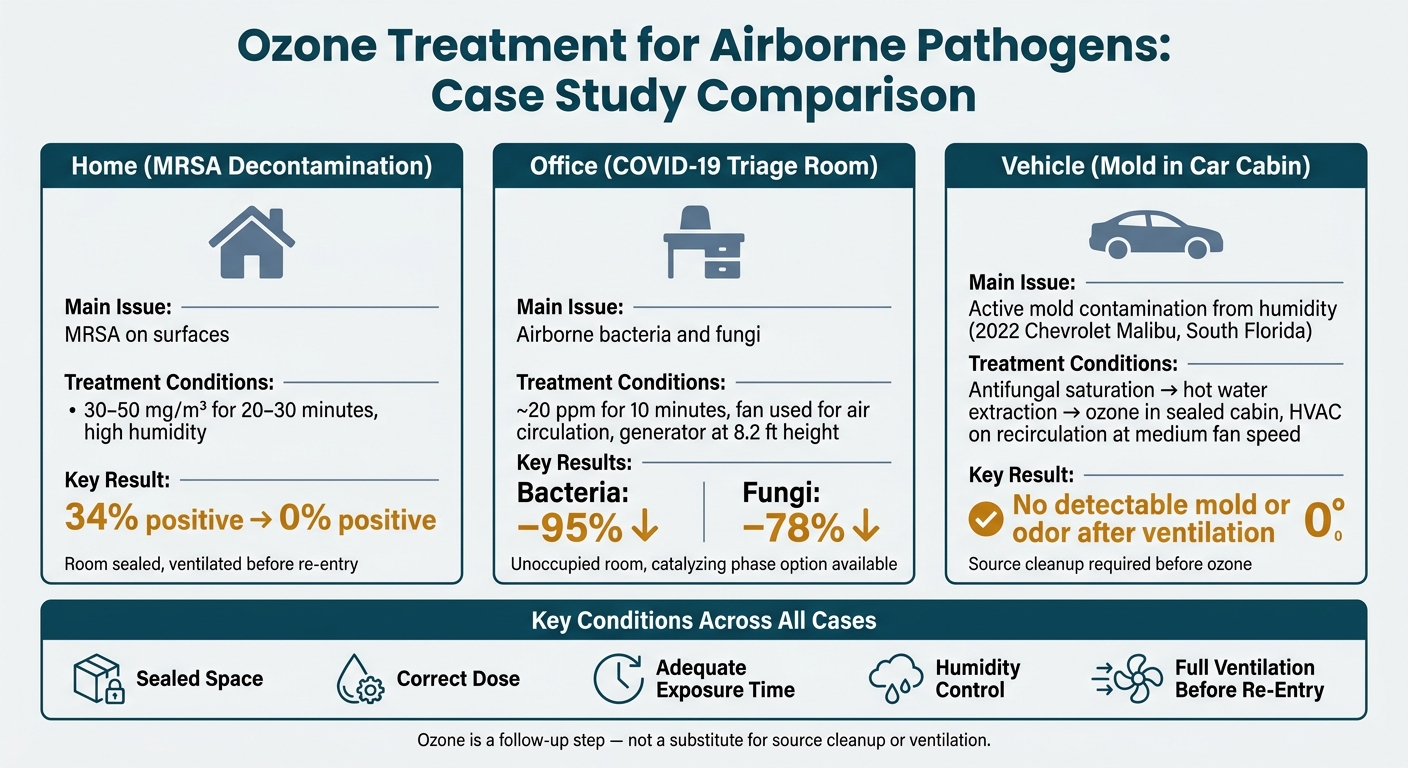
Ozone Treatment Results: Home vs. Office vs. Vehicle
Home Case Study: Ozone Treatment After Indoor Air Contamination
Room Setup, Cause, and Treatment Time
In October 2006, researchers at the Academic Medical Center in Amsterdam reported a home MRSA decontamination case. Before treatment, environmental sampling found MRSA in 34% of home surface samples.
One reason ozone was used is simple: it can move into spots that are tough to reach with sprays or UV light, including crevices, fabrics, and the undersides of furniture. In this case, the home was sealed and treated at 30 to 50 mg/m³ for 20 to 30 minutes under high humidity. After that, the room was left to let the ozone decay, then ventilated before testing.
Results and Safe Re-Entry Steps
After treatment, all environmental cultures were negative for MRSA, compared with 34% positive before ozone.
For safe re-entry, timing matters. Ozone decays to oxygen in about 20 to 30 minutes at 86°F (30°C), so the home was ventilated before anyone went back inside. It also makes sense to remove ozone-sensitive rubber items before treatment. For more details on the process, see our disinfection service FAQs.
The office case shows how this same method works in a shared workspace with more occupant turnover.
sbb-itb-5fea4da
Office Case Study: Air Cleaning in a Shared Workspace
Workspace Conditions and Exposure Time
In April 2021, researchers treated a COVID-19 triage administrative room in Brazil with ozone and measured the air before and after. The room had frequent healthcare worker traffic, so air cleaning was a high priority. That matters because airborne pathogens are affected by room size, airflow, and how long the space is exposed.
The team treated the unoccupied room with about 20 ppm of ozone for 10 minutes. The generator sat about 8.2 feet (2.5 meters) high, and a circulating fan pushed ozone into corners and other dead-air areas. In plain terms, this case helps show what happens in a shared room where air movement plays a big role, not just the ozone dose.
Air Sampling Results Before and After Treatment
After the 10-minute cycle, air sampling showed steep drops in microbes. Before treatment, the room measured 3.3 × 10² CFU/m³ of bacteria and 1.3 × 10³ CFU/m³ of fungi. After treatment, bacteria fell 95% and fungi fell 78%.
Some newer units also include a catalyzing phase that uses UV-C lamps or catalytic converters to turn leftover ozone back into oxygen. That can cut down the waiting time before people can safely go back into the room.
The vehicle case study shows how this same setup changes in a smaller, enclosed cabin.
Vehicle Case Study: Ozone Use in a Car, Van, or RV
Source of Contamination and Cabin Treatment Steps
Vehicles are smaller spaces, but they can be harder to treat than they look. The air inside the cabin, the upholstery, and the HVAC ducts all have to be treated as one system. Contamination can settle in the HVAC unit, under the seats, in carpet backing, and along other hidden airflow paths that basic cleaning may miss.
A clear example comes from DShine Details in 2022. The job involved a 2022 Chevrolet Malibu in South Florida. The car had active mold contamination on the seats and carpets, tied to the area’s high humidity. The team followed a set sequence: antifungal saturation first, then hot water extraction, and then ozone treatment in a sealed cabin. That order is important. Using ozone or steam on live mold before pre-treatment can aerosolize spores and push them into the HVAC system.
During the ozone stage, the HVAC system was set to recirculation mode with the fan at medium speed. That pushed ozone through the evaporator core and the ductwork.
Results, Limits, and Ventilation After Treatment
After treatment and ventilation, there was no detectable mold or odor left. The result lines up with the same factors seen in home and office cases: a sealed space, controlled exposure, airflow through the HVAC system, and full ventilation before anyone goes back in.
Ozone can clear contamination inside the treated cabin, but it doesn’t fix the cause. If moisture stays in the vehicle, or if the source of contamination remains, the problem can come back. After any ozone cycle, the vehicle has to be aired out before anyone drives or rides in it .
| Vehicle Type | Contamination Source | Treatment Approach | Documented Outcome |
|---|---|---|---|
| 2022 Chevrolet Malibu | Active mold contamination from humidity | Antifungal saturation + hot water extraction + ozone | No detectable mold or odor after ventilation |
This same pattern shows up again: source cleanup, sealed exposure, then full ventilation. That’s why vehicle cases make a useful comparison with the home and office examples covered earlier.
What These Case Studies Show for Homes, Offices, and Vehicles
Conditions That Affected Results Across Cases
Put side by side, the home, office, and vehicle cases all point to the same set of operating conditions. In each case, results came down to a sealed space, the right dose, enough exposure time, humidity, and proper ventilation. When dose, humidity, or ventilation weren’t controlled, performance fell off.
Humidity had a big effect across the cases. Pathogen type mattered as well. Fungi generally needed higher doses than bacteria. The office case showed that gap clearly, with bacteria dropping 95% and fungi dropping 78%.
There’s another piece to this: surface deposition. Some ozone is lost to walls, fabrics, and equipment, which means less is left for the target contamination. So the dose has to account for that loss.
When Professional Ozone Service Makes Sense
These patterns matter most when contamination sticks around or when the space is too large, has multiple rooms, or is hard to seal with routine cleaning alone. The Amsterdam MRSA case makes that plain: 34% of samples were positive before treatment, and all were negative after.
Professional ozone service makes the most sense when contamination keeps coming back, source cleanup is finished, and the space can be sealed and ventilated the right way. Vehicle treatment follows the same rule. It only works after source cleanup and full ventilation.
Ozone works best as a targeted follow-up step for enclosed spaces. It does not replace source control or ventilation.
Sanitize Everything With Ozone
FAQs
Is ozone safe after treatment?
Yes – when used the right way, ozone is safe after treatment. It’s unstable, so it breaks down on its own into diatomic oxygen and doesn’t leave toxic residue or harmful byproducts behind.
That said, safety still matters. No one should be in the area during active treatment, and the space needs fresh-air ventilation afterward before anyone goes back in.
Can ozone replace cleaning?
No. Ozone can help disinfect air and surfaces in homes, offices, and vehicles, but it doesn’t replace physical cleaning.
It works best alongside mechanical cleaning and regular ventilation, especially in hard-to-reach spots like HVAC ducts, upholstery, and behind furniture. Ozonated Cleaning LLC uses this method to support sanitization, but manual upkeep is still part of the job.
Why are fungi harder to remove?
Fungi are often harder to remove because they can produce spores that resist disinfection more than many other contaminants.
They can also get some protection when they sit on porous surfaces or certain building materials. In those cases, ozone may be used up before it reaches the contamination itself.
So the outcome depends a lot on the type of surface and whether the needed ozone concentration is maintained right where the contamination is.
Recent Comments