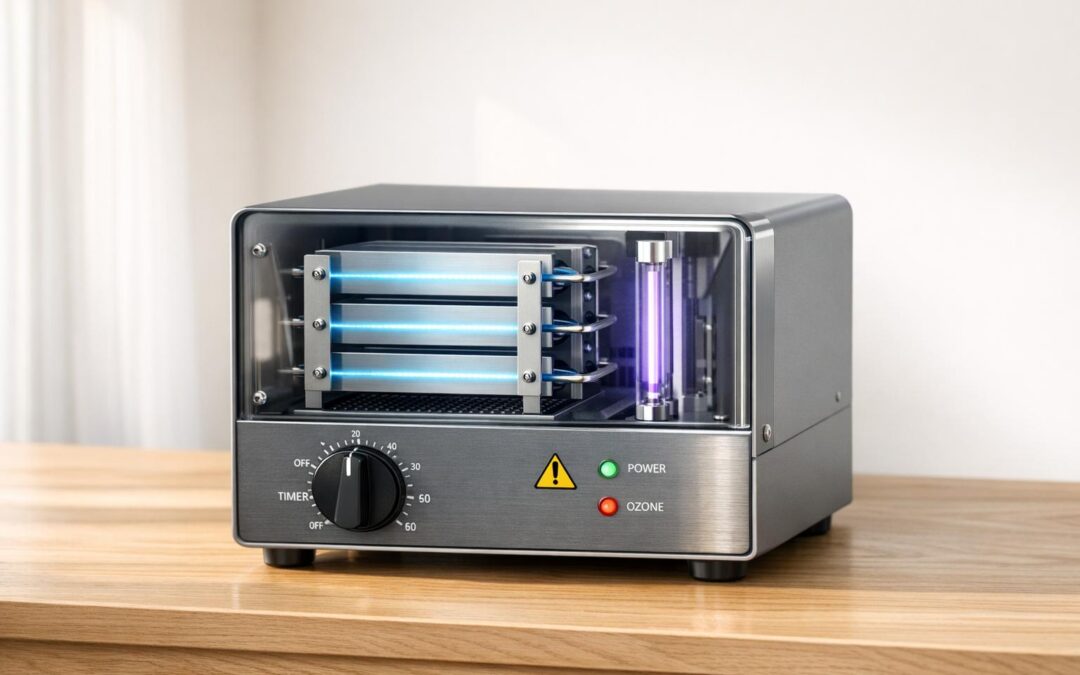
Ozone generators create ozone (O₃), a gas used to clean air, remove odors, and kill bacteria, mold, and viruses. These machines work by converting oxygen (O₂) into ozone using either high-voltage electricity (corona discharge) or ultraviolet (UV) light. Ozone’s reactive nature allows it to break down contaminants at a molecular level, making it effective for odor removal and disinfection. However, ozone is unstable and can be harmful if not used correctly.
Key Points:
- How They Work: Ozone generators use corona discharge or UV light to produce ozone on-site.
- Applications: Commonly used for odor removal, mold remediation, and air disinfection in unoccupied spaces.
- Safety: Spaces must be vacated during use, and proper ventilation is needed after treatment.
- Limitations: Not effective against synthetic odors; prolonged exposure can damage materials like rubber and plastics.
Ozone generators are powerful tools, but they require careful handling to ensure safe and effective results.
The Science of Ozone and Oxidation
What Is Ozone?
Ozone (O₃) is a molecule made up of three oxygen atoms. Its structure, with an extra oxygen atom loosely attached, makes it inherently unstable and highly reactive.
"The extra oxygen atom makes ozone highly reactive. It’s unstable and readily seeks to revert back to its more stable diatomic form (O₂)." – The Institute for Environmental Research and Education
This instability drives ozone to interact aggressively with other substances as it tries to shed that third atom. At low concentrations, ozone is colorless, but at higher levels, it can appear faintly blue. That distinct, fresh scent you notice after a thunderstorm? That’s ozone, naturally created by lightning.
How Oxidation Works
Ozone’s third oxygen atom doesn’t just drift away – it actively bonds with contaminants like bacteria, mold spores, and odor-causing gases. This process, called oxidation, disrupts the structure of these substances, effectively neutralizing them.
Here’s how it works: when ozone encounters something like phenol gases from smoke, it breaks them down into simpler, odorless compounds. Similarly, it damages the cell walls of bacteria and viruses, rendering them unable to survive or reproduce.
Ozone’s oxidizing power isn’t just theoretical – it’s measurable. With a redox potential of +2.07 V, it’s the second strongest oxidizer available, surpassed only by fluorine. For comparison, chlorine, widely used for disinfection and water treatment, has a redox potential of just 1.36 V.
These chemical properties highlight the importance of understanding the differences between naturally occurring ozone and the controlled ozone used in purification processes.
Natural Ozone vs. Controlled Ozone
Ozone plays different roles depending on where it’s found. In the stratosphere, it forms a protective layer that shields the Earth from harmful UV rays. At ground level, however, ozone behaves very differently – it’s a component of smog and can irritate the respiratory system.
Controlled ozone, on the other hand, is purposefully generated for specific tasks like biological odor removal, mold remediation, and disinfection. This type of ozone is produced at high concentrations – often exceeding 5,000 mg per hour – using specialized generators in unoccupied indoor spaces. The table below highlights the distinctions between these three types of ozone:
| Feature | Natural (Stratospheric) | Ground-Level (Smog) | Controlled (Generated) |
|---|---|---|---|
| Source | UV sunlight, lightning | Vehicle/industrial emissions | Corona discharge, UV lamps |
| Location | Upper atmosphere | Lower atmosphere | Indoor enclosures |
| Purpose | UV protection | Unintended byproduct | Odor removal, disinfection |
| Safety | Safe and essential | Hazardous pollutant | Hazardous if space is occupied |
It’s worth noting that ozone can react with certain volatile organic compounds (VOCs) indoors, sometimes producing secondary byproducts like formaldehyde. This underscores the need for careful handling during controlled ozone treatments – a topic that will be explored further in this guide.
sbb-itb-5fea4da
How Ozone Generators Work
While ozone is highly effective, it’s important to compare ozone and hydroxyl systems to see which technology fits your specific environment.
How Ozone Generators Produce Ozone
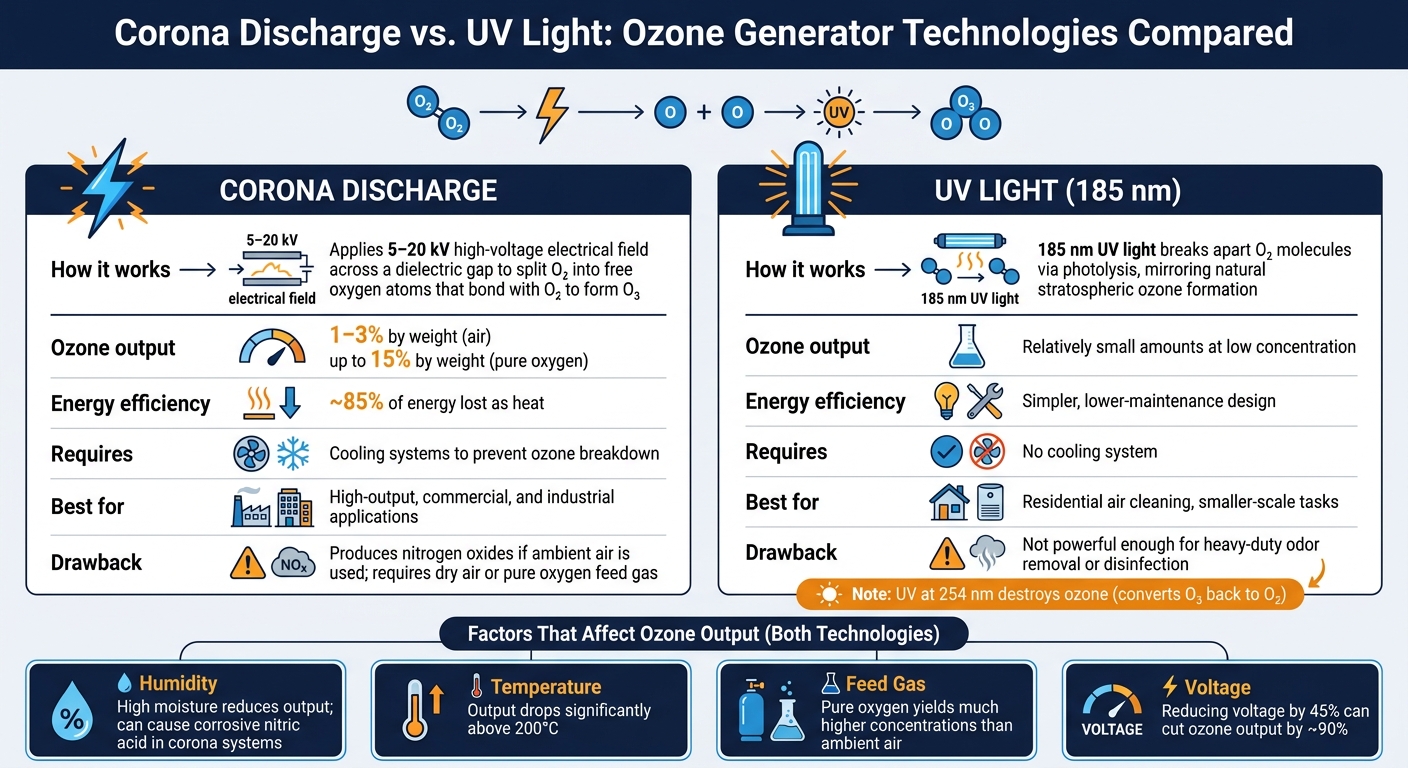
Corona Discharge vs. UV Light: Ozone Generator Technologies Compared
Ozone isn’t something you can bottle up and ship – it’s too unstable and breaks down quickly. Because of this, ozone has to be made on-site, ensuring it’s ready to tackle air cleaning and odor removal. Ozone generators do this by transforming ordinary oxygen (O₂) from the air into ozone (O₃) using one of two main methods: corona discharge or ultraviolet (UV) light.
Corona Discharge Technology
Corona discharge mimics what happens naturally during a lightning strike. By applying a high-voltage electrical field – usually between 5 and 20 kV – across a narrow gap containing a dielectric material, oxygen molecules (O₂) are split into individual atoms. These free oxygen atoms then bond with other O₂ molecules to form ozone (O₃).
"Ozone generators use high voltages or UV light to create ozone artificially by decomposing oxygen molecules into individual oxygen atoms. These radicals can then combine with oxygen molecules to form ozone (O₃)." – Absolute Ozone
This method is widely used for high-output systems. It can produce ozone concentrations of 1% to 3% by weight from clean, dry air and up to 15% by weight when using pure oxygen. However, it comes with a drawback: about 85% of the energy used in a corona discharge reactor is lost as heat, which can speed up ozone breakdown. To counteract this, cooling systems are often necessary.
For simpler, lower-maintenance needs, UV technology offers an alternative.
Ultraviolet (UV) Technology
UV-based ozone generators take a different approach. They use lamps that emit light at a wavelength of 185 nanometers, which has just the right amount of energy to break apart oxygen molecules through a process called photolysis. This process mirrors how ozone is naturally formed in the Earth’s stratosphere.
"Ozone generation by radiation only depends on the spectrum (and power) of the lamp. There is also a dependency on moisture (humidity), oxygen concentration and temperature." – Holger Claus, Vice President of Technology, Ushio America, Inc.
While UV technology is simpler and easier to maintain, it’s not as powerful. As Bob Smith-McCollum, Vice President of Marketing at Pacific Ozone, explains: "Ozone generators based on UV radiation typically produce relatively small amounts of ozone at a very low concentration.". This makes UV systems better suited for smaller-scale tasks like residential home sanitization rather than heavy-duty odor removal or disinfection. This high-output capability is essential for ozone disinfection for event spaces and large commercial venues.
Interestingly, UV light at 254 nm does the opposite of its 185 nm counterpart – instead of creating ozone, it breaks it down back into oxygen.
Factors That Affect Ozone Output
No matter which technology is used, several factors can influence how much ozone a generator produces:
| Factor | Effect on Output |
|---|---|
| Humidity | High moisture levels reduce ozone production and can lead to the formation of corrosive nitric acid in corona discharge systems. |
| Temperature | Higher temperatures speed up ozone decomposition. Output drops significantly above 200°C. |
| Feed gas | Using pure oxygen instead of ambient air (which is about 21% oxygen and 80% nitrogen) results in much higher ozone concentrations. |
| Voltage | Lowering the applied voltage by 45% can reduce ozone output by nearly 90%. |
The type of feed gas is particularly crucial in professional-grade systems. When ambient air is used, the nitrogen it contains can react in the discharge chamber, creating nitrogen oxides – unwanted byproducts that lower purity and can harm equipment. To avoid this, high-output systems often rely on dried air or concentrated oxygen.
How Ozone Generators Clean Air and Remove Odors
The Treatment Process
Ozone’s strong oxidizing properties make it highly effective for tackling common indoor odors and contaminants. Here’s how the process works: the ozone generator is placed in a sealed area, where it releases ozone that spreads throughout the space. This gas penetrates even the tiniest fibers and crevices, targeting hard-to-reach areas. Once the treatment cycle is complete, the area must remain unoccupied for at least 1 to 2 hours, allowing the ozone to naturally break down into oxygen before it’s safe to re-enter.
What Happens When Ozone Meets Contaminants
Ozone (O₃) is inherently unstable, constantly seeking to shed its extra oxygen atom and revert to oxygen (O₂). When this free atom encounters odor-causing compounds – like phenols from cigarette smoke – it reacts with them, breaking apart their molecular structure. This process doesn’t mask odors; it eliminates them at their source.
"Ozone cleaning… works by utilizing ozone (O3), a powerful oxidizing agent, to break down odor molecules, bacteria, viruses, mold, and other organic contaminants at their source." – The Institute for Environmental Research and Education
Beyond odors, ozone’s oxidation process also damages the cell walls of bacteria, mold spores, and viruses, effectively neutralizing them. Additionally, corona discharge generators produce negative ions, which cause airborne particles like dust and allergens to clump together and settle, further improving air quality.
Understanding these chemical reactions helps clarify both the benefits and the limitations of ozone treatment.
Strengths and Limitations of Ozone Treatment
Ozone treatment is excellent for eliminating organic odors – think tobacco smoke, pet smells, or mold – and leaves no residue behind. However, it has its limitations. The space must remain unoccupied during treatment, and prolonged exposure to ozone can damage materials like rubber or certain plastics. It’s also not a permanent solution for mold unless the source of moisture is addressed.
| Factor | Detail |
|---|---|
| Occupancy | The area must be vacated by people, pets, and plants during treatment. |
| Material sensitivity | Long-term exposure can degrade rubber, specific plastics, and other delicate materials. |
| Mold recurrence | Kills active mold spores but won’t stop regrowth if moisture issues persist. |
| Synthetic odors | Less effective against synthetic chemicals or strong artificial fragrances. |
While ozone is a powerful tool for sanitization and odor removal, it works best when paired with other measures to address underlying problems, such as moisture control or structural repairs.
How to Use Ozone Generators Safely
Health and Safety Considerations
When using ozone generators, safety should always come first. Ozone, while effective, is a strong oxidizer that can irritate the respiratory system at high concentrations. Symptoms like coughing, chest tightness, and difficulty breathing can occur, especially for individuals with asthma, heart disease, or other respiratory issues.
Ozone can also interact with common household chemicals, such as those found in pine or citrus-based cleaners, to produce harmful byproducts like formaldehyde and ultrafine particles. The California Air Resources Board warns:
"Ozone has been found to react with existing chemicals in the air to create additional toxic pollutants, most notably formaldehyde and ultrafine particles."
Additionally, high levels of ozone may temporarily impair your sense of smell, making it harder to detect lingering unsafe concentrations.
Best Practices for Safe Use
A critical safety rule is simple: never use an ozone generator in an occupied space. Ensure that all people, pets, and plants are removed before starting the unit. Commercial-grade ozone generators can release over 5,000 mg of ozone per hour, which can quickly surpass safe exposure limits.
Before using ozone, address the root cause of the issue. For example, clean up mold, identify and remove odor sources, or control moisture levels to enhance the effectiveness of the treatment. This can also help minimize the amount of ozone required. Always adhere to the manufacturer’s guidelines on run time and room size – exceeding these recommendations won’t improve results and could increase risks. For more complex or persistent problems, professional services like Ozonated Cleaning LLC may be a better option.
Ventilating the Space After Treatment
After completing an ozone treatment, proper ventilation is crucial to ensure the area is safe to re-enter. Ozone naturally breaks down into oxygen, with a half-life of about 20 minutes. However, residual ozone and secondary pollutants can linger, especially in poorly ventilated spaces.
To speed up the dissipation process, open windows and use exhaust fans to circulate fresh air. The New York State Department of Health emphasizes the risks of secondary reactions:
"Ozone can react with other chemicals in the air to produce additional chemicals and fine particles that can also be irritating to the eyes, nose, throat and lungs."
Continue ventilating the area until all traces of ozone and byproducts have cleared. Depending on the intensity of the treatment and the room’s size, it’s wise to wait through several ozone half-life cycles before re-entering. When in doubt, allowing extra time is always the safer choice.
Professional Ozone Treatment Services
Why Professional Ozone Applications Matter
While ozone generators can be effective tools, professional treatments take things to the next level by ensuring thorough odor and contaminant removal. DIY units might help with smaller, surface-level issues, but they often fall short when it comes to addressing the root causes of odors or reaching every corner of a space. Professional ozone applications go beyond simply releasing ozone – they target both the contamination itself and any underlying issues that contribute to it.
Trained technicians meticulously prepare the area, ensuring the treatment penetrates every nook and cranny. Whether it’s a compact vehicle or a sprawling 10,000-square-foot office, professional-grade equipment ensures complete coverage in a single session. This level of precision and care is what sets local services like Ozonated Cleaning LLC apart.
Ozonated Cleaning LLC: Local Ozone and Hydroxyl Services
Ozonated Cleaning LLC, based in Chicagoland, specializes in professional ozone and hydroxyl treatments. Their services cater to a wide range of spaces, from residential homes and commercial facilities (like hotels, gyms, and restaurants) to vehicles, including cars, RVs, and boats.
Their approach combines two powerful technologies: ozone, which oxidizes and neutralizes odor compounds, and hydroxyl radicals, which have been shown to eliminate bacteria, viruses, and fungi with a 99.99% kill rate, as confirmed by research from Kansas State University. The process is entirely chemical-free – no sprays, perfumes, or masking agents are used. Instead, ozone and hydroxyl radicals naturally break down into oxygen and water vapor, leaving no harmful residues behind.
Clients often report results that far surpass anything they’ve achieved with DIY methods. For example, Jordan F. shared:
"They did more to remove some pet odors I’ve been dealing with than anything I’ve tried so far."
Similarly, Giedre G., who struggled with a persistent "old house" smell, remarked:
"When I bought the house it had specific ‘Old house’ smell. I tried many things but nothing was working… After 8 hours the smell is eliminated."
Ozonated Cleaning LLC serves Chicago and its surrounding suburbs, including Naperville, Aurora, Joliet, Schaumburg, and Evanston. Their service area even extends into parts of Northwestern Indiana and Southeastern Wisconsin. By focusing on targeted ozone treatments, they help create cleaner, fresher spaces while significantly improving indoor air quality.
Conclusion: Understanding Ozone Generators and Their Uses
Ozone generators work by producing reactive O₃, which targets and neutralizes odor-causing compounds, bacteria, viruses, and pollutants. Whether created through corona discharge or UV radiation, ozone leaves no chemical residue behind.
To use them safely, it’s crucial to vacate the area being treated, eliminate the odor source beforehand, and ensure proper ventilation before returning. The EPA recommends keeping indoor ozone levels below 0.05 ppm. Generally, spaces treated with ozone can be safely re-entered within 24 hours after a professional application.
For minor odor issues, a consumer-grade ozone generator might do the trick. But for larger areas, persistent smells, or concerns about pathogens, professional-grade systems are far more effective. These industrial systems can handle spaces ranging from small vehicles to commercial properties as large as 10,000 square feet in a single session.
If you’re facing tough odors or contamination, professional treatment offers a thorough and efficient solution. For those in the Chicagoland area, Ozonated Cleaning LLC provides expert ozone and hydroxyl treatments for homes, businesses, vehicles, RVs, and boats. Their chemical-free approach combines ozone’s oxidizing power with hydroxyl technology to address odors and pathogens at their source.
Knowing how ozone generators work and following proper procedures ensures safe and effective results, especially for large-scale or challenging applications.
FAQs
How do I know what ozone generator size I need for my room?
To pick the right ozone generator, start by calculating your room’s total volume. Simply multiply the room’s length, width, and height. Most consumer ozone generators are labeled by the square footage they cover, typically ranging from under 1,000 sq. ft. to over 4,000 sq. ft.. Make sure the generator is suitable for your space – this helps avoid the risks of over-treating.
If you’re looking for professional-grade odor removal or disinfection, Ozonated Cleaning LLC provides expert services tailored to a variety of spaces.
How long should I wait before re-entering after an ozone treatment?
After using an ozone generator, it’s important to wait at least two hours before re-entering the space. This allows the gas to dissipate completely. For larger treatments, some manufacturers recommend waiting between 12 and 24 hours to ensure safety. While ozone usually breaks down into oxygen within 30 to 60 minutes, the two-hour window provides an extra layer of precaution. During both the treatment and ventilation phases, make sure the area remains free of people, pets, and plants.
Can ozone treatments create formaldehyde or other harmful byproducts?
Yes, ozone treatments can lead to harmful byproducts when ozone interacts with specific chemicals in the air. For instance, ozone reacts with volatile organic compounds (VOCs) – commonly present in household cleaners, air fresheners, and personal care items – to create secondary pollutants like formaldehyde. Formaldehyde is a recognized carcinogen and can irritate the respiratory system. Other potential byproducts include aldehydes, ketones, organic acids, and ultrafine particles, all of which can cause irritation to the eyes, nose, throat, and lungs.
Recent Comments