
If people need to stay in the space, I’d choose hydroxyl over ozone. That’s the short answer.
Here’s why:
- Hydroxyl can run in occupied spaces
- Ozone requires people, pets, and plants to leave
- Hydroxyl is gentler on electronics, rubber, leather, and artwork
- It can keep treating odors for 3 to 7 days
- Ozone is faster, but it often needs only 2 to 4 hours in an empty space
- Ozone shock treatments can reach 8–12+ ppm
- Hydroxyl systems run at levels well under 1 ppm
So when I compare the two, the tradeoff is simple: hydroxyl is slower, but easier to use in places that need to stay open. Ozone still has a place, especially for hard-hit, vacant spaces. But if uptime, safety, and material care matter most, hydroxyl usually makes more sense.
Quick Comparison
| Factor | Hydroxyl | Ozone |
|---|---|---|
| People in the space | Yes | No |
| Typical run time | 3–7 days | 2–4 hours |
| Re-entry delay | None in normal use | 30–60 minutes after treatment |
| Effect on materials | Gentler | Can wear down some materials |
| Best use | Occupied homes, cars, and businesses | Empty spaces with strong odor |
If you’re deciding between them, I’d keep it simple: use hydroxyl when the space stays in use, and ozone when the space can be cleared out.
What Is The Real Difference Between Hydroxyl and Ozone?
sbb-itb-5fea4da
Hydroxyl vs. Ozone: The Basics
Ozone generators make ozone (O₃) using corona discharge or UV light. They remove odors through oxidation. That extra oxygen atom reacts with odor molecules and breaks them down at the chemical level. The catch is simple: ozone treatment levels are not safe to breathe, so these machines have to be used in empty spaces. They work fast, which is why they’re often used for severe smoke damage, biohazard remediation, and vehicle reconditioning.
Hydroxyl generators work differently. They use UV-C light, a titanium dioxide catalyst, and humidity to produce hydroxyl radicals. Those radicals break down odors and VOCs into simpler byproducts. This process is also effective when testing hydroxyl technology against pathogens on surfaces. And because hydroxyl radicals vanish almost right away, they don’t build up in the air. That’s the reason hydroxyl systems can improve indoor air quality in occupied spaces.
Both tools go after the same main issue: bad air and stubborn odor molecules. The differences in how they work set up the five benefits below.
1. Safer for Occupied Spaces
The biggest difference comes down to one thing: do people need to leave the space or not?
With ozone, they do. Ozone shock treatments hit concentrations of 8–12+ ppm, which is high enough to irritate the respiratory system and harm people and pets. And the risk doesn’t end when the machine turns off. The area still needs 30 to 60 minutes of ventilation before it’s safe to go back in. That’s a big deal in homes, businesses, and vehicles that can’t be fully emptied.
Hydroxyl generators are different. They operate at levels far below 1 ppm. Hydroxyl radicals also vanish almost right away, so they don’t build up in the air. Dr. Araps, Ph.D. in Organic Chemistry, notes that atmospheric hydroxyls do not penetrate beyond the body’s outer layers.
That difference shows up fast in day-to-day use. A business doesn’t need to stop work. A homeowner doesn’t need to stay somewhere else. Restoration crews can even keep working in the same area while the machine is running.
There is a trade-off, though. Hydroxyl treatments usually run 3 to 7 days, while ozone shock treatments take 2 to 4 hours. So yes, hydroxyl is slower. But for occupied spaces, that slower pace is what lets people keep using the space without interruption.
2. Chemical-Free, Low-Residue Sanitization
Hydroxyl adds no chemicals and no fragrance. Instead, it uses UV light and a TiO2 catalyst to produce reactive hydroxyl radicals. Those radicals break down odor molecules and VOCs rather than just covering them up.
The byproducts are mostly carbon dioxide and water. And the radicals vanish almost at once, so they don’t leave behind a lasting smell or residue. That’s a big part of why hydroxyl works well in delicate interiors.
Ozone is different. It can leave behind a metallic or oxidized odor after treatment. Hydroxyl avoids the leftover smell people often connect with ozone.
This also affects the items inside the space. Ozone can bleach wet materials and wear down natural rubber, latex, and some plastics over time. Hydroxyl is gentler on sensitive materials, including electronics, leather, and artwork. If you’re dealing with a space filled with high-value contents, that matters.
That low-residue profile is a major reason hydroxyl fits sensitive spaces so well. It also helps the system run continuously without disrupting the space.
3. Continuous Odor and VOC Reduction
Longer run time matters most when odors keep coming out of deep inside materials. It gives hydroxyl radicals more time to break down odors as they slowly release from porous surfaces like carpet, drywall, insulation, and upholstery.
That steady treatment is helpful when odors come back after the first cleaning. Smoke, protein residues, pet odors, and mold-related VOCs can keep off-gassing long after a space looks clean. Hydroxyl radicals continue breaking down those compounds as they emerge, which can help cut down on odor return. That low-residue, continuous action works well in spaces that need a gentler approach over time.
Humidity also affects hydroxyl output because the process uses water vapor. When the air is dry, output can drop. Adding humidity support can help keep performance more consistent.
4. Better Compatibility With Furnishings, Materials, and Electronics
That low-residue performance helps protect sensitive items too. Hydroxyl is gentler on materials because it runs at much lower levels than ozone. Ozone shock treatments can hit concentrations that are high enough to damage certain materials.
Natural rubber and latex are hit especially hard. With prolonged ozone exposure, their molecular structure can start to break down, which leads to brittleness and decay. Wet fabrics can also be a problem. Ozone may bleach damp carpet or upholstery, which is a serious issue in spaces with recent water damage or high humidity.
That makes hydroxyl a better fit for contents that can’t be moved, such as rubber, plastic, electronics, artwork, and damp materials. It matters most in furnished spaces where clearing everything out just isn’t an option.
In offices, server rooms, vehicles, RVs, and boats, hydroxyl can treat the space without requiring contents to be removed. On actual jobs, that can make all the difference.
A smoke-damaged Manhattan condo with a major art collection was treated with hydroxyl generators without damaging the artwork.
5. Stronger Backing From Research and Regulatory Guidance
Published testing and agency guidance point to a clear practical difference between ozone and hydroxyl. Health agencies classify ozone as a treatment for unoccupied spaces, while hydroxyl is meant for occupied use when used as directed to eliminate various odor types.
That gap isn’t just a matter of marketing language. It’s backed by third-party testing from Underwriters Laboratories, the Lovelace Respiratory Research Institute, and Comparative Biosciences. A 13-week FDA GLP study in rats, conducted under FDA GLP guidelines, also found no adverse effects from hydroxyl exposure.
Some hydroxyl systems also have FDA Class II medical-device clearance for occupied use.
Post-fire testing adds another useful data point. In that testing, hydroxyl reduced contaminants to low parts-per-billion levels in under 8 hours, which falls within OSHA safety limits.
When to Choose Hydroxyl Over Ozone
The five points above make the choice pretty straightforward: pick hydroxyl generators for air quality when the space needs to stay occupied.
Hydroxyl works well for places with people still inside, items that need a gentler approach, and jobs that call for longer treatment times. It also makes sense in spaces that can’t be cleared out. Ozone is a better fit for fully vacant areas that need a short, strong treatment. With ozone, everyone has to leave first, and re-entry has to wait.
For severe cases, a two-step plan can work well: use ozone first while the space is empty, then switch to hydroxyl after people return to help deal with lingering odors.
Here’s a quick guide to match the method to the job.
| Situation | Better Choice |
|---|---|
| Occupied space | Hydroxyl |
| People, pets, or plants present | Hydroxyl |
| Sensitive electronics or fine art | Hydroxyl |
| Continuous treatment needed | Hydroxyl |
| Severe odor in a vacant space | Ozone |
| Post-fire shock treatment before re-entry | Ozone, then Hydroxyl |
Hydroxyl and Ozone: Side-by-Side Comparison
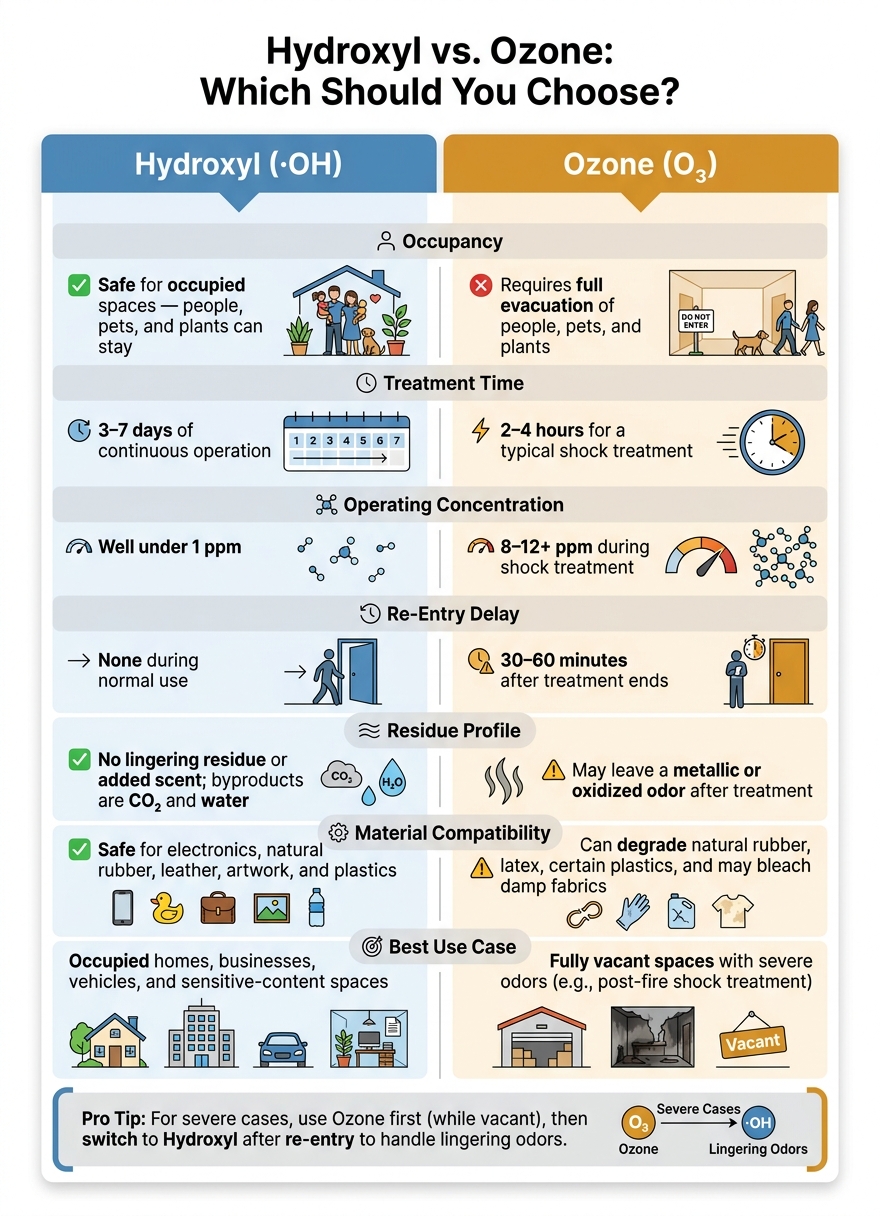
Hydroxyl vs. Ozone: Side-by-Side Comparison
Use this quick comparison to see where hydroxyl makes more sense than ozone in specific settings like restrooms.
| Factor | Hydroxyl (·OH) | Ozone (O₃) |
|---|---|---|
| Occupancy | Safe for occupied spaces – people, pets, and plants can stay | Requires full evacuation of people, pets, and plants |
| Treatment Time | 3–7 days of continuous operation | 2–4 hours for a typical shock treatment |
| Residue Profile | No lingering residue or added scent | May leave an ozone smell |
| Material Compatibility | Safe for electronics, natural rubber, leather, artwork, and plastics | Can degrade natural rubber, latex, and certain electronics with prolonged exposure |
| Health Considerations | Designed for occupied use when used as directed | Requires evacuation during treatment |
| Humidity Requirement | Requires ambient humidity to generate radicals | Less dependent on added humidity |
In plain terms, the big tradeoff is simple: hydroxyl is slower but can run around people and sensitive materials, while ozone is faster but needs an empty space and more caution. This is a core safety protocol in any guide to home odor removal with ozone.
That practical gap is why occupancy and material safety usually drive the decision.
Conclusion
Hydroxyl’s strengths are pretty simple: it’s safer around people, leaves no residue, can run nonstop in occupied spaces, is gentler on sensitive materials, and fits spaces that need to stay in use.
The tradeoff is time. Hydroxyl works more slowly, but that slower pace is exactly why it can be used in occupied spaces. For occupied homes and businesses, hydroxyl is usually the better fit. It’s the practical option when uptime matters. Choose hydroxyl when people need to stay in the space and materials need to be protected.
FAQs
How do I know whether hydroxyl or ozone is right for my space?
It mostly comes down to one thing: can the space be empty during treatment? Ozonated Cleaning LLC uses both options, so the approach can match what the job calls for.
Choose ozone when you need fast, heavy-duty odor removal or deep sanitizing and the area can be fully vacated.
Choose hydroxyl when people need to stay in the space. It’s safe for people, pets, and plants, and it won’t damage delicate belongings.
Why does hydroxyl take longer to remove odors than ozone?
Hydroxyl radicals last less than two seconds. That means they need to be made and distributed nonstop if you want them to keep doing their job.
At the molecular level, they break down odor molecules fast. But the treatment itself is more gradual and steady. Ozone shock treatments are high-intensity and work fast in unoccupied spaces. Hydroxyl treatment, on the other hand, usually takes several days in occupied settings.
Does hydroxyl work on smoke, pet, and mold odors?
Yes. Hydroxyl technology is highly effective at neutralizing smoke, pet, and mold odors because it breaks down the molecules that cause those smells instead of just covering them up.
That matters in the real world. Odors from smoke, pets, and mold often sink deep into porous materials like upholstery, carpets, and even parts of a building’s structure. Hydroxyl technology can help remove those deep-set odors at the source.
Another big plus: it can run continuously in occupied homes and businesses, so treatment doesn’t have to stop daily life or business operations.
Recent Comments