
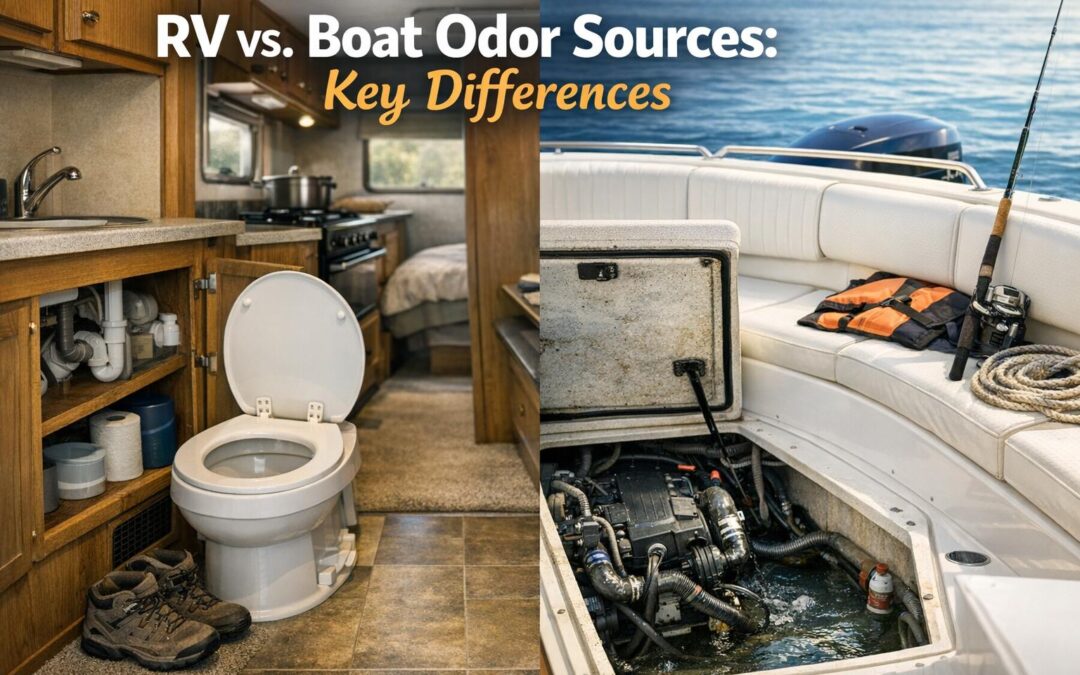
RVs and boats face odor problems due to confined spaces and limited ventilation, but the causes vary. RVs often deal with smells from waste tanks, dry P-traps, and moisture buildup from daily activities. Boats, on the other hand, struggle with odors from bilge water, seawater in waste systems, and decomposing organic material like fish residue. Identifying the source is critical since similar smells can have different origins, such as a "fishy" odor signaling electrical issues in an RV but organic buildup on a boat.
Here’s a quick breakdown of the key differences:
- RVs:
- Waste tanks (black and gray), dry P-traps, and water heater issues.
- Moisture from cooking, showering, and condensation leads to mold.
- Kitchen odors from food residue and ammonia leaks in refrigerators.
- Boats:
- Bilge water mixed with oil, fuel, and debris.
- Stagnant seawater in toilets and permeated hoses.
- Organic buildup in livewells, bait wells, and anchor lockers.
Quick Comparison:
| Category | RV Odor Source | Boat Odor Source |
|---|---|---|
| Waste Systems | Black/gray tanks, dry P-traps | Bilge water, seawater in toilets |
| Moisture Issues | Cooking, showering, condensation | Bilge, shower sumps, AC condensate |
| Organic Residue | Food, household waste | Fish scales, bait, mud, seaweed |
| Key Gas Produced | Hydrogen sulfide (rotten egg smell) | Methane, fuel/exhaust fumes |
To tackle odors, RV owners should focus on waste system maintenance and reducing indoor moisture, while boat owners should prioritize cleaning bilges and managing seawater-related issues. Ozone treatments can help neutralize persistent smells in both environments.
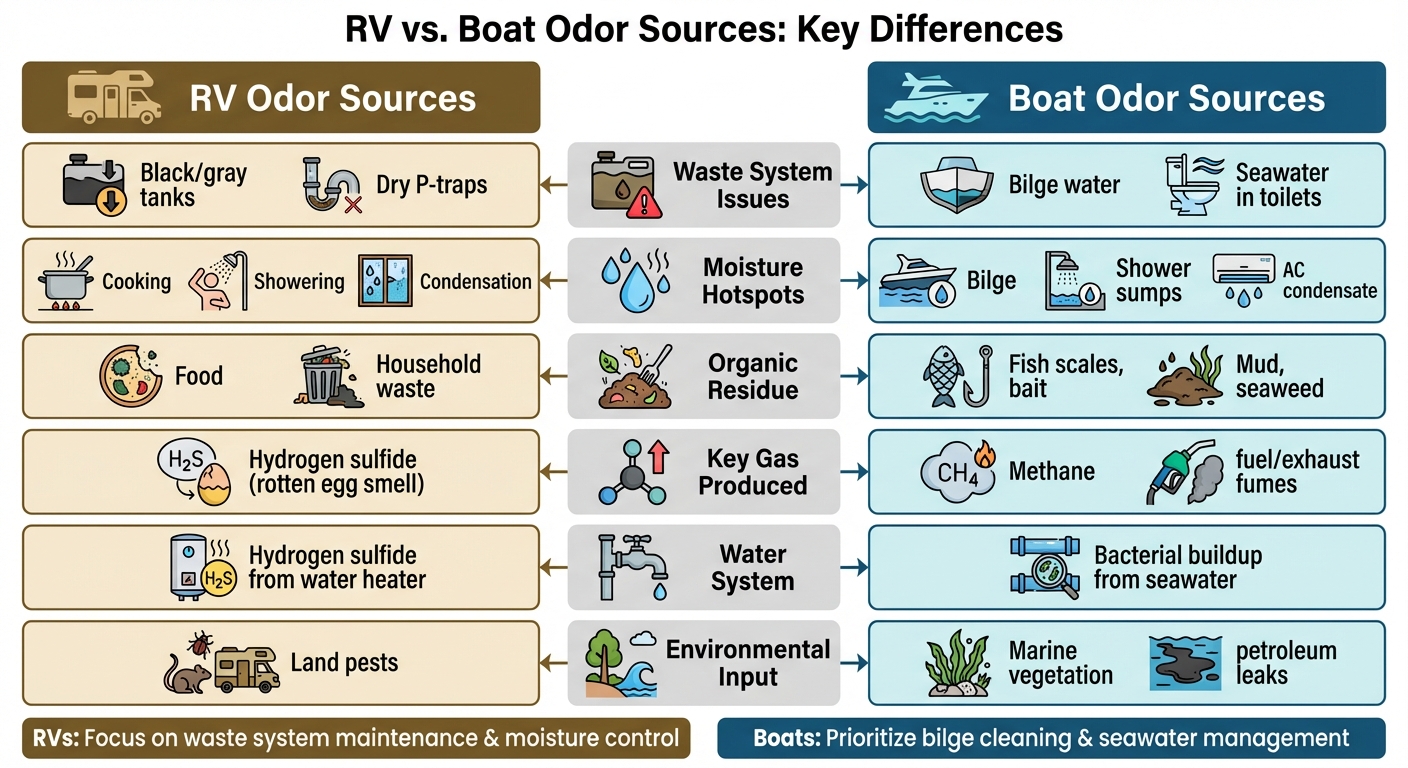
RV vs Boat Odor Sources Comparison Chart
RV Odor Sources
Holding Tanks and Waste Systems
One of the main culprits behind unpleasant RV odors is the black water tank. This tank harbors anaerobic bacteria, which release hydrogen sulfide and methane gases – the intensity of these odors increases when temperatures rise above 85°F. To keep odors under control, it’s recommended to empty the black water tank when it’s about two-thirds full. This ensures a more thorough cleaning process.
"Anaerobic bacteria (from your gut) produce all the foul-smelling gases (hydrogen sulfide and methane) that come from your RV toilet, while aerobic bacteria… produce carbon dioxide and water." – Unique Camping + Marine
Another common issue is a dry P-trap, which occurs when water evaporates from unused sinks or showers, allowing gases from the tank to seep into the RV. Simply pouring water into the drain can restore the seal and block odors. Additionally, a malfunctioning water heater, often due to anode rod breakdown, can produce a rotten egg smell. Running water for 10 seconds during flushes helps maintain a barrier and reduce this odor.
Beyond waste systems, excess moisture inside the RV can make odor problems even worse.
Moisture and Mold Problems
Everyday activities like cooking, showering, and even breathing introduce moisture into the compact space of an RV. Because RVs often have thin walls and are parked outdoors, condensation forms when warm indoor air meets cooler surfaces.
"Moisture and humidity are your worst enemies in a camper. When things are sealed up tight moisture and humidity build up from cooking, showers, windows, and even breathing." – OHI
This buildup of moisture creates the perfect environment for mold and mildew to thrive, especially in dark, damp areas like under sinks, inside furniture cushions, and within the RV’s structural frame. To combat this, installing vent covers allows for airflow even during rainy weather. Additionally, using campground bathhouses for showers and cooking outside helps minimize steam and humidity inside the RV. Placing desiccants, silica gel packs, or activated charcoal in closets can also help absorb excess moisture.
Kitchen and Food Storage Problems
Cooking in the confined space of an RV can quickly fill the air with strong odors, while trapped steam can encourage mold growth. Food particles and grease that go down the kitchen sink can rot in the P-traps or the gray water tank, leading to unpleasant, garbage-like smells. Unlike the black tank, the gray tank needs cleaning more frequently – about every two weeks – because soapy water and food debris decompose quickly.
RV refrigerators can also be a source of sharp chemical odors, often caused by ammonia-based refrigerant leaks. These leaks are typically accompanied by yellow residue near the fridge. To prevent moisture buildup while cooking, always run exhaust fans and open windows for cross-ventilation. For clogged or smelly drains, a simple solution involves pouring 1/4 cup of baking soda and 1/2 cup of white vinegar down the drain, letting it fizz for 15 minutes, and then flushing with boiling water. Lastly, hidden spills around trash bins should be cleaned regularly to avoid lingering odors.
How to prevent and eliminate RV and boat holding tank odors? Odorlos
Boat Odor Sources
Boats often contend with a unique combination of smells, ranging from petroleum products to decaying organic material. These odors are notably different from those found in RVs due to the marine environment and the systems onboard.
Bilges and Petroleum Leaks
The bilge, the lowest section of a boat’s hull, is a catch-all for various fluids and contaminants. Unlike the sealed holding tanks in RVs, bilges collect a messy mixture of water, engine oil, fuel spills, grease, and exhaust residue, creating a potent cocktail of odors. To complicate matters, many boats route shower and icebox drains directly into the bilge, introducing hair, soap scum, and rotting food particles to the mix. This environment becomes a perfect breeding ground for mold and bacteria.
Adding to the problem, a malfunctioning marine battery can release hydrogen sulfide gas, producing a rotten egg smell often mistaken for sewage. Experts suggest using biodegradable cleaning solutions to tackle these issues effectively. However, the best approach to odor control is keeping the bilge completely dry after pumping – using towels, sponges, or a wet/dry vacuum can help achieve this.
But bilges aren’t the only culprits when it comes to unpleasant boat smells. Marine waste systems bring their own set of challenges.
Marine Waste Systems
Boat toilets, commonly referred to as "heads", often rely on raw seawater for flushing. This seawater contains billions of microorganisms, which begin to decay inside the intake hoses and around the bowl rim, generating strong odors.
"Fresh water contains billions of microorganisms… once pumped into the holding tank… these microorganisms start to die and decay and are generally the biggest cause of the bad smell." – Practical Sailor
Marine sanitation expert Peggie Hall highlights that stagnant seawater in the head intake system exacerbates these odors. Regular use of the toilet helps flush out decaying organisms, keeping smells at bay. The intensity of these odors can depend on location – shallow, warm waters like the Chesapeake Bay tend to produce stronger smells compared to deeper, colder offshore waters.
Another common issue is hose permeation. Over time, sewage sitting in low spots can seep through the sanitation hose material, leading to persistent odors. A quick "wipe test" with a clean rag on the hose’s outer surface can reveal if it smells of sewage. If it does, it’s time to replace the hose.
In addition to waste systems, organic residues from fishing activities can also contribute to lingering odors.
Fish Residue and Organic Buildup
Livewells, bait wells, and anchor lockers are notorious for collecting fish scales, mud, and marine organisms, all of which decompose quickly and produce strong smells. Anchor rodes, if stored wet, can also become breeding grounds for mold and mildew.
"Your boat’s livewell is a breeding ground for bacteria, which can generate nasty smells. If you don’t clean out the livewell regularly, expect your boat to reek of dead fish." – Boats.net
To prevent these odors, regular maintenance is crucial. Pressure washing livewells after each trip and flushing them with fresh water can help eliminate saltwater bacteria. For anchor lockers, it’s essential to empty them completely, clean with a bleach and water solution, and ensure everything is fully air-dried before storing the rode again. Using specialized marine cleaners with plant-based enzymes can also break down organic residues, addressing the root cause of the smells rather than just masking them.
sbb-itb-5fea4da
RV vs. Boat Odor Sources: Main Differences
When it comes to odor issues, RVs and boats have their own distinct challenges, shaped by their environments and systems. While both deal with odors in confined spaces, the underlying causes are quite different. For RVs, odors often originate from internal moisture and problems in the waste system, like bacterial imbalances in holding tanks or steam from cooking and showering in tight quarters. Boats, on the other hand, face marine-specific problems, such as stagnant bilge water, seawater-based waste systems, and organic buildup from fish residue and bait.
Water systems also play a significant role in odor creation. In RVs, freshwater systems can lead to hydrogen sulfide smells when water heater components react with the water. Boats, however, frequently use seawater for flushing, which can result in bacterial growth in the plumbing system.
"Compared to a house, cleaning aboard boats is complicated by the marine environment, the additional systems that are also more tightly packed, and less frequent use of practically everything." – Environmental Marine
Structural differences further contribute to these odor challenges. Boats have bilges where water, oil, fuel, and organic runoff can collect and stagnate – an issue not found in RVs. RVs, however, may experience odors when dry P-traps in sinks or drains allow tank gases to seep into living spaces. Boats also contend with odors from anchor lockers that trap mud and vegetation, as well as livewells that accumulate fish scales and organic matter. These structural distinctions call for tailored odor management strategies.
Comparison Table: RV vs. Boat Odor Sources
| Category | RV Odor Sources | Boat Odor Sources |
|---|---|---|
| Waste System Issues | Black/grey tank bacterial imbalance, dry P-traps | Bilge stagnation, sanitation hose permeation |
| Water System | Hydrogen sulfide from water heater components | Bacterial buildup from stagnant seawater |
| Moisture Hotspots | Window condensation, bathroom, and kitchen steam | Bilge, shower sumps, AC condensate, hull vents |
| Organic Contaminants | Food waste, household sewage | Fish residue, bait, seaweed, mud in lockers |
| Environmental Input | Land pests | Marine vegetation, petroleum leaks, bilge fuel/oil |
| Key Gas Produced | Hydrogen sulfide (rotten egg smell) | Methane, petroleum/exhaust fumes |
Addressing these unique odor sources requires specific solutions for each type of vehicle. For RV owners, maintaining a healthy bacterial balance in holding tanks and swapping magnesium anode rods for zinc ones can help prevent hydrogen sulfide odors. Boat owners should focus on keeping bilges as dry as possible and inspecting sanitation hoses for odor permeation using a simple "rub test" – wiping the hose with a dry paper towel to detect trapped smells. Tailored approaches like these are essential to managing odors effectively in both environments.
Odor Removal Solutions for RVs and Boats
Ozone Treatment Benefits
Ozone technology offers a chemical-free way to eliminate odors in RVs and boats. Unlike air fresheners that only cover up smells, ozone (O₃) – the world’s second strongest oxidizer – targets odor-causing gas molecules directly, breaking them down and neutralizing the smell at its source.
"Ozone is a highly effective deodorizer because it doesn’t just mask odors – it destroys them at the source." – Susan Duffy, Founder, Queenaire Technologies
What makes ozone stand out is its ability to penetrate deeply into areas that are hard to clean, like cracks, upholstery, and ductwork. This makes it especially effective in tackling odors in RVs and boats, where moisture often creates a breeding ground for bacteria. In fact, ozone generators are proven to eliminate over 99.98% of bacteria. Plus, after about 20 minutes, ozone naturally reverts back to oxygen, leaving no chemical residue behind.
For the best results, start by thoroughly cleaning the interior and ensuring all shampooed surfaces are completely dry. Running the vehicle’s AC on "re-circulate" during the process helps ozone reach internal ductwork. However, it’s crucial to perform ozone treatments in unoccupied spaces – people, pets, and plants must be removed beforehand. After the treatment, ventilate the area for at least 30 minutes with open windows before re-entering.
Ozonated Cleaning LLC Services
Professional services can maximize the benefits of ozone technology, especially in confined spaces like RVs and boats.
Ozonated Cleaning LLC, serving the Chicagoland area, specializes in odor removal for RVs and boats. Their Vehicle Deodorizing service, priced at $150, tackles odors from holding tanks, mold, fish residue, and bilge areas. Custom pricing is available for larger vehicles.
The company uses a combination of ozone and hydroxyl technologies to address various odor issues. While ozone is ideal for unoccupied spaces, hydroxyl technology – often referred to as the "detergent of the atmosphere" – provides a safe alternative for spaces that need to remain occupied. This dual approach ensures effective treatment for moisture-related odors in RVs and persistent smells in boat bilges. Additionally, professional oversight during these treatments helps prevent potential damage to materials like rubber, adhesives, and certain plastics.
Conclusion
RVs and boats each come with their own set of odor challenges. In RVs, odors often stem from bacteria in holding tanks, failing water heater anode rods, or mechanical issues like propane leaks. Boats, on the other hand, typically face smells caused by stagnant bilge water, permeated sanitation hoses, or leftover fish residue. The main distinction lies in how these odors are addressed: RVs usually benefit from chemical or biological treatments to manage tank bacteria, while boats often require mechanical cleaning and replacing odor-absorbing components.
While standard cleaning can tackle surface odors, deeply embedded smells often demand professional solutions. Advanced treatments, like ozone therapy, go beyond masking odors – they neutralize the molecules causing the smell at their source. For example, in Chicagoland, Ozonated Cleaning LLC provides a specialized vehicle deodorizing service for $150, combining ozone and hydroxyl treatments to target odors in both RVs and boats, from holding tanks to bilges.
Pinpointing the source of the odor is key to resolving it effectively. A "rotten egg" smell in an RV might hint at a failing anode rod or propane leak, while the same smell in a boat could point to a permeated sanitation hose. Addressing these root causes not only eliminates the odor but also helps prevent it from returning. By tailoring your approach to your vehicle’s specific needs, you can ensure a fresher, longer-lasting solution.
FAQs
What are the main causes of odors in RVs and boats?
Confined spaces like RVs and boats often come with their own set of odor challenges. In RVs, common culprits include kitchen and food odors, mold or mildew growth, and off-gassing from new furniture or materials. Boats, meanwhile, frequently deal with smells caused by mold and mildew, stagnant bilge water, and leaky plumbing systems. Because both environments are compact and often exposed to moisture, maintaining fresh air through proper ventilation and regular cleaning is key to keeping odors at bay.
How can I control moisture and prevent odors in my RV?
To keep your RV fresh and free from odors, managing moisture is essential. Start by keeping the indoor humidity between 30% and 50% – this range helps prevent mold and mildew, which often lead to unpleasant smells. A digital hygrometer is a handy tool to monitor humidity levels accurately.
Ventilation plays a big role, too. Open windows, use roof vents, or run exhaust fans to boost airflow and cut down on moisture buildup. If you notice any leaks, address them right away and seal up areas where water might sneak in. Pay close attention to spots prone to condensation, like under sinks, around water heaters, or inside storage compartments, and make sure they stay dry.
For a more lasting solution, try moisture absorbers or invest in a small dehumidifier built for tight spaces. These simple steps can go a long way in keeping your RV comfortable and odor-free.
What are the advantages of using ozone treatment to remove odors in RVs and boats?
Ozone treatment offers an efficient way to get rid of stubborn odors in RVs and boats. Ozone (O₃) works by breaking down odor-causing bacteria, mold, and mildew at the molecular level. The best part? It doesn’t leave any harmful residues behind, making it a safe, chemical-free option for enclosed spaces where airflow is limited, and odors tend to stick around.
Not only is ozone treatment safe and eco-conscious, but it’s also quicker and more effective than traditional cleaning methods. It can handle tough smells from cooking, mildew, or even bilge areas, leaving the air fresher and more enjoyable. On top of that, ozone’s ability to eliminate bacteria and viruses adds a layer of sanitation, making it a great all-in-one method to keep your RV or boat clean and odor-free.
Recent Comments