
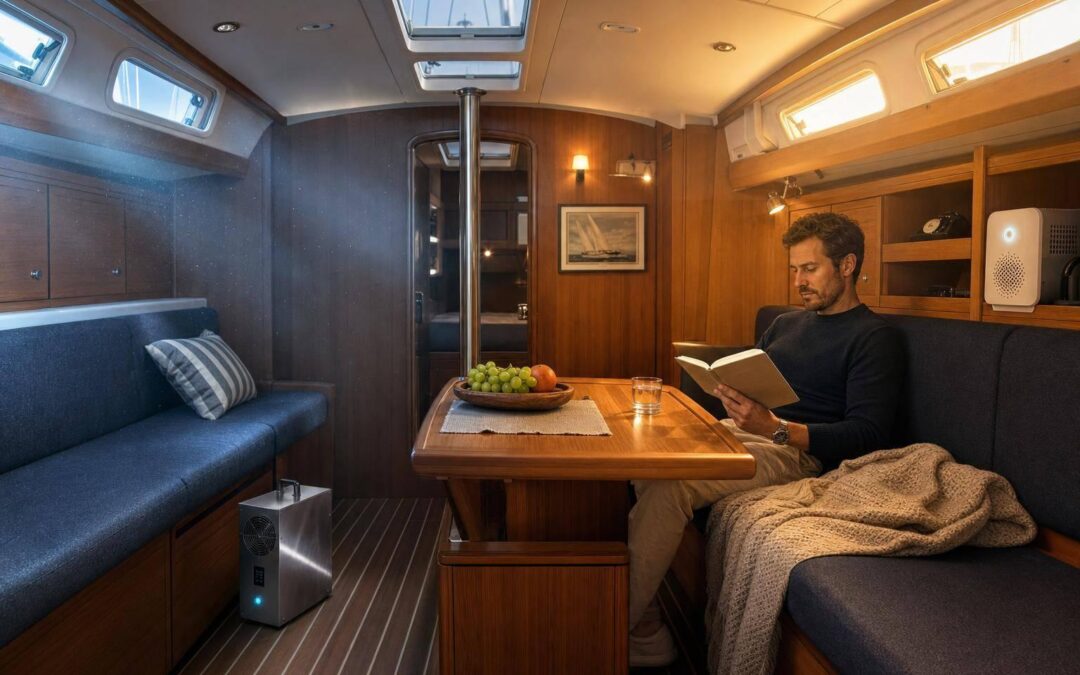
If I need the short answer: I’d pick ozone for heavy boat cabin odors in an empty boat, and hydroxyl for milder odors when people still need to use the cabin.
Boat cabins trap moisture, mildew smells, fuel odors, and stale air fast. This article comes down to three simple questions:
- How bad is the odor?
- Can the cabin stay empty during treatment?
- Am I willing to risk wear on rubber, plastics, and some electronics?
Here’s the core takeaway in plain English:
- Ozone works faster and hits deeper-set odors
- Hydroxyl works more slowly but is safer around people and materials
- Boat cabins often do better when the odor source is fixed first – like bilge water, leaks, mold, or fuel residue
- For moisture control, marine guidance often aims for 40% to 60% relative humidity
- Ozone treatment levels can reach 5 to 10 ppm+ in sealed cabins, far above OSHA’s 0.1 ppm 8-hour limit for people
That means the choice is less about which one is “best” overall and more about which one fits your boat, your odor problem, and whether the cabin must stay usable.
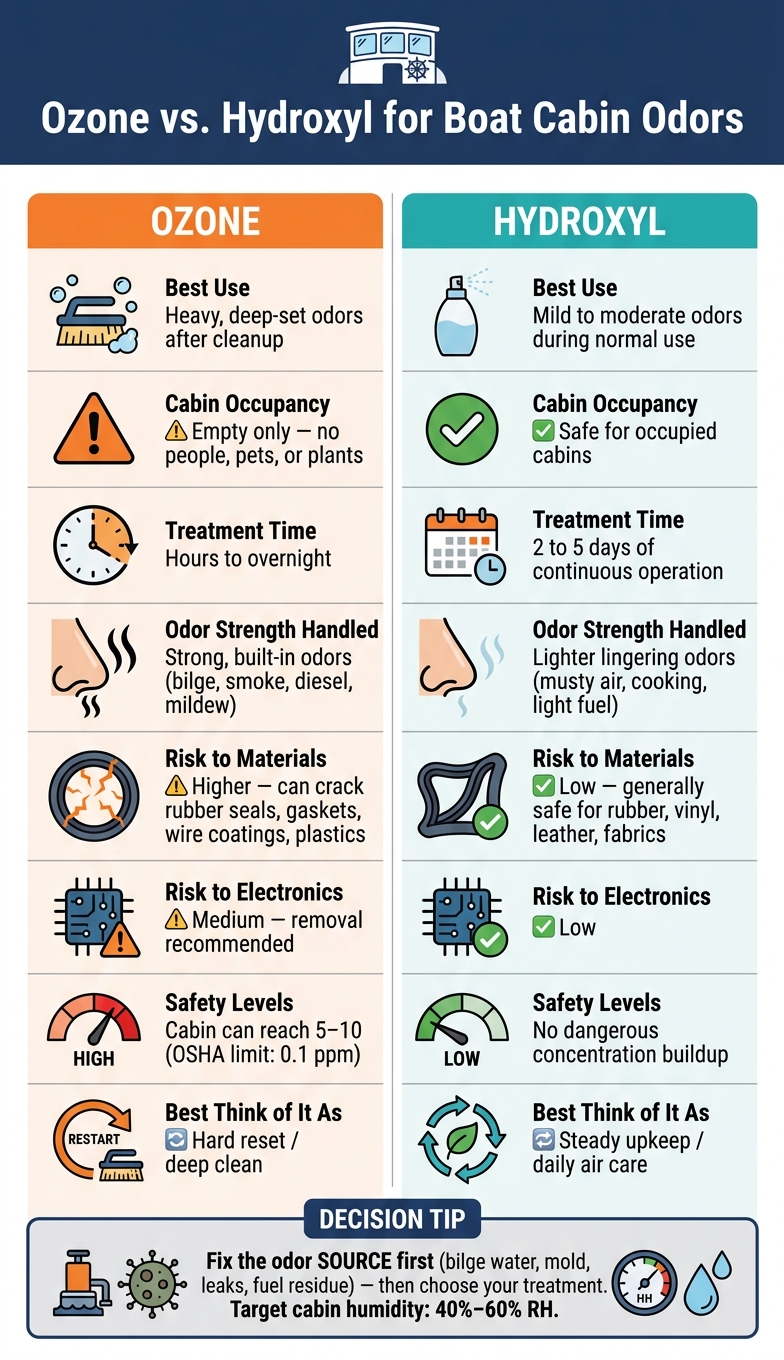
Ozone vs. Hydroxyl for Boat Cabin Odors: Side-by-Side Comparison
How does hydroxyl technology compare to ozone?
sbb-itb-5fea4da
Quick Comparison
| Factor | Ozone | Hydroxyl |
|---|---|---|
| Best use | Heavy odors after cleanup | Mild to moderate odors during normal use |
| Cabin occupancy | Empty only | Usually okay with people present |
| Treatment time | Hours to overnight | 2 to 5 days in many cases |
| Odor strength handled | Strong, built-in odors | Lighter lingering odors |
| Risk to materials | Higher | Lower |
| Risk to electronics | Medium | Low |
| Best for | Bilge, smoke, diesel, mildew set into soft goods | Musty air, cooking smells, light fuel or sewage odor after cleanup |
If I were choosing fast: ozone is the hard-reset option, while hydroxyl is the steady-use option.
Ozone Technology for Boat Cabin Air
For deep odors in an unoccupied cabin, ozone is the strongest option for marine air quality. Ozone (O₃) is a highly reactive gas that moves into porous marine materials and tight spaces like foam cushions, carpeting, headliners, and bilge areas. It breaks down embedded odor sources and contaminants instead of just covering them up.
Where Ozone Works Best in Boats
Ozone works best on stubborn boat odors such as bilge smells, smoke, bait and fish odors, and fuel or oil contamination that sticks around even after the original issue has been fixed. In these cases, surface cleaning usually doesn’t go far enough.
Use ozone only in a sealed, empty cabin. When you close hatches, ports, and doors, you create a treatment zone so the ozone can build up and reach enclosed surfaces. Small cabins may need 1–2 hours. Larger boats with deep odors may need overnight treatment or split sessions. That’s why ozone is so effective – but it’s also why it comes with strict safety rules and material limits.
Safety Limits and Material Risks in Marine Interiors
Ozone needs careful handling. Sealed cabins can hit 5–10 ppm or more during treatment, which is far above OSHA’s 0.1 ppm 8-hour limit and the EPA‘s 0.070 ppm outdoor air standard. At those levels, ozone can cause respiratory irritation, coughing, chest tightness, and asthma flare-ups. No people, pets, or plants should be on board while the generator is running.
There’s also a materials issue. Ozone’s oxidizing action can crack or harden natural rubber and some synthetic rubber seals, gaskets, hoses, and flexible wire insulation over time. Some plastics, foams, and finishes may discolor or weaken with repeated exposure. In humid, salty boat conditions, ozone can also speed up corrosion on metal contacts and circuit boards. Shorter treatment times and keeping generator output away from sensitive equipment can help lower those risks.
What to Expect from an Ozone Treatment on a Boat
Once the generator shuts off, the cabin still isn’t ready right away. Ozone needs time to react and then fade out. A practical minimum is 30–45 minutes of decay time after treatment, followed by 1–2 hours of active ventilation with hatches open, fans running, or HVAC on if available. If that sharp ozone smell is still there – often described as chlorine-like or electrical – seal the cabin again and give it more time.
This is where professional handling can make a big difference, especially on larger or more complex vessels. An experienced service provider will check cabin volume, look for material sensitivities, and set generator output and run time to fit the boat. They can also combine ozone treatment with upstream fixes like bilge cleaning, moisture control, and mold remediation, so the ozone is focused on deep deodorizing instead of trying to fight active contamination.
Hydroxyl Technology for Boat Cabin Air
If ozone is the heavy-duty deep-clean option for an empty cabin, hydroxyl is the safer pick for day-to-day use. Hydroxyl generators create short-lived OH radicals that oxidize various odor types and break them down into simpler byproducts. The big plus: they can run safely in occupied cabins.
Where Hydroxyl Fits Best in Boats
Hydroxyl tends to work best when people are still using the cabin and the odor problem is moderate, not extreme. On boats, that usually means damp or musty smells from bilges, lockers, and soft furnishings that are already clean but still hold odor. It also fits smoke, cooking, or fuel smells in occupied boats where ventilation is limited.
On a boat, that makes safety and material compatibility the main selling point.
Why Hydroxyl Is Better Suited to Occupied Cabins
Its biggest edge is simple: you don’t have to clear out the boat. Hydroxyl systems can run around people, pets, and cabin contents without requiring evacuation. They are also generally safe for common cabin materials and electronics.
For a liveaboard or a cruising boat that’s used often, that’s a big deal. If leaving the vessel empty for treatment isn’t practical, hydroxyl gives you a workable path that doesn’t disrupt daily life as much.
What to Expect from a Hydroxyl Treatment on a Boat
The downside is speed. Most moderate odors take about 2 to 5 days of nonstop operation before they start to fade. So this isn’t the kind of fix you run for a few hours and call done.
For better coverage, place the generator in an open spot near the center of the cabin or close to the HVAC return. Keep it away from direct splashes and let it run continuously. A little air movement from fans or the boat’s HVAC helps carry the radicals into corners, lockers, and soft furnishings that still air won’t reach well.
On multi-cabin boats, it often helps to move the unit partway through the job or use a second device. That’s especially useful for tighter spaces like ducts and lockers, where air circulation can be poor.
One last point matters: hydroxyl helps control odors after cleanup. It doesn’t replace mold removal or water-damage repair.
That sets up the main tradeoff: speed versus safety.
Ozone vs. Hydroxyl: Effectiveness and Safety in Boat Cabins
In a boat cabin, the choice usually comes down to three things: speed, safety, and whether anyone is still using the space.
Which Technology Removes Boat Odors More Effectively
Ozone is the faster pick for odors that have sunk deep into the cabin. If you’re dealing with bilge contamination, mildew trapped in cushions or other soft furnishings, or fuel smells after an incident, ozone can hit hard and work fast.
Hydroxyl works at a slower pace, but that can make more sense for routine cabin use. In a liveaboard or a cabin that gets used often, a steady reduction over time is often more workable than a one-time shock treatment.
That gap in speed leads straight to the next issue: safety while the cabin is occupied.
Which Technology Is Safer for People and Boat Materials
This is where the split gets much sharper. Ozone treatment means the cabin must be completely empty. No people, pets, or plants should stay on board during treatment, and you have to ventilate the space afterward.
The other issue is material damage. Ozone can harm rubber, gaskets, wire coatings, and some plastics. And on a boat, those parts are all over the place. Sensitive electronics and natural rubber items should be removed or covered before treatment. Hydroxyl generators, on the other hand, are generally safe for rubber, vinyl, leather, electronics, and fabrics.
| Factor | Ozone | Hydroxyl |
|---|---|---|
| Odor removal speed | Fast (hours to overnight) | Gradual (many hours to days) |
| Odor removal strength | High-impact for severe contamination | Steady reduction for moderate odors |
| Occupancy requirement | Cabin must be fully vacated | Generally suitable for occupied cabins when used as directed |
| Risk to materials and finishes | High – can degrade seals, coatings, and discolor sensitive surfaces | Low – generally material-safe |
| Risk to electronics | Moderate – removal recommended | Low |
So the tradeoff is pretty clear: ozone is built for tough odor cleanup, while hydroxyl improves indoor air quality for day-to-day cabin care.
How to Choose Between Ozone and Hydroxyl for Your Boat Cabin
Once the speed-versus-safety tradeoff is clear, the choice gets pretty simple: use ozone for severe odor cleanup in an empty cabin, and use hydroxyl for day-to-day odor control in a cabin people still use.
Best for Severe Odors
If you’re dealing with heavy mildew, diesel, smoke, or a stubborn odor that sticks around even after cleaning, ozone is usually the stronger option in a fully vacated cabin.
That said, this only works when no one is inside the cabin. Ozone should not be used in occupied spaces.
Best Choice for Routine Cabin Air Quality and Safer Treatment
For routine freshness and a treatment with fewer occupancy concerns, hydroxyl is the better fit. It can be used in occupied cabins and works well for lingering musty, cooking, sewage, or fuel odors after the source has been fixed.
Think of it this way: ozone is more like a hard reset, while hydroxyl is better for steady upkeep.
When to Hire a Professional Boat Odor-Removal Service
If the odor keeps coming back, the air treatment may not be the main issue. In many cases, recurring fuel, sewage, or mildew smells point to a hidden source that needs to be found first.
A pro can check places like:
- the bilge
- lockers
- HVAC
- saturated materials
Then they can figure out whether ozone, hydroxyl, or a mix of both makes sense for the job.
For boat owners in the Chicagoland area, Ozonated Cleaning LLC provides ozone and hydroxyl treatment for boats.
FAQs
Can ozone remove mold odors if the moisture problem is still there?
Ozone can neutralize mold odors at the molecular level. But it doesn’t fix the moisture problem that lets mold grow in the first place.
If that moisture sticks around, mold can keep spreading and the smell can come back. For results that last, ozone treatment should be used along with moisture control.
How do I know if my boat odor is severe enough for ozone instead of hydroxyl?
Ozone is usually the best fit for severe odors that stick around after normal cleaning, or when you need fast, heavy-duty odor removal and the boat can be left completely empty.
Common signs include mold in wood or upholstery, lingering smells after flooding or sewage problems, or stubborn odors that don’t go away with standard deodorizers. Since ozone treatment requires everyone to leave the boat and can affect materials like rubber and electronics, it’s usually kept for these more extreme situations.
Should I remove cushions or electronics before treating the cabin?
If you’re using an ozone generator, yes – remove or protect sensitive items like electronics, rubber parts, and some fabrics. Ozone is corrosive, and it can cause lasting damage.
With a hydroxyl generator, you usually don’t need to remove cushions or electronics. Hydroxyl treatment is safe to use around electronics and delicate materials like upholstery and plastics.
Recent Comments