
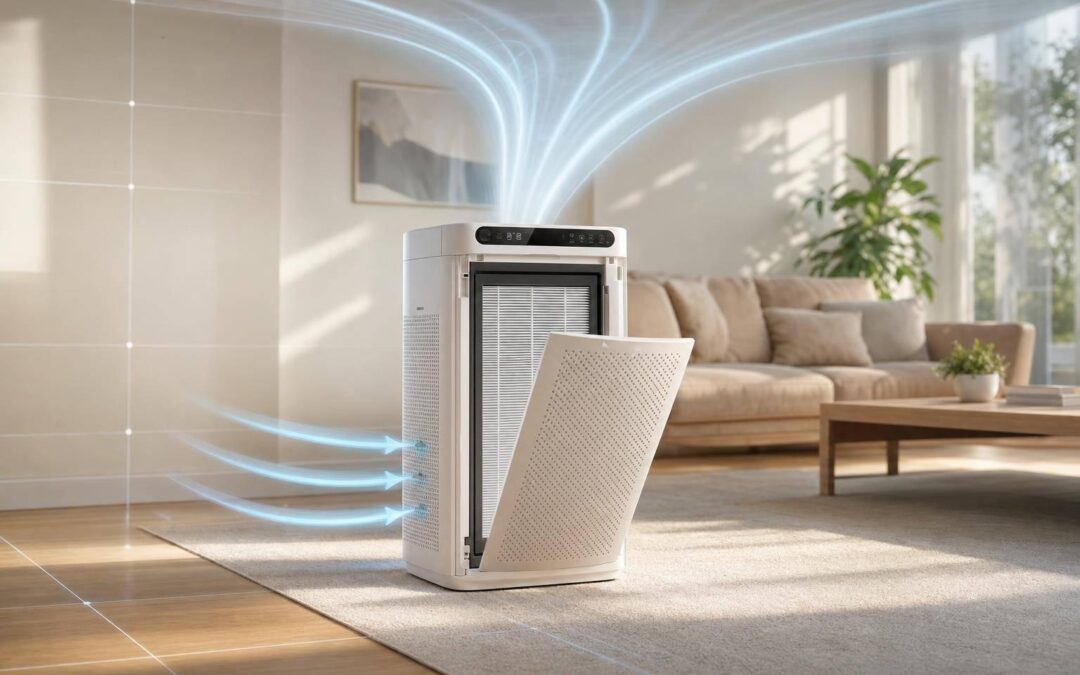
A HEPA label alone does not tell you how well a purifier will clean your room. If I want the short answer, it’s this: CADR, airflow, sealing, filter condition, and room size matter more than the HEPA claim by itself.
Here’s the simple breakdown:
- HEPA efficiency tells me how the filter media performs under test conditions.
- CADR tells me how much clean air the whole unit delivers, in CFM.
- More airflow can clean a room faster, but only if the unit stays sealed and the fan can handle the filter resistance.
- More filter area usually means lower face velocity and lower pressure drop at the same airflow.
- Dirty filters add resistance, which can cut airflow even if the media still filters well.
- Leaks matter a lot: even small bypass leaks can hurt particle removal.
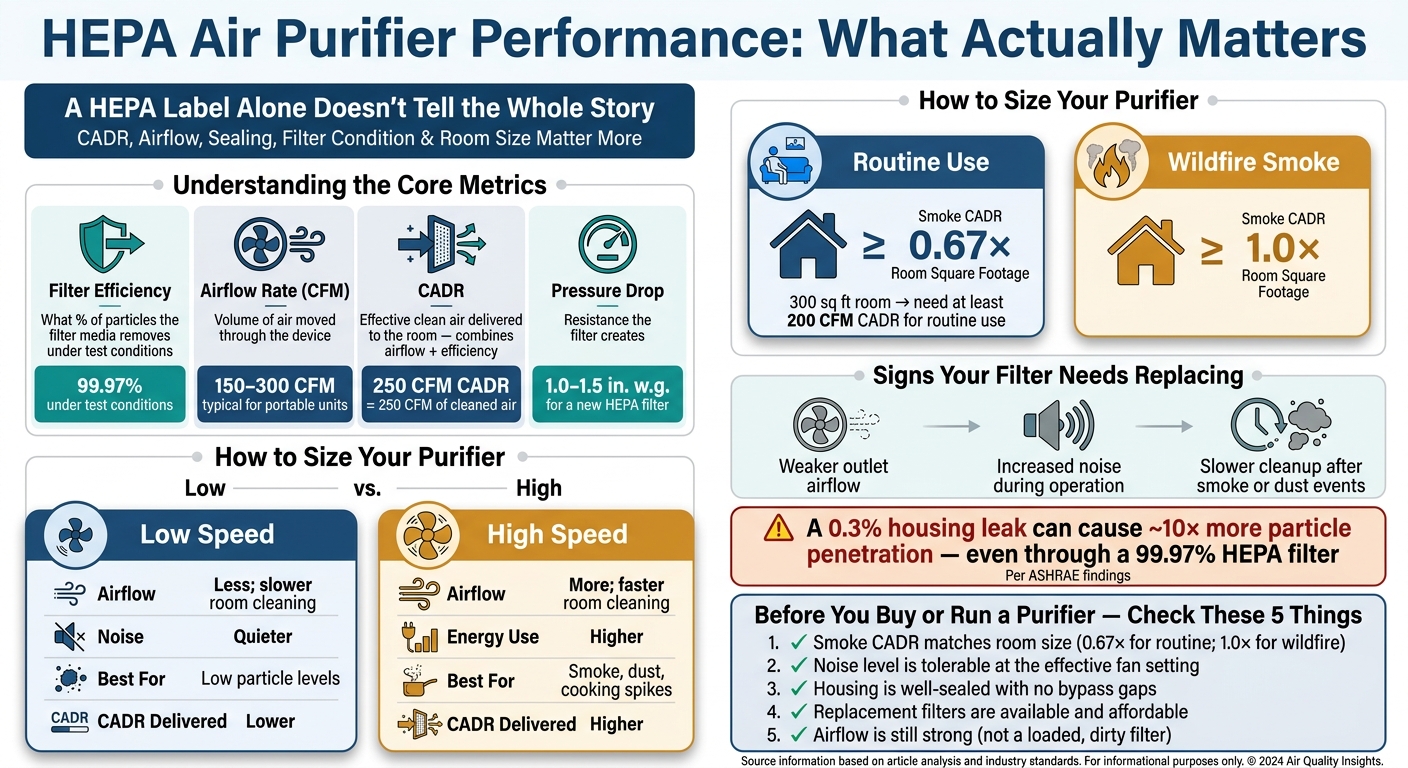
- For sizing, a good rule is about 0.65 CFM of CADR per square foot. In simple terms, look for about 0.67× room square footage for routine use, or about 1.0× for wildfire smoke.
A few numbers stand out:
- Portable HEPA purifiers often land around 150–300 CFM smoke CADR
- A new HEPA filter can add about 1.0–1.5 in. w.g. of pressure drop
- HEPA media is often rated at 99.97% under set test conditions
- A very small leak can lead to much more particle penetration
If I were picking or using a purifier, I’d focus on these questions first:
- Does the smoke CADR match the room size?
- Can I run it at a setting I can live with for noise?
- Is the housing well sealed?
- Are replacement filters easy to get and priced in a way that fits my budget?
- Is airflow still strong, or is the filter likely loaded up?
| Check | What I’d look for |
|---|---|
| Room match | 0.67× room square footage for normal use; 1.0× for smoke-heavy conditions |
| Main metric | Smoke CADR, not just HEPA wording |
| Airflow limits | More fan speed helps, but resistance and noise go up |
| Filter condition | A dirty filter can cut output |
| Build quality | Tight seal, clear intake, and clear outlet |
So if I had to sum up the whole article in one line, I’d say this: a purifier works best when it balances filter efficiency, airflow, low leakage, and proper sizing.
HEPA Air Purifier Performance: CADR vs. Filter Efficiency Explained
The Truth About CADR Tests
sbb-itb-5fea4da
Does Higher Airflow Make a HEPA Filter Work Better?
Higher airflow can clean a room faster, but only when the purifier still filters well and stays properly sealed. Push more air through the same filter, and resistance goes up too. That can cut delivered airflow and make the unit louder.
So the short version is simple: higher airflow is not automatically good, and it’s not automatically bad either.
A purifier running at top speed with a dirty filter or a filter that isn’t seated well may deliver less useful clean air than a well-kept unit running at a middle setting. That tradeoff makes more sense once you look at airflow rate next to face velocity.
Airflow Rate vs. Face Velocity
At the same CFM, a larger filter means lower face velocity.
Here’s why that matters: a purifier with a larger, deeply pleated filter spreads the same CFM over more surface area. That lowers face velocity and reduces resistance. A purifier with a small, flat filter moving that same CFM does the opposite. It drives face velocity up, which increases pressure drop and can limit sustained airflow.
In practice, performance depends on more than the HEPA label. Filter area, fan capacity, internal layout, and housing seals all play a part. Airflow by itself never tells the whole story.
Filter Efficiency and CADR Are Not the Same Thing
Filter efficiency tells you what share of particles the filter media removes from air passing through it under test conditions. CADR tells you how much cleaned air the full device actually delivers to the room. CADR reflects both airflow and removal efficiency.
That difference matters. A filter may be rated at 99.97% efficiency at the rated test condition, but if the fan moves only a small amount of air – or if air leaks around the filter – the purifier’s room-cleaning output will still be limited. High efficiency does not mean strong room-cleaning performance when airflow is low.
These terms are connected, but they measure different things:
| Measure | What It Indicates | Why It Matters |
|---|---|---|
| Filter efficiency | Percentage of particles removed from air passing through the media under test conditions | Shows single-pass media performance, but not how much clean air the full device delivers |
| Airflow rate | Volume of air moved through the device (CFM) | More airflow processes more room air, but higher velocity increases pressure drop |
| CADR | Effective delivery rate of cleaned air to the room (CFM) | Combines airflow and removal efficiency; most useful for comparing portable purifiers |
| Pressure drop | Resistance the filter creates as air passes through it | Higher resistance can reduce airflow, increase fan energy, and raise noise levels |
Portable HEPA purifiers often reach smoke CADRs of about 150–300 CFM. A 250 CFM CADR means the unit delivers 250 CFM of cleaned air. It does not mean the fan is moving 250 CFM of raw air, because CADR already factors in removal efficiency.
That’s the key distinction. If you’re comparing devices, CADR usually gives you a clearer picture than HEPA percentages alone.
How Pressure Drop, Fan Speed, and Dirty Filters Change Performance
The tradeoff in delivered airflow comes down to pressure drop. That’s the resistance the fan has to push against, usually measured in inches of water gauge (in. w.g.). Even a clean HEPA filter adds resistance, which is why the fan has to be sized with that filter in mind. A new HEPA filter can start with a pressure drop of about 1.0–1.5 in. w.g. And if air speed doubles, pressure drop can roughly quadruple.
Low Fan Speed vs. High Fan Speed: The Tradeoffs
There isn’t one setting that’s always best. It depends on what’s going on in the room right now. If the air is mostly calm, a lower setting may be enough. If you’re dealing with smoke, dust, or cooking particles, a higher setting usually makes more sense. Either way, check the test data for the exact model. Fan motor strength, filter area, controls, and housing design all matter.
| Factor | Lower Fan Speed | Higher Fan Speed |
|---|---|---|
| Airflow | Less; room cleaning is slower | More; the room cleans faster |
| Noise level | Usually quieter; may be more comfortable for bedrooms or occupied spaces | Usually louder due to higher fan and airflow rates |
| Energy use | Typically lower while running | Typically higher while running |
| Resistance | Lower | Higher |
| Best use case | Low particle levels | Smoke, dust, or cooking spikes |
| CADR delivered | Lower | Higher; usually highest at top speed |
What Happens When a HEPA Filter Loads Up with Particles
As dust, smoke residue, and other particles build up in the filter media, resistance goes up. EPA materials note that dust loading usually raises resistance and can slightly raise efficiency. That sounds a little odd at first, but here’s the catch: the fan now has to push harder to move air through the filter. If the purifier doesn’t make up for that loss, delivered airflow drops.
So the filter may still do a good job on each pass, but the purifier moves less room air per minute. And that means the room takes longer to clean. In places with lots of dust, smoke, pet dander, or cooking particles – homes, offices, vehicles, RVs, boats, or small commercial spaces – that buildup can happen much sooner.
A few warning signs can hint that resistance has climbed enough to hurt day-to-day performance:
- Weaker airflow from the outlet
- More noise during operation
- Slower cleanup after dust, smoke, or cooking events
When airflow drops even though the unit still has a strong HEPA label, the next thing to look at is purifier design and sealing.
Why Purifier Design and Sealing Matter as Much as the HEPA Label
When airflow drops, the next thing to check is simple: does the purifier’s housing send that air through the filter at all? If air slips past the filter through a gap, the HEPA media can’t clean it. The U.S. EPA warns that poor filter frames and bad installation can cut performance by a lot. Even a 99.97% filter can fall short if the housing isn’t airtight. ASHRAE reports that a 0.3% leak can lead to about 10 times more particle penetration.
Once the housing is sealed, the filter’s shape and surface area start to matter. Pleating packs more media into the same space, which lowers media velocity and pressure drop. In plain English, that means less resistance and less noise. But the inner layout matters just as much. If the intake design pushes most of the air through one part of the filter, that section clogs sooner. And when that happens, filter life drops, noise goes up, and the fan has to work harder.
A HEPA label tells you about the filter media under test conditions. It does not tell you how the whole purifier performs once everything is put together. AHAM treats CADR as a system rating, not just a filter claim. So the next step is to check the full device, not only the label on the filter.
How to Choose and Run a HEPA Purifier Effectively
What to Check Before Buying or Using a Unit
Once you account for sealing and airflow limits, the next step is simple: match the purifier’s actual output to your room. Start with the room’s square footage, then compare that number with the unit’s smoke CADR – not the brand’s promoted coverage claim. For day-to-day use, aim for a smoke CADR of at least 0.67× the room’s square footage. If you’re dealing with wildfire smoke, aim for about 1.0×.
Before you buy or start using a unit, check these basics:
| Factor | What to look for |
|---|---|
| Smoke CADR vs. room size | At least 0.67× room area for routine use; about 1× for wildfire smoke |
| Noise tolerance | Can you run it consistently at the setting that delivers useful airflow? |
| Filter cost and availability | Replacement filters should be easy to find and reasonably priced |
| Replacement schedule | Follow the manufacturer’s interval; heavy use shortens it. |
| Sustained airflow | Use whole-device CADR data, not filter-only claims. |
Sizing is only part of the job. Placement and fan speed matter too, because they affect whether the purifier can keep moving enough air. Keep the intake and outlet clear of walls, curtains, and furniture. If the grille is blocked, airflow can drop. When cooking, dust, or smoke levels jump, switch to a higher fan setting. Once the air clears, turn it back down.
Key Takeaways: Airflow and HEPA Filter Results
Filter efficiency and room performance are not the same thing. A high-efficiency filter may sound great on paper, but it won’t clean a room fast if the unit moves too little air or leaks around the housing. In day-to-day use, CADR, airflow, fan setting, and upkeep shape the result far more than the filter label by itself.
The goal is to balance filter quality, airflow, sealing, room size, fan speed, and maintenance. Change filters on schedule and keep the grilles clear. Those two small habits do a lot to help the unit keep up its airflow over time.
FAQs
How do I calculate the right CADR for my room?
To pick the right CADR for your room, start with a high-quality HEPA filter and make sure it’s rated for the size of your space. That part matters more than most people think. If the unit is too small, it may not clean the air well enough to remove particles at the level you want.
The source material makes one thing clear: CADR plays a major role in particle removal. But it doesn’t give a set formula for matching CADR to room size.
If you want help looking at your space and figuring out what makes sense for better air quality, Ozonated Cleaning LLC can help.
Can a dirty HEPA filter still remove particles well?
No. A dirty HEPA filter does not remove particles well. When the filter gets clogged, airflow drops. And once that happens, harmful particles can end up moving back into your space instead of getting trapped.
Replacing the filter on a regular schedule helps your system trap particles more efficiently and keeps air handling performance where it should be.
How can I tell if my purifier has air leaks?
The search results don’t spell out exact steps for finding air leaks in a portable HEPA purifier itself. Still, there’s one thing worth watching: leaks in connected ductwork can let unfiltered air slip past the filtration system.
To help keep the unit working as it should, stick to a routine maintenance schedule. It also helps to check your manufacturer’s manual or ask a qualified technician to inspect the seals and airflow efficiency.
Recent Comments