
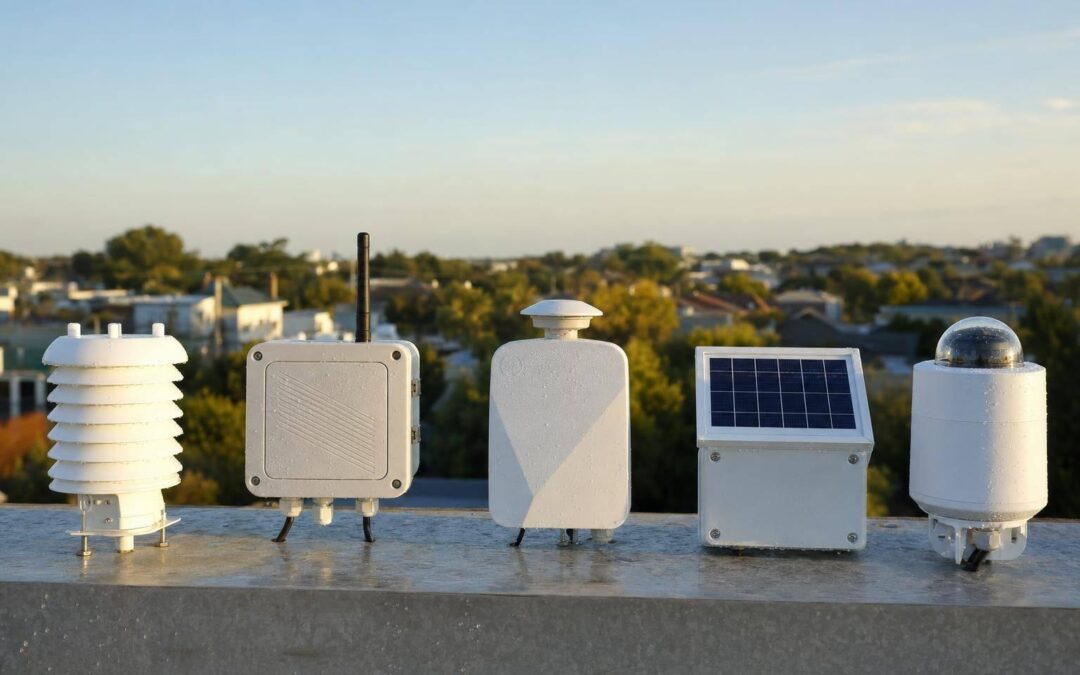
If I want an outdoor monitor to stay useful for months or years, I look past the sensor list first. I check five things: what it measures, how it handles heat, cold, and rain (similar to HVAC odor source detection where environmental factors matter), how it stays powered and connected, whether it stores data during outages, and how much service it needs over time.
Here’s the short version:
- IQAir AirVisual Outdoor: best for fixed-site PM tracking with wired or Wi-Fi options and up to 2 years of local storage.
- Aeroqual AQS One: best if I need particles plus gases like O₃, NO₂, CO, SO₂, H₂S, CH₄, or VOCs, with 5+ years of onboard storage.
- IQAir AirVisual Outdoor Solar System: best for remote sites where grid power is a problem.
- Davis Instruments AirLink: a lower-cost PM-only choice, but it has no onboard memory, so Wi-Fi stability matters a lot.
- PurpleAir Flex: a lower-cost PM monitor with public map sharing and optional microSD offline logging, but setup details matter.
A few facts shape the whole decision:
- Long-term outdoor monitors are supplemental, not regulatory-grade.
- Some gas sensors may last only 1 to 2 years.
- EPA-style placement guidance often puts the inlet around 3 to 6 feet above ground.
- Side-by-side checks can take 48 hours, and 1 to 2 weeks is often better for PM comparisons.
If I had to narrow the choices fast, I’d do it like this: pick Aeroqual for multi-pollutant work, IQAir for steady PM records, the solar IQAir setup for off-grid use, and Davis or PurpleAir for lower-cost PM tracking.
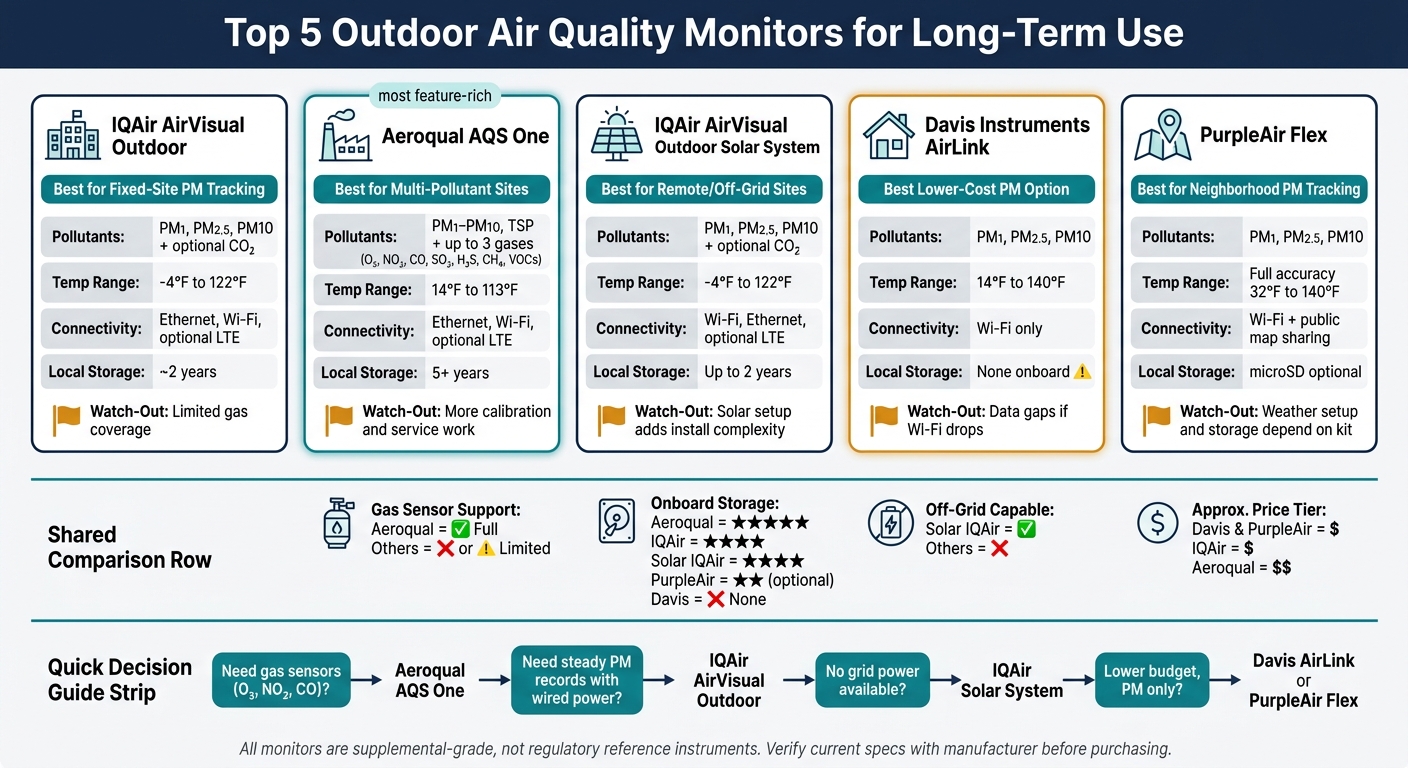
Top 5 Outdoor Air Quality Monitors Compared: Key Specs at a Glance
AirGradient Outdoor Air Quality Monitor REVIEW! // BEST Outdoor Air Quality Monitor?
sbb-itb-5fea4da
Quick Comparison
| Monitor | Best For | Main Pollutants | Temp Range | Connectivity | Local Storage | Main Watch-Out |
|---|---|---|---|---|---|---|
| IQAir AirVisual Outdoor | Fixed-site PM tracking | PM1, PM2.5, PM10; optional CO₂ | -4°F to 122°F | Ethernet, Wi-Fi, optional LTE | ~2 years | Limited gas coverage |
| Aeroqual AQS One | Multi-pollutant sites | PM + selectable gases | 14°F to 113°F | Ethernet, Wi-Fi, optional LTE | 5+ years | More service and calibration work |
| IQAir AirVisual Outdoor Solar System | Remote/off-grid PM tracking | PM1, PM2.5, PM10; optional CO₂ | -4°F to 122°F | Wi-Fi, Ethernet, optional LTE | Up to 2 years | Solar setup adds install work |
| Davis Instruments AirLink | Lower-cost home/site PM tracking | PM1, PM2.5, PM10 | 14°F to 140°F | Wi-Fi | None onboard | Data gaps if Wi-Fi drops |
| PurpleAir Flex | Neighborhood PM tracking | PM1, PM2.5, PM10 | 14°F to 140°F for stated use; full accuracy starts at 32°F | Wi-Fi | microSD optional | Weather setup and storage depend on kit |
My main takeaway: buy the monitor that fits your pollutants, climate, power setup, and maintenance budget – not just the one with the nicest app or the lowest price.
What to Look for in a Long-Term Outdoor Monitor
Buying an outdoor air quality monitor for long-term use is a different job from buying a device for spot checks. Once a unit is installed outside for months or years, the basics matter most: build quality, weather tolerance, and ease of service. Fancy app features are nice, but they won’t help much if the monitor can’t handle heat, cold, rain, or long stretches in the field. Use the points below to judge the five monitors that follow.
Pollutants the Monitor Can Measure
Start with the pollutants you need to measure. That sounds obvious, but it’s easy to get this backward.
A PM-only monitor can track smoke and dust. That’s useful in many cases. But it won’t tell you anything about ozone, nitrogen dioxide, or carbon monoxide. If your location is close to a road, warehouse, plant, or other emission source, gas sensors may matter just as much as particle data.
The simple rule: match the monitor to the air problem you’re trying to track, not the other way around.
Outdoor Housing and Weather Protection
A good outdoor enclosure has to do two jobs at once. It needs to keep out rain, dust, insects, and direct sun, while still letting enough air reach the sensor.
That balance matters. EPA testing guidance says weatherproof enclosures should still allow ample airflow around the sensor. So don’t just look for a sealed box. Look for details that show the unit was built for outdoor use, such as:
- UV-resistant materials
- Protected air inlets
- A simple way to inspect and clean the vents
If the vents clog or the housing traps too much heat, readings can go off track.
Operating Range and Climate Fit
Always check the published operating temperature range in °F. Don’t rely on the storage range. They’re not the same thing.
A monitor that performs well in mild weather may struggle in a Minnesota winter below 32°F or an Arizona summer above 100°F. And temperature is only part of the story. High humidity, condensation, and wind-driven rain can put extra strain on the system.
It’s also worth checking one small but often missed detail: does the stated range apply to the whole device, or only to the sensor itself? The full system includes the power supply, communications hardware, and battery too. If one weak part fails, the monitor is down.
Connectivity and Data Retention
For long deployments, data gaps are a headache. So think hard about how the monitor connects and what happens when that connection drops.
Ethernet is often the steadiest option for fixed sites. Wi-Fi is easier to set up, but signal loss can be a problem. Cellular can work well in remote spots, though it comes with recurring costs.
Onboard storage matters because outages happen. Power fails. Networks go down. A solid monitor should store readings locally and then upload that buffered data once the connection comes back.
Before you buy, check the basics:
- Whether timestamps are preserved
- What export options are available
- How long the manufacturer keeps data in its cloud platform
Maintenance, Calibration, and Serviceability
If a monitor will stay outside for a long time, it should be serviceable in the field. Otherwise, every small issue turns into a bigger one.
Before buying, check whether the sensing module can be replaced on its own, how the device flags calibration drift, and whether the manufacturer provides firmware updates and remote diagnostics. EPA recommends performance checks before, during, and after a deployment.
Sensor life matters too. Some gas sensors may remain usable for only one to two years, depending on the technology. That’s a big deal for budgeting. The sticker price is only part of the cost. Replacement parts and upkeep can shape which models make sense for months or years of outdoor use.
At-a-Glance Comparison Table
This table sums up the models with manufacturer-backed specs from the retrieved material. Since specs can change by setup, check the latest datasheet before you buy.
It also gives you a quick side-by-side look at the points that matter most for long-term outdoor use: range, enclosure, connectivity, storage, and upkeep.
| Monitor | Measured Pollutants | Operating Temperature Range | Outdoor Rating / Enclosure | Connectivity | Data Storage | Service Needs | Long-Term Use Case |
|---|---|---|---|---|---|---|---|
| IQAir AirVisual Outdoor | PM1, PM2.5, PM10; optional CO₂; temperature, humidity, barometric pressure | −4°F to 122°F (−20°C to 50°C) | Outdoor enclosure; rain and spray resistant | Ethernet, 2.4-GHz Wi-Fi, optional 3G/4G/LTE via USB modem | ~2 years local; cloud via manufacturer platform | Periodic inlet inspection, sensor-health checks, manufacturer-recommended service | Connected particulate tracking for homes, campuses, and businesses |
| Aeroqual AQS One | Configurable: PM1, PM2.5, PM4, PM10, TSP; selectable gases including VOCs, O₃, NO₂, CO, H₂S, SO₂, CH₄ | 14°F to 113°F (−10°C to 45°C) | IP65-rated glass-reinforced plastic cabinet with integrated aluminum solar shield | Wi-Fi and Ethernet standard; optional 4G LTE cellular | 5+ years onboard | Gas-sensor calibration and replacement, particulate inlet care, filter and enclosure inspection | Multi-pollutant monitoring for industrial and research sites |
Only these two models have manufacturer-backed specs in the retrieved material. The next sections look at all five picks one by one.
For configurable systems like Aeroqual AQS One, the measured pollutants depend on the sensor package you choose.
1. IQAir AirVisual Outdoor Monitor
This model works well for fixed sites that need steady particulate tracking and simple networked logging. The IQAir AirVisual Outdoor is a fixed, connected air quality monitor made for continuous, long-term deployment.
Measured Pollutants
IQAir AirVisual Outdoor measures PM1, PM2.5, and PM10, along with temperature, humidity, and barometric pressure. Some versions also support an optional CO₂ module with a 400–10,000 ppm range, so it’s smart to confirm the exact configuration before you buy. In its standard form, this is mainly a particulate monitor. Gas sensing is limited unless that CO₂ add-on is included. If your site needs months or years of uninterrupted particulate records, that narrower sensor set can actually be a good match.
Outdoor Durability and Operating Range
IQAir rates the unit for use from -4°F to 122°F and 0–100% RH, non-condensing. The power adapter should stay in a protected spot. IQAir does not list an IP rating for this model, so it’s best to follow the manufacturer’s mounting instructions closely. The company also recommends installation below 6,560 feet (2,000 meters) in elevation.
Connectivity and Data Storage
The unit supports 100 Mbps Ethernet, 2.4 GHz Wi-Fi (802.11 b/g/n), and optional 3G/4G/LTE through a USB modem. For fixed installs, wired Ethernet and PoE are usually the better choice, with cable runs up to 80 meters. Peak power draw is 12 watts, and local storage can hold up to two years of data.
If the network drops, the device stores readings and sends them once the connection comes back. That’s a big deal for long-term monitoring, because gaps in the record can turn a good dataset into a patchy one. It’s still wise to export data on a regular basis, especially for projects that run for many months.
Calibration and Long-Term Maintenance
Long-term performance comes down to upkeep as much as sensor specs. IQAir recommends letting the unit run for at least three days with steady power and a stable connection before checking baseline stability. The company does not give one set calibration interval for every setup, so service timing should follow site conditions and current manufacturer guidance.
A few routine checks go a long way:
- Inspect the inlet for dust, insects, and moisture.
- Keep a log of firmware updates, power interruptions, cleaning, and sensor checks.
- Compare readings with a nearby reference station during stable weather.
2. Aeroqual AQS One
The Aeroqual AQS One is a fixed outdoor station built for continuous, long-term monitoring. It’s often used for industrial fencelines and compliance work. In long deployments, the big win isn’t only sensor range. It’s dependable uptime with less hands-on service. Choose this model when you need configurable gas and particle monitoring, not just PM tracking.
Measured Pollutants
The main draw here is flexibility. You can match the sensor package to the site instead of forcing the site to fit the device.
Its configurable setup can measure PM1, PM2.5, PM4, PM10, and TSP, along with up to three gases at the same time. Gas options include ozone (O₃), nitrogen dioxide (NO₂), carbon monoxide (CO), sulfur dioxide (SO₂), hydrogen sulfide (H₂S), methane (CH₄), and VOCs.
Before you buy, check exactly which sensor modules are included in your quote. That should include the measurement ranges and detection limits too.
Outdoor Durability and Operating Range
The unit uses a lockable IP65-rated enclosure with an integrated aluminum solar shield. Its standard operating range is 14°F to 113°F. If your site deals with tough winters, an optional winterization kit can extend operation to about −40°F in suitable configurations.
At about 19 × 13 × 7.4 inches and under 28.6 pounds, it’s not huge, but it still needs a secure mounting structure and enough clearance around the air inlet. That part matters more than people think. A cramped install can cause headaches later.
Connectivity and Data Storage
Standard connectivity includes Wi-Fi and Ethernet, and there’s an optional cellular modem for remote sites without wired access. If you plan to use cellular, confirm carrier support, SIM requirements, and antenna placement before ordering.
Local onboard storage can hold more than five years of data, which helps with multi-year projects or sites with spotty network access. In plain terms, if the network drops out now and then, the station can still keep logging. Even with that buffer, scheduled data exports are still a smart habit.
Calibration and Long-Term Maintenance
Aeroqual factory-calibrates the AQS One with NIST-traceable references and recommends calibration every 12 months for gas modules and every 24 months for the particle monitor. If you’re using the Particle Profiler module, that interval drops to 12 months.
Routine maintenance includes:
- Filter changes
- Inlet flow checks
- Pump inspections
- Cleaning the sharp-cut cyclone
Service intervals should match site conditions, especially dust, humidity, and pollutant levels.
3. IQAir AirVisual Outdoor Solar System
The IQAir AirVisual Outdoor Solar System adds solar power, battery backup, and optional cellular connectivity to the AirVisual Outdoor monitor. It’s built for places where grid power or wired internet just isn’t practical, like construction sites and community air monitoring projects. If power access is your main roadblock for remote PM monitoring, this setup makes a lot of sense.
Measured Pollutants
This monitor measures PM1, PM2.5, and PM10, along with temperature, relative humidity, and barometric pressure. There’s also an optional 3-PM/CO₂ version that adds carbon dioxide monitoring. In that setup, the CO₂ range is 400–10,000 ppm.
If you also need ozone, NO₂, CO, or SO₂ data, this unit won’t cover that on its own. You’d need extra sensors or a different monitoring platform.
Outdoor Durability and Operating Range
The monitor is rated for −4°F to 122°F (−20°C to 50°C) and 0% to 100% relative humidity, non-condensing. Its particulate sensor can handle concentrations up to 1,000 µg/m³, which makes it a good match for heavy smoke events, including wildfire smoke.
One thing to watch: the solar kit may have different operating limits than the monitor itself, so it’s smart to check those specs on their own.
Connectivity and Data Storage
The unit supports 2.4-GHz Wi-Fi, 100-Mbit Ethernet, and optional 3G/4G/LTE through a USB modem. If you plan to use cellular, you’ll need a compatible SIM card and data plan. It’s also worth checking carrier coverage and modem support before locking in a site location. A remote setup can look fine on paper and still turn into a headache if signal strength is weak.
For storage, the monitor can keep up to two years of local data. That gives you some breathing room during outages or connection drops.
Calibration and Long-Term Maintenance
Solar power cuts down on site visits, but it doesn’t erase maintenance needs. One helpful feature here is the use of pre-calibrated sensor modules that can be replaced in the field. So if a PM or CO₂ sensor needs to be changed, you can swap the module on-site instead of shipping the whole unit back for service. That can reduce downtime quite a bit in remote deployments.
It’s still smart to inspect the basics on a routine basis:
- Inlet
- Enclosure
- Cables
- Mounting hardware
- Battery
- Solar panel
After installation, sensor swaps, or outages, compare readings with a nearby reference station.
4. Davis Instruments AirLink
If you want a simpler, lower-cost PM-only monitor, the AirLink is a strong pick. The Davis Instruments AirLink is a low-cost, Wi-Fi-connected PM monitor built for fixed locations with steady power and 2.4-GHz Wi-Fi. It works with WeatherLink Cloud and usually costs about $179–$189. You can use it on its own or pair it with an existing Davis weather station, which makes setup easier if you’re already in the Davis ecosystem.
Measured Pollutants
The AirLink reports PM1.0, PM2.5, and PM10 in µg/m³. It also logs temperature and relative humidity. It does not measure gases like ozone, carbon monoxide, nitrogen dioxide, or sulfur dioxide.
AQMD field testing found strong PM1 correlation with reference instruments and moderate PM2.5 correlation, while PM10 performance was weaker. If you’re tracking long-term trends, PM2.5 is the metric to lean on most.
Its long-term use comes down less to how many things it measures and more to whether it can stay in a stable outdoor setup year after year.
Outdoor Durability and Operating Range
The AirLink is rated for 14°F to 140°F (-10°C to 60°C), which fits many U.S. climates. For outdoor use, Davis says it must be mounted vertically and used with the manufacturer’s outside-use protective cover. If your site often drops below 14°F, take a close look before making it part of a long-term install.
Connectivity and Data Storage
This is where you need to pay attention. The AirLink has no onboard memory, so connectivity is the main long-term weak spot. It sends data to WeatherLink Cloud over 2.4-GHz Wi-Fi, with readings updated about once per minute.
If Wi-Fi drops, you get data gaps. Simple as that. So it only makes sense in places where the connection stays steady at the exact mounting point. Before you install it, check for strong 2.4-GHz coverage where the unit will sit, not just somewhere nearby. It also makes sense to review WeatherLink’s cloud retention and export options to see if they match your multi-year monitoring plan.
Calibration and Long-Term Maintenance
The AirLink uses factory calibration and is not a regulatory reference instrument. Treat the ±10 µg/m³ accuracy spec as a lab rating, not a promise for every field setup.
For long-term trend tracking, it’s smart to co-locate the unit near a reference monitor early and document any bias you see. If readings keep looking off or the connection starts acting shaky, contact Davis support.
5. PurpleAir Flex
The PurpleAir Flex is a $289 Wi-Fi PM monitor built for long-term outdoor tracking. If you want the full setup, plan to spend at least $334 for the sensor, weatherproof power adapter, and microSD card.
What makes it stand out? The price is lower than many outdoor PM monitors, it can log data offline, and it’s easy to roll out across a neighborhood. Public map sharing also helps with block-by-block tracking.
Measured Pollutants
The Flex uses dual Plantower PMS6003 sensors to report PM1.0, PM2.5, and PM10. It also measures temperature, humidity, and barometric pressure. There’s a BME688 VOC reading too, but it’s still experimental and not dependable for VOC decisions.
In testing, PM1.0 and PM2.5 line up well. PM10 is less dependable, so it helps to treat those readings with more care.
Outdoor Durability and Operating Range
Outdoor placement matters just as much as the hardware. PurpleAir lists three operating ranges: functional from −40°F to 140°F, operational from 14°F to 140°F, and full accuracy from 32°F to 140°F. If you’re collecting data below freezing, read it with caution.
A simple setup rule goes a long way: mount it under a ventilated shelter, like an eave. That helps block rain and spray without choking off airflow.
Connectivity and Data Storage
The Flex connects through 2.4 GHz Wi-Fi and sends readings to the PurpleAir Real-Time Map with 1-minute resolution. It needs continuous USB power, and the power supply does not come in the box.
For outages, the onboard SD logger can keep collecting data offline. But the microSD card is sold separately, and it should be formatted and tested before you put the unit into service. If you want steady long-term logging, you need both a stable Wi-Fi connection and a tested SD card. Before permanent installation, check the card’s supported capacity, file format, and export process.
Calibration and Long-Term Maintenance
Long-term use isn’t just about mounting the sensor and walking away. The Flex works best as a supplemental PM monitor. Use a local correction, collocate it early with a nearby reference monitor, and clean the inlet on a regular basis.
How to Read and Compare the Top 5 Picks
Apply the Same Criteria Across All 5 Picks
Now that all five models are in front of you, use one checklist for every single one. Judge each monitor on the same six points: pollutant coverage, outdoor durability, connectivity, data retention, maintenance requirements, and best-fit use case. And when you can, note whether a spec is a factory rating, an optional feature, or a third-party observation.
Start with pollutant coverage. Then move into durability, data handling, and service needs. That order helps fast. Pollutant coverage is what separates PM-only monitors from multi-gas stations. If you skip that shared framework, a broad-featured station can look a lot like a PM-only monitor at first glance.
It also helps to split connectivity from local storage. They sound related, but they solve different problems. Local storage matters most at remote sites where internet service drops in and out. Cellular can help, but it adds a recurring cost, so include it in total ownership cost.
The table below shows how those six checks sort the two models with the clearest published documentation. Think of it as a decision aid, not a second spec sheet. Each row points to a tradeoff that can push the choice one way or the other.
| Criterion | IQAir AirVisual Outdoor | Aeroqual AQS One |
|---|---|---|
| Pollutant breadth | PM-only (with optional CO₂) | Multi-gas and multi-particle; configurable to site needs |
| Enclosure protection | Rain- and spray-resistant; not intended for immersion | Lockable IP65 weatherproof enclosure |
| Operating temperature | −4°F to 122°F | 14°F to 113°F |
| Local storage | 2 years – adequate for connected sites | 5+ years – better for remote or intermittent-network sites |
| Connectivity | Wi-Fi, Ethernet, PoE, optional cellular | Wi-Fi, Ethernet, optional cellular |
| Best fit | Neighborhood PM and environmental trend monitoring | Multi-pollutant, industrial, or research deployments |
For the Davis Instruments AirLink and PurpleAir Flex, use those same columns too. If a field isn’t verified, mark it as "needs confirmation" instead of assuming the monitor doesn’t have that feature. That’s a small step, but it can save you from a bad comparison.
Verify Manufacturer Specs Before Buying
Before you buy, download the current manufacturer datasheet and user manual for the exact model and revision. That step matters most for the Davis Instruments AirLink and PurpleAir Flex, where outdoor enclosure details, storage behavior during outages, and maintenance needs can change across product generations.
Pay close attention to what "weatherproof" means in the manual. Check the IP rating, inlet protection, and whether the power adapter has to stay indoors or inside a separate weatherproof enclosure. If one document says something that another one leaves out, go with the most current official source.
Then move on to the practical tradeoffs in the next section. There, you’ll compare each model side by side in day-to-day terms.
Advantages and Limitations Table
Use this table to compare the five picks across the traits that matter most for long-term outdoor use: durability, pollutant coverage, connectivity, storage, and upkeep.
| Monitor | Outdoor Durability | Pollutants Measured | Connectivity | Storage | Maintenance | Strongest Use Case | Principal Limitation |
|---|---|---|---|---|---|---|---|
| IQAir AirVisual Outdoor Monitor | Outdoor enclosure; rain and spray resistant; rated −4°F to 122°F | Best for networked PM monitoring; optional CO₂ expands coverage | Ethernet, 2.4-GHz Wi-Fi, PoE, and optional 3G/4G/LTE modem | Up to 2 years local storage with cloud upload | Periodic inlet and enclosure cleaning, network and power checks, manufacturer-directed sensor servicing | Long-term networked particulate and environmental monitoring at facilities, campuses, and community sites | Limited gas coverage without add-ons |
| Aeroqual AQS One | Lockable IP65 glass-reinforced plastic cabinet with aluminum solar shield; rated 14°F to 113°F | Configurable PM and gas modules; actual coverage depends on installed sensors | Wi-Fi and Ethernet standard; optional 4G LTE cellular | More than 5 years of onboard data storage | Can be calibrated in the field; requires sensor-module checks, calibration, and enclosure inspection | Industrial, fenceline, and multi-pollutant monitoring where configuration flexibility matters most | Requires module-specific calibration and upkeep |
| IQAir AirVisual Outdoor Solar System | Remote-site solar deployment; verify current housing and weather protection | PM1, PM2.5, PM10, relative humidity, temperature, and barometric pressure; CO₂ optional in some configurations | Not separately confirmed in reviewed documentation | Not separately stated in reviewed documentation | Follow the base model’s inspection and cleaning routine; confirm solar-system service intervals in current documentation | Remote outdoor sites where grid power is unavailable | Adds solar-system installation complexity |
| Davis Instruments AirLink | Environmental rating and outdoor protection should be verified in current model documentation | Primarily particulate matter; verify the exact sensor package | Ethernet and 2.4-GHz Wi-Fi; verify current service terms | Cloud retention depends on service plan | Periodic enclosure and inlet inspection, connectivity checks, and comparison with nearby reference data | Connected PM monitoring for homes, facilities, and distributed sites | Outdoor protection, storage, and service terms need confirmation |
| PurpleAir Flex | Outdoor protection depends on the installed housing or mounting kit | Primarily particulate monitoring; verify the current sensing package | Wi-Fi connected; service terms need confirmation | Cloud retention depends on service plan | Periodic inlet inspection, power and connectivity checks, and comparison with nearby reference data | Lower-cost networked particulate monitoring and neighborhood-scale supplemental data collection | Outdoor protection and service terms vary by kit |
Once the shortlist is clear, the next step is installation and long-term upkeep.
Installation and Data Quality Tips for Multi-Year Outdoor Monitoring
After you compare devices, installation and upkeep decide whether the data stays reliable.
Choose a Good Mounting Location
For multi-year monitoring, placement matters just as much as sensor choice. The EPA recommends putting the inlet about 3–6 feet above ground if you want readings that reflect typical human exposure.
Height is only part of it. The area around the monitor can change what it reads. Walls, roof overhangs, fences, HVAC exhausts, dense shrubs, and tree canopies can trap pollution or push airflow in odd directions. That can pull readings away from what the surrounding air is doing.
Walk the site at different times of day. Look for grills, dryer vents, idling vehicles, generators, and dust sources. If you can’t avoid an obstruction, keep horizontal clearance at least twice the obstruction’s height above the inlet. For trees, keep the monitor at least 66 feet from the outer edge of the tree canopy, or 33 feet at minimum if you don’t have that much space.
Follow Mounting and Orientation Guidance
The IQAir AirVisual Outdoor, for example, must be installed vertically with its air-inlet openings facing downward. If you flip it or block the inlet, airflow can drop off. Water or debris can also get in, and particle readings may suffer.
Use the manufacturer’s recommended pole or wall hardware. Make sure power cables are protected from moisture and abrasion. If the manual says the unit can sit fully outdoors, install it that way. If not, place it in a covered, ventilated spot. It also helps to photograph the final setup from a few angles and write down the height, orientation, and distances to nearby trees and structures.
Good mounting protects airflow, and that helps protect data quality.
Keep a Maintenance and Data Log
Keep a simple log with the installation date, serial number, firmware version, sensor setup, mounting height, orientation, power source, and network or cellular connection. Also record cleaning, part swaps, firmware updates, outages, and relocations.
During routine reviews, check for drift, dust buildup, failed parts, and any shift in sensor position. Save raw data before you apply corrections or remove points. That way, you can tell whether a spike came from a real air event or from maintenance work.
Compare Against Nearby Reference Data
From time to time, compare your readings with a nearby regulatory or reference station as a quality-control step for long-term trend tracking. The best check is side-by-side testing: run your sensor close to the reference monitor, keep both inlets at about the same height, and expose them to similar airflow.
Don’t expect the numbers to match exactly. Focus on synchronized hourly or daily trends instead.
If your monitor shows repeated PM2.5 spikes that the nearest regulatory station does not show, first look for local causes, such as:
- a nearby wood-burning appliance
- a grill
- an idling vehicle
- a wind-direction shift
- resuspended dust
- an inlet partly blocked by vegetation
These site-level issues can explain a lot. If the gap keeps showing up under similar conditions, temporarily run the device next to a reference or portable reference monitor. That can help you figure out whether the monitor has drifted or whether it’s picking up a real microenvironment.
Aeroqual’s field-calibration guidance recommends at least 48 hours of side-by-side testing, with 1 to 2 weeks is better, for PM monitors under representative conditions.
Use reference data as a check, not as an exact match.
Plan for Ongoing Ownership Costs
Plan for more than the upfront purchase. Over several seasons, costs can include replacement sensors, calibration or correction services, cellular data plans, cloud subscriptions and data-export fees, weatherproofing hardware, technician time, and storm damage.
Before you commit, check a few boring-but-important details: whether data history is kept forever or limited by subscription tier, whether raw data can be exported, and whether replacement parts are likely to still be available a few years down the road. Those are normal ownership issues for any monitor expected to keep running across multiple years.
How Outdoor Monitoring Differs From Odor Removal Services
There’s one last line worth drawing here: monitoring and remediation are two different jobs.
An outdoor air quality monitor tracks pollutants and outdoor conditions over time. That’s its lane. It does not remove odors or disinfect surfaces. For odor removal and disinfection in Chicagoland, Ozonated Cleaning LLC removes odors and disinfects surfaces for residential, commercial, vehicle, RV, and boat spaces. Long-term monitoring shows when air quality shifts. Remediation deals with why it shifted.
That distinction matters more than it may seem at first glance. A post-treatment reading may show that a pollutant level changed, but it does not prove the odor source was removed or that the space was disinfected. Many odor sources also fall outside what a standard outdoor monitor is built to track.
Ozone treatment is its own category and needs controlled procedures, occupancy restrictions, and proper ventilation.
So the clean split is simple:
- Use a monitor for measurement and trend tracking.
- Use a cleaning and disinfection service for odor removal and sanitization.
That keeps the focus where it belongs: outdoor monitors measure air; they don’t fix the source.
Conclusion
There’s no one-size-fits-all monitor. The right choice comes down to what you need to measure, where you plan to install it, and how much time you can put into upkeep.
For particulate tracking, IQAir AirVisual Outdoor, Davis Instruments AirLink, and PurpleAir Flex are the best fits. If you need to measure ozone or other gases, go with Aeroqual AQS One. For remote locations without grid power, IQAir AirVisual Outdoor Solar System makes the most sense.
Before you buy, check five things:
- pollutant fit
- climate limits
- power and connectivity
- maintenance
- lifetime cost
Use current manufacturer specs as your final source, since configurations, regional availability, and software policies can change.
A monitor that matches the job, sits in the right spot, stays connected, and gets regular maintenance will give you better long-term data than a poorly placed unit that’s left alone for months.
FAQs
Which outdoor air quality monitor is best for my site?
The best outdoor air quality monitor depends on what you need it to do. Some buyers need a unit for regulatory compliance. Others just want steady environmental tracking over time.
For long-term monitoring, MOS sensors are often a smart pick. They’re durable, cost less than many other options, and can detect low ambient ozone levels. If your top priority is precision, UV absorption reference-grade monitors are the standard. They deliver the highest accuracy, but they also cost more and need more upkeep. For spot checks or fast readings in the field, portable handheld devices are usually the most practical option.
How often do outdoor air quality monitors need maintenance?
Outdoor air quality monitors need regular maintenance if you want accurate readings over time. The exact schedule depends on the device, but a few tasks show up again and again. For example, some units need weekly particle filter changes, along with periodic calibration to correct for environmental drift.
Sensors also wear down. Humidity and temperature swings can slowly affect how they perform, so some sensors may need to be replaced every one to two years.
The safest move is simple: follow the manufacturer’s instructions for calibration, part replacement, and general upkeep.
Where should I install an outdoor air quality monitor?
Install the sensor at breathing height, usually 3 to 6 feet above the ground, in an open area with good airflow.
Keep it away from buildings, fences, dense vegetation, grills, smoking areas, idling vehicles, trees, and shrubs. Also make sure it sits at least 3 feet above the ground to cut down on water splash and ground-level interference.
Recent Comments