
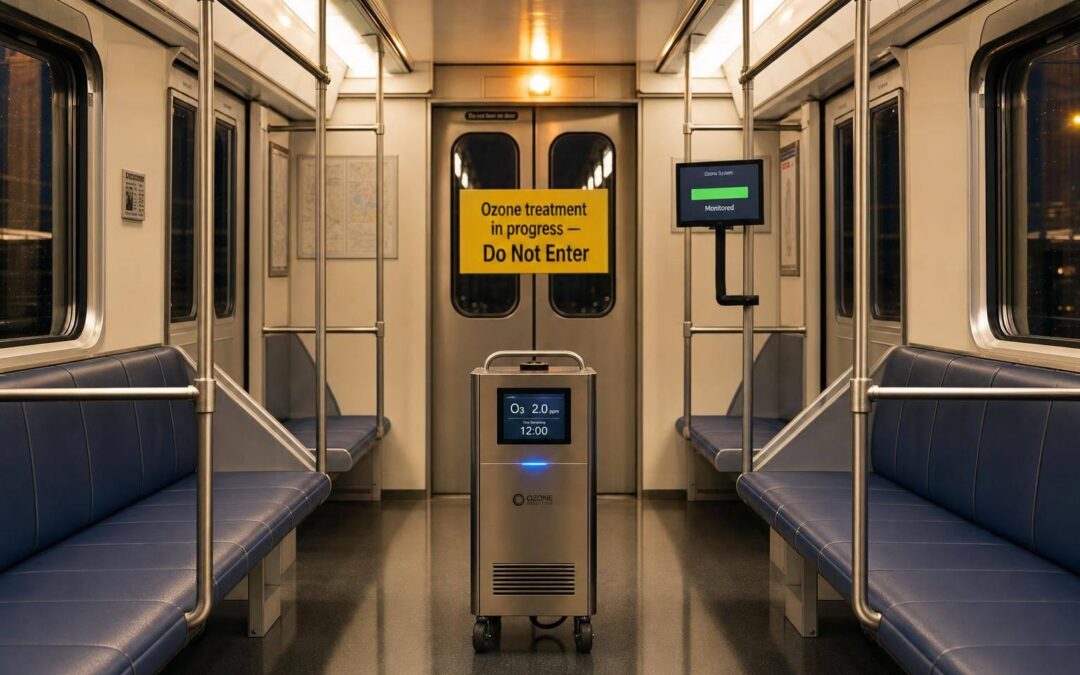
If I had to boil this down to one point, it’s this: ozone can help with odor control and some extra disinfection in buses and subway cars, but only when the vehicle is empty, sealed, monitored, and cleared before anyone goes back in.
I wouldn’t treat ozone as the main cleaning method. The article makes that clear. Routine cleaning and EPA-registered disinfectants do most of the work, while ozone is a last-step add-on used during off-service hours. The August 2026 study cited in the piece found that standard cleaning had the biggest effect on surface bacteria, while ozone cut fungal load after cleaning, with P = .0058.
Here’s the short version:
- Ozone kills microbes by oxidation
- It can reach air, vents, fabrics, and tight spots
- It must not be used with passengers or workers inside
- OSHA’s 8-hour exposure limit is 0.1 ppm
- NIOSH lists 5 ppm as immediately dangerous to life or health
- Bus treatment may run around 2 ppm for about 37 minutes
- Rail cars may need up to 5 ppm, more time, or more than one unit
- Re-entry should happen only after monitoring treatment effectiveness with meter checks to confirm levels below 0.1 ppm
- EPA does not support ozone use in occupied indoor spaces for germ control
What I take from the article is simple: ozone has a narrow job. It fits after normal cleaning, during overnight service windows, with logs, warning signs, lockout steps, ventilation, and clearance checks. It can help with smells and some leftover contamination, but it is not a shortcut and not a replacement for standard transit cleaning.
Quick Comparison
| Method | Main Use | What It Does Well | Main Limits | Safety |
|---|---|---|---|---|
| Ozone | Off-service odor control and extra disinfection (see how ozone removes odors safely) | Reaches vents, fabrics, and crevices | Mixed field results; can damage some rubber/plastics | Empty vehicle, meter checks, ventilation, re-entry clearance |
| Liquid disinfectants | Regular surface cleaning | Works well on high-touch points when used by label | Labor-heavy; weaker on hidden or porous areas | PPE and correct use required |
| UV-C vs. Ozone | Out-of-service treatment or HVAC use | Can inactivate some pathogens on exposed surfaces | Line-of-sight only; not for occupied spaces | Eye/skin protection and controls required |
So if you’re asking whether ozone belongs in a transit cleaning program, my answer is: yes, but only as a controlled extra step after the main cleaning is done.
sbb-itb-5fea4da
Safety Rules and U.S. Regulatory Requirements
Why Buses and Subway Cars Must Be Empty During Treatment
Ozone only works for disinfection when the concentration is high enough to kill germs. And that’s exactly why safety has to come first.
A bus or subway car must be empty during treatment because disinfection-level ozone goes past safe exposure limits. OSHA sets an 8-hour limit of 0.1 ppm, and NIOSH classifies 5 ppm as immediately dangerous to life or health. Exposure can irritate the lungs and worsen asthma or bronchitis.
In practice, safe ozone use in buses and subway cars comes down to a few non-negotiables: the vehicle stays empty, sealed, and monitored until it has been cleared.
Monitoring, Ventilation, and Re-Entry Checks
Before anyone steps back into a treated vehicle, ozone levels should be checked with a calibrated ozone meter. That part isn’t optional. It’s the step that tells you whether the space is safe or not.
During treatment, keep ventilation grilles closed so the ozone concentration stays where it needs to be. After treatment, ventilate the vehicle until ozone readings drop below 0.1 ppm. Some systems also catalyze residual ozone back into oxygen, which can cut downtime.
Those checks decide when a bus or subway car can go back into service.
Worker Protection and Recordkeeping
Once clearance is confirmed, the focus shifts to controlling access and documenting the job. Transit staff need a clear overnight procedure for treatment, restricted access, and release back to service.
Staff should be trained on:
- Preset cycle times
- Ventilation control
- Lockout procedures
Post "DANGER: OZONE TREATMENT IN PROGRESS" at every entry point.
You’ll also want a simple log for each treated vehicle. Record the vehicle ID, date, cycle time, peak ozone reading, and clearance check before the vehicle goes back into service.
Ozone Disinfection Protocols for Buses and Subway Cars
Bus Treatment Steps and Common Operating Ranges
Treat ozone as the last step, not the first. Start by vacuuming and wiping high-touch surfaces. Once that prep work is done, empty the vehicle and seal it.
Place the generator in a central spot, with at least 3 feet of clearance from nearby obstacles. Close the ventilation grilles before starting the cycle. If those grilles stay open, ozone can leak out and the treatment gets weaker. After the cycle ends, ventilate the vehicle and verify clearance before anyone goes back inside.
Subway and Rail Car Adjustments for Larger Interiors
Subway and commuter rail cars take more work because the interior is bigger and harder to treat evenly. The basic process stays the same, but larger cars need more output and more time.
The long, narrow shape can make even distribution harder, so one unit may not reach every area. If the car has partitioned sections, such as a driver’s cab or a restroom compartment, keep the internal doors open during treatment so ozone can move through the full interior. In most cases, this work fits best into an overnight maintenance window.
| Feature | Bus (Under ~30 sq ft) | Subway/Rail Car (100+ sq ft) |
|---|---|---|
| Target Concentration | ~2 ppm | Up to 5 ppm |
| Typical Cycle Time | ~37 minutes | Longer or higher output required |
| Generator Setup | Single central unit | Multiple units or high-output generators |
| Internal Doors | N/A | Keep open for full coverage |
Limits of Ozone Performance in Real Transit Conditions
Results can shift a lot based on temperature and humidity. Research found no bacterial reduction at 72°F, but modest effects at 97°F. Ozone also works less reliably against airborne bacteria when airflow is poorly controlled.
That matters in day-to-day transit use. It affects how large the generator should be, where sensors should go, and how the treatment cycle gets planned.
Equipment, Setup, and Service Planning
Generators, Sensors, and Vehicle-Specific Setup
Transit cars don’t all look the same. Some have tight cabins, some have open layouts, and some move air very differently once the doors close. That’s why equipment choice and schedule timing play a big part in how well ozone fits into day-to-day fleet work.
Transit ozone systems are made for vehicle mounting and come in 12V, 24V, and 120V versions. Some units can be flush-mounted into walls, and fixed-mount systems can also be installed in vehicle ceilings for automated overnight cabin treatment.
Placement matters. The unit should match the vehicle’s size, layout, airflow, and interior materials. In plain English: put the system where it works with the cabin’s airflow and geometry, not against it.
Once placement is set, the next job is working treatment into the vehicle’s off-service window.
Fitting Ozone Into Overnight or Off-Service Cleaning Schedules
Ozone treatment works best during overnight or other off-service windows. Fixed-mount ceiling systems can make automated overnight treatment easier, while manual application adds labor during off-hours.
The aim is simple: use the maintenance window you already have, with no added downtime. This approach is often preferred over traditional methods because ozone is safer than chemical disinfection when applied correctly in unoccupied spaces.
When to Bring In a Professional Service Provider
For Chicagoland fleets, Ozonated Cleaning LLC provides ozone- and hydroxyl-based vehicle disinfection and odor removal.
Ozone vs. Other Transit Sanitization Methods: Key Takeaways
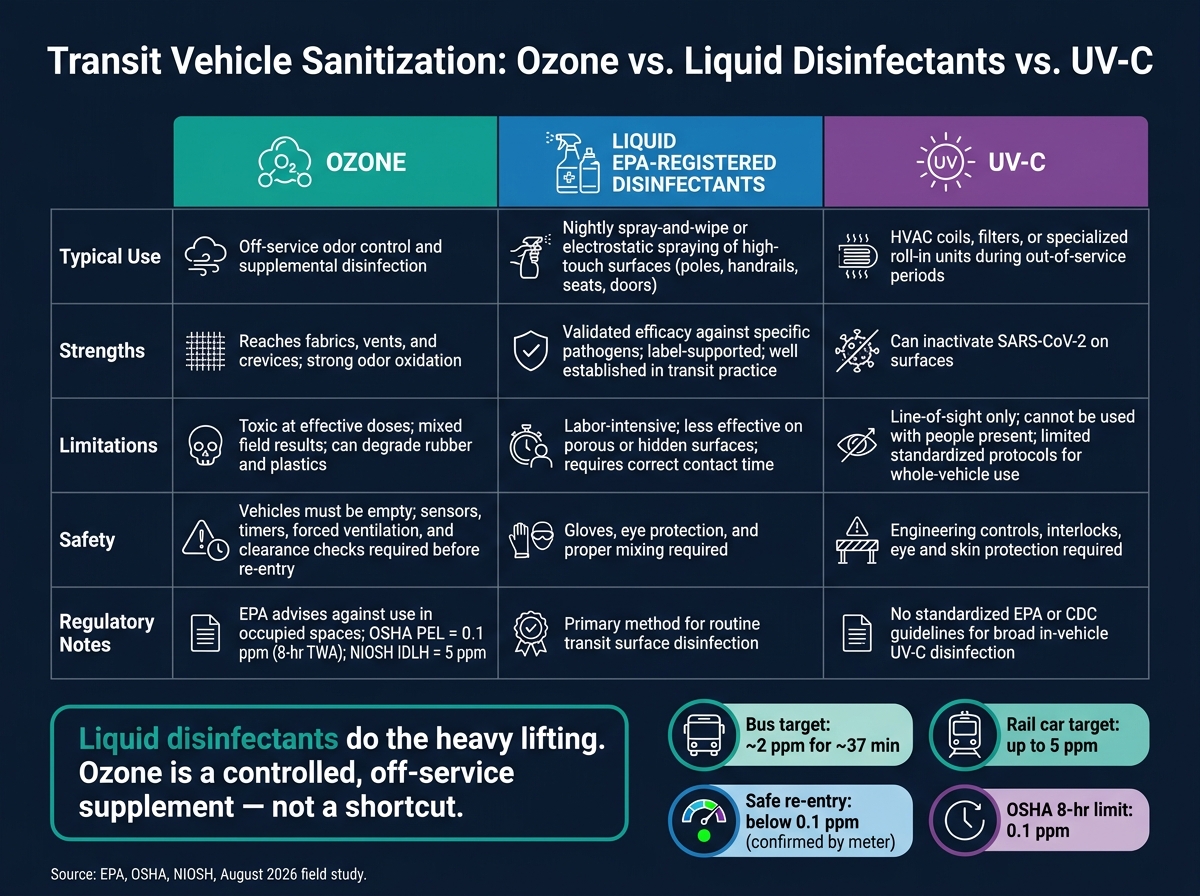
Ozone vs. Liquid Disinfectants vs. UV-C: Transit Vehicle Sanitization Compared
Where Ozone Works Well and Where It Falls Short
Once you get past the protocol details, the main issue is pretty simple: where does ozone fit in an actual transit cleaning program?
Ozone can reach fabrics, vents, and tight crevices that wipes often miss. It also helps reduce odor compounds, which is one reason transit teams look at it in the first place.
But the drawbacks matter just as much. Ozone at levels that can disinfect is hazardous to people. EPA states:
"when used at concentrations that do not exceed public health standards, ozone applied to indoor air does not effectively remove viruses, bacteria, mold, or other biological pollutants."
That warning lines up with field data. A bus study found no disinfection at 300–600 ppb for 20 minutes at roughly 60% relative humidity against a coronavirus surrogate on bar surfaces. On the other hand, tram and metro trials used 55 ppm or more, with the vehicles left empty. So the role of ozone is narrow: it works only as an off-service, supplemental step.
Comparison Table: Ozone, Liquid Disinfectants, and UV-C in Transit Vehicles
The comparison comes down to this: ozone helps cover gaps, while routine surface disinfection handles the main job.
| Method | Typical Use in Buses & Subways | Strengths | Limitations | Safety Considerations | Regulatory Notes |
|---|---|---|---|---|---|
| Ozone | Off-service odor control and supplemental disinfection | Reaches fabrics, vents, and crevices; strong odor oxidation | Toxic at effective doses; mixed field results; can degrade rubber and some plastics | Vehicles must be empty; sensors, timers, forced ventilation, and clearance checks are needed before re-entry | EPA advises against use in occupied spaces; OSHA PEL is 0.1 ppm (8-hr TWA) |
| Liquid EPA-registered Disinfectants | Nightly spray-and-wipe or electrostatic spraying of high-touch surfaces such as poles, handrails, seats, and doors | Validated efficacy against specific pathogens; label-supported; well established in transit practice | Labor-intensive; less effective on porous or hidden surfaces; requires correct contact time | Gloves, eye protection, and proper mixing required; avoid incompatible chemical combinations | Primary method for routine transit surface disinfection |
| UV-C | HVAC coils, filters, or specialized roll-in units during out-of-service periods | Can inactivate SARS-CoV-2 on surfaces | Line-of-sight required; cannot be used with people present; limited standardized protocols for whole-vehicle use | Engineering controls, interlocks, and eye/skin protection required | No standardized EPA or CDC guidelines for broad in-vehicle UV-C disinfection |
Conclusion: Safe Use, Proper Timing, and Realistic Expectations
The practical takeaway is clear: ozone can support odor reduction and supplemental disinfection, but only under controlled conditions. Liquid disinfectants still do the heavy lifting in a compliant transit hygiene program. Ozone has a role, but it is not a shortcut.
Whether an ozone program works comes down to proper dosing, monitoring, and clearance checks. For fleets in the Chicagoland area, Ozonated Cleaning LLC can manage ozone treatment within a documented sanitation program.
FAQs
How often should transit vehicles get ozone treatment?
Transit vehicles should generally get ozone treatment every 1 to 3 months. That schedule helps keep vehicles clean without creating too much downtime.
The best timing depends on how often the vehicle is used and what it’s exposed to. If a vehicle carries a lot of passengers or stays in service most of the day, monthly treatments often make the most sense. It’s best to schedule treatment when the vehicle is empty so the process is safe and works as intended.
Can ozone damage seats, rubber, or plastic parts?
Yes. Ozone is highly reactive, so it can damage some materials. Rubber can crack, weaken, or break down over time. Long exposure may also affect certain fabrics, electronic parts, and the coating on electrical wires.
To help avoid that, professional technicians check the space first and protect or remove sensitive items before treatment.
What equipment is needed to verify safe re-entry?
Use remote ozone monitoring equipment to verify that ozone levels have fallen below 0.10 ppm after treatment.
If professional-grade monitoring isn’t available, keep the space ventilated for at least 4 hours. Then do a final inspection to make sure the area is safe for normal use.
Recent Comments