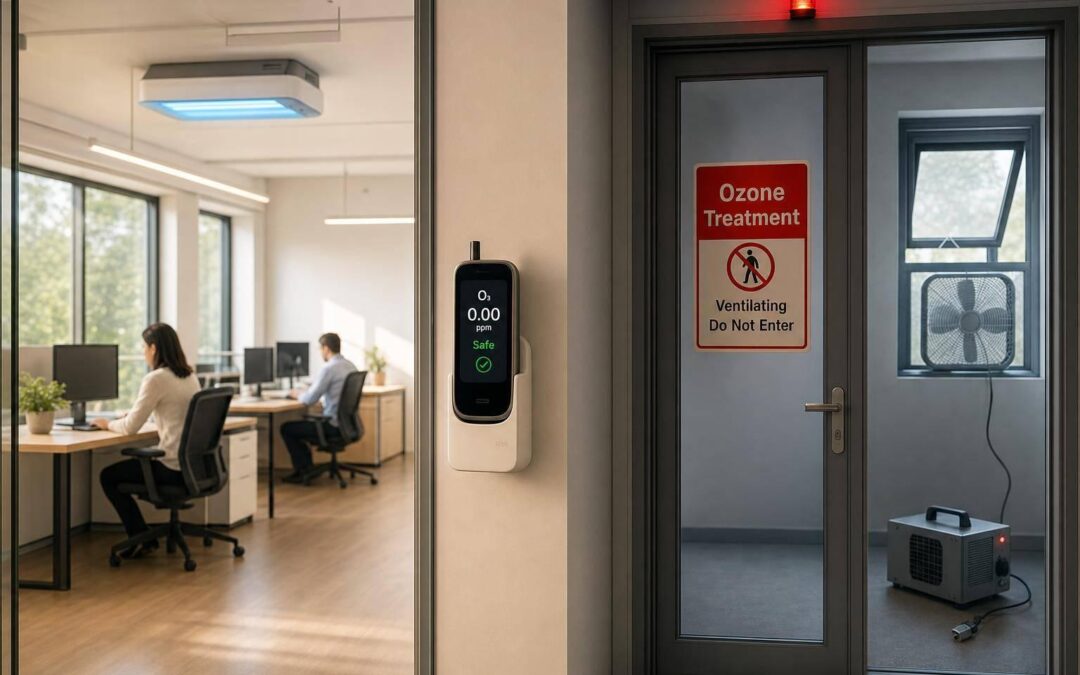
If people will be in the room, UV-C is usually the safer fit. If ozone is used, the space must be empty first. That’s the short answer.
Here’s the plain-English version:
- UV-C can help control germs in air, but only when the light is kept away from skin and eyes.
- Ozone can help with strong odors and sealed-space treatment, but it works at levels that are not safe to breathe.
- 254 nm UV-C can burn eyes and skin on direct exposure.
- 222 nm UV-C may lower skin and eye risk, but it can still create ozone, formaldehyde, and particles indoors.
- OSHA’s 8-hour ozone limit is 0.1 ppm, and the FDA limit is 0.05 ppm for certain devices.
- With ozone, smell is not a safe test. Re-entry should wait until a calibrated monitor shows levels under 0.05 ppm.
- With upper-room UV-C, ceilings should be at least 8 feet, with 8.5 feet preferred.
If I had to reduce the whole topic to one rule, it would be this: UV-C is for controlled use around people; ozone is for empty spaces only.
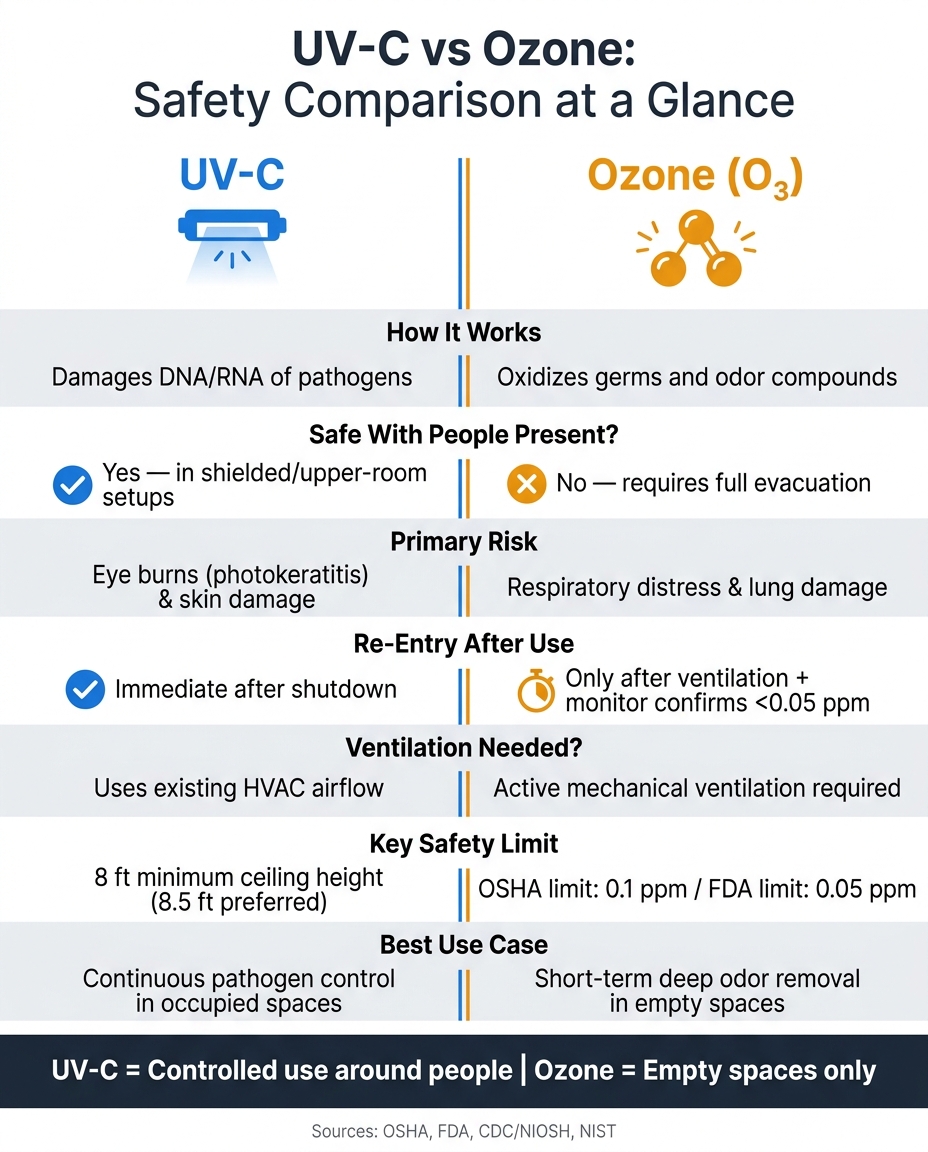
UV-C vs Ozone: Safety Comparison at a Glance
Does UVC light create ozone by reacting with oxygen?
sbb-itb-5fea4da
Quick Comparison
| Factor | UV-C | Ozone |
|---|---|---|
| How it works | Damages DNA/RNA | Oxidizes germs and odor compounds |
| Safe with people present? | Yes, in shielded setups | No |
| Main risk | Eye and skin injury | Lung and breathing harm |
| Best fit | Day-to-day air treatment | Short-term odor removal |
| Re-entry after use | Usually right after shutdown | Only after ventilation and testing |
| Extra concern | Some lamps can make ozone | Can react with fragrances and cleaners |
Bottom line: if you want steady air treatment in an occupied building, UV-C is usually the better path. If you need deep odor treatment after smoke, mold, or a sealed vehicle job, ozone may fit – but only with full vacancy, ventilation, and meter-based clearance.
How UV-C Works and Where the Safety Risks Are
UV-C inactivates viruses, bacteria, and fungi by damaging their DNA and RNA. The most common germicidal wavelength is 254 nm, and it’s the one most people mean when they talk about germicidal UV.
A newer option, 222 nm (Far-UV-C), is safer for skin and eyes. But that doesn’t make it harmless. Indoors, it can still generate ozone and other byproducts, so “safer for skin and eyes” should never be read as risk-free. In practice, the big safety controls are shielding, placement, and maintenance.
UV-C in HVAC and Upper-Room Air Disinfection
There are two main ways UV-C is used in buildings: inside HVAC ducts and in upper-room germicidal UV (GUV) fixtures.
In-duct systems sit inside the air handling unit or ductwork, which keeps the light away from occupants. Upper-room systems are mounted near the ceiling and send light horizontally above the breathing zone. To cut the chance of eye and skin exposure, a ceiling height of at least 8 feet is recommended, with 8.5 feet preferred.
Air movement does the rest. Fans or HVAC airflow push room air through the upper UV zone and keep it there long enough to inactivate pathogens.
CDC/NIOSH recommends UV-C as one part of a layered plan that also includes ventilation.
That last point matters. These setups work only if the UV light stays out of the occupied zone.
Main UV-C Safety Risks
Direct exposure to 254 nm UV-C can cause photokeratitis and erythema (sunburn-like skin damage).
UV-C can also damage materials over time. Wood, wallpaper, rubber, and plants can fade or degrade, so light-sensitive items should be shielded or moved out of the exposure area.
Lamp type matters too. Not all UV-C lamps are ozone-free. Standard quartz lamps can transmit 185 nm light, which splits oxygen molecules and generates ozone. Lamps made with titanium-doped quartz block that wavelength and prevent ozone formation.
For 222 nm systems, optical filters can suppress radiation below 200 nm, but ventilation still matters. Recent NIST research found that 222 nm light can react with indoor fragrances and generate ozone, formaldehyde, and nanoparticles.
Put simply, the light itself isn’t the only issue. The fixture, the lamp material, the room setup, and the air all play a part.
These risks are controlled through access limits, fixture design, and routine service.
UV-C Installation and Maintenance Best Practices
Safe UV-C use depends on proper installation, controlled access, and regular maintenance.
"Upper-room GUV systems are generally custom designed for the space in which they will be used. Systems should be designed, installed, and tested with the help of a qualified HVAC professional or a reputable UV-system manufacturer." – CDC/NIOSH
Access control is a must. Switches should be lockable or placed in restricted areas so untrained staff or the public can’t accidentally turn systems on or off. Warning labels should be posted anywhere the UV zone could be reached.
Maintenance needs the same level of care. Always power off the unit before any ceiling-level work. Trained service personnel should follow lockout/tagout procedures and wear proper PPE. Lamps should be cleaned once a year with rubbing alcohol while powered off, and replaced every 12 to 24 months.
| Condition | Safe UV-C Practice | Unsafe UV-C Practice |
|---|---|---|
| Ceiling height | 8.5 ft or higher (minimum 8 ft) | Below 8 ft where occupants can reach the UV zone |
| Lamp type | Ozone-free titanium-doped quartz | Standard quartz that transmits 185 nm |
| Safe setup | Directed horizontally above occupied zones or inside HVAC ducts | Directed toward or reflected onto occupants |
| Switch access | Lockable or restricted to trained staff | Standard switches accessible to anyone |
| Service | Powered off with lockout/tagout; PPE used | Servicing fixtures while lamps are energized |
| Material risk | Plants removed; sensitive surfaces shielded | Plants or light-sensitive materials left in the UV zone |
Ozone brings a separate rule: the space must be empty before treatment begins. For more details on how these treatments work, see our disinfection service FAQs.
How Ozone Works and Why Exposure Control Matters
Ozone (O₃) is an unstable gas made on-site. It works by oxidizing microorganisms and odor-causing compounds across a sealed space. That’s why the big safety issue isn’t just using ozone. It’s keeping it contained and controlling when anyone can go back inside.
Indoor Ozone Uses for Odor Removal and Disinfection
In professional settings, ozone is used to deal with smoke, mold, and chemical odors. It’s also used for disinfection in sealed spaces such as vehicles, RVs, and boats.
For ozone treatment to work, the space needs to be sealed and unoccupied. The treatment also needs the right concentration for a set amount of time. If those pieces aren’t in place, the job can fall apart fast.
Main Ozone Safety Risks
Here’s the hard truth: ozone only works at levels that are not safe to breathe, which is why removing odors safely requires strict protocols.
OSHA sets the maximum 8-hour workplace exposure at 0.1 ppm, and the FDA limit for medical devices is 0.05 ppm (50 ppb). Professional treatments use higher concentrations because lower levels usually won’t do the job.
At higher levels, ozone can irritate the lungs and lead to coughing, chest tightness, shortness of breath, and worse asthma symptoms. It can also react with indoor terpenes from fragrances and cleaning products, which may create formaldehyde and ultrafine particles. And there’s another problem: smell is not a safe way to judge ozone levels.
Best Practices for Professional Ozone Treatment
Because ozone has to stay contained to be effective, safe use depends on strict occupancy control. In plain English, nobody should be inside during treatment. That means no people, no pets, and no plants.
A safe professional process follows a tight sequence:
- Clear the space completely
- Run treatment for a controlled period
- Ventilate the area well
- Allow time for ozone to decay
- Confirm levels before re-entry
Nearby occupied areas should also be sealed off so ozone doesn’t drift through doorways or HVAC systems. That part matters more than many people think. Ozone doesn’t care where the treatment zone “ends” on paper.
After treatment, ozone needs time to break down and be ventilated out. Re-entry should happen only after a calibrated ozone monitor shows levels below 0.05 ppm.
That’s the line between safe professional use and unsafe use:
| Condition | Safe Professional Treatment | Unsafe Treatment |
|---|---|---|
| Occupancy | Fully unoccupied – no people, pets, or plants | Occupied or partially occupied spaces |
| Concentration | High levels for a controlled, limited duration | Continuous low-level emission in occupied areas |
| Ventilation | Active mechanical ventilation after treatment | No ventilation or recirculated air only |
| Monitoring | Verified with calibrated sensors before re-entry | Relying on smell to judge safety |
| Secondary risks | Reactive chemical sources removed beforehand | Fragrances or terpene-based products left in the space |
| Adjacent spaces | Treatment area sealed off | Ozone allowed to migrate to occupied rooms |
UV-C vs Ozone: Safety, Use Cases, and Decision Points
UV-C vs Ozone in Occupied and Unoccupied Spaces
Once the safety rules are clear, the decision gets pretty simple: will people be in the space or not?
That’s the main dividing line.
Properly designed UV-C systems – especially 254 nm lamps placed in HVAC ducts or upper-room fixtures – can operate while people are present, as long as direct exposure to skin and eyes is blocked. Ozone is a different story. It requires an empty space. The EPA says ozone generators should not be used in occupied areas because they can produce harmful concentrations. And the workflow is different too: when UV-C shuts off, people can come back in right away. No flush-out step is needed. Ozone calls for evacuation first, then ventilation before re-entry.
Which Technology Fits Which Situation
If the goal is continuous pathogen control in an occupied building, UV-C is the practical option. It works in the background, helps deactivate airborne microorganisms, and doesn’t force you to clear the building.
For short-term, heavy-duty odor removal – especially after smoke or fire damage – ozone makes more sense. It can move into porous materials in ways UV-C light can’t. That’s why it’s often used for deep disinfection in unoccupied spaces.
Put simply:
- Ozone is a better match for one-off odor events.
- HVAC-integrated UV-C is a better match for day-to-day air treatment when people still need to use the space.
Side-by-Side Safety Comparison Table
Here’s the short side-by-side view.
| Factor | UV-C (254 nm) | Ozone (O₃) |
|---|---|---|
| Primary risks | Skin burns and eye injury from direct exposure | Respiratory distress, chest pain, and lung damage |
| Occupied-space suitability | Yes, when shielded or installed in upper-room/HVAC fixtures | No – requires full evacuation during treatment |
| Ventilation needs | Uses existing HVAC airflow | Active mechanical ventilation required after treatment |
| Material concerns | Can degrade some plastics and organic materials over time | Corrosive to rubber, certain plastics, and some metals |
| Technician safeguards | Protective eyewear and clothing for installation and maintenance | Respirators and ozone monitors are required |
| Re-entry timing | Immediate – no waiting period after shutdown | Delayed – only after flush-out and monitoring confirm safe levels |
| Best use | Continuous pathogen control and HVAC mold/bacteria control | Short-term deep odor removal and sealed-space disinfection |
Safety Checklists and Key Takeaways
Use these final checks before operating or going back into a treated space.
UV-C Safety Checklist
Turn fixtures off before any maintenance or ceiling access. NIOSH says UV fixtures should be powered off before maintenance or ceiling-level work.
- Choose ozone-free lamps made with titanium-doped quartz to avoid ozone generation.
- Use lockable switches so the system can’t be turned on during maintenance.
- Post warning signage near any disinfection zone.
- Clean lamps only when powered off.
Ozone works under a different rule: the space must be empty before treatment starts.
Ozone Safety Checklist
The space must be completely empty – no people and no pets – before the generator runs.
- Ventilate the area with outdoor air, exhaust fans, or mechanical ventilation after treatment.
- Don’t use odor as a safety test. Check safe levels with a calibrated monitor before re-entry.
- Confirm levels are below 0.05 ppm before anyone goes back in.
- Protect rubber, plastics, and sensitive electronics from ozone exposure. This is especially critical in confined marine settings, such as when using ozone for bilge odor removal.
Key Takeaways: Safest Practices for Each Technology
UV-C, when properly shielded or installed in upper-room or HVAC setups, is meant for continuous use in occupied spaces. Ozone needs an empty space and a verified flush-out period before anyone returns.
Both can cause harm if used the wrong way. UV-C can injure eyes and skin through direct exposure. Ozone can damage the respiratory system at higher levels. In both cases, safe use comes down to proper installation, monitoring, and trained operators.
FAQs
Is 222 nm UV-C safe indoors?
Far-UV-C light at 222 nm is generally seen as safe for human skin and eyes in occupied indoor spaces. The main reason is simple: its short wavelength doesn’t penetrate deeply into living tissue.
That said, it can still produce small amounts of ozone and other secondary air pollutants. In practice, those effects are lower when devices run at low intensities and the room has good ventilation.
How long should I wait after ozone treatment?
After an ozone treatment, no one should go back into the space until the gas has cleared and reached safe levels.
A common rule of thumb is to wait 2 hours after the treatment ends. That said, the timing can vary. In some cases, ozone may clear in as little as 30 minutes. In others, it can take several hours, depending on the conditions in the space.
Proper ventilation matters here. Before re-entry, the area should be aired out well. Ozonated Cleaning LLC also recommends using professional monitoring equipment to confirm that ozone levels are safe.
Can ozone damage furniture or electronics?
Yes. Ozone is a strong oxidizing agent, which means it can react with and wear down some household materials.
It’s especially hard on rubber. Over time, rubber may crack, become brittle, or even break down into dust. Ozone can also affect sensitive electronics and other materials that oxidize easily. Ozonated Cleaning LLC recommends removing sensitive items, such as artwork and rubber materials, before treatment.
Recent Comments