
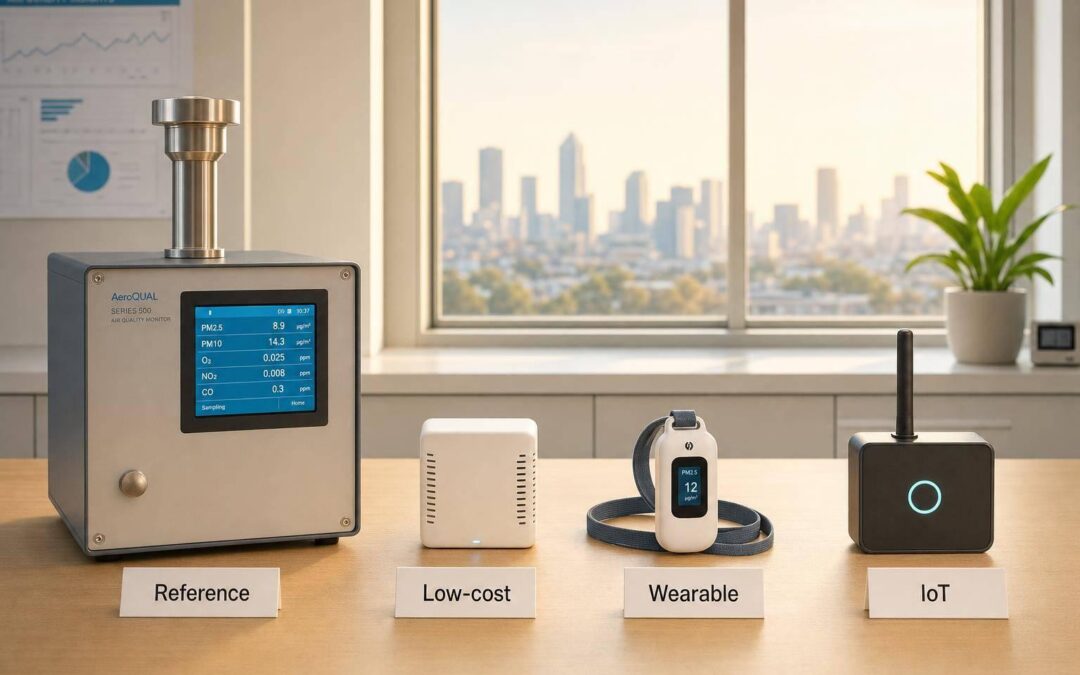
If you need to decide whether a space is safe after ozone or hydroxyl treatment, the monitor type matters more than the price tag. In this article, I compare reference-grade stations, low-cost sensor networks, mobile/wearable monitors, and IoT real-time systems based on accuracy, use case, portability, and cost – from about $100 to $40,000+.
Here’s the short version:
- Reference-grade stations are for compliance and clearance proof. They cost the most, but they give the strongest data.
- Low-cost sensors are best for trend tracking and room-to-room checks, not safety-critical clearance decisions.
- Mobile and wearable monitors help me check the breathing zone and walk through spaces during exposure checks or post-treatment sweeps.
- IoT systems add alerts, cloud logging, and remote oversight, but they still depend on calibration and sensor upkeep.
A few numbers stand out:
- Americans spend about 22.25 hours per day indoors
- Indoor pollutant levels can be 2–4x higher than outdoor levels
- Ozone shock treatments can reach 8–12+ ppm
- Re-entry often depends on getting back below 0.1 ppm
- Low-cost sensors may cost under $2,500, while reference-grade units can run $15,000–$60,000+
If I had to boil the whole article down to one point, it would be this: use the monitor that matches the decision. For awareness, lower-cost tools can work. For worker exposure, portable tools help. For clearance and compliance, I need higher-grade data.
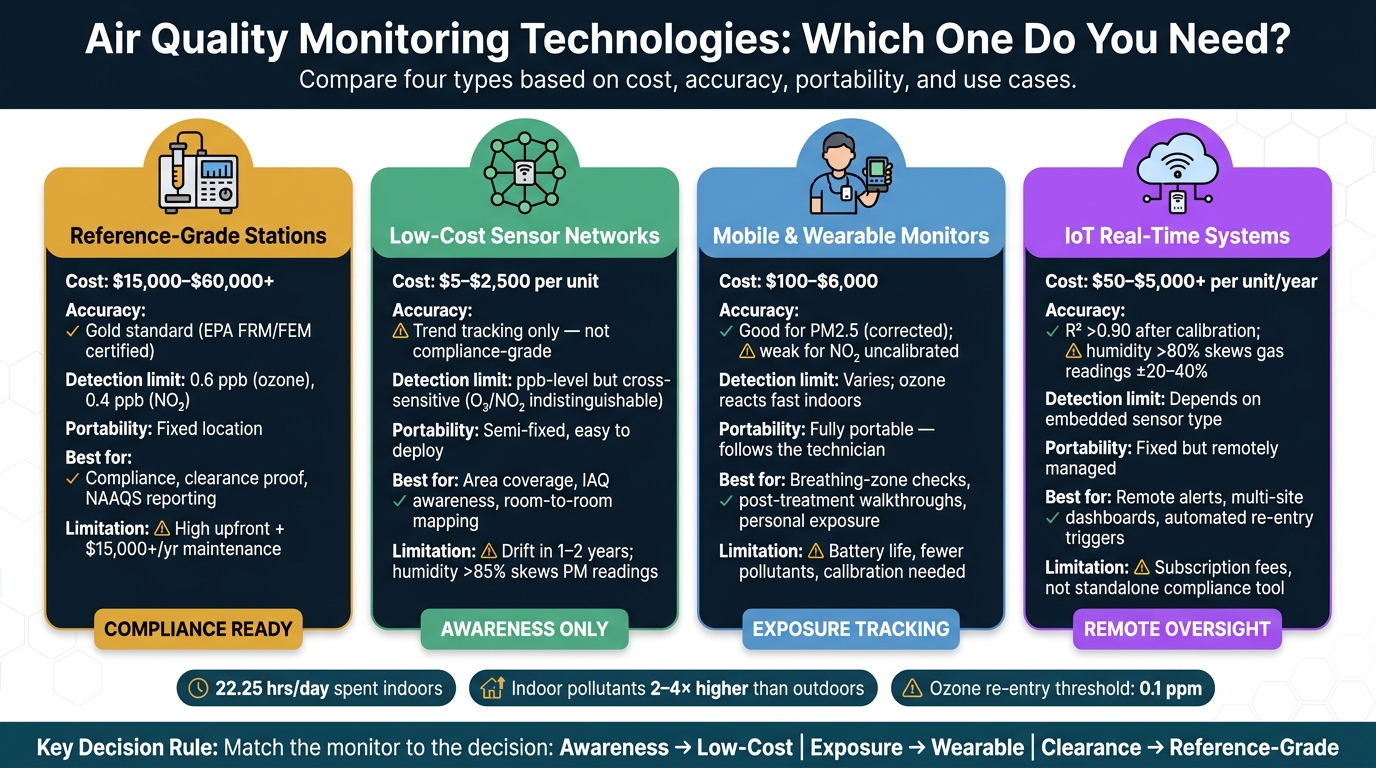
Air Quality Monitor Types: Accuracy, Cost & Use Case Compared
Quick Comparison
| Technology | Best for | Main limit | Typical cost |
|---|---|---|---|
| Reference-grade stations | Compliance, clearance proof, high-accuracy checks | High upfront and upkeep cost; fixed location | $15,000–$60,000+ |
| Low-cost sensor networks | Trend tracking, area coverage, basic awareness | Drift, cross-sensitivity, weaker clearance support | $5–$2,500 |
| Mobile/wearable monitors | Personal exposure, breathing-zone checks, walkthroughs | Battery life, calibration needs, fewer pollutants | $100–$6,000 |
| IoT real-time systems | Remote alerts, multi-site logging, live dashboards | Subscription fees, sensor aging, not for compliance by itself | $50–$5,000+ per unit/year |
That’s the core comparison. Below, I break down where each option fits, where it falls short, and how to pick the right setup for ozone- and hydroxyl-related work.
sbb-itb-5fea4da
1. Reference-Grade Monitoring Stations
Reference-grade monitors (FRM/FEM) are the EPA’s compliance benchmark for air quality measurement. Put simply, they set the accuracy baseline for the lower-cost systems that come next.
Accuracy & Detection Limits
The gap between reference-grade instruments and lower-cost sensors is large. A reference-grade ozone analyzer has a detection limit of 0.6 ppb, while NO₂ analyzers can go as low as 0.4 ppb using chemiluminescence. These instruments also have to meet EPA coefficient of variation thresholds of 7% for ozone and 15% for NO₂.
NIOSH sets a similar target:
"Direct reading instruments for gaseous exposure assessment should measure within ± 25% of the true concentration of the target analyte with 95% certainty." – NIOSH
Reference networks such as the National Air Toxics Trends Station (NATTS) can measure more than 100 pollutants, including VOCs, carbonyls, and PM10 metals.
Treatment Workflow Fit
For ozone or hydroxyl treatment workflows, reference-grade stations play a key part in safety and clearance. After an ozone shock treatment, where concentrations often reach 8–12+ ppm, you need verified data showing that levels have dropped below the 0.1 ppm occupational exposure limit before anyone goes back inside.
That’s the point: with ozone disinfection in enclosed spaces, it’s not just about taking a reading. It’s about proving re-entry is safe.
In hydroxyl workflows, reference-grade instruments can also confirm trace-level changes in controlled spaces like hospitals and medical facilities.
Cost & Maintenance
A single reference-grade gas analyzer costs $15,000–$40,000. PM analyzers cost $25,000–$60,000+. Annual O&M can top $15,000 per year.
And that’s only part of the picture. You also need climate-controlled housing, grid power, calibration, security, technical support, and data management.
Data & Control Integration
Reference stations can send data to cloud servers for storage and visualization through software APIs. Even so, they’re far less portable than modern low-cost sensor setups.
Agencies use them as regulatory anchors, then pair them with denser sensor networks to get better spatial coverage. That trade-off between accuracy and coverage becomes much easier to see once you look at lower-cost sensor networks.
2. Low-Cost Sensor Networks
If reference-grade stations set the accuracy baseline, low-cost sensor networks make it possible to cover a lot more ground for much less money. The U.S. EPA defines low-cost sensors (LCS) as devices that cost less than $2,500 per unit, although single sensor modules can cost as little as $1 to $500.
Accuracy & Detection Limits
LCS work well for spotting patterns and shifts over time, but not for compliance use. Electrochemical (EC) sensors can pick up gases like ozone and NO₂ at parts-per-billion levels. The catch is cross-sensitivity, which can blur the signal and make readings hard to trust without calibration.
"The worst cross-sensitivity for EC sensors is the one between NO₂ and O₃… they are therefore indistinguishable by EC sensors." – Idris Hayward, National Physical Laboratory
For particles, low-cost networks often rely on optical particle counters (OPCs). These sensors cannot detect particles smaller than 0.3 μm because of the light wavelength they use. Humidity can also throw things off. When relative humidity climbs above 85%, hygroscopic particles such as salts and nitrates absorb water and swell, which can lead OPCs to overestimate PM mass by a lot. Day-to-day swings in temperature and humidity add more error on top of that.
Treatment Workflow Fit
For ozone and hydroxyl treatments, LCS are best used to map room-to-room differences, not to decide whether a space is safe for re-entry. Metal oxide sensors (MOS) respond in under 2 seconds after pre-heating, so they’re useful when you want to watch treatment trends in near real time.
The bigger issue shows up after treatment. Baseline drift can come from electrode wear, electrolyte evaporation, or dust buildup. And that drift can lead to unsafe clearance readings in as little as a few weeks. That’s why site-specific recalibration matters before using these sensors to confirm re-entry safety after ozone treatment.
Cost & Maintenance
Costs vary a lot depending on how bare-bones or full-featured the setup is. A basic ozone sensor module can cost $5 to $200, while a full professional sensor node with housing, data logging, and connectivity still stays under $2,500.
Service life is another limit. Most EC sensors last only 1 to 2 years before electrode degradation makes them unreliable. Annual O&M for consumer-grade units ranges from $0 to $200, while professional systems often roll maintenance into a subscription that covers the hardware, connectivity, and replacements for one flat yearly fee.
Data & Control Integration
Professional LCS nodes usually connect through cellular networks such as 4G/GPRS and push live data to cloud dashboards and alert systems. That setup makes them useful when teams need quick visibility across many locations.
A good example came in 2026, when the Monterey Bay Air Resources District deployed 25 Clarity Node-S sensors across 21 municipalities to support eight reference stations for real-time wildfire smoke tracking.
Do not use uncalibrated sensor data for health decisions. Field-calibrate against a reference instrument first. For personal exposure tracking and spot checks, mobile and wearable platforms fill the next gap.
3. Mobile and Wearable Monitoring Platforms
Unlike fixed sensor networks, mobile and wearable platforms follow people as they move through a space. That makes a big difference when you care less about room averages and more about technician exposure and re-entry safety.
Accuracy & Detection Limits
Portable PM2.5 monitors often line up well with reference instruments once temperature and humidity are corrected.
PM10 is a different story. It tends to be less dependable because many devices estimate it from PM2.5 instead of measuring it directly.
Ozone is harder to track at the personal level. Indoor levels can change fast, and ozone reacts quickly with surfaces and skin. Because of that, data from a nearby station can miss what someone is actually breathing.
Portable NO2 sensors are still the weakest link. Error rates can be extreme when the devices are not calibrated, but field calibration cuts that error by a lot.
Treatment Workflow Fit
For ozone and hydroxyl treatment workflows, wearable monitors cover a blind spot that stationary units can’t. They measure real-time conditions in the breathing zone – the air a technician actually inhales – instead of sampling from a wall mount or tripod in one fixed spot.
They also help with post-treatment clearance sweeps. If you walk a sensor through each sub-room and into corners, you can check that O3 levels have fallen below safety limits across the whole area , which is a critical step in determining optimal ozone treatment time, not just where one stationary monitor happens to sit. Direct-reading instruments should be used only when they meet exposure-assessment accuracy targets.
Cost & Maintenance
Pricing varies quite a bit:
- Wearable sensors: $100–$300
- Professional portable units: $800–$3,000
- Research-grade units: $2,000–$6,000
The purchase price isn’t the whole story. Ongoing costs include sensor replacements at $50–$200 and cloud data subscriptions at $5–$15 per month.
Calibration is the main hassle here. Annual maintenance usually costs 10%–20% of the purchase price.
Data & Control Integration
Most consumer and professional portable units connect to smartphone apps over Bluetooth or Wi-Fi, which makes real-time readouts easy to check in the field. Higher-end wearables can stream second-by-second data to a cloud dashboard.
When portable sensors are placed on carts or other moving platforms to map large spaces, foam mounts or sleeves help cut vibration noise.
For continuous alerts, remote oversight, and automated logging, IoT-enabled systems build on this setup.
4. IoT-Enabled Real-Time Monitoring Systems
Portable monitors give you readings on the spot. IoT systems go a step further. They add remote alerts, automation, and a view across many devices at once. That turns air quality sensing from a one-time check into a continuous system that people can act on. By combining low-cost sensors, cloud analysis, and AI, IoT air quality systems support real-time pollution forecasting and source identification.
Accuracy & Detection Limits
IoT sensors are useful for real-time oversight, but they are not a substitute for reference-grade compliance monitoring.
For PM2.5, well-calibrated units can reach R² values above 0.90 when compared with reference monitors after calibration. Ozone and VOC monitoring are more affected by outside conditions. Electrochemical sensors are a common pick for O3 detection, but humidity above 80% can skew readings by 20% to 40%. That’s a big swing.
A simple fix helps: pair gas and particle sensors with temperature and humidity monitoring. That gives the system more context and helps offset those effects in real time. AI can also correct drift, interference, and data gaps.
Treatment Workflow Fit
This becomes most useful after ozone treatment, when a site needs proof that it is safe for re-entry.
Platforms like ThingsBoard can use rule chains to send automatic alerts and control equipment when readings cross a set limit. In ozone disinfection workflows, that same setup can trigger an alert once ozone levels drop below the re-entry threshold.
Cost & Maintenance
| Tier | Price Range | Typical features |
|---|---|---|
| Budget | $50–$150 | Basic PM2.5 and temperature/humidity monitoring, usually over Wi-Fi |
| Mid-range | $150–$400 | Adds gas sensors, IP65 weatherproofing, and LoRaWAN |
| Premium/Research | $400–$1,000+ | Multi-gas suites, cellular connectivity, and cloud analytics |
In the field, professional IoT units are often priced from a few hundred dollars to a few thousand dollars each. Some subscription models cost $500 to $5,000 per unit per year.
Remote diagnostics can cut maintenance trips. But sensors still wear out over time, so it makes sense to plan for replacement every 2 to 3 years. Electrochemical sensors also need recalibration every 6 to 12 months. If you want fewer moving parts on the buying side, subscription-based Sensing-as-a-Service plans can bundle hardware, connectivity, and remote calibration into one annual fee.
Data & Control Integration
The big win here is not just better visibility. It’s fewer site visits and faster action.
APIs can send data into GIS dashboards or building management systems. Remote diagnostics also cut hands-on maintenance. For remote sites where Wi-Fi drops out, NB-IoT or LTE-M can keep devices connected while using little power.
One more practical safeguard is an external hardware watchdog timer such as the TPL5010. If a node freezes because of a firmware hang, the watchdog can reboot it automatically. That can reduce manual maintenance trips by up to 60%.
Cost-Benefit Findings and Pros and Cons
No single monitoring category works best in every case. The right pick depends on what you need to verify, how much you can spend, and whether you need pinpoint accuracy or broader area coverage. The main question isn’t which system costs the least. It’s whether the system is accurate enough for the decision in front of you.
Reference-grade ozone analyzers deliver high accuracy, but they cost a lot to buy and run. Low-cost consumer sensors are much easier on the budget, but they aren’t fit for decision-grade use. That makes them a poor choice for safety-critical calls, like deciding when it’s safe to re-enter a space after an ozone shock treatment.
For ozone disinfection, that’s the part that matters most: can the sensor confirm safe re-entry, or can it only tell you that ozone was present at some point? When you need to verify that ozone has fallen below the 0.1 ppm re-entry threshold, Heated Metal Oxide Sensors (HMOS) are a fit for low-level clearance checks. EC sensors respond faster for leak detection, but they’re more cross-sensitive to NO₂.
Hydroxyl radicals are a different story. They can’t be measured directly in real time, so verification depends on equipment checks like UV bulb hours and catalyst condition.
These monitoring tiers line up well with different disinfection jobs, from personal exposure checks to full site clearance. Here’s how the trade-offs play out in practice:
| Category | Pros | Cons | Use Cases |
|---|---|---|---|
| Reference-Grade | Gold-standard accuracy; decision-grade for compliance | Very expensive; sparse deployment; intensive maintenance | Not practical for homes, vehicles, or small commercial spaces |
| Low-Cost Sensors | Affordable; easy to deploy; useful for awareness | Accuracy drifts; not suitable for safety decisions | IAQ awareness (residential); supplemental trends (small commercial) |
| Mobile/Wearable | Portable; tracks personal exposure | Lower accuracy; short battery life; limited pollutants covered | Personal exposure tracking; industrial hygiene spot-checks; leak detection in vehicles and boats |
| IoT/Professional | Near-reference data; scalable; remote calibration | Subscription cost; not intended for regulatory reporting | Smart home remediation; compliance and safety monitoring; fleet and marina management |
In many cases, the lowest-cost setup that still works well is a few accurate anchor devices paired with wider low-cost coverage. Monterey Bay Air Resources District showed this in 2026 by pairing 8 reference stations with 25 Clarity Node-S sensors across 21 municipalities for wildfire tracking.
For professional ozone and hydroxyl service providers, a managed monitoring subscription – about $500 to $5,000 per unit per year – wraps hardware, cellular connectivity, and remote calibration into one set fee. That can cut the run-rate burden that makes reference-grade systems so expensive over time.
Conclusion
These monitoring types support different decisions, not the same one. The best setup comes down to one thing: what the data needs to prove. Reference-grade systems fit compliance work. Low-cost and IoT systems fit day-to-day visibility. Mobile and wearable tools fit exposure tracking.
Reference-grade systems (FRM/FEM) are the right pick when results must be compliance-ready, such as for NAAQS reporting or compliance documentation. Low-cost and IoT-enabled systems work best for routine visibility, not compliance. In schools, offices, construction sites, and industrial fencelines, they provide real-time data without the infrastructure burden of a reference station. When the focus moves from area trends to personal exposure, mobile and wearable devices step in. They are most useful for short-term, location-specific readings.
For ozone- and hydroxyl-related work, the same logic applies: clearance verification calls for ozone sensors accurate enough to confirm safe re-entry, exposure checks call for a wearable in the breathing zone, and routine monitoring in treated spaces is where low-cost or IoT tools fit best.
A hybrid approach often makes the most sense: use reference-grade anchors for results you can defend, then add portable or IoT tools for broader day-to-day coverage. The right sensor is the one that answers the question in front of you.
FAQs
Which monitor is best for safe re-entry after ozone treatment?
For safe re-entry after ozone treatment, wait at least 20 to 60 minutes after the generator shuts off. That gives the ozone time to break down into breathable oxygen.
Ozone can irritate the respiratory system, so no one should be in the space during treatment. That includes people, pets, and plants. Before anyone goes back in, air the area out well.
Ozonated Cleaning LLC offers professional ozone and hydroxyl odor removal and sanitization services in the Chicagoland area.
Can a low-cost sensor be trusted for clearance decisions?
No. Low-cost sensors usually aren’t dependable enough on their own for high-stakes clearance decisions.
They can help with extra monitoring or personal exposure research. But problems with accuracy, cross-sensitivity, and interference from temperature and humidity mean they don’t replace professional verification.
When should I choose wearable monitoring over fixed sensors?
Choose wearable or portable monitors for short-term testing or quick spot-checks in different places. They work well for general health awareness and for noticing big shifts in air quality.
Choose fixed sensors when you need steady, high-accuracy data from one location over time. That includes things like compliance, seasonal trend tracking, or protecting people with specific health sensitivities.
Recent Comments