Ozone cleaning is a game-changer for reducing harsh chemicals and waste in cleaning. Using just air, water, and electricity, it disinfects, removes odors safely, and cleans surfaces safely. From healthcare to food processing, ozone is a powerful solution that leaves no residue, requires less water, and cuts energy use.
Here are 7 key ways ozone is used in cleaning:
- Healthcare Facilities: Disinfects surfaces without harmful residues.
- Odor Removal: Neutralizes tough smells in homes and vehicles.
- Carpet Cleaning: Removes stains and odors without sticky residues.
- Kitchen & Bathroom Cleaning: Sanitizes surfaces safely, even on food-contact areas.
- Laundry: Cleans fabrics with less detergent and cold water.
- Food Processing: Extends shelf life and kills pathogens.
- Industrial Cleaning: Cleans delicate equipment like semiconductors.
Ozone works faster than chlorine, is cost-effective (just $0.0018 per liter), and eliminates the need for plastic packaging. It’s already used in hospitals, homes, and industries to improve safety, save resources, and protect the environment.
1. Surface Disinfection in Healthcare and Commercial Facilities
Chemical-Free and Residue-Free Cleaning
Hospitals, clinics, and office buildings are under constant pressure to maintain sterile environments while minimizing exposure to synthetic chemicals. Ozone technology offers a solution by generating a powerful disinfectant on-site using just water, oxygen, and electricity. This eliminates the need for synthetic detergents, fragrances, or dyes, which often leave behind unwanted chemical residues.
One of ozone’s standout features is its rapid decomposition. After oxidizing pathogens, it breaks down into pure oxygen within about two hours, leaving no toxic residues behind. This means surfaces in patient rooms, waiting areas, and surgical suites are safe for use immediately after treatment. This quick breakdown ensures a safer environment, especially in high-risk areas.
Pathogen, Odor, and Stain Elimination
Ozone is highly effective against a wide range of pathogens. In controlled lab tests, it has been shown to inactivate up to 99% of viruses within just 30 seconds of direct exposure. For real-world scenarios, achieving a 99.9% reduction in airborne viral particles typically takes 8 to 10 minutes, while surface-bound viruses may require about 30 minutes.
In surgical settings, specialized ozone systems can achieve a 6-log (99.9999%) reduction of bacteria, viruses, and even resistant spores. What sets ozone apart is its ability to penetrate crevices and hard-to-reach areas that manual cleaning might miss, ensuring thorough disinfection in enclosed spaces where precision matters most.
Reduced Water and Energy Usage
Traditional cleaning methods often involve frequent trips to refill cleaning solutions, which can disrupt workflows and waste time. Portable ozone generators solve this problem by producing disinfectant on demand, eliminating the need for constant refills. This not only enhances worker efficiency but also reduces the environmental impact tied to the production, transportation, and disposal of chemical cleaning products. By cutting down on water and energy usage, ozone technology offers a practical and eco-conscious alternative.
sbb-itb-5fea4da
2. Odor Elimination in Residential and Vehicle Spaces
Pathogen and Odor Elimination
Ozone works by oxidizing the molecules responsible for unpleasant odors, effectively neutralizing them at their source instead of just covering them up. This makes it particularly effective against stubborn odors like cigarette smoke, pet urine, and mold.
"Ozone eliminates odors through a powerful oxidation process, breaking down odor-causing molecules at their source rather than simply masking them." – The Institute for Environmental Research and Education
What sets ozone apart is its ability to penetrate deeply into porous materials like carpets, upholstery, and even vehicle interiors. It reaches areas that traditional cleaning methods often miss, ensuring a more thorough deodorization process.
Applications in Residential, Commercial, and Industrial Settings
Ozone treatment is a practical solution for a variety of spaces. It’s commonly used in homes dealing with smoke damage, persistent pet odors, or musty environments. Vehicles, too, benefit from ozone treatment, especially when odors are trapped in fabric seats, floor mats, or ventilation systems.
For example, in the Chicagoland area, Ozonated Cleaning LLC provides odor removal services with pricing that reflects the scope of work: $600 to $900 for residential spaces depending on square footage, $150 per vehicle, and $200 per semi-truck. This method is not only effective but also chemical-free, making it an appealing option for those looking for a residue-free cleaning process. However, it’s worth noting that proper safety measures are critical during ozone treatments.
Chemical-Free and Residue-Free Cleaning
Once ozone has oxidized the odor-causing molecules, it naturally breaks down into oxygen, leaving no chemical residues behind. However, due to its high reactivity, strict safety protocols are essential. People, pets, and plants must vacate the treatment area, and the space should be ventilated for 30–60 minutes after the process.
"High concentrations of ozone can be harmful to human health. It can irritate the respiratory system, causing coughing, shortness of breath, and even lung damage." – The Institute for Environmental Research and Education
Additionally, ozone can degrade materials like rubber, certain plastics, and some fabrics. To avoid damage, sensitive items should either be removed or properly covered during high-concentration treatments. This precaution ensures the safety and longevity of materials while still achieving effective odor removal.
Sanitize Everything With Ozone
3. Carpet and Upholstery Stain Removal
Ozone’s proven ability to tackle odors and surface contaminants extends seamlessly into the realm of carpet and upholstery care, offering a reliable option for stain removal. When deciding on the best approach for deep restoration, it helps to compare ozone and hydroxyl cleaning methods to see which fits the specific environment.
Cleaning Without Chemicals or Residue
Aqueous ozone is created by infusing water with ozone generated electrically. This results in a powerful cleaning solution that effectively removes soils, mold, mildew, and odors – all without the need for synthetic detergents. Once dry, it leaves no residue on carpet or upholstery fibers. This is a clear advantage over traditional detergents, which often leave behind sticky residues that attract dirt and accelerate re-soiling.
"The treatment process does not add chemicals to the water, which also means that once it dries, there is no chemical residue, which is one of the key causes for rapid re-soiling of carpets." – Cleanfax
Tackling Pathogens, Odors, and Stains
Aqueous ozone excels at breaking down tough stains embedded deep in carpet and upholstery fibers. It also neutralizes lingering biological odors through oxidation. Whether applied as a prespray for stubborn spots or used with extraction tools, it works effectively and evaporates into oxygen within an hour, ensuring the area is safe for use soon after treatment.
Practical Use in Various Settings
In March 2016, a major Midwest university adopted aqueous ozone systems for its cleaning operations. This switch cut chemical usage by 50%, leading to cost savings and aligning with the university’s efforts to reduce packaging waste and the environmental impact of chemical deliveries. For commercial spaces, fill stations installed in janitorial closets make it easy for staff to dispense aqueous ozone directly into sprayers or extractors.
This approach not only rejuvenates carpets and upholstery but also promotes a cleaner, more sustainable way to maintain fabrics.
4. Kitchen and Bathroom Sanitization
Kitchens and bathrooms require top-notch cleaning to maintain hygiene, but traditional chemical disinfectants often leave behind residues, especially on food-contact surfaces, or demand extensive rinsing. Ozone technology offers a game-changing, chemical-free solution to these challenges.
Chemical-Free and Residue-Free Cleaning
Aqueous ozone is created on-site by infusing ozone into water using nothing more than oxygen and electricity. This process produces a powerful sanitizing solution that eliminates contaminants without leaving behind any chemical residues. Once its job is done, ozone reverts to regular oxygen (O₂), ensuring surfaces like countertops, sinks, and toilets are left spotless, without sticky films or harmful residues.
"[Aqueous] ozone has enjoyed a long history of use and is known as a broad-spectrum biocide against viruses, bacteria, biofilms, fungi and protozoa." – Food Safety Magazine
This residue-free approach makes food-contact surfaces safer and more effective for pathogen removal.
Pathogen, Odor, and Stain Elimination
Ozone’s oxidation-reduction potential (2.07 V) far surpasses chlorine’s (1.36 V), making it a highly effective agent for neutralizing microorganisms on contact. By targeting key components of microbial cells, it eliminates pathogens efficiently. Studies dating back to 1939 demonstrate ozone’s ability to inhibit yeast and mold growth, making it an excellent choice for damp areas like bathrooms and food preparation spaces.
Reduced Water and Energy Usage
Unlike many traditional sanitizers that require hot water or steam, ozone works efficiently in cold water, within a temperature range of 32°F to 86°F. This eliminates the need for energy-intensive water heating. Plus, since ozone leaves no chemical residue, there’s no need for repeated rinsing, cutting down on water usage. On-site ozone generation also reduces waste, as fewer trips to restock cleaning chemicals are needed, saving workers up to an hour per shift.
"These technologies are helping us significantly reduce the environmental impacts associated with the manufacturing and disposing of literally tens of millions of plastic bottles, cardboard cartons, [and] paper and plastic shipping materials." – Stephen Ashkin, Father of Green Cleaning
Take, for instance, Ozonated Cleaning LLC, which uses on-site aqueous ozone systems to provide chemical-free cleaning in residential and commercial spaces across the Chicagoland area.
5. Laundry and Fabric Hygiene
Ozone has already proven its worth in various cleaning applications, and its impact on laundry hygiene is no exception. By integrating ozone into laundry systems, you can achieve hospital-grade disinfection while consuming far less energy. Traditional washing machines depend on hot water – heated to at least 140°F – to kill germs, which accounts for about 90% of the energy they use. Ozone, however, delivers the same level of cleanliness using cold water, making it a game-changer for both efficiency and sustainability.
Chemical-Free and Residue-Free Cleaning
Ozone (O₃) stands out as a powerful oxidizer that breaks down organic materials, bacteria, and viruses, ultimately reverting to oxygen. This process is entirely free of harsh chemicals, making it an excellent choice for comparing ozone vs. chemicals for allergy relief and sensitive skin caused by detergent residues.
"Once the third oxygen atom is used to oxidize an organic or inorganic contaminant, there is only an oxygen (O₂) molecule left. This is one reason why ozone is preferred as an oxidant to various chemicals, because it does not leave any type of residual chemical." – American Laundry News
Ozone also reduces water’s surface tension and opens up fabric fibers, allowing it to lift dirt and odors effectively. For lightly soiled laundry, ozone can eliminate the need for detergent altogether, while heavier loads may require 20% to 30% less detergent compared to traditional methods.
Pathogen, Odor, and Stain Elimination
Ozone’s oxidizing power is 3,000 times more effective than chlorine bleach. It disrupts the cell walls of microorganisms, eliminating up to 99.9% of bacteria, viruses, and mold. This makes ozone laundry systems as effective as those used in hospitals, all without relying on scalding water. Unlike fragrances that merely cover up odors, ozone neutralizes them by breaking down their organic sources. It also acts as a natural bleach, keeping whites bright and colors vibrant while extending the life of fabrics. These benefits have made ozone a popular choice across various laundry operations.
Applications in Residential, Commercial, and Industrial Settings
Initially adopted by large-scale facilities like hospitals and hotels, ozone technology is now making its way into homes through compact, easy-to-use generators that connect to standard washing machines. In the U.S., over 2,000 ozone laundry systems are already in use, and residential interest is growing as people seek reliable ways to sanitize everyday laundry. This shift highlights ozone’s expanding role in reducing the environmental impact of cleaning practices.
Reduced Water and Energy Usage
Ozone’s ability to clean effectively with cold water significantly reduces energy use. Heating water can be cut by up to 85%, rinse cycles can be reduced by 25–50%, and drying times shortened by 10–30%.
"Hot water use can be slashed by up to 95%." – Bob Smith-McCollum, Director of Marketing, Pacific Ozone Technology
For commercial operations, ozone can shorten wash cycles by 30% or more, saving time, labor, and utility costs. For households, this means lower utility bills and a smaller environmental footprint, all while achieving fresher, cleaner laundry.
6. Food Processing and Vegetable Preservation
Ozone has become an important tool in the food industry, offering a way to keep produce fresh and safe without leaving behind chemical residues. This approach aligns with the industry’s push for cleaner, more sustainable methods. Food processors are constantly challenged to eliminate pathogens while preserving product quality, and ozone provides a solution without the environmental downsides of traditional sanitizers.
Chemical-Free and Residue-Free Cleaning
One of ozone’s standout features in food processing is its ability to sanitize without leaving any residue. Unlike chlorine, which can produce harmful by-products, ozone naturally breaks down into oxygen.
"Notably, when ozone is applied to food, it leaves no residues since it decomposes quickly." – ScienceDirect
This residue-free property makes ozone an excellent choice for treating fresh produce, meeting the increasing consumer demand for chemical-free and pesticide-free products. The U.S. FDA recognized ozone as "Generally Recognized as Safe" (GRAS) for bottled water in 1982 and extended this approval to all food contact applications in 2001.
Its clean decomposition also enhances its effectiveness in tackling pathogens, odors, and stains.
Pathogen, Odor, and Stain Elimination
Ozone’s high oxidation potential makes it a stronger disinfectant than both hydrogen peroxide and chlorine. Studies have shown that ozonated water can reduce Escherichia coli by 99.999% and significantly decrease other pathogens like Listeria monocytogenes, Salmonella choleraesuis, and Staphylococcus aureus. It achieves this by breaking down critical cellular components such as cell walls, enzymes, and genetic material.
In 2002, North Coast Seafood Co. adopted an ozone system for fish processing and saw a 50% increase in the shelf life of their white fish products. Similarly, Strickland Produce Co. implemented an ozone and filtration system for fresh-cut salads, reporting improved food safety, longer shelf life, and reduced water usage.
Applications in Residential, Commercial, and Industrial Settings
Ozone’s versatility allows it to be used in both gaseous and aqueous forms, providing flexibility for food processors. Aqueous ozone is commonly used for washing or rinsing produce during or after harvest, while gaseous ozone is applied to storage areas to prevent mold and decay. For gaseous ozone to work most effectively, maintaining a relative humidity between 90% and 95% is crucial.
In 2007, Plumrose USA Inc. installed a centralized ozone system capable of producing 28 grams per hour to sanitize equipment and work areas used for processing ham, turkey, and chicken. Similar protocols are used for ozone disinfection for event spaces to ensure large-scale hygiene. The system delivered ozonated water through closed piping to clean stainless steel coolers and plastic containers. Beyond disinfection, ozone has also been effective in reducing pesticide residues on produce, such as mancozeb on apples and other residues on grapes.
Ozone’s benefits extend beyond food safety and shelf life, offering a more efficient and resource-conscious approach to food processing.
Reduced Water and Energy Usage
At one large food processing facility, using a mobile ozone system reduced the steps for surface sanitation from four to two, cutting daily water usage from 15,000 gallons to 6,000 gallons. This change saved the company $18,960 annually in chemical and wastewater management fees. Ozone’s effectiveness at ambient temperatures eliminates the need for energy-intensive steam or hot water sanitation. It also allows for the reconditioning and reuse of process water, which is particularly valuable in industries like dairy processing that generate significant wastewater.
"Ozone is an eco-friendly technology that reduces the company’s environmental costs and facilitates their compliance with statutory obligations." – ScienceDirect
7. Industrial and Semiconductor Cleaning
Ozone technology isn’t just for food processing; it’s also making waves in industries where precision and cleanliness are non-negotiable, like high-tech manufacturing.
Chemical-Free and Residue-Free Cleaning
In semiconductor manufacturing, ozone has stepped in as a cleaner, greener alternative to harsh chemicals like sulfuric acid and hydrogen peroxide, commonly used in "Piranha" etches and RCA cleaning processes. By breaking down pollutants at the molecular level and decomposing into oxygen, ozone eliminates the need for chemical waste disposal.
Take the "Cold Strip" process, for example. It combines deionized water with ozone at temperatures between 39°F and 50°F to remove inorganic impurities from silicon wafers. Organic contaminants are converted into harmless carbon dioxide during the process. This method is particularly gentle on delicate metals like gold, copper, and aluminum, making it a versatile solution for semiconductor cleaning.
Applications in Semiconductor Facilities
Ozone plays a key role in a variety of semiconductor manufacturing tasks, including photoresist stripping, wafer surface cleaning, and maintaining ultrapure water for rinsing. Advanced Oxidation Processes (AOPs) utilize ozone and UV light to generate hydroxyl radicals with a strong oxidation potential (2.80V), which effectively eliminate metallic and organic contaminants. Ozone gas generators also help neutralize volatile organic compounds and airborne pollutants, ensuring cleanroom air meets strict purity standards.
"Ozone ensures that wafer surfaces, equipment, and cleanroom environments remain free from bacteria, viruses, and other microorganisms that can compromise device integrity." – Inquivix Technologies
This level of precision and cleanliness not only protects the integrity of the devices but also helps manufacturers save on energy and costs.
Reduced Water and Energy Usage
Switching to ozone-water cleaning offers another major advantage: it works effectively at room temperature. This eliminates the need for high-temperature RCA processes, cutting down on energy use. In high-volume production, ozone-water systems can lower per-wafer cleaning costs by 20–30% and improve particle removal efficiency by 25–40% compared to traditional chemical methods. While initial setup costs can vary, the operational savings and reduced environmental risks make it a smart choice for large-scale semiconductor production.
"Ozone-water cleaning meets ultra-clean requirements while significantly reducing hazardous chemical use and environmental liability." – Biozone Manufacturing
How Ozone Compares to Traditional Cleaning Methods
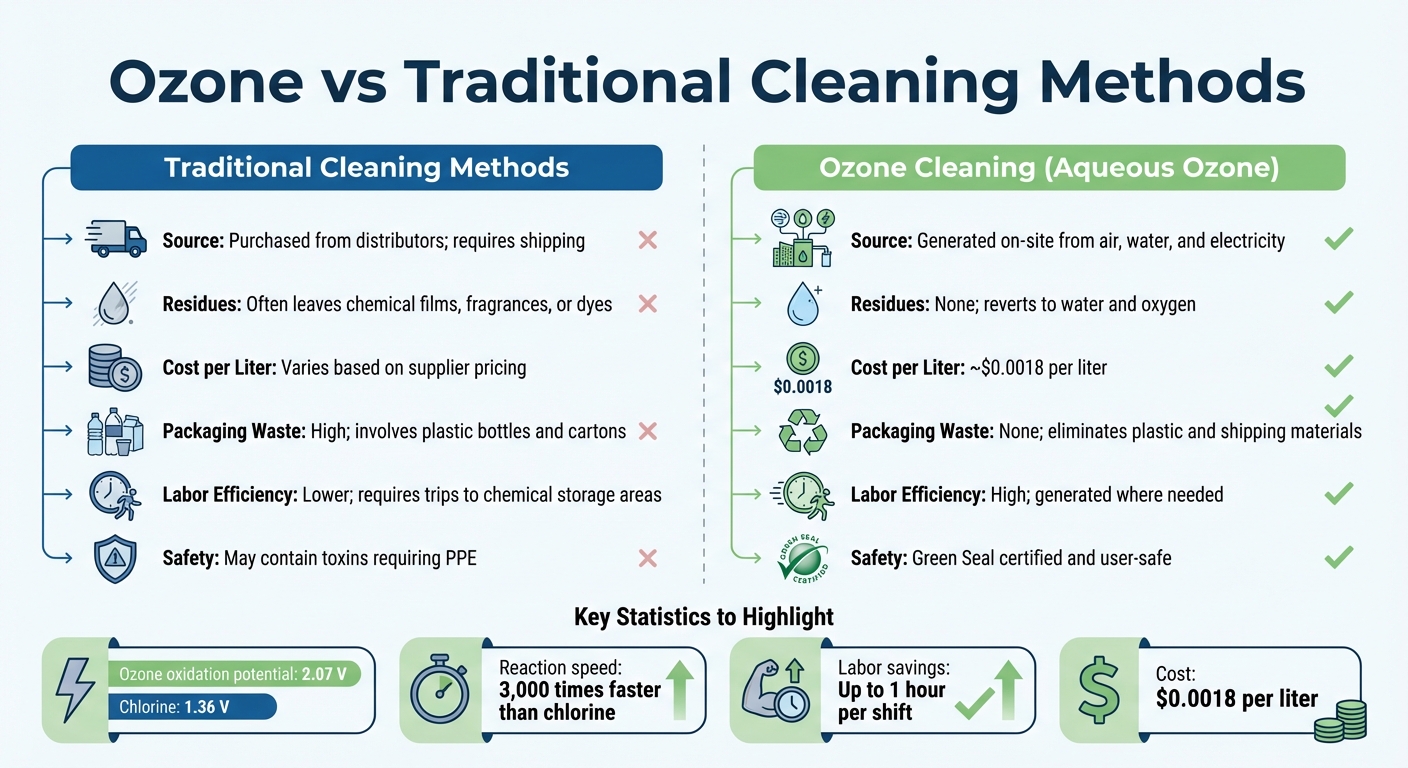
Ozone vs Traditional Cleaning Methods: Cost, Efficiency, and Environmental Impact Comparison
Ozone cleaning offers a practical alternative to conventional methods by cutting down on waste, costs, and labor. Traditional cleaning relies heavily on chemicals packaged in plastic bottles, which need storage space and often leave behind residues like synthetic fragrances and dyes. In contrast, ozone cleaning generates its solution on-site using just water, air, and electricity. The result? It reverts back to oxygen and water, leaving no chemical residues or artificial scents behind. This approach ties in seamlessly with the environmentally friendly practices and home sanitization steps emphasized throughout this discussion.
When it comes to cost, aqueous ozone stands out at approximately $0.0018 per liter, making it an incredibly economical choice – imagine filling an entire bucket for almost nothing. Additionally, generating ozone on-site eliminates the need for chemical deliveries and reduces labor, saving up to 15 minutes per refill trip or even an hour during a single shift. Its safety record is also well-established, with ozone being used for disinfecting drinking water since as far back as 1893.
"These technologies are helping us significantly reduce the environmental impacts associated with the manufacturing and disposing of literally tens of millions of plastic bottles, cardboard cartons, [and] paper and plastic shipping materials."
– Stephen Ashkin, President of The Ashkin Group
The benefits of ozone cleaning clearly highlight its role as a sustainable, chemical-free cleaning solution. Here’s a quick side-by-side comparison:
| Feature | Traditional Cleaning Methods | Ozone Cleaning (Aqueous Ozone) |
|---|---|---|
| Source | Purchased from distributors; requires shipping | Generated on-site from air, water, and electricity |
| Residues | Often leaves chemical films, fragrances, or dyes | None; reverts to water and oxygen |
| Cost per Liter | Varies based on supplier pricing | ~$0.0018 per liter |
| Packaging Waste | High; involves plastic bottles and cartons | None; eliminates plastic and shipping materials |
| Labor Efficiency | Lower; requires trips to chemical storage areas | High; generated where needed |
| Safety | May contain toxins requiring PPE | Green Seal certified and user-safe |
Conclusion
Ozone technology provides seven practical applications that bring sustainable cleaning to healthcare facilities, homes, vehicles, kitchens, laundries, food processing plants, and industrial operations. Its versatility highlights ozone’s potential as a cleaning solution that minimizes environmental impact. By disinfecting surfaces, eliminating odors, sanitizing fabrics, and cleaning without chemical residues, ozone offers an effective, chemical-free alternative to traditional cleaning methods. The technology works by generating cleaning power on-site using only water, air, and electricity, then safely reverts back to oxygen, leaving no harmful byproducts behind.
The science backs up ozone’s effectiveness. With an oxidation potential of 2.07 V and reaction speeds up to 3,000 times faster than chlorine, it delivers powerful cleaning results while adhering to safety standards that have been in place for drinking water disinfection since 1893. Additionally, Green Seal-certified ozone systems can save up to an hour of labor per shift and significantly reduce waste from plastic bottles and shipping materials.
"Building and business owners are now turning to the professional cleaning industry to help them implement their sustainability initiatives, we can expect to see more organizations adopt aqueous ozone technology as a very green and sustainable way to keep their facilities clean and healthy."
– Matt Montag, Sales Distribution Manager, CleanCore Technologies
For those in the Chicagoland area, Ozonated Cleaning LLC (https://ozonatedcleaning.com) offers professional ozone-based services for odor removal and disinfection. They cater to residential spaces, commercial facilities, vehicles, RVs, and boats. Their FDA-approved ozone and hydroxyl treatments provide chemical-free solutions, with pricing starting at $150 for vehicle deodorizing and $600-$900 for home treatments, depending on square footage.
Whether you’re managing a facility, running a business, or maintaining your home, ozone technology delivers measurable environmental and operational benefits while meeting the high hygiene standards of today.
FAQs
Is ozone cleaning safe for people and pets?
Ozone cleaning poses risks to both people and pets while it’s in progress. Ozone exposure can irritate the respiratory system and is harmful to living organisms. To ensure safety, the area must be completely evacuated before starting the process. It’s crucial to follow all recommended guidelines and wait until the ozone has fully dissipated before re-entering the space.
When should I use ozone gas vs. aqueous ozone water?
Ozone gas works exceptionally well for deep cleaning and eliminating odors in spaces that are unoccupied. Its ability to reach into tight, hard-to-access areas makes it highly effective. However, for safety reasons, the area must be vacated during the treatment process. On the other hand, aqueous ozone water is a safer option for surface sanitation, especially in environments like food processing or areas where people are present. It’s non-toxic, safe for direct contact with surfaces, and even approved for use on surfaces that come into contact with food.
What surfaces or materials can ozone damage?
Ozone can harm materials such as Buna-N (Nitrile), natural rubber, nylon, and zinc. It can also lead to softening, swelling, or weakening in some plastics and rubber materials. Be cautious when using ozone around these surfaces to avoid causing damage.
Recent Comments