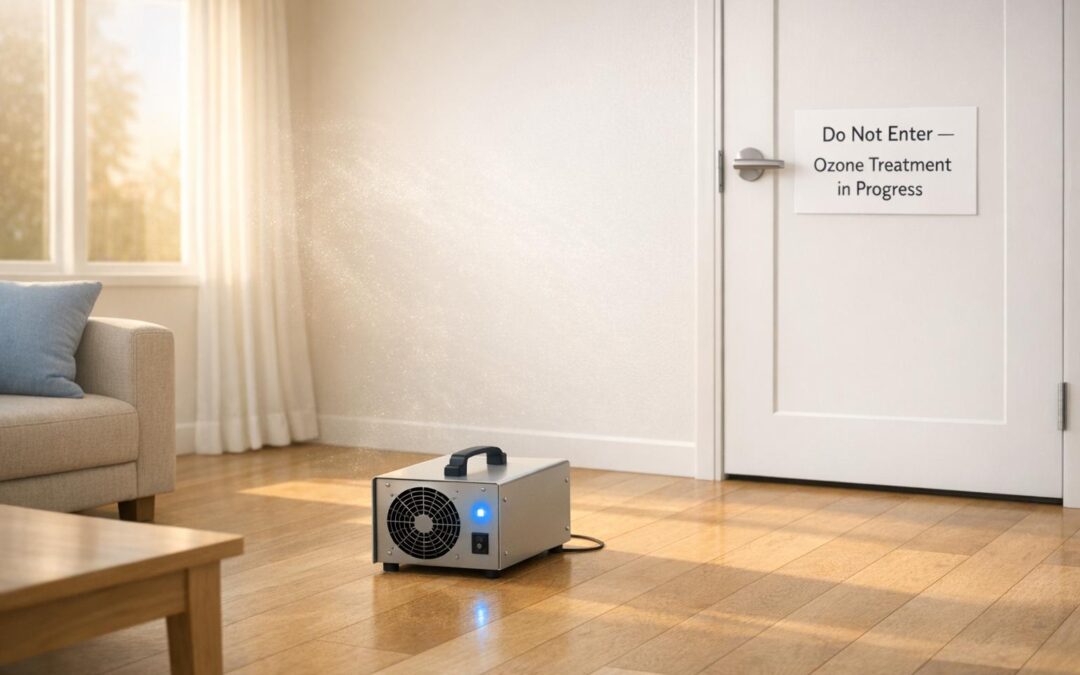
Ozone is a powerful tool for eliminating odors at their source. Unlike air fresheners that mask smells, ozone works by breaking down odor-causing molecules through oxidation. It penetrates fabrics, walls, and crevices, tackling hidden sources of odors without leaving residues. After treatment, ozone naturally reverts to oxygen, making it effective and chemical-free. However, high concentrations required for odor removal can pose health risks, so treatments must occur in unoccupied spaces with proper safety protocols.
Key Points:
- How it works: Ozone oxidizes and dismantles odor molecules.
- Applications: Removes smoke, pet, cooking odors, and commercial odors.
- Safety: Requires evacuation, proper ventilation, and adherence to exposure limits.
- Professional use: For severe odors, experts ensure safe and effective treatment.
Ozone’s ability to deeply penetrate and eliminate odors makes it a practical option for stubborn smells in homes, businesses, and vehicles.
How Ozone Works at the Molecular Level
What Ozone Is Made Of
Ozone (O₃) is a molecule made up of three oxygen atoms bonded together. Unlike the oxygen we breathe (O₂), which is stable with just two atoms, ozone’s third oxygen atom makes it unstable and highly reactive. Structurally, ozone has a bent shape – similar to water – with an O–O–O angle of 116.78° and bond lengths of 127.2 pm.
This third oxygen atom is what makes ozone so reactive. It can easily detach and bond with other molecules. That reactivity is key to ozone’s ability to neutralize odors. The molecule is so unstable that it breaks apart quickly, especially when it encounters pollutants, fueling the oxidation process described below.
Oxidation: How Ozone Breaks Down Odors
When ozone interacts with an odor molecule, its third oxygen atom detaches and bonds with the odor molecule. This process, known as oxidation, changes the odor molecule’s structure.
"The third oxygen atom can detach from the ozone molecule, and re-attach to molecules of other substances, thereby altering their chemical composition." – U.S. Environmental Protection Agency (EPA)
During oxidation, ozone breaks the molecular bonds of complex organic compounds, converting them into simpler, non-odorous substances like carbon dioxide and water vapor. This chemical transformation eliminates the source of the odor at its core, much like how ozone eliminates pathogens in similar environments.
Why Ozone Works Well in Airspaces
Ozone’s gaseous nature gives it a unique advantage. As a gas, it spreads throughout a room, reaching airborne particles and penetrating fabrics, carpets, walls, and even small crevices that liquids can’t access. This allows ozone to neutralize odors both on surfaces and deep within porous materials.
Because it can permeate these materials, ozone effectively tackles stubborn smells that traditional cleaning methods often fail to remove. By addressing the molecular source of the odor – no matter where it’s hiding – ozone ensures thorough and lasting odor elimination.
sbb-itb-5fea4da
How Do Ozone Treatments Eliminate Odours? (Ozone Generators Explained)
Common Odors Ozone Neutralizes
Ozone treatment is a powerful way to tackle odors that traditional cleaning methods often leave behind. Because it’s a gas, ozone can penetrate hard-to-reach places, breaking down odor molecules at their source. Let’s explore how it works on common household, smoke, and commercial odors.
Household Odors
Ozone is particularly effective at addressing a range of home odors by targeting them at their origin. For example, it neutralizes pet dander, which is the main culprit behind lingering pet smells. Cooking odors, especially those from oils and other food-related substances, are another common problem. Ozone reacts with volatile organic compounds (VOCs) in these materials, breaking them apart on a molecular level.
It’s also a great tool for tackling mold and mildew odors. These musty smells are caused by spores, which ozone can oxidize, although higher concentrations are often needed for this task. However, there’s one limitation: ozone doesn’t work on pet urine odors because urea, the primary component in urine, doesn’t oxidize.
Smoke and Tobacco Odors
Ozone is especially effective at removing stubborn smoke odors. It reacts with phenols and acrolein – two compounds responsible for the strong smell of smoke – neutralizing their odor-causing properties. This makes it an excellent option for eliminating tobacco smoke that has seeped into furniture, curtains, and carpets.
"We use ozone generators when a hotel room has smoke odors, and the OdorFree eliminates them in short order." – Bill Simmons, Hilton Garden Inn
For professional ozone treatments to remove smoke, costs typically range from $400 to $800, with an average around $600. In cases of severe fire damage that require treating an entire home, costs can climb to $3,000.
Commercial Odors
Ozone also shines when it comes to commercial odor problems. Hotels frequently use it to remove tobacco smoke, stale air, and body odors from guest rooms. Restaurants rely on ozone to neutralize smells from cooking grease, spoiled food, and kitchen exhaust. In fitness centers, it’s used to combat locker room odors and sweat lingering in gym equipment. Even waste management facilities use ozone to address odors in garbage compactor rooms and trash storage areas where decaying organic matter creates persistent smells.
These commercial applications often involve "shock treatment", where high concentrations of ozone are applied in unoccupied spaces. This approach ensures deep-set odors are permanently removed rather than just masked. By breaking down odor molecules even in tough environments, ozone proves to be an effective solution for a variety of challenging odors.
Safe Practices for Ozone Treatment
While ozone is effective in eliminating odors and contaminants, it comes with health risks if not handled properly. The US EPA warns, "Whether pure or mixed with other chemicals, ozone can be harmful to health". To safely harness ozone’s odor-removing power, it’s essential to follow strict safety protocols that minimize exposure risks while ensuring effective treatment.
Preparing the Space for Treatment
Before starting ozone treatment, make sure to remove all people, pets, plants, and fish tanks from the area. It’s worth noting that ozone treatment concentrations often exceed safe exposure limits. For context, the FDA caps indoor medical device ozone output at 0.05 ppm, while OSHA sets an 8-hour workplace exposure limit at 0.10 ppm.
Additionally, eliminate the source of the odor (or consider ozone vs hydroxyl methods for different environments) and safeguard sensitive items like rubber, electrical coatings, fabrics, and artwork.
Choose the right machine size. A 1991 study by Richard J. Shaughnessy and L. Oatman demonstrated the risks of using oversized machines. A device rated for 3,000 square feet was tested in a 350-square-foot room, leading to ozone levels between 0.50 and 0.80 ppm – 5 to 10 times above public health limits. Oversized equipment can create dangerously high concentrations that persist longer than necessary.
Operating Ozone Machines Safely
To prevent ozone from escaping the treatment area, seal the space thoroughly. Close windows, block door gaps with towels, and cover HVAC vents with plastic sheeting. Set your HVAC system to "Off" instead of "Auto" to stop ozone from circulating through the ductwork into other areas. Always follow the manufacturer’s instructions and post warning signs to alert others to the treatment in progress. The EPA stresses that "conditions should be sufficiently controlled to ensure that no person or pet becomes exposed".
It’s also important to note that ozone output isn’t always linear. For example, a medium setting on some machines may produce much more than half the ozone of a high setting. This unpredictability makes it critical to monitor and control the process carefully.
Once the treatment cycle ends, the focus shifts to safely clearing the ozone from the area before it can be reoccupied.
When It’s Safe to Reenter
Ozone naturally breaks down into oxygen within about 30 minutes. If the area remains sealed, wait 2-4 hours after treatment before ventilating. If you ventilate immediately, wait at least 30 minutes, then open windows and use fans to help clear the air. Allow an additional hour before reentering, ensuring the ozone odor is completely gone.
Don’t rely solely on your sense of smell to determine safety. Ozone exposure can quickly dull your ability to detect its sharp, chlorine-like odor. Reentry is generally safe once the smell has fully dissipated.
Exposure Limits:
| Organization | Ozone Exposure Limit |
|---|---|
| FDA (Medical Devices) | 0.05 ppm |
| OSHA (8-hour average) | 0.10 ppm |
| NIOSH (Upper limit) | 0.10 ppm |
| EPA (8-hour outdoor average) | 0.08 ppm |
Ozone vs. Other Odor Solutions
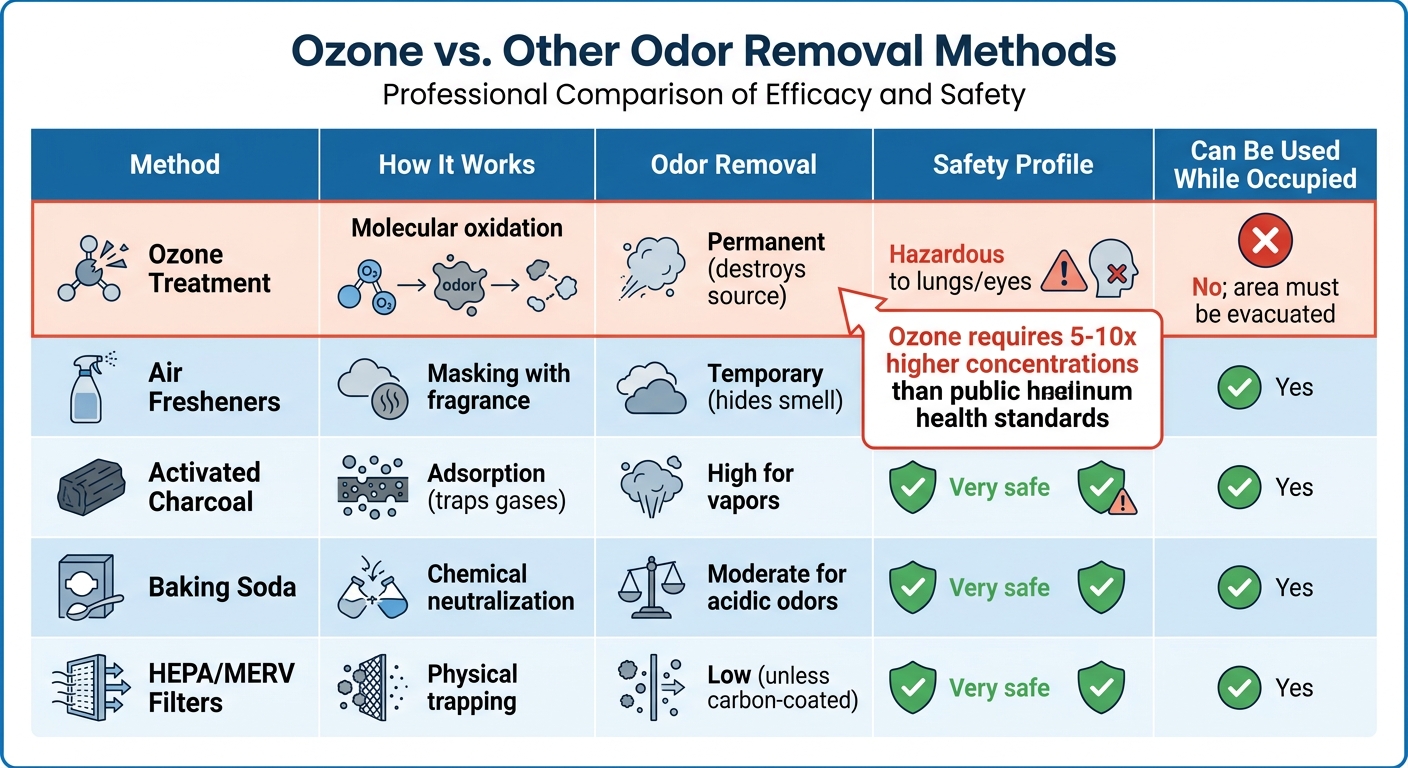
Ozone Treatment vs Other Odor Removal Methods Comparison
Ozone works by oxidizing odor-causing molecules, effectively breaking them down. Unlike air fresheners that simply mask smells with fragrances, ozone targets and destroys the source of odors. Other methods like activated charcoal rely on adsorption to trap odors, while baking soda neutralizes them chemically. However, these approaches require direct contact to be effective. This is where ozone stands out – it has the ability to permanently eliminate odors, not just hide or absorb them.
That said, ozone treatment requires significantly higher concentrations to work effectively. According to the US EPA, "Available scientific evidence shows that at concentrations that do not exceed public health standards, ozone has little potential to remove indoor air contaminants". To neutralize odors, ozone levels must be 5 to 10 times higher than what is considered safe for human exposure. This means such treatments can only take place in unoccupied spaces.
Comparison Table: Ozone vs. Other Methods
| Method | How It Works | Odor Removal | Safety Profile | Can Be Used While Occupied |
|---|---|---|---|---|
| Ozone Treatment | Molecular oxidation | Permanent (destroys source) | Hazardous to lungs/eyes | No; area must be evacuated |
| Air Fresheners | Masking with fragrance | Temporary (hides smell) | Generally safe; may contain VOCs | Yes |
| Activated Charcoal | Adsorption (traps gases) | High for vapors | Very safe | Yes |
| Baking Soda | Chemical neutralization | Moderate for acidic odors | Very safe | Yes |
| HEPA/MERV Filters | Physical trapping | Low (unless carbon-coated) | Very safe | Yes |
This table outlines both the strengths and limitations of ozone compared to other odor control methods.
While ozone is effective for eliminating odors, it does have its drawbacks. For one, it doesn’t remove physical particles like dust, pollen, or smoke particles – tasks better suited for HEPA or MERV filters. Ozone is also ineffective against certain gases like carbon monoxide and formaldehyde. Additionally, it can damage materials such as rubber, leather, and some plastics through oxidation. In some cases, ozone can interact with chemicals in new carpets, producing harmful by-products like aldehydes.
For routine air quality improvement, standard air purifiers are the better option. Ozone treatments should be reserved for more severe odor problems, such as those caused by smoke damage or water-related issues. Always follow strict safety protocols and professional guidelines when using ozone.
When to Choose Professional Ozone Services
Consumer-grade ozone machines often fall short when tackling serious odor problems. That’s because effective ozone treatment requires concentrations that are typically 5 to 10 times higher than public health standards permit. To safely and thoroughly address biological and stubborn odors, professional ozone services become essential. Here’s when you should consider calling in the experts.
Residential Applications
Some household odors are so persistent that regular cleaning just doesn’t cut it. That’s where professional ozone services step in. These services not only achieve the high ozone levels needed to break down tough odors but also handle the associated safety risks. Odors trapped in materials like carpet padding, duct linings, and ceiling tiles require the deep penetration that professional-grade equipment provides.
For example, after a fire, professional ozone treatments can effectively neutralize the complex chemical compounds that cause lingering smoke odors. Similarly, in mold remediation, ozone levels between 10 and 20 ppm are often used to destroy mold spores. Keep in mind, though, that even lower concentrations – around 5 ppm – can pose immediate health risks. This is why trained professionals are critical for ensuring safety during and after treatment.
Commercial and Vehicle Odor Removal
Vehicles, RVs, and boats are particularly tricky when it comes to ozone treatments. These confined spaces can experience rapid ozone spikes that are unsafe. Professionals bring the expertise needed to manage these risks while avoiding damage to sensitive components like rubber seals and electrical wiring. They use precision techniques to ensure effective odor removal without harming the interior.
For businesses, professional ozone treatments are typically scheduled during off-hours to minimize disruption. Thorough ventilation is always performed before anyone reenters the space, ensuring safety and compliance with health standards.
Ozonated Cleaning LLC, serving the Chicagoland area, offers professional odor removal services tailored to different needs. Prices range from $600–$900 for homes (depending on square footage), $150 per vehicle, and $200 per semi-truck. Their process combines ozone and hydroxyl technology to eliminate odors from sources like smoke, pets, and mold, all without leaving behind chemical residues.
Benefits of Professional Expertise
DIY ozone generators often come with imprecise controls, which can lead to safety hazards. For instance, a "medium" setting on a consumer-grade machine might produce far more ozone than expected. Additionally, ozone exposure can dull your sense of smell, making it harder to detect dangerous levels. Professionals, on the other hand, use calibrated equipment and portable gas detectors to monitor ozone levels in real time, ensuring that the concentration drops below 0.1 ppm before the space is deemed safe for reentry.
Beyond safety, professionals know how to avoid damaging materials during treatment. High ozone levels can degrade rubber, neoprene, and some fabric dyes. They can also react with chemicals in new carpets, creating harmful byproducts like aldehydes and formaldehyde. By understanding these risks, trained technicians prevent costly mistakes, ensuring that ozone treatments solve problems without creating new ones. This level of expertise underscores the value of choosing professional services for effective and safe odor removal.
Conclusion
Ozone works differently from typical air fresheners or cleaning products. Instead of masking odors, it chemically dismantles odor-causing molecules. According to the US EPA, this happens because ozone’s third oxygen atom detaches and reacts with other chemicals, altering their composition to neutralize smells at the source.
Because ozone is a gas, it can reach areas that traditional cleaning methods often miss – like fabrics, air vents, and small cracks. This makes it particularly effective for tackling tough odors, from pet smells in homes to lingering smoke damage in commercial spaces. As emphasized throughout this guide, how ozone machines remove home odors through deep penetration and oxidation sets it apart. Plus, after the process, ozone naturally converts back into oxygen, leaving no residue behind.
Safety precautions are crucial when using ozone. The concentration needed for effective odor removal is 5 to 10 times higher than what is considered safe for occupied spaces. That’s why professional services are essential for handling serious odor issues. Trained technicians ensure that ozone levels drop below 0.1 ppm before re-entering the treated area. These safety measures highlight the importance of relying on experts for both effective and safe results.
For those in the Chicagoland area dealing with challenging odors from smoke or mold, Ozonated Cleaning LLC provides professional ozone and hydroxyl treatments. Their services combine expertise with strict safety protocols, with pricing starting at $600–$900 for residential spaces, $150 for vehicles, and $200 for semi-trucks.
When applied in unoccupied spaces with proper ventilation, ozone offers thorough, residue-free odor removal that other methods simply can’t match.
FAQs
Will ozone damage furniture or electronics?
Ozone exposure can be tough on electronics, leading to corrosion and the breakdown of plastic parts. To protect your devices, it’s a good idea to keep them away from high ozone levels for extended periods. While furniture typically isn’t impacted, it’s still wise to take basic precautions to maintain its condition.
How do I know the space is safe to reenter after treatment?
When ozone levels drop to safe concentrations, the space becomes safe to reenter. However, just because the smell is gone doesn’t mean it’s safe. To ensure ozone is reduced to non-harmful levels, proper ventilation or air purification might be necessary. Always verify that conditions are safe before going back in.
When should I hire a professional instead of using a DIY ozone machine?
If you’re dealing with severe or extensive odor problems, it’s best to hire a professional. They have the right tools and know-how to handle the situation safely and effectively. While DIY ozone machines might help with small, localized odors, professionals are better equipped to tackle stubborn or widespread issues – especially when proper setup and safety are essential. Expect professional services to cost between $400 and $800, depending on the extent of the problem.
Recent Comments