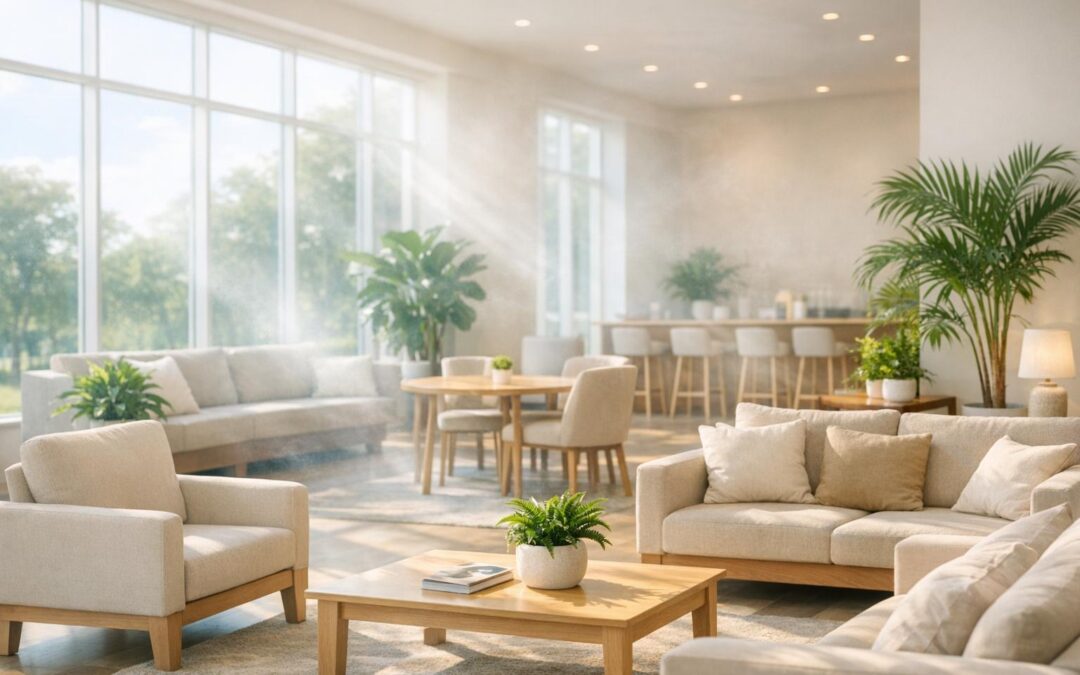
Ozone cleaning is an effective, chemical-free method to sanitize public spaces like schools, offices, and gyms. It eliminates pathogens, odors, and allergens by oxidizing contaminants at a molecular level. Unlike chemical cleaners, ozone leaves no residue and reaches areas that are difficult to access, such as air ducts and porous materials. This process improves indoor air quality and reduces health risks associated with chemical residues.
Key Points:
- Kills 99.99% of bacteria and viruses, including SARS-CoV-2.
- Neutralizes odors by breaking down odor-causing molecules.
- Leaves no chemical residue; ozone reverts to oxygen within minutes.
- Reaches hidden areas that manual cleaning often misses.
- Lowers long-term cleaning costs by eliminating the need for chemical supplies.
For businesses, ozone cleaning offers a safer, faster, and more thorough solution compared to traditional methods.
Sanitize Everything With Ozone
Cleaning Challenges in Public Spaces
Places like schools, offices, and other busy public areas deal with cleaning hurdles that traditional methods often can’t fully tackle. With constant foot traffic bringing in contaminants and a mix of issues ranging from food waste to airborne particles, these environments demand a deeper, safer cleaning approach.
Stubborn Odors and Poor Air Quality
Lingering odors in public spaces are more than just unpleasant – they’re a sign of hidden contamination. These smells often come from decomposing organic materials, food waste, smoke (which releases phenol gases), and volatile organic compounds (VOCs). These substances can seep into carpets, upholstery, and other porous surfaces. While air fresheners and sprays might cover up the odors for a while, they don’t actually address the root cause.
Bacteria, Viruses, and Allergens in Shared Areas
Beyond odors, microbial contamination is a serious health concern in shared spaces. Bacteria, viruses, and allergens spread quickly through respiratory droplets and bioaerosols, which can travel over 3 feet before settling on frequently touched surfaces like desks, doorknobs, and handrails. For example, a study conducted in June 2021 across four supermarkets in an Italian city revealed that traditional cleaning left a median Total Bacterial Count (TBC) of 93 cfu/m³ in the air at opening time. Alarmingly, Penicillium was detected in 93% of the air samples. Conventional methods often miss hard-to-reach areas like the backs of chairs, tops of furniture, ceilings, and deep within porous materials, allowing pathogens to linger.
"Traditional cleaning procedures cannot guarantee the removal of microbial agents, in particular structural ravines and the equipment or surfaces difficult to reach by the operators."
– Giuseppina Moccia, Department of Medicine Surgery and Dentistry, University of Salerno
Chemical Residue from Standard Cleaning Products
Chemical cleaners bring their own set of problems. Chlorine-based disinfectants, for instance, can create harmful by-products that stick around long after cleaning is done. These residues often require extra rinsing and can pose health risks. Additionally, biofilms – protective layers formed by microbes – make it necessary to physically scrub surfaces before sanitizers can even work effectively.
These persistent challenges highlight the need for a more effective and safer cleaning solution, paving the way for ozone cleaning as a comprehensive approach.
How Ozone Cleaning Works
Ozone cleaning relies on a natural oxidizer to break down contaminants at the molecular level. Unlike traditional cleaning methods that depend on scrubbing or chemical reactions, ozone (O₃) works by releasing a free oxygen atom. This atom reacts with pollutants through oxidation, allowing ozone to tackle contaminants that are often out of reach for conventional cleaning techniques.
The Science Behind Ozone’s Cleaning Power
Ozone is one of the most powerful oxidizers available, making it highly effective at neutralizing threats that standard cleaners often miss. When ozone molecules come into contact with bacteria or viruses, they disrupt the outer microbial layers and damage their genetic material. Research shows that ozone eliminates 99% of viruses, including SARS-CoV-2, and achieves a 99.99% reduction in bacteria (also known as a 4-log reduction).
Ozone also neutralizes odor-causing gases by breaking apart their molecular structure. For example, it can completely eliminate phenol gases from smoke or sulfur-based gases from waste. As noted by Elena Grignani and her team at the Environmental Research Centre:
"Ozone is a powerful oxidant reacting with organic molecules, and therefore has bactericidal, virucidal, and fungicidal actions."
Within just 20 minutes, ozone naturally reverts to pure oxygen, leaving no toxic residue behind. This makes it a safe and residue-free option for improving public spaces. Additionally, since ozone exists as a gas, it can provide complete coverage of a room, ensuring no area is left untreated.
Reaching Hidden and Hard-to-Access Areas
One of ozone’s standout features is its ability to diffuse effortlessly in its gaseous form. This allows it to reach contaminants hidden in HVAC ducts, crevices, and porous materials. Thanks to its density (2.14 kg/m³), ozone naturally settles near the ground, making it particularly effective at treating floors and lower surfaces. In larger buildings, ozone can be distributed through existing ventilation systems by installing generators near furnaces or air conditioning units. This ensures that every area serviced by the ductwork receives thorough treatment.
Benefits of Ozone Cleaning for Public Spaces
Eliminating Pathogens and Allergens
Ozone cleaning is highly effective at destroying harmful microorganisms that traditional cleaning methods often overlook. Its oxidation process disrupts bacterial membranes and damages the genetic material of viruses, including SARS‑CoV‑2. For example, a June 2021 study conducted in four supermarkets in Apulia, Italy, found that ozonation reduced air bacterial counts by half and almost completely eliminated bacteria on surfaces.
Ozone doesn’t stop at bacteria and viruses – it also addresses allergens. During the discharge process, ions are released that cause dust, pollen, and other airborne particles to clump together, making them easier to remove and providing relief for individuals with allergies.
Removing Odors at the Source
Ozone cleaning goes beyond disinfecting; it also eliminates unpleasant odors at their origin. Unlike air fresheners that merely mask smells, ozone works by oxidizing and breaking down odor-causing molecules, such as phenols and sulfur compounds. This process ensures that stubborn odors embedded in fabrics, walls, and other hard-to-reach areas are completely neutralized.
Chemical-Free and Environmentally Safe Process
One of the standout features of ozone cleaning is its chemical-free nature. Ozone is generated on-site and naturally reverts back to oxygen within 20 to 150 minutes, leaving no toxic residue behind.
As Emmanuel I. Epelle explained in the Chemical Engineering Journal:
"Ozone yields faster microbial inactivation kinetics, compared to other oxidative agents used in chemical disinfectants… and is considered safer than chlorine, which produces harmful disinfection by-products."
With an oxidation potential of 2.07 V – higher than hydrogen peroxide (1.80 V) and chlorine (1.36 V) – ozone reacts with organic matter up to 3,000 times faster than chlorine. This rapid reaction makes it an efficient cleaning agent without the environmental risks associated with traditional chemical disinfectants.
Better Air Quality for Building Occupants
Ozone cleaning doesn’t just disinfect surfaces and air – it also enhances overall indoor air quality. Its ionization process causes airborne particles to settle, while its oxidation mechanism neutralizes volatile organic compounds. Because ozone is a gas, it can reach areas that are typically missed during standard cleaning, such as under furniture, inside vents, and deep in crevices. This thorough coverage helps create a healthier and more comfortable environment for employees, customers, and visitors in public spaces.
sbb-itb-5fea4da
Ozone Cleaning vs. Chemical-Based Methods
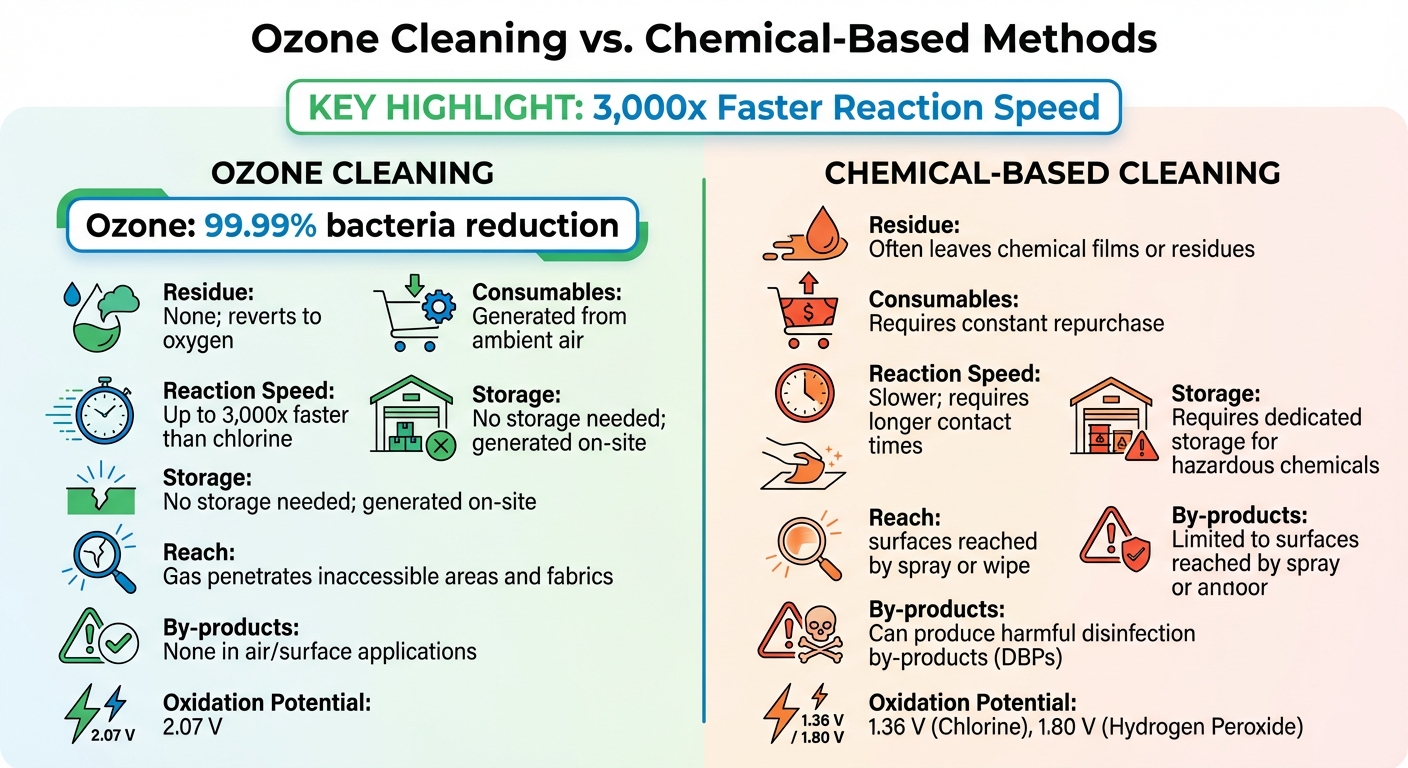
Ozone vs Chemical Cleaning Methods Comparison
Comparison of Ozone and Chemical Cleaning Methods
Facility managers face an important choice: stick with traditional chemical disinfectants or switch to ozone technology. This decision impacts not just costs but also safety and environmental considerations. Let’s break down how ozone stacks up against chemical-based methods.
Chemical disinfectants come with ongoing expenses for purchase, storage, and disposal. In contrast, ozone is generated on-site and naturally reverts to oxygen within minutes, eliminating the need for recurring purchases or hazardous storage requirements.
Ozone also outpaces chemicals in terms of reaction speed. It reacts with organic matter up to 3,000 times faster than chlorine. This means lower concentrations and shorter contact times can achieve outstanding disinfection results. As Giuseppina Caggiano from the University of Bari Aldo Moro explained:
"Compared to other disinfectants, lower ozone concentrations and shorter contact times are sufficient to inactivate the environmental microbial population".
Here’s a side-by-side look at the two methods:
| Feature | Ozone Cleaning | Chemical-Based Cleaning |
|---|---|---|
| Residue | None; reverts to oxygen | Often leaves chemical films or residues |
| Consumables | Generated from ambient air | Requires constant repurchase |
| Reaction Speed | Up to 3,000x faster than chlorine | Slower; requires longer contact times |
| Storage | No storage needed; generated on-site | Requires dedicated storage for hazardous chemicals |
| Reach | Gas penetrates inaccessible areas and fabrics | Limited to surfaces reached by spray or wipe |
| By-products | None in air/surface applications | Can produce harmful disinfection by-products (DBPs) |
| Oxidation Potential | 2.07 V | 1.36 V (Chlorine), 1.80 V (Hydrogen Peroxide) |
While ozone cleaning does require vacating the area and ventilating before re-entry, chemical methods carry their own risks, such as skin and eye irritation, toxic ingestion, and harmful by-products. From a cost perspective, commercial ozone generators for professional use are priced at approximately $1,299.00, with maintenance kits ranging from $69.95 to $89.95. This one-time investment eliminates the recurring expenses associated with chemical supplies.
With these advantages, ozone technology presents itself as a safer, more environmentally friendly option for disinfecting public spaces.
Ozone Cleaning Services from Ozonated Cleaning LLC
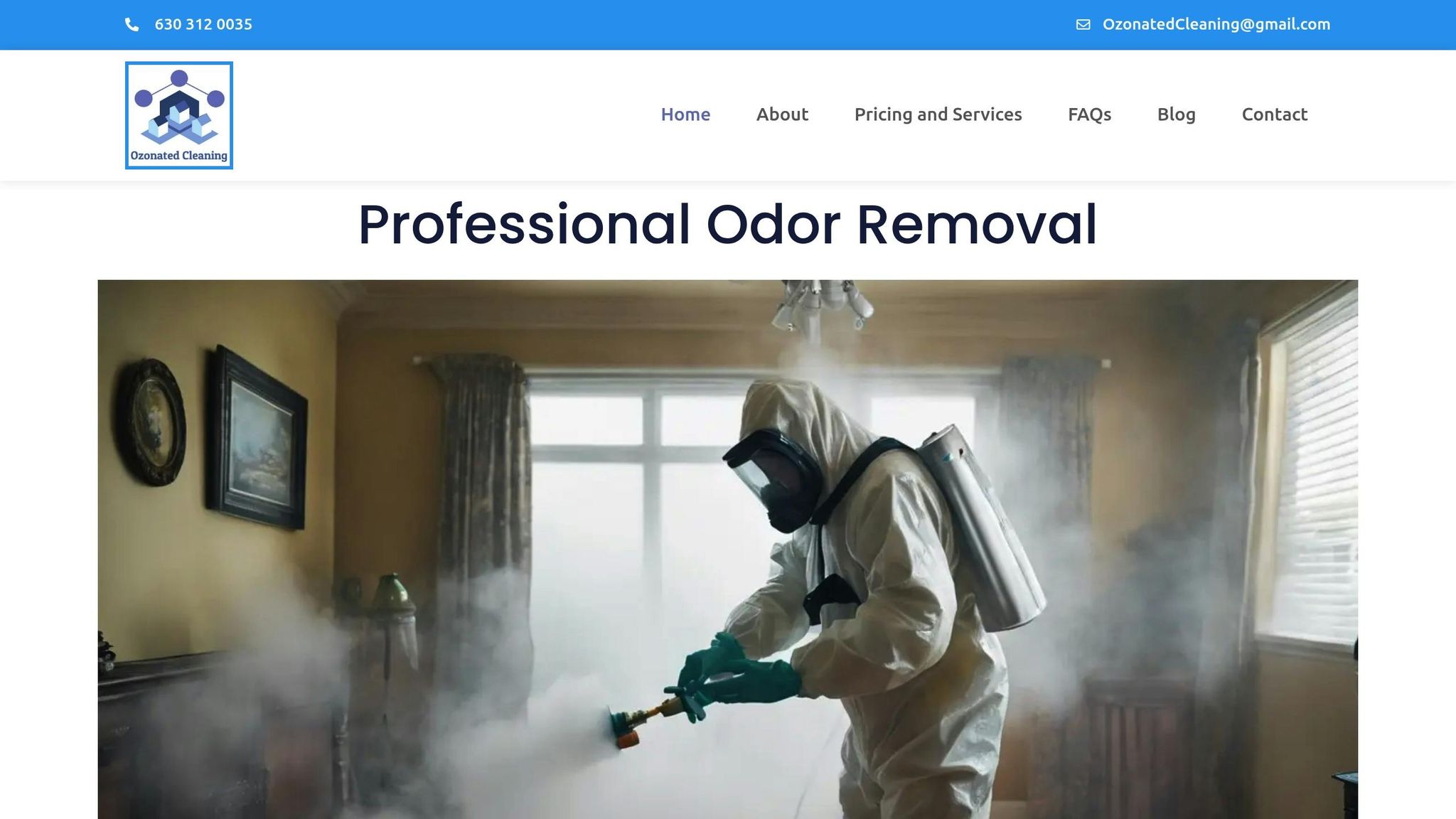
Ozonated Cleaning LLC provides ozone and hydroxyl treatment services designed to address the unique needs of public spaces.
Tailored Solutions for Commercial Properties
Serving the greater Chicagoland area, as well as parts of Northwestern Indiana and Southeastern Wisconsin (with an added travel fee), Ozonated Cleaning LLC specializes in offering professional-grade ozone and hydroxyl treatments for a variety of commercial settings.
Their services cater to spaces like hotels, gyms, restaurants, car dealerships, and healthcare facilities. Whether it’s a single vehicle or an office spanning up to 10,000 square feet, they tackle persistent odors caused by marijuana, tobacco, smoke, burnt food, pet urine, chemical vapors, curry, and even vomit. The treatment method – ozone or hydroxyl – depends on the size of the area and the level of contamination. Most treatments are completed in just one session, minimizing downtime for businesses. To prepare, clients are required to remove the odor source, open interior doors and cabinets, and ensure basement humidity stays at or below 45%. Spaces must remain vacant during treatment, and they are generally safe to re-enter within 24 hours, as advised by the technicians.
These treatments are designed to deliver effective results while keeping business interruptions to a minimum.
Transparent Pricing and Custom Quotes
The cost of treatment varies based on the technology used, the size of the area, and the severity of the odor. This chemical-free process leaves no harmful residues or need for additional cleanup, although a temporary sterile scent may linger for a short time.
Conclusion
Ozone cleaning offers a modern, effective way to address the shortcomings of traditional cleaning methods, providing a residue-free and efficient option for public spaces. As a natural oxidizer, ozone breaks down into oxygen within about 20 minutes, eliminating pathogens and odors without leaving behind harmful residues. Its unique ability to penetrate hidden spaces – like air ducts and porous materials – ensures a thorough cleaning that goes beyond what manual methods can achieve. In fact, ozone treatments often result in a 99.99% reduction in bacteria. BioSure highlights this advantage:
"Ozone is a strong oxidant that acts as a natural sanitizer. Sanitization using ozone removes the need for dangerous chemical disinfectants and is an environmentally friendly alternative to traditional sanitization products."
For facilities managers, property owners, and business operators in the Chicagoland area, ozone cleaning is a practical solution. Professional services, like those offered by Ozonated Cleaning LLC, bring the necessary expertise and equipment to tailor treatments for any space – whether it’s a single vehicle or a large commercial property.
FAQs
What makes ozone cleaning a better option than traditional chemical cleaning methods?
Ozone cleaning stands out as a safer and more environmentally conscious option compared to traditional chemical-based methods. Instead of relying on liquid chemicals, ozone – a natural gas – works by breaking down the cellular walls of bacteria, viruses, and fungi. Once the cleaning process is complete, ozone simply reverts back to oxygen, leaving no chemical residues behind. This means no rinsing is required, and there’s no risk of lingering allergens or unpleasant odors on surfaces.
What’s more, ozone can be produced on-site, making it especially handy for cleaning hard-to-reach spaces and porous materials. At disinfection levels, it’s non-toxic, supports eco-friendly cleaning initiatives, and even enhances indoor air quality. For public spaces seeking a residue-free and safe cleaning option, Ozonated Cleaning LLC offers professional ozone-based disinfection and odor removal services throughout the Chicagoland area.
Is ozone cleaning safe to use in public spaces while people are present?
Ozone cleaning can be a safe option for public spaces when handled with care. The key is to keep ozone levels within the safety limits set by OSHA and the EPA, ensuring the area is well-ventilated. If stronger concentrations are necessary for effective cleaning, it’s essential to vacate the space during the process.
When applied properly, ozone cleaning provides a safe and environmentally conscious method for sanitizing and eliminating odors in public areas. This makes it an effective tool for promoting cleanliness and a healthier atmosphere.
What are the costs and savings of switching to ozone cleaning for businesses?
Switching to ozone cleaning often requires an upfront investment in an ozone generator, though rental or leasing options are also available. While the initial cost might seem steep, the long-term savings can make it a worthwhile choice.
Ozone cleaning minimizes the need to buy chemical disinfectants regularly and can cut down cleaning times, which helps reduce labor expenses. Plus, its efficiency in sanitizing spaces quickly means public areas – like hospitals, schools, and transit hubs – can be used more frequently, making it especially practical for high-traffic locations.
For many businesses, the combination of lower chemical costs, shorter cleaning times, and reduced staffing needs translates into noticeable savings over time.
Recent Comments