
Ozone plays a key role in disinfection and air quality, but measuring it accurately is critical to avoid safety risks, wasted resources, or regulatory violations. Whether you’re monitoring ozone in air or water, the right tools and methods can ensure precise results. Here’s a quick summary:
- Air Measurement: UV photometry is the most accurate method, while electrochemical sensors are portable and practical for quick checks.
- Water Measurement: The Indigo Trisulfonate method offers high accuracy for regulatory needs, while DPD kits are suitable for quick field tests.
- Safety: Always follow strict protocols when handling ozone, as improper exposure can be hazardous.
Key Tools for Measurement:
- Air: UV photometers, electrochemical sensors.
- Water: Indigo Trisulfonate kits, UV absorption sensors, DPD kits.
Accurate ozone measurement ensures safety, compliance, and effective use in applications like water treatment and air monitoring. Below, we’ll explore the methods, tools, and safety precautions in detail.
Safety Precautions and Required Tools
Safety Precautions
Handling ozone demands strict adherence to safety protocols due to its strong oxidizing properties. According to NIOSH, the Recommended Exposure Limit (REL) and OSHA‘s Permissible Exposure Limit (PEL) for ozone is 0.1 ppm (0.2 mg/m³) over an 8-hour workday. Exposure levels of 5 ppm or higher are classified as Immediately Dangerous to Life or Health (IDLH). To protect yourself:
- For ozone exposure up to 1 ppm, use a chemical cartridge respirator.
- At 2.5 ppm, a powered air-purifying respirator is necessary.
- For levels approaching 5 ppm, a full facepiece gas mask or SCBA is required in IDLH conditions.
"Ozone is a powerful oxidizer and reacts with all oxidizable materials, both organic and inorganic." – NIOSH
Never rely on odor detection to assess ozone levels. Instead, always use calibrated monitoring equipment. Perform a bump test with zero air and span gas at the start of each workday to ensure accuracy. If working in areas with flammable atmospheres, use only tools labeled as "intrinsically safe" and certified with the correct Class and Division numbers.
Since ozone is denser than air, position both yourself and your detectors at lower heights to detect accumulation. Ensure proper ventilation, replace batteries only in non-hazardous areas, and decontaminate equipment onsite to avoid cross-contamination. By following these safety measures, you can minimize risks and ensure accurate ozone monitoring.
Measurement Tools and Calibration
Once safety precautions are in place, it’s time to focus on the tools necessary for precise ozone monitoring. Reliable equipment, coupled with regular calibration, is essential for maintaining both safety and efficiency.
For air monitoring, consider these options:
- UV photometry analyzers: Known for their high accuracy and regarded as the gold standard.
- Electrochemical sensors and portable handheld detectors: These range in price from approximately $200 to $1,000 and often require accessories like 10-meter tipping towers, sample inlets, and dust filters to remove contaminants such as pollen before measurement.
For water measurement, different technologies are used:
- Electrochemical (amperometric) sensors
- UV absorption sensors
- Colorimetric test kits: These utilize methods like indigo trisulfonate or DPD for ozone detection.
Additional tools for water analysis include spectrophotometers or colorimeters, as well as self-filling reagent ampoules for field testing.
Calibration is key to ensuring accuracy. Use factory settings or field-standard solutions for manual calibration. For colorimetric methods, self-zeroing with indigo trisulfonate kits is effective. UV photometers typically rely on an ozone absorption cross-section value of 304.39 atm⁻¹ cm⁻¹ at 254 nanometers. For maximum precision, compare air photometers annually with a NIST standard reference photometer.
How to Measure Ozone in Air
UV Photometry Method
UV photometry is widely regarded as the most reliable method for measuring ozone in air. This approach takes advantage of ozone’s ability to absorb ultraviolet light at 254 nm. Using the Beer-Lambert Law, it compares the intensity of light passing through ambient air ($I$) with that of ozone-free air ($I_0$), following the equation $I/I_0 = e^{-\alpha cl}$.
Modern UV photometry analyzers work by splitting the air sample into two streams: one containing ambient air and the other treated with an ozone scrubber to create an ozone-free reference. A low-pressure mercury discharge lamp emits UV light at the critical 254 nm wavelength, which passes through an absorption cell. A photodiode or photomultiplier tube then measures the light intensity. It’s crucial to ensure that 99.5% of the detector’s radiation is at this wavelength for accurate results.
"The absorption cross-section value… (304.39 atm⁻¹ cm⁻¹ ± 0.94 atm⁻¹ cm⁻¹) will begin use in all U.S. Standard Reference Photometers (SRPs) on January 1, 2025." – Environmental Protection Agency
To start, power up the system and allow it to reach thermal equilibrium. Maintain a flow rate of 2 L/min to flush the absorption cell properly. Begin by sampling zero air to record the stable light intensity ($I_0$). Then, switch to ambient air and record its intensity ($I$). Make sure to log the cell’s temperature and pressure to ensure accurate parts-per-million (ppm) calculations.
Regular maintenance is key to reliable measurements. Replace Teflon particle filters weekly to prevent dust and pollen from contaminating the cell. Use only inert materials like glass or Teflon for connections downstream of the ozone generator to minimize ozone loss, which must remain below 5%. For precision, keep the linearity error under 5% and ensure the photometer’s accuracy stays within less than 0.005 ppm or 3%.
For portable and less complex setups, electrochemical sensors offer an alternative.
Electrochemical Sensors
Electrochemical sensors provide a portable and low-maintenance option for ozone monitoring, especially in scenarios where fixed, high-accuracy systems like UV photometry aren’t practical. These sensors work by generating an electrical current proportional to the ozone concentration in the air. Their compact size and fast response make them suitable for handheld detectors and continuous inline monitoring.
However, the U.S. EPA categorizes electrochemical sensors as suitable for supplemental monitoring, as their data quality often falls short compared to reference methods like UV photometry. These sensors are sensitive to environmental conditions such as temperature, humidity, and atmospheric pressure, which can affect their accuracy and baseline readings. Additionally, they may experience cross-sensitivity to similar compounds, like nitrogen dioxide or volatile organic compounds, leading to false readings.
"Ozone sensors can also be affected by temperature, relative humidity, and pressure and can experience a drift in their sensitivity and their baseline measurements over time." – Jessa Ellenburg, Director of Educational Outreach, 2B Technologies
To maintain accuracy, regular calibration is essential. Begin with a factory calibration before using the sensor and perform manual field calibration with reference gases to account for drift and environmental factors. Adhering to EPA performance protocols ensures better consistency in data collection. For regulatory-grade measurements, UV photometry remains the preferred choice due to its robustness against interference from other compounds.
How to Measure Ozone?
sbb-itb-5fea4da
How to Measure Ozone in Water
Measuring ozone in water accurately is as crucial as monitoring it in the air. Because ozone is unstable in water, specialized techniques are required. The three most widely used methods – Indigo Trisulfonate, Iodometric Titration, and DPD Colorimetric – each have their own strengths depending on your needs and testing environment. Here’s a breakdown of how each method works.
Indigo Trisulfonate Colorimetric Method
This method relies on a blue dye, potassium indigo trisulfonate, which fades when exposed to ozone. The degree of color loss directly correlates with the ozone concentration.
To perform the test:
- Add 10 ml of indigo reagent to a sampling flask.
- Introduce the water sample into the reagent (never the other way around to avoid ozone loss).
- Mix gently and measure the absorbance at 600 nm using a spectrophotometer or colorimeter.
The difference between this reading and that of a blank sample (indigo reagent plus distilled water) reveals the ozone concentration.
"The indigo colorimetric method is quantitative, selective and simple. The method is applicable to lake water, river infiltrate, manganese-containing groundwaters, extremely hard groundwaters, and even biologically treated domestic wastewaters." – Standard Methods for the Examination of Water and Wastewater
To ensure accuracy:
- Adjust the sample to pH 2 to reduce ozone loss caused by hydroxide ions.
- If chlorine is present (up to 10 ppm), add malonic acid to prevent interference.
- For manganese-containing water, use glycine to selectively remove ozone in a secondary sample, then subtract this value from the total reading.
High-purity indigo trisulfonate (>80%) offers excellent sensitivity, with a molar absorptivity of about 20,000 M⁻¹cm⁻¹ at 600 nm. Standard test kits, such as those from CHEMetrics, measure ozone in the 0-0.75 ppm range. For quicker field testing, "self-zeroing" ampoules simplify the process by eliminating the need for a separate blank sample.
For laboratory confirmation, a titration method can also be employed.
Iodometric Titration Method
This method measures ozone by reacting it with potassium iodide (KI) to release free iodine ($I_2$), which is then titrated with sodium thiosulfate.
Here’s how it works:
- Add KI solution to the water sample immediately to stabilize the ozone.
- Adjust the sample to pH 2 with sulfuric acid or a buffer.
- Titrate the iodine with sodium thiosulfate, using a starch indicator to identify the endpoint (the solution changes from blue to colorless).
For automated detection, a potentiometric method with a double platinum electrode can be used. This method can detect ozone levels as low as 0.1 mg/L.
However, the iodometric method has its challenges:
- It requires strict pH control and precise reagent preparation.
- It is prone to interference from other oxidizers, making it less selective.
Due to these complexities, this method is better suited for laboratory settings rather than routine fieldwork.
DPD Colorimetric Method
The DPD method is a fast and inexpensive way to test ozone on-site. Ozone reacts with potassium iodide to form iodine, which then reacts with DPD to produce a pink color. The intensity of this color, measured at 515 nm using a colorimeter, indicates the ozone concentration.
While simple and widely available, the DPD method has some limitations:
- It cannot distinguish between ozone and other oxidizers like chlorine.
- Tablets or powders used in DPD kits may lose accuracy due to ozone escaping during dissolution.
To improve accuracy:
- Use liquid reagents or vacuum-sealed ampoules instead of dry reagents to minimize ozone loss.
In bottled water production, ozone levels are typically kept around 0.4 ppm, ensuring proper disinfection without damaging the bottles. While the DPD method is ideal for quick checks in clean water, it lacks the precision needed for regulatory reporting. For such purposes, the Indigo Trisulfonate method remains the go-to option due to its higher accuracy and selectivity.
Comparing Measurement Methods for Air and Water
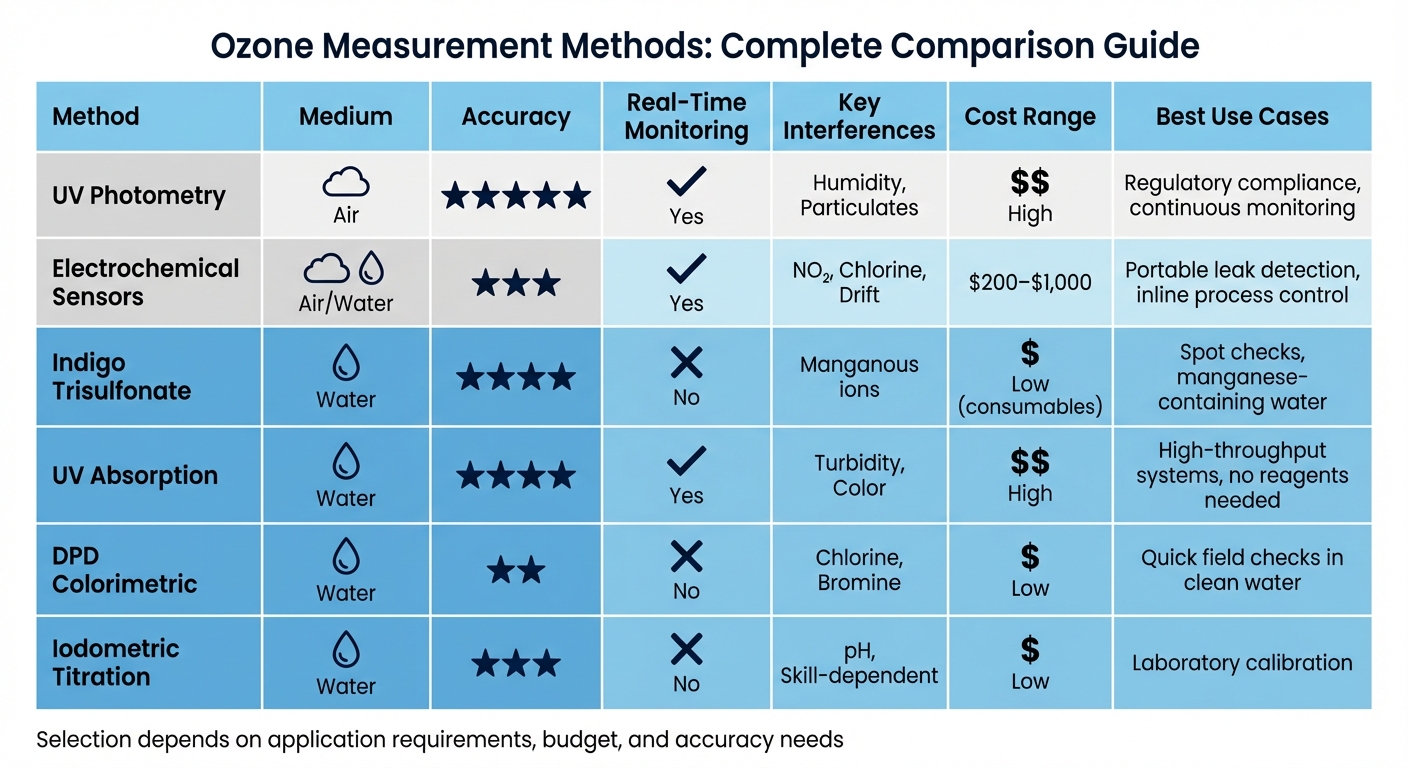
Ozone Measurement Methods Comparison: Air vs Water Testing Accuracy and Cost
Selecting the right method to measure ozone depends on several factors: the medium (air or water), the required level of accuracy, and the budget. For air monitoring, UV photometry stands out as the most precise option. When it comes to water, the Indigo Trisulfonate method is widely chosen for regulatory purposes and situations demanding high accuracy, thanks to its strong selectivity. High-purity indigo trisulfonate (over 80%) boasts a molar absorptivity of approximately 20,000 M⁻¹ cm⁻¹ at 600 nm. For continuous monitoring of water, membrane-covered electrochemical sensors excel by detecting dissolved ozone levels as low as 0.001 mg/L, making them ideal for applications in industries like pharmaceuticals or microelectronics.
The difference in how data is collected – whether in real-time or manually – further distinguishes these methods. Real-time measurement is crucial in many scenarios. Methods like UV photometry and electrochemical sensors provide continuous data, making them suitable for ongoing monitoring. On the other hand, colorimetric techniques – such as Indigo Trisulfonate and DPD – require manual sampling and processing. These methods are better suited for spot checks rather than continuous monitoring. As Isa M. Tanriverdi emphasizes:
"Precise ozone measurement isn’t a ‘nice to have’ – it’s essential. Overdosing can lead to pipe corrosion and unnecessary energy costs."
Interference factors also vary depending on whether ozone is measured in air or water. For air, environmental conditions like humidity and particulates can affect measurements. In water, challenges include turbidity (especially for UV methods), chlorine (impacting DPD tests), and manganous ions (affecting Indigo methods). For example, when chlorine levels reach up to 10 ppm, adding malonic acid to the Indigo method can help prevent inaccurate readings.
Below is a comparison of the most common measurement methods to help clarify their strengths, limitations, and best use cases.
Comparison Table for Measurement Methods
| Method | Medium | Accuracy | Real-Time | Key Interferences | Cost Range | Best For |
|---|---|---|---|---|---|---|
| UV Photometry | Air | Very High | Yes | Humidity, Particulates | High | Regulatory compliance, continuous monitoring |
| Electrochemical | Air/Water | Moderate | Yes | NO₂, Chlorine, Drift | $200–$1,000 | Portable leak detection, inline process control |
| Indigo Trisulfonate | Water | High | No | Manganous ions | Low (consumables) | Spot checks, manganese-containing water |
| UV Absorption | Water | High | Yes | Turbidity, Color | High | High-throughput systems, no reagents needed |
| DPD Colorimetric | Water | Low–Moderate | No | Chlorine, Bromine | Low | Quick field checks in clean water |
| Iodometric Titration | Water | Moderate | No | pH, Skill-dependent | Low | Laboratory calibration |
The cost of these methods varies widely. Portable air detectors, for instance, range from $200 to $1,000. While UV photometry has a higher upfront cost, it avoids ongoing expenses for consumables. Water colorimetric kits, on the other hand, are inexpensive initially but require regular reagent purchases. Similarly, electrochemical sensors are affordable but need frequent calibration to maintain accuracy.
Conclusion and Recommendations
Selecting the best ozone measurement method starts with understanding your specific requirements. For tasks like regulatory air monitoring or managing high-throughput water systems, UV absorption stands out for its precision and stability. While the initial investment is higher, this method avoids ongoing reagent costs, making it a long-term solution for consistent performance. On the other hand, electrochemical sensors are ideal for real-time monitoring in commercial or industrial settings, such as food processing or pharmaceutical applications. These sensors offer a good mix of accuracy and automation but do require regular calibration to address potential drift.
For smaller-scale needs, there are more economical options. Colorimetric kits provide a simple and affordable way to perform residential spot checks. In water testing, the Indigo Trisulfonate method is often preferred over DPD because it handles interferences more effectively. Additionally, since ozone is heavier than air, it’s crucial to position air monitors at the right height to ensure accurate readings.
When evaluating your options, don’t overlook the total cost of ownership, including maintenance and consumables. While UV systems have a higher upfront cost, they eliminate recurring reagent expenses. Conversely, colorimetric kits and portable electrochemical detectors may be less expensive initially but require ongoing purchases for consumables or periodic calibration. Balancing these costs against your performance needs will help you choose the most practical solution.
Accurate ozone measurement is essential for ensuring safe and effective disinfection. The method you choose should align with your environment and objectives. Industrial water treatment often requires continuous monitoring using UV systems or membrane-covered electrochemical sensors capable of detecting trace levels as low as 0.001 mg/L. For commercial applications, inline electrochemical sensors that integrate with SCADA systems are a great choice for automated process control. Meanwhile, residential or field testing can usually be handled effectively with simple colorimetric kits, which don’t require power or complicated setups.
If you’re in the Chicagoland area and need expert advice on applying these techniques to optimize ozone performance, Ozonated Cleaning LLC (https://ozonatedcleaning.com) offers professional guidance tailored to meet your specific needs.
FAQs
What safety precautions should I take when measuring ozone in air or water?
When measuring ozone in air or water, safety should always come first due to ozone’s toxic and highly reactive properties.
Work in a well-ventilated area, and whenever possible, use equipment with built-in exhaust systems to prevent dangerous gas buildup. If there’s a chance ozone levels might exceed the safe limit of 0.1 ppm over an 8-hour period, make sure to wear the right personal protective equipment (PPE). This includes ozone-rated respirators, chemical-resistant gloves, safety goggles, and lab coats. For working with higher concentrations, a supplied-air respirator might be required.
Before starting, double-check that all equipment is properly calibrated to ensure accurate measurements. Limit the time spent in areas with elevated ozone levels, and place sensors in well-mixed areas to avoid misleading readings. Above all, never exceed the recommended exposure limits to protect yourself and others.
What’s the difference between UV photometry and electrochemical sensors for monitoring ozone in the air?
UV photometry is widely regarded as the gold standard for measuring ozone levels in the air. This method uses ultraviolet light at a wavelength of 253.7 nm to directly detect ozone concentrations. It delivers precise and stable readings across a broad range, from about 1 to 1,000 ppb, making it ideal for continuous monitoring. In fact, the EPA relies on this technique as its primary calibration method for ozone measurement. One of its standout advantages is its resilience to external factors like temperature and humidity, ensuring consistent performance in various conditions.
On the other hand, electrochemical sensors offer a more budget-friendly and portable alternative, with prices ranging from $300 to $2,000. These sensors work by producing a current through a chemical reaction with ozone. However, their accuracy can be influenced by environmental factors such as temperature, humidity, and even the natural aging of the sensor itself. They’re a practical choice for quick assessments or cost-conscious setups, but they demand frequent calibration and may fall short in precision for regulatory or long-term applications.
Ultimately, UV photometry is the go-to option for high-precision, professional use, while electrochemical sensors provide an affordable and convenient solution for less demanding needs.
Why is the Indigo Trisulfonate method commonly used to measure ozone in water?
The Indigo Trisulfonate method is a popular choice for measuring ozone levels in water due to its precision and effectiveness across various concentrations. It relies on a blue dye that reacts immediately with ozone, ensuring a quick and uncomplicated process. Plus, the dye is non-toxic, adding an extra layer of safety to its use.
One of the standout features of this method is its ability to resist interference from other substances, like chlorine. By incorporating malonic acid during testing, any potential chlorine interference is neutralized, ensuring accurate results.
Its straightforward procedure, reliable accuracy, and easy waste management make it a go-to option for both scientific research and professional water testing.
Recent Comments