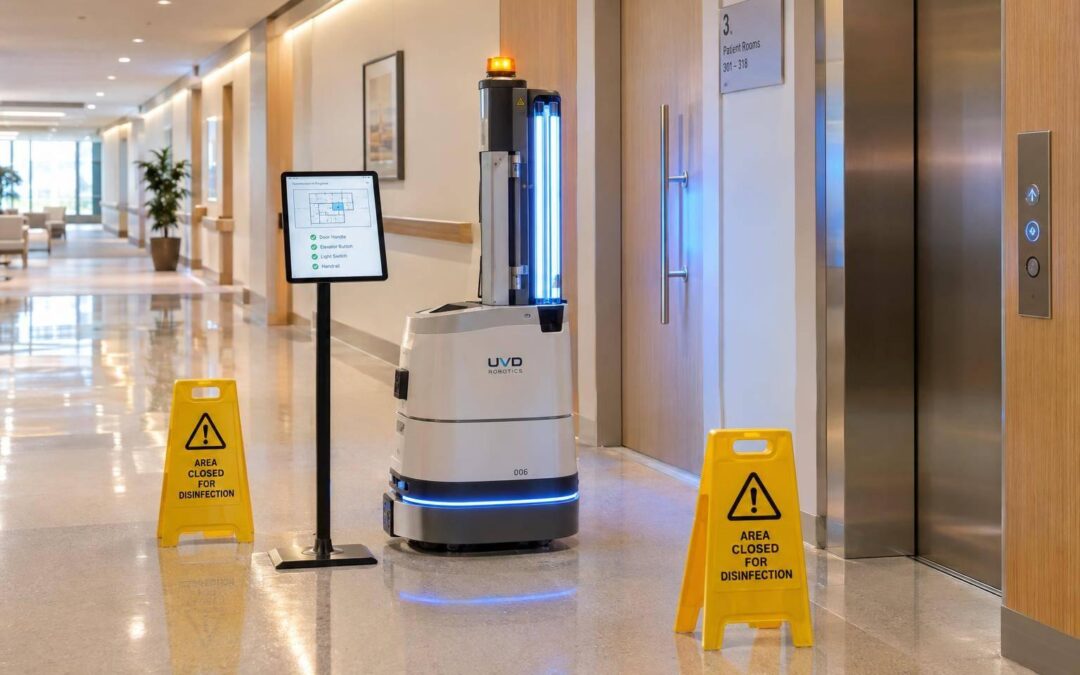
I start with the surface – not the robot. Clean first, then choose UV-C or a label-approved disinfectant that fits the material and target germ. Some liquid products require 1–10 minutes of wet contact time; your product’s EPA label sets the rule.
Here’s what I check before using a robot:
- Reach: Can a mobile robot, remote-controlled unit, or robotic arm treat each assigned handle, button, and counter?
- Treatment: UV-C needs enough direct exposure. Liquid methods need complete wetting for the labeled contact time.
- Safety: Check material limits, clear the treatment area, and follow exposure, ventilation, and re-entry rules.
- Results: Check missed spots, treatment records, and equipment condition. Assign unreachable surfaces to manual treatment.
- Fit: Tight homes, vehicle cabins, and cluttered rooms may be better suited to manual wiping. Care settings require facility approval.
My bottom line: <u>a finished route is not proof of disinfection</u>. Neither is a better smell. I treat odor removal as a separate job, with its own source removal, safety checks, and records.
Cleaning and disinfection robot »DeKonBot«
sbb-itb-5fea4da
Robot Types, Treatment Methods, and Surface Limits
Once you’ve set the goal, choose a robot that fits the room layout, can reach the assigned touchpoints, and respects surface limits.
Mobile Robots, Remote-Controlled Units, and Robotic Arms
A completed route does not mean every touchpoint was treated. Check whether the robot can treat handles, switches, controls, and undersides. Confirm its starting position, navigation accuracy, obstacle detection, and sprayer or lamp angle.
Compare robots by touchpoint access – not just how well they move through the floor plan.
| Feature | Autonomous mobile robots | Remote-controlled units | Robotic arms |
|---|---|---|---|
| Touchpoint access | Follow mapped routes to accessible touchpoints | Approach touchpoints under operator direction | Reach touchpoints within a fixed, programmed range |
| Treatment methods | Model-specific UV-C or liquid payloads | Model-specific emitters or sprayers | Targeted liquid application or supported UV-C tools |
| Supervision | Model-dependent monitoring; access controls still required | Continuous operator control | Setup checks and monitored operation |
| Room preparation | Remove obstacles, define boundaries, and clear people and animals | Provide safe access and working clearance | Position objects consistently and clear the work envelope |
| Surface reach | Limited by obstacles, shadows, and head position | Operator can adjust angle and distance | Precise within programmed reach; cannot cover an entire room |
| Treatment time | Depends on validated dose, distance, and dwell time | Depends on targets, operator technique, and exposure requirements | Depends on programmed movements and required exposure |
UV-C, Electrostatic Spraying, and Targeted Liquid Treatment
UV-C dose depends on output, distance, angle, obstructions, and dwell time. Follow validated positioning and dwell-time instructions. Do not count reflected or indirect UV-C as a full dose.
For liquid treatment, choose an EPA-registered disinfectant whose label permits the application method, surface, setting, and target organism. Use electrostatic application only when the label allows it. Keep the surface visibly wet for the full labeled contact time. Charged droplets may improve deposition on some hard, nonporous surfaces, but they do not guarantee complete coverage or enough wet contact time.
| Method | Coverage limits | Exposure controls | Treatment time | Residue | Verification |
|---|---|---|---|---|---|
| UV-C | Shadows, recesses, distance, and angles can prevent an adequate dose | Exclude people and animals; use provided interlocks and warning controls | Validated dose, distance, and dwell time | No chemical residue | Check lamp output, dose or cycle records, and shadowed areas |
| Electrostatic spraying | Blocked surfaces, undersides, and gaps may remain untreated | Follow label PPE, ventilation, vacancy, and re-entry rules | Full labeled wet contact time | Possible chemical residue or required rinse | Check spray pattern, wetness, contact time, and dilution |
| Targeted liquid treatment | Limited by tool reach, alignment, and complete wetting | Control spray exposure; follow label and equipment restrictions | Label-specific wet contact time and drying instructions | May require wiping or rinsing | Check each assigned touchpoint and record exceptions |
EPA label examples show electrostatic contact times from 1 to 10 minutes and spray distances from about 6 to 18 inches; one label example calls for approximately 2.5 feet.
Program the robot for the selected label – not a standard spray setting. Allow separate time for setup, application, contact time, and any required re-entry delay.
Surface Compatibility and Treatment Restrictions
Review the label, robot manual, surface instructions, and facility policy together. Material compatibility does not establish a pathogen claim, and a hard-surface claim does not cover porous materials. Repeated UV-C exposure can damage plastics, rubber, fabrics, coatings, and finishes. Document prohibited items before treatment.
| Surface type | UV-C: exposure and shadowing | Electrostatic spray: moisture and residue | Targeted liquid: moisture and residue | Main restriction |
|---|---|---|---|---|
| Electronics and touchscreens | Manufacturer approval required; recesses may be shaded | Avoid unless expressly permitted; liquid can enter ports and seams | Use an approved wipe or controlled application | Follow device instructions |
| Upholstery | Texture and depth limit exposure | Requires specific porous-material and application claims | Use only a supported material and pathogen claim | Hard-surface claims do not apply |
| Wood | Repeated exposure may damage finishes | Excess wetting can damage wood or finish | Use compatible chemistry and controlled wetting | Check finish guidance; test an inconspicuous area |
| Natural stone | Confirm sealer and finish compatibility; shaded areas remain | Incompatible acids or oxidizers may damage stone | Use approved chemistry; follow rinse directions | Verify stone and sealer compatibility |
| Painted finishes | Repeated exposure may fade coatings | Moisture or solvents may soften or stain paint | Control wetting; check residue instructions | Confirm coating compatibility |
| Corrosion-sensitive metals | No liquid residue; nearby coatings may degrade | Chlorides, oxidizers, or retained moisture may promote corrosion | Select compatible chemistry; rinse or dry as directed | Prevent retained chemical residue |
| Food-contact surfaces | Direct exposure required; does not replace required cleaning procedures | Use only products labeled for food-contact use and complete any required rinse | Complete labeled contact time and any required rinse | Use potable water for required post-treatment rinsing |
Reserve shaded, recessed, liquid-sensitive, or unreachable surfaces for approved targeted treatment. Before the robot runs, assign each touchpoint a compatible method and record exceptions separately. Use these limits to plan space preparation, treatment, and verification in the next step.
Safe Setup, Treatment, and Verification
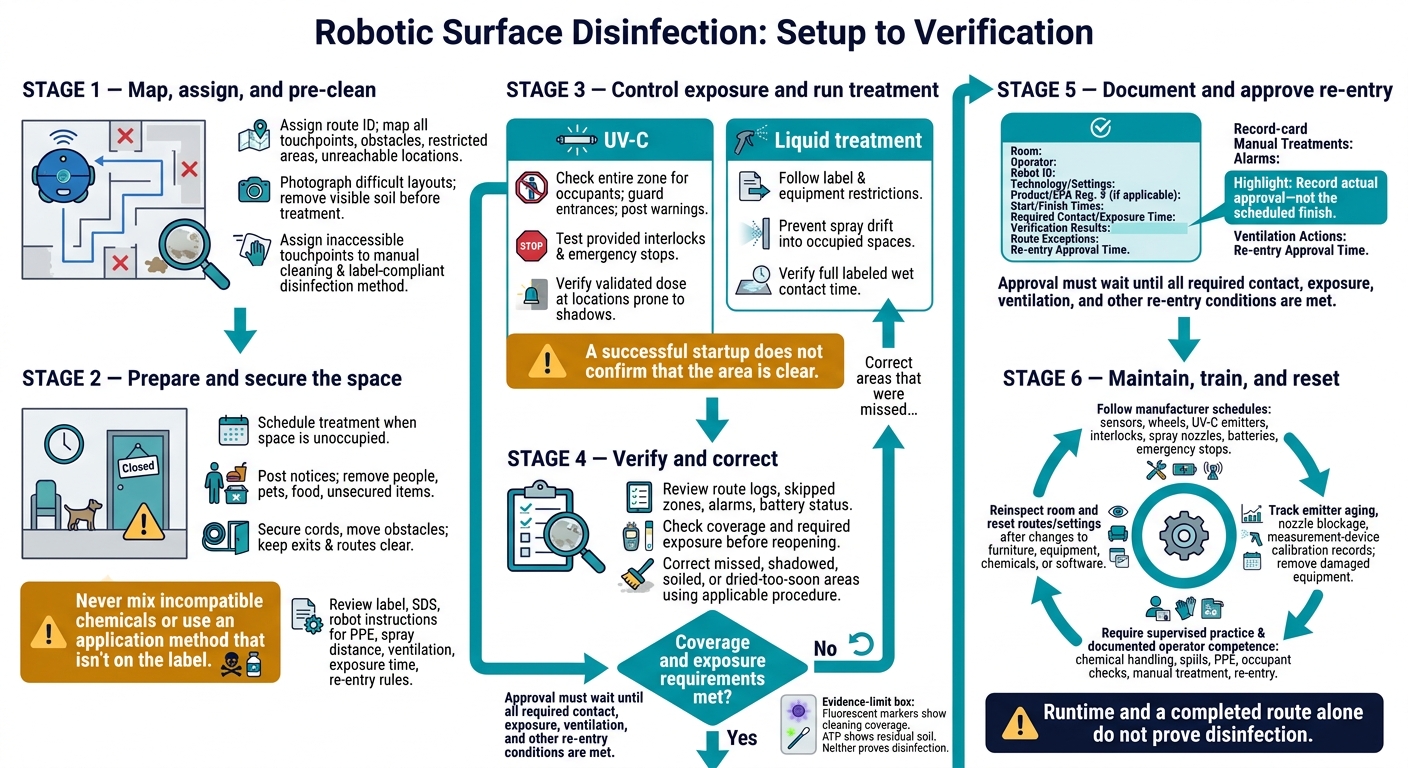
Robotic Surface Disinfection: Setup to Verification
Once you’ve chosen the robot and treatment method, follow this workflow to prepare the room, run treatment, and check the results.
Map Touchpoints and Prepare the Space
Inspect the room, assign a route ID, and map every touchpoint, obstacle, restricted area, and location the robot can’t reach. Photograph difficult layouts and remove visible soil before treatment. List inaccessible touchpoints for manual cleaning and compatible disinfection services that follow the product label.
Schedule treatment when the space is unoccupied. Post notices and remove people, pets, food, and unsecured personal items. Secure loose cords and move obstacles as needed, keeping exits, fire equipment, and accessible routes clear.
Control Exposure and Follow Treatment Instructions
Check the product label, safety data sheet (SDS), and robot instructions for PPE, spray distance, ventilation, exposure time, and re-entry rules. Never mix incompatible chemicals or use an application method that isn’t on the label.
Before running UV-C treatment, check the entire treatment zone for occupants. Guard entrances, post warnings, and test the provided interlocks and emergency stops. Keep spray from drifting into occupied spaces. A successful startup does not confirm that the area is clear.
Check Coverage and Record Results
Before reopening the space, check coverage and exposure. Review route logs, skipped zones, alarms, and battery status. Verify wet contact time or, for UV-C, the validated dose at locations prone to shadows. Runtime and a completed route alone do not prove disinfection.
Fluorescent markers show cleaning coverage, while ATP shows residual soil. Neither proves disinfection. Before releasing the space, use the applicable procedure to correct areas that were missed, shadowed, still soiled, or dried too soon.
Documentation is part of verification – not just paperwork. Record the room, operator, robot ID, technology, settings, product name, and EPA registration number when applicable. Include start and finish times, required contact or exposure time, verification results, route exceptions, manual treatments, alarms, corrective actions, ventilation actions, and re-entry approval time.
Record actual approval, not the scheduled finish. Approval must wait until all required contact, exposure, ventilation, and other re-entry conditions are met.
Maintain Equipment and Train Operators
Keep equipment and operator skills ready for repeatable disinfection runs. Follow manufacturer schedules for cleaning sensors, inspecting wheels and navigation components, checking UV-C emitters, testing occupancy sensors and interlocks, inspecting spray nozzles and pumps, charging and inspecting batteries, and testing emergency stops.
Track emitter aging, nozzle blockage, and calibration records for radiometers or other measurement devices. Remove damaged equipment from service.
Require supervised practice and documented proof that operators can handle chemicals, respond to spills, use PPE, check for occupants, perform manual treatment, and approve re-entry. Reinspect the room and reset routes and settings after any change to furniture, equipment, chemicals, or software.
Where Robots Fit and How They Support Odor Control
Commercial Buildings, Care Settings, and Homes
Choose robotic treatment where it fits the space and task; use manual cleaning where it’s faster. Use robots only after routine cleaning, on accessible touchpoints that can be treated consistently. Commercial treatment requires compatible surfaces, validated coverage, and keeping occupants out.
Office reception counters, classroom desks, and hotel room touchpoints may fit when treatment can occur between uses.
Healthcare and senior-care rooms require facility-policy review, infection-prevention approval, and coordination with nursing and environmental services. At home, scattered touchpoints and tight rooms often make manual wiping faster and more reliable.
| Situation | Treatment decision |
|---|---|
| Exposed, compatible hard surfaces with validated coverage; occupants can be excluded | Robotic treatment may fit after routine cleaning. |
| Visible soil, spills, clutter, irregular objects, or obstructed touchpoints | Use manual cleaning and appropriate targeted disinfection. |
| Upholstery, delicate finishes, or moisture-sensitive electronics | Exclude unless equipment instructions and the product label permit treatment. |
| Surgical instruments or reusable medical devices | Exclude; follow required reprocessing. |
Vehicles, RVs, Boats, and Confined Spaces
Before choosing treatment, check aisle width, steps, ventilation, upholstery, electronics, seals, and moisture-sensitive finishes. Fitting inside the cabin doesn’t guarantee coverage. Seats, compartments, and fixtures can block exposure. Shadows, seams, and tight spaces limit both UV-C and liquid coverage.
Targeted manual treatment is often more practical for handles, steering controls, switches, tables, and bathroom fixtures. Don’t use robotic treatment unless you can confirm that the equipment can maneuver and the space can be isolated. Use manual treatment if coverage, ventilation, or material compatibility is uncertain.
Coordinate Surface Disinfection With Odor Removal
Odor control needs its own workflow, even when it happens alongside disinfection. Persistent odors require finding the source, physically cleaning affected areas, and fixing moisture or ventilation problems. A surface-disinfection robot does not automatically deodorize upholstery, remove contaminated material, or fix dampness.
Keep separate disinfection and odor records. Record the surfaces, treatment parameters, exclusions, and verification for disinfection. For odor work, document the source, affected materials, source-removal work, deodorization method, ventilation, re-entry checks, and follow-up findings.
Ozonated Cleaning LLC provides odor removal and surface disinfection using ozone and hydroxyl technology for Chicagoland homes, businesses, vehicles, RVs, and boats. Assess each proposed treatment separately for safety, evidence of efficacy, material effects, and ventilation requirements. Odor reduction does not prove disinfection.
Ozone can irritate the lungs. Concentrations needed for some odor-reduction applications may exceed levels considered safe for people. Ozone treatment requires an unoccupied, isolated space, with people, pets, and plants removed. Treatment must be followed by ventilation and verified safe re-entry – not just a set waiting period. When comparing ozone vs hydroxyl, hydroxyl systems also require review of operating limits, by-products, ventilation, and material compatibility.
Conclusion: Match the Robot to the Surface and Goal
After planning, treatment, and verification, match the robot to the job. Assess the job before choosing the robot. Map touchpoints, surface materials, occupancy patterns, and ventilation. Start with one pilot room to check coverage and compatibility. Then set a schedule based on use and risk.
Pre-clean and follow both equipment instructions and the product label. Use only label-approved methods, and keep surfaces wet for the full contact time. Set exposure controls and re-entry requirements before treatment.
Check individual touchpoints – not just whether the robot finished its route. Document missed areas and corrective work. Manual cleaning handles touchpoints the robot misses or can’t reach. These checks separate a completed route from verified disinfection.
Identify odor sources and plan professional or DIY removal separately. Better odor does not mean disinfection has occurred. Neither a completed route, a UV-C cycle, nor an odor change alone proves effective disinfection. Choose a method only when the robot, agent, surface, and target use match.
FAQs
How often should I schedule robotic disinfection?
Use ozone treatments for specific decontamination needs, not routine maintenance. How often you treat a space should depend on your sanitization goals, contamination levels, and foot traffic. Ozone treatments require an unoccupied space, so schedule them during planned shutdowns, overnight, or early in the morning.
For continuous air quality maintenance in occupied spaces, consider hydroxyl generators designed for 24/7 use. Confirm that the model is approved for occupied spaces and follow the manufacturer’s safety instructions.
What should I measure during a pilot run?
Measure ozone levels in real time using calibrated portable or fixed monitors to check treatment effectiveness and compliance with regulatory safety limits. Track temperature and humidity, too.
For aqueous treatments, record the ozone concentration (ppm or mg/L) and how long surfaces stay wet. For gaseous treatments, log generator settings, total exposure time, and the ventilation time needed to bring ozone below 0.1 ppm for safe re-entry, subject to applicable safety requirements.
Timestamp all readings and treatment records for quality assurance.
How can I tell if robotic disinfection is cost-effective?
Weigh upfront investment and long-term maintenance costs against savings from less downtime, reduced labor, fewer chemical disinfectant purchases, and less material degradation. Robotic and automated ozone systems can help lower costs by cutting manual cleaning needs and shortening turnaround times between events or fleet uses.
For specialized needs, Ozonated Cleaning LLC offers tailored protocols to help maintain hygiene standards while using your facility’s resources efficiently.
Recent Comments