Indoor air pollution is a major health concern, affecting 90% of Americans who spend most of their time indoors. Poor air quality can lead to respiratory issues, heart problems, and even reduced productivity. Ozone technology offers a powerful way to address common indoor pollutants like odors, bacteria, viruses, mold, and VOCs (volatile organic compounds). However, ozone treatments require professional handling due to safety risks at high concentrations.
Key Takeaways:
- What Ozone Does: Neutralizes odors, kills bacteria/viruses, and reduces mold and VOCs by breaking them down at a molecular level.
- How It Works: Ozone’s reactive third oxygen atom targets contaminants, but it must be used in unoccupied spaces due to health risks.
- Benefits: Reaches hidden areas, eliminates odors at the source, and leaves no harmful residue when applied correctly.
- Safety: Professional services ensure controlled use, proper ventilation, and protection of sensitive materials.
Ozone treatments are ideal for tackling severe contamination but should be paired with other methods like HEPA filtration and ventilation for long-term air quality improvement.
What Is an Ozone Generator? Uses, Risks, and How It Affects Indoor Air Quality
How Ozone Technology Works
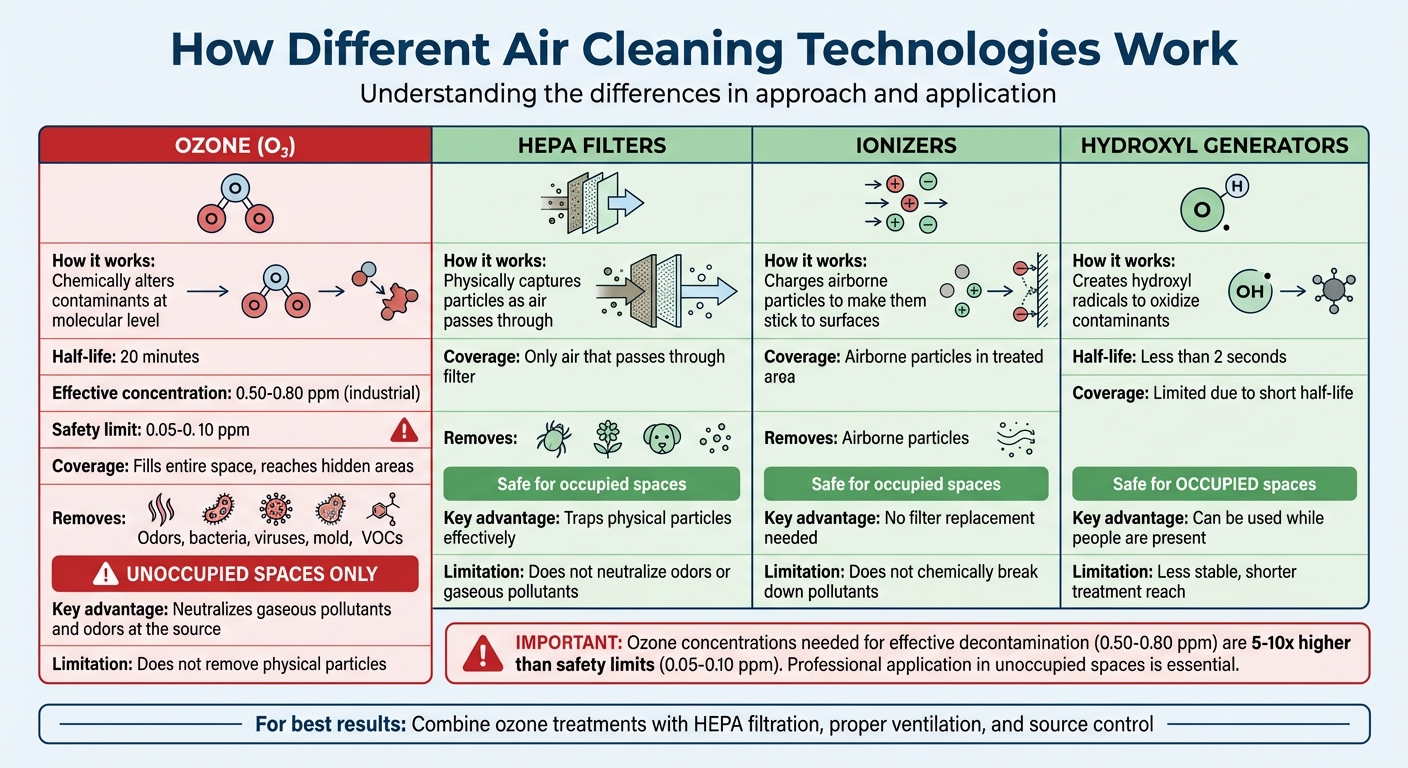
Ozone vs Other Air Cleaning Methods: Technology Comparison Chart
What Is Ozone and How Does It Work?
Ozone (O₃) is a molecule made up of three oxygen atoms, which makes it far more reactive than regular oxygen (O₂). In nature, ozone is created through processes like lightning strikes, photosynthesis, and ultraviolet radiation. It’s recognized as one of the most powerful oxidants on Earth, ranked just behind fluorine in strength.
What makes ozone so effective is its unstable third oxygen atom. This atom easily detaches and bonds with other molecules, altering their chemical structure. When ozone interacts with odor-causing gases, bacteria, or mold spores, it breaks them down at a molecular level, eliminating odors right at their source.
Ozone doesn’t stick around for long. It has a half-life of about 20 minutes, meaning it naturally decomposes back into oxygen fairly quickly. As a gas, ozone can spread throughout a room, reaching surfaces, fabrics, walls, and ceilings – even in hard-to-reach areas. However, the concentrations needed to effectively neutralize pollutants are much higher than what is considered safe for human exposure. For example, the FDA caps ozone emissions from indoor medical devices at 0.05 ppm, while OSHA limits workplace exposure to an average of 0.10 ppm over an 8-hour period. By comparison, industrial ozone generators used in controlled settings can produce concentrations between 0.50 and 0.80 ppm – 5 to 10 times above public health limits. Because of this, ozone treatments must be conducted in unoccupied spaces by trained professionals to ensure safety.
Ozone Compared to Other Air Cleaning Methods
Ozone stands apart from other air cleaning technologies because it doesn’t just trap particles – it actively neutralizes gaseous pollutants and odors. Unlike mechanical filters like HEPA, which physically capture particles such as dust, pollen, and pet dander as air passes through, ozone fills an entire space and chemically alters contaminants.
Ionizers, another common technology, work by charging airborne particles, causing them to stick to surfaces or each other. However, they don’t chemically break down pollutants. Hydroxyl generators offer another option, but they operate differently. As Susan Duffy, Founder of Queenaire Technologies, explains:
Hydroxyl Generators are safe to use in occupied spaces whereas Ozone Generators are safe to operate in unoccupied spaces.
Hydroxyl radicals have an extremely short half-life – less than two seconds – making them less stable than ozone. Ozone’s longer half-life of 20 minutes allows it to persist long enough to treat an entire space effectively, though it requires unoccupied conditions for safe use.
Unlike liquid chemical cleaners that must physically contact surfaces to work, ozone can penetrate porous materials and reach hidden areas. That said, it doesn’t remove physical particles like dust or dander from the air. For the best results in improving indoor air quality, ozone treatments should be paired with proper ventilation and efforts to control pollution at its source.
These differences highlight ozone’s ability to tackle pollutants in ways that other methods simply can’t.
Benefits of Ozone for Indoor Air Quality
When it comes to tackling indoor air pollutants, ozone provides a versatile approach to improving air quality on multiple fronts.
Eliminating Persistent Odors
Ozone doesn’t just cover up odors – it breaks them down at a molecular level. By chemically altering odor molecules, ozone effectively neutralizes stubborn smells like pet dander, cigarette smoke, body odors, and even the lingering scent of fire damage.
The duration of treatment depends on the severity of the odor. That said, ozone is not effective against pet urine odors due to the chemical stability of urea, which doesn’t oxidize well.
For odors to be permanently removed, the root cause must also be addressed. As AirPureLife explains:
Ozone will remove an odor permanently as long as you also take care of the source of that odor.
If issues like pet waste, water-damaged carpets, or decaying materials aren’t resolved, odors may return even after ozone treatment.
In addition to tackling odors, ozone disrupts microbial contaminants, offering further benefits for air quality.
Killing Bacteria and Viruses
Ozone works by chemically altering microorganisms. Its third oxygen atom detaches and reacts with other substances, changing their chemical structure. This process can deactivate or kill bacteria, viruses, and mold.
However, achieving effective microbial decontamination requires ozone levels that exceed public health safety limits. For this reason, such treatments must be carried out in unoccupied spaces by trained professionals who follow strict safety protocols.
Ozone’s oxidizing power doesn’t stop there – it also helps manage mold and volatile organic compounds (VOCs).
Controlling Mold, Mildew, and VOCs
Ozone reacts with VOCs, such as acrolein from secondhand smoke or chemicals emitted by new carpets, breaking them down into less harmful substances. It can also inhibit the growth of mold and mildew through high-concentration treatments in unoccupied spaces.
Despite its effectiveness, there are limitations. Ozone struggles to penetrate porous materials like ceiling tiles, duct linings, or deep fabric fibers where mold spores may hide. As the Lawrence Berkeley National Laboratory points out:
The concentrations of ozone required to kill bacteria and mold on surfaces are far too high and at these concentrations the ozone poses immediate risks to health.
Additionally, ozone reactions with VOCs can produce secondary pollutants like formaldehyde and ultrafine particles, making proper ventilation crucial. Long-term air quality improvements often require addressing the source of the problem, such as fixing moisture issues or removing VOC-emitting materials.
Whether it’s eliminating odors, neutralizing bacteria and viruses, or reducing mold and VOCs, ozone treatments should be handled by professionals. At Ozonated Cleaning LLC, we specialize in safe, chemical-free ozone treatments tailored to improve air quality in homes, vehicles, and businesses throughout the Chicagoland area.
sbb-itb-5fea4da
Why Use Professional Ozone Services
When it comes to ozone treatments, consumer-grade ozone generators often fall short. They fail to achieve the high concentrations required for effective decontamination, and at safe levels, ozone barely makes a dent in removing contaminants or odors. To truly sanitize a space, concentrations must exceed public health safety limits – something the US EPA cautions against:
"The concentration of ozone would have to greatly exceed health standards to be effective in removing most indoor air contaminants."
This is where professional ozone services come in. These experts safely apply high-concentration treatments in unoccupied spaces, ensuring biocidal levels are reached without endangering people or pets. By doing so, they maximize ozone’s ability to eliminate microbes and odors while maintaining safety.
Treating Hard-to-Reach Areas
One of the standout advantages of professional ozone treatments is their ability to tackle contamination in places manual cleaning can’t reach. Thanks to its gaseous nature, ozone seeps into ductwork, behind walls, into ceiling tiles, and through structural gaps where odors and contaminants often linger. This is particularly useful in post-disaster scenarios, such as after fires or floods, where ozone can oxidize smoke particles and mold spores embedded deep within materials.
Professionals also design systems to ensure even distribution of ozone, addressing its tendency to cling to surfaces. They understand that while ozone is highly effective in many areas, it may struggle with biological contaminants deeply embedded in porous materials. Additionally, ozone works at impressive speeds, killing bacteria over 3,000 times faster than chlorine and breaching bacterial membranes more than 50% more efficiently.
Chemical-Free and Environmentally Safe
A major benefit of ozone is its natural decomposition into oxygen, leaving behind no harmful residues. However, it’s not entirely risk-free – if not managed properly, ozone can react with indoor chemicals to create secondary pollutants like formaldehyde, aldehydes, and ultrafine particles. As Mellifiq explains:
"Ozone is the most effective method of treating air and water from a time and cost perspective and can be applied in a broad range of industrial applications."
Professional services manage these risks by ensuring proper ventilation post-treatment to remove residual ozone and any byproducts. They also take precautions to protect sensitive materials, as high ozone levels can damage items like rubber, electrical wire coatings, fabrics, and artwork with delicate dyes. This level of control allows ozone to be used safely across a variety of settings.
Solutions for Homes, Vehicles, and Businesses
Professional ozone treatments are versatile, addressing contamination in homes, vehicles, and commercial properties. At Ozonated Cleaning LLC, we provide services throughout the Chicagoland area, offering solutions for residential spaces, businesses, vehicles, RVs, boats, and semi-trucks. These treatments effectively tackle stubborn odors and biological contaminants that other methods fail to resolve.
For residential properties, our services range from $600 to $900 depending on the size of the space, targeting odors embedded in carpets, upholstery, and structural materials. Vehicle deodorizing is available for $150 per vehicle, while semi-truck sanitization costs $200 per truck – a valuable service for creating healthier environments for long-haul drivers.
The difference between professional and DIY ozone treatments is stark. Consumer devices often fail to deliver consistent results and can pose health risks without achieving proper decontamination. Professional services, on the other hand, use industrial-grade corona discharge ozone generators and specialized techniques to ensure odors and pathogens are fully eliminated – not just masked.
Safe Application of Ozone Technology
Preventing Ozone Overexposure
Ozone is highly effective at eliminating odors and pathogens, but it operates at concentrations that can be unsafe for humans and animals. The U.S. Environmental Protection Agency (EPA) emphasizes this risk:
"Whether in its pure form or mixed with other chemicals, ozone can be harmful to health".
Federal guidelines limit ozone exposure to 0.05–0.10 ppm for indoor devices and workplace safety. However, a controlled study revealed that a consumer ozone generator meant for a 3,000-square-foot area produced ozone levels of 0.50 to 0.80 ppm in a much smaller 350-square-foot room. That’s five to ten times higher than public health standards.
Ozone doesn’t just pose direct health risks – it can also react with indoor chemicals, creating dangerous byproducts like formaldehyde and ultrafine particles. Additionally, it can damage materials such as rubber, electrical wire coatings, fabrics, and even artwork. Complicating matters further, olfactory fatigue can dull your ability to detect dangerously high ozone levels.
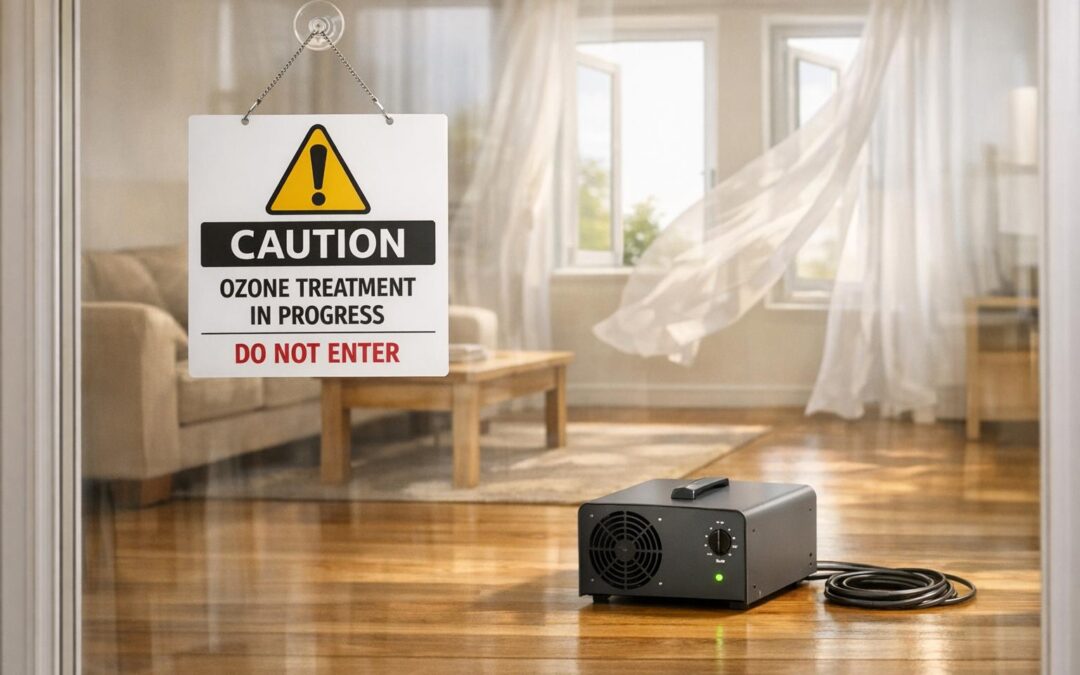
For safety, ozone treatments must always take place in completely unoccupied spaces. This means removing all people, pets, and plants from the area and ensuring full ventilation before anyone re-enters.
Benefits of Professional Services
Given the strict safety measures required, professional ozone services are the best way to ensure controlled and effective treatments. Trained technicians know how factors like room size, furnishings, and ventilation influence ozone levels – details that can be challenging for untrained users to manage. Even when following manufacturer guidelines, consumer-grade ozone devices can produce unsafe concentrations.
Ozonated Cleaning LLC specializes in high-concentration ozone treatments across the Chicagoland area, prioritizing safety at every step. Our technicians seal off treatment areas, confirm they are unoccupied, and use industrial-grade equipment to achieve effective decontamination. We also take precautions to protect sensitive materials, manage ventilation, and ensure safe re-entry conditions before completing any job. Whether it’s a home (priced between $600 and $900 depending on size), a vehicle ($150), or a semi-truck ($200), our services deliver results that consumer devices simply can’t match – without compromising safety.
Conclusion: Improving Air Quality with Ozone
Ozone technology provides an effective way to address indoor air quality challenges that other methods often fall short of solving. Its ability to chemically neutralize odor molecules, bacteria, viruses, and VOCs makes it particularly useful for handling tough situations like fire damage, mold growth, and stubborn odors. That said, the same reactive nature that makes ozone effective also means it must be handled with care to avoid potential hazards.
Using ozone for decontamination requires concentrations far above the safe exposure limits for humans (0.05–0.10 ppm). In fact, effective treatments often involve levels that are 5 to 10 times higher, making professional application in unoccupied spaces essential.
At Ozonated Cleaning LLC, we specialize in providing high-concentration ozone treatments safely and efficiently throughout the Chicagoland area. Whether it’s for homes, vehicles, or semi-trucks, our trained technicians manage every step of the process to ensure thorough and safe decontamination.
For ongoing air quality management, ozone treatments work best when combined with other proven methods like source control, proper ventilation, and HEPA filtration. While ozone is not a solution for continuous air purification, it’s an excellent tool for addressing serious contamination issues. When applied by skilled professionals, ozone achieves results that consumer-grade devices simply can’t match.
Tired of dealing with lingering odors and harmful contaminants? Visit Ozonated Cleaning LLC to explore professional ozone treatment options designed to meet your needs.
FAQs
How does ozone treatment improve indoor air quality compared to other methods?
Ozone treatment takes a different approach to cleaning the air by using ozone (O₃), a strong oxidizing agent, to tackle odors, bacteria, viruses, and other airborne pollutants at their core. Unlike traditional air purifiers like HEPA filters or activated carbon, which capture contaminants, ozone actively breaks down harmful particles and neutralizes odors. This makes it particularly effective for deep cleaning and removing stubborn smells in spaces where people aren’t present.
That said, ozone treatment comes with a significant caveat: inhaling ozone can irritate the respiratory system. For areas where people are present, safer options like HEPA filters are a better choice, as they continuously improve air quality without generating harmful byproducts. Ozone treatment works best in unoccupied spaces that need intensive disinfection or odor removal.
Can ozone generators be safely used while people are in the room?
No, using ozone generators in spaces where people are present is not safe. Ozone acts as a lung irritant and can trigger respiratory problems when inhaled. Extended exposure to ozone indoors can pose serious health risks.
To ensure safety, ozone generators should only be operated in unoccupied areas. After use, the space must be thoroughly ventilated before anyone reenters. Always adhere to the manufacturer’s instructions and safety recommendations when using ozone-based devices.
What are the advantages of using professional ozone services to improve indoor air quality?
Professional ozone services provide a reliable solution for enhancing indoor air quality. With the help of trained technicians, ozone technology is used to remove tough odors, sanitize surfaces, and reduce allergens, promoting a healthier and more comfortable environment. Unlike do-it-yourself approaches, professionals ensure ozone is applied correctly and safely, reducing health risks and avoiding misuse.
Ozone treatments excel at tackling persistent odors, bacteria, mold, and other contaminants that regular cleaning methods often leave behind. These services are well-suited for homes, businesses, and even vehicles where maintaining clean air is a priority. For safety, ozone is applied exclusively in unoccupied spaces by skilled experts who carefully manage its use.
Recent Comments