
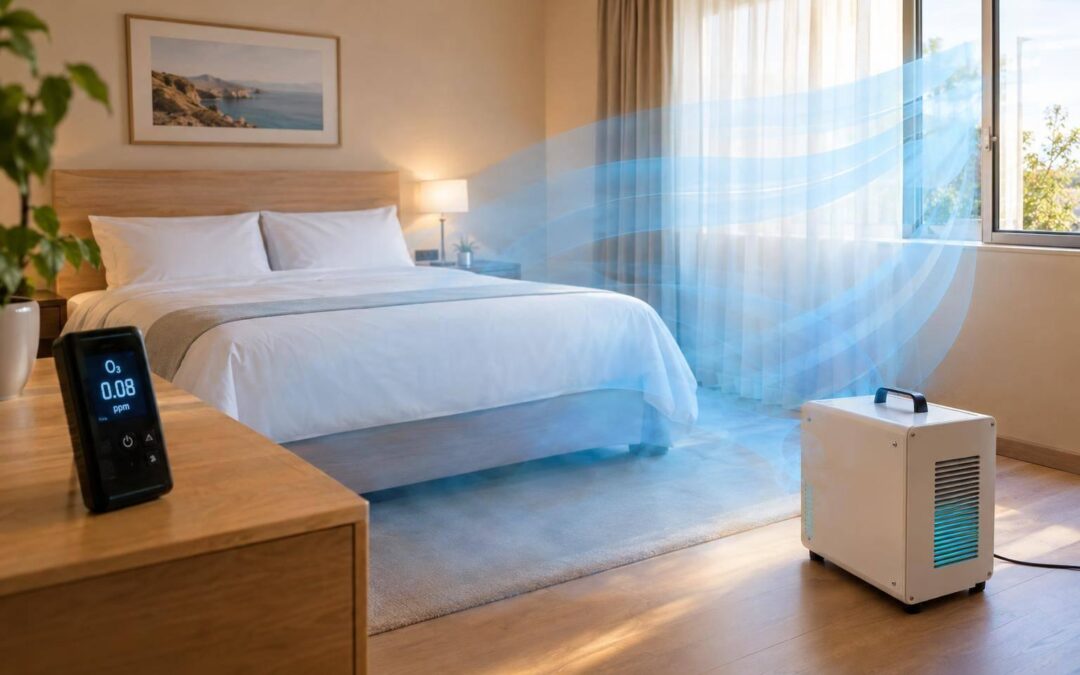
Ozone can reduce hotel room odors, but it doesn’t replace cleaning – or prove a room is safe. I’d start by removing the odor source, fixing moisture problems, and keeping the room vacant and isolated during professional treatment.
My room-turnover checklist comes down to three steps:
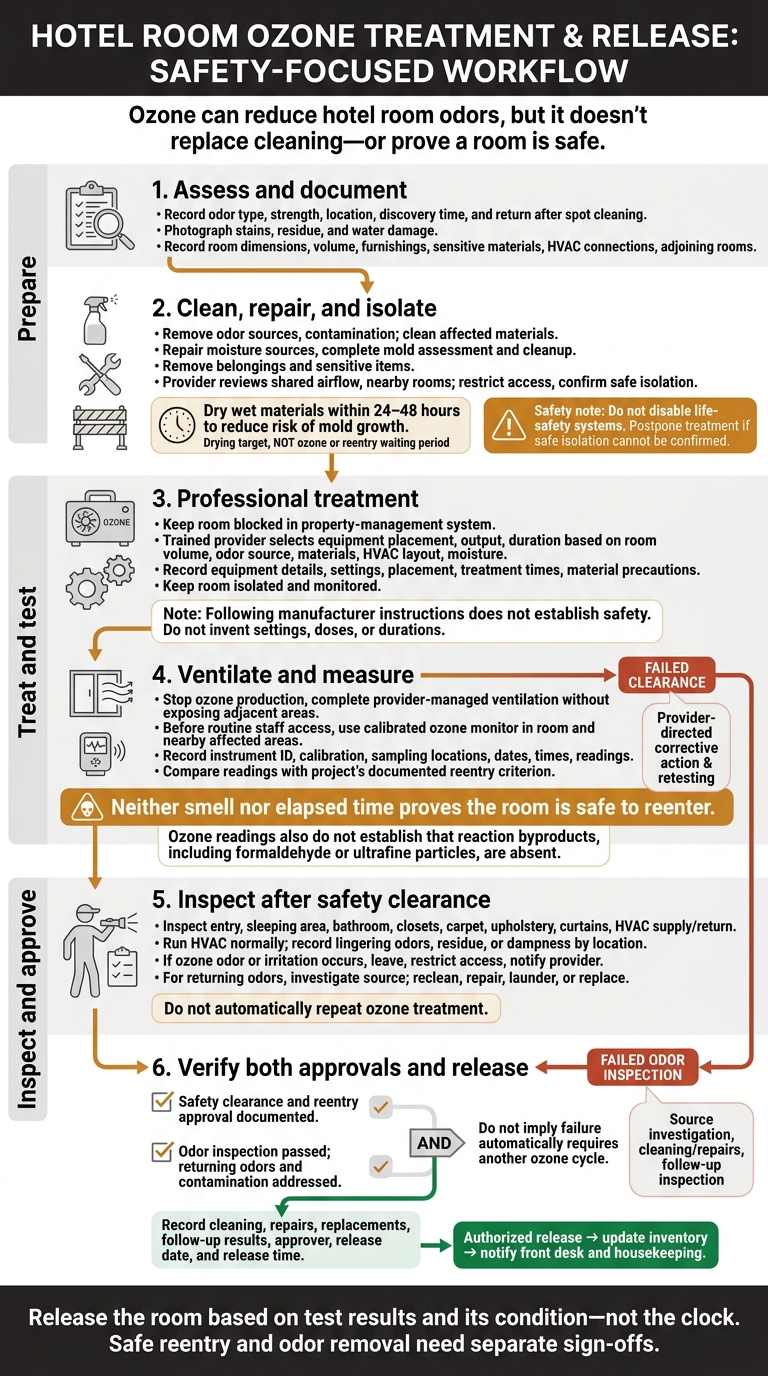
- Prepare: Document the odor, clean affected materials, and have the provider check shared airflow and nearby rooms.
- Treat and test: Allow time for treatment, ventilation, and calibrated ozone measurements. A timer or lack of smell cannot confirm safety.
- Inspect and approve: Check for returning odors, finish any repairs or cleaning, and record both safety clearance and odor approval before releasing the room.
For damp materials, the drying target is 24–48 hours to help prevent mold growth. My bottom line: <u>release the room based on test results and its condition – not the clock.</u>
Hotel Ozone Treatment: From Odor Assessment to Room Release
Assess the Odor and Prepare the Room
Once the room is vacant and isolated, document conditions before cleaning so the provider can match treatment to the odor source. Record the odor’s type, strength, location, when it was discovered, and whether it returns after spot cleaning. Photograph stains, residue, and water damage.
Measure the room in feet and calculate its volume in cubic feet. Note bathrooms, closets, furnishings, mattresses, carpet, curtains, HVAC connections, and adjoining rooms. Flag rubber, latex, plastics, dyes, electronics, and finishes for the provider to review. In some cases, the provider may recommend comparing ozone vs hydroxyl to determine which method is safer for these sensitive materials.
Clean Smoke, Food, Mildew, and Pet Contamination
Before cleaning, check under beds, behind furniture, along carpet edges, and inside appliances. Wash affected linens and removable covers according to their care labels.
Match pre-cleaning to the odor source so treatment targets contamination ozone can reach. Checks after clearance help confirm whether the room is ready for turnover.
| Odor source | Common odor reservoirs | Pre-cleaning | After-clearance check |
|---|---|---|---|
| Smoke | Drapes, carpet, upholstery, walls, HVAC filters | Remove ash; clean residue; launder textiles; inspect filters and furnishings | Recheck fabrics, closets, and HVAC outlets for residue or returning odor |
| Food | Appliances, trash cans, carpet, upholstery, drains | Remove food and trash; clean spills, grease, appliances, and affected drains | Recheck appliances, waste areas, and spill sites for sour or rancid odors |
| Mildew | Damp padding, drywall, wood, HVAC components | Repair moisture sources; dry materials; assess and clean mold | Verify moisture correction and cleanup, not just odor loss |
| Pets | Carpet padding, mattresses, baseboards, subfloor | Remove waste; use compatible enzymatic cleaners; inspect underlying materials; replace materials that cannot be cleaned | Recheck seams, floor edges, and beneath furniture for odor |
Once you identify the odor source, address moisture and contamination first. For damp rooms, CDC recommends drying wet materials within 24–48 hours to reduce the risk of mold growth. Visible or suspected mold needs assessment and cleanup before treatment.
Remove Belongings and Isolate the Room
Remove belongings, medications, food, drinks, plants, and other sensitive items as directed to protect them and reduce treatment complications. Keep an inventory of guest property that staff move.
Have the provider assess shared ducts, bathroom exhausts, connecting doors, transfer grilles, and adjacent rooms. That review should include whether neighboring rooms must be vacated.
Only authorized personnel should change HVAC controls. Do not disable life-safety systems. Postpone treatment if safe isolation cannot be confirmed.
Use this checklist to confirm the room is ready for treatment.
Preparation checklist
- [ ] Odor record, photos, dimensions, and room volume complete.
- [ ] Trash, contamination, textiles, and belongings addressed.
- [ ] Moisture repairs and mold cleanup completed.
- [ ] Sensitive materials, HVAC pathways, and adjacent rooms reviewed.
- [ ] Access restricted; provider approved.
sbb-itb-5fea4da
Plan Treatment and Room Turnover
Keep the room blocked in the property-management system until clearance is documented. Treatment can begin once cleaning, isolation, and documentation are complete.
Choose Professional Treatment Settings
After cleaning and isolation, a trained provider sets the treatment plan. The provider should choose equipment placement, output, and duration based on room volume, the odor source, porous materials, HVAC layout, moisture, and manufacturer specifications.
Position equipment to treat affected areas without exposing sensitive materials, electronics, rubber, plants, or artwork. Following manufacturer instructions does not establish safety; hazardous ozone levels can still occur.
Record the equipment model, output setting, placement, start and stop times, room dimensions, and material-compatibility precautions. Keep the room isolated and monitored throughout treatment.
Allow Time for Treatment and Clearance
Schedule the full service window, not just generator runtime. Ozone decay, controlled ventilation, clearance testing, and additional cleaning can all extend the time the room stays out of service.
| Stage | Required work | Timing factors | Completion criteria |
|---|---|---|---|
| Setup | Confirm the room is empty and the odor source has been addressed; coordinate HVAC controls; record room and equipment details. | Room size, furnishings, HVAC layout, and material sensitivity. | Front desk blocks inventory; housekeeping removes the room from work queues; maintenance coordinates equipment access and HVAC controls; provider approves setup. |
| Ozone cycle | Run equipment under the written service plan and monitor treatment. | Odor severity, room volume, and equipment output. | Cycle completed; no entry without permission. |
| Ventilation | Stop ozone production and complete provider-managed air exchange. | HVAC capacity, weather, and ozone decay. | Ventilation plan completed. |
| Inspection | Measure ozone; inspect surfaces and furnishings; complete further cleaning or source removal as needed. | Sampling locations, instrument limits, and persistent odor. | Readings meet the documented reentry criterion; inspection passes. |
| Room release | Obtain safety approval, update inventory, and notify front desk and housekeeping. | Test results, odor checks, repairs, and follow-up. | Clearance logged; room returned to service. |
After the ozone cycle ends, ventilation and testing determine when turnover can proceed.
Ventilate and Measure Ozone Before Reentry
Manage outdoor-air ventilation so exhaust does not reach adjacent rooms, corridors, or shared-air spaces. Before routine staff access, measure ozone in the room and nearby affected areas with a calibrated ozone monitor. Record the instrument identification, calibration information, sampling locations, dates, times, and readings, then compare the results with the documented reentry criterion.
Neither smell nor elapsed time proves the room is safe to reenter.
OSHA’s 8-hour worker limit is 0.1 ppm, but guest-room release should follow the project’s documented reentry criterion. Ozone readings also do not establish that reaction byproducts, including formaldehyde or ultrafine particles, are absent.
Treatment-to-turnover checklist
- [ ] Room blocked throughout treatment, ventilation, and testing.
- [ ] Equipment settings, treatment times, and ventilation recorded.
- [ ] Calibrated measurements meet the documented reentry criterion.
- [ ] Post-clearance inspection and required cleaning completed.
Next, inspect the room and confirm the odor stays gone before release. If readings or odor checks fail, address the issue through further testing, inspection, and follow-up before returning the room to service.
Check Results and Approve Room Release
After clearance testing, confirm that the room still smells clean and has no signs of hidden contamination. Safe reentry and odor removal need separate sign-offs. A passing ozone reading does not prove the odor source is gone. Keep the room out of inventory until both checks pass.
Inspect the Room After Safety Clearance
Follow the same inspection order each time: entry, sleeping area, bathroom, closets, carpet, upholstery, curtains, and HVAC supply and return airflow. Run the HVAC normally and record any lingering odors, residue, or dampness by location. If you notice an ozone odor or respiratory irritation, leave the room, restrict access, and notify the provider.
If an odor returns during inspection, trace its source before releasing the room. Reclean, launder, or replace contaminated materials as needed. Do not automatically repeat ozone treatment; consider odor types hydroxyl technology eliminates if the source is persistent. Smoke residue, pet waste, and saturated padding may remain even when the air smells better.
Persistent mildew odors call for a moisture investigation. Unresolved moisture can allow mold growth to continue.
Investigate Returning Odors and Record Follow-Up
Check carpet padding, mattresses, bed bases, drains, traps, HVAC components, and hidden moisture or damage inside walls. Record when and where the odor returns so maintenance can narrow the search. Refer active leaks, visible mold, wet materials, or suspected HVAC contamination for appropriate assessment and repair before release.
Keep a single room record covering the source, preparation, treatment conditions, ventilation, clearance reading, odor inspection, and corrective work. A designated hotel manager, engineering lead, or environmental-health and safety representative should review that record and authorize release – not rely on the treatment end time alone.
Use the release record to track treatment, inspection, and approval.
Room-release verification
- [ ] Clearance and reentry approval are documented.
- [ ] Location-by-location odor inspection passed.
- [ ] Returning odors and contamination were addressed.
- [ ] Cleaning, repairs, replacements, and follow-up results are recorded.
- [ ] Approver, release date, and release time are logged.
Conclusion: Confirm Safety and Odor Removal Before Release
Release the room only after it passes both safety clearance and odor inspection. Let the room’s condition and clearance results – not the clock – determine when it’s ready.
Chicagoland hotels can contact Ozonated Cleaning LLC for professional biological odor removal and hydroxyl services and disinfection services for guest rooms. Ask for the safety-clearance procedure, ozone measurement method, ventilation plan, follow-up inspection process, and scheduling estimate.
Housekeeping, front desk, and management should agree on approval before the room returns to inventory.
FAQs
How does ozone break down odor-causing molecules?
Ozone (O3) removes odors through a chemical process called oxidation. Its loosely attached third oxygen atom reacts with odor-causing molecules and breaks apart their structure. In the process, ozone returns to stable oxygen (O2).
Rather than masking smells, ozone breaks down odors at the source, often turning odor-causing substances into harmless byproducts such as water and carbon dioxide.
Why do some hotel odors resist ozone treatment?
Ozone breaks down odor molecules in the air and on surfaces. But odors can return if the source remains. Ozone can’t fix leaks, persistent moisture, sewer gas, or heavy smoke residue buildup.
Odors can also linger deep in porous materials, such as carpet padding, subflooring, or insulation, or inside HVAC components. Ozone may not reach these areas at high enough concentrations to fully neutralize the odors.
What should I ask about ozone reaction byproducts?
Ask which volatile organic compounds (VOCs) or room materials could react with ozone to form secondary pollutants. Reactions involving cleaning products, fragrances, paints, and new carpets can produce formaldehyde, other aldehydes, ketones, organic acids, and ultrafine particles.
Standard ozone detectors measure residual ozone – not these byproducts. Ask how the room’s contents have been assessed to reduce these risks and how the air has been checked to confirm it’s safe for occupancy.
Recent Comments