Ozone can reduce smoke odors, but it cannot remove the residue behind them. I’d start with cleaning – not a generator – (or compare ozone vs hydroxyl for safer alternatives) and hire a provider who keeps the space empty until ventilation and testing confirm reentry conditions.
Here’s what I’d ask the provider to do:
- Find and clean the source: Remove smoke debris, wash affected surfaces, and assess soaked-in residue for replacement.
- Contain the treatment: Isolate shared airflow, protect sensitive materials, and keep people and pets out.
- Check before reentry: Vent outdoors and measure ozone levels. <u>Smell alone is not a safety test.</u>
- Document the work: Record treatment details, clearance readings, and any remaining concerns.
OSHA’s ozone limit is 0.1 ppm averaged over 8 hours, but that workplace limit is not a blanket reentry standard for homes or sensitive occupants. I’d ask which clearance threshold applies – and avoid any provider who calls ozone harmless.
Professional Ozone Smoke Odor Removal: 6 Essential Steps
Step 1: Assess and Prepare the Space
Before ozone treatment, the provider must measure the space and remove obstacles that could block cleaning or ozone exposure. Record the floor area, ceiling height, room count, affected materials, odor strength, source areas, visible residue, and HVAC layout. For vehicles and RVs, include cabin volume and connected compartments.
Note shared ducts, return-air grilles, hallways, and other air pathways. These details help show where ozone can reach – and where remaining residue may continue to cause odors.
Remove Smoke Sources and Clean Surfaces
Remove cigarettes, ash, filters, and contaminated disposable items. Check closets and cabinets, plus seat gaps and the trunk in vehicles. Follow local rules when disposing of hazardous waste and fire-damaged materials.
Clean affected surfaces using methods that are safe for each material. Wash fabrics according to their care labels, and arrange upholstery or carpet cleaning. If residue has soaked into padding, mattresses, drywall, or headliners, have those materials assessed for restoration or replacement.
Have the provider inspect HVAC filters, coils, blower compartments, duct liners, and return-air paths. Ask for a list of the areas included in the work.
Protect Materials and Keep Occupants Out
Remove or protect sensitive materials, including rubber, plastics, textiles, artwork, photographs, and finished surfaces. Ozone can damage these materials, depending on its concentration and the length of exposure. Remove plants, food, and medications, and identify any irreplaceable items.
Keep people and pets out until the provider confirms it is safe to reenter. Coordinate warning signs and entry controls with tenants, employees, maintenance staff, and neighbors who share airflow. If shared ventilation cannot be isolated, postpone treatment. In such cases, consider hydroxyl systems for occupied spaces as an alternative. A closed door is not enough.
sbb-itb-5fea4da
Step 2: Isolate the Space for Professional Treatment
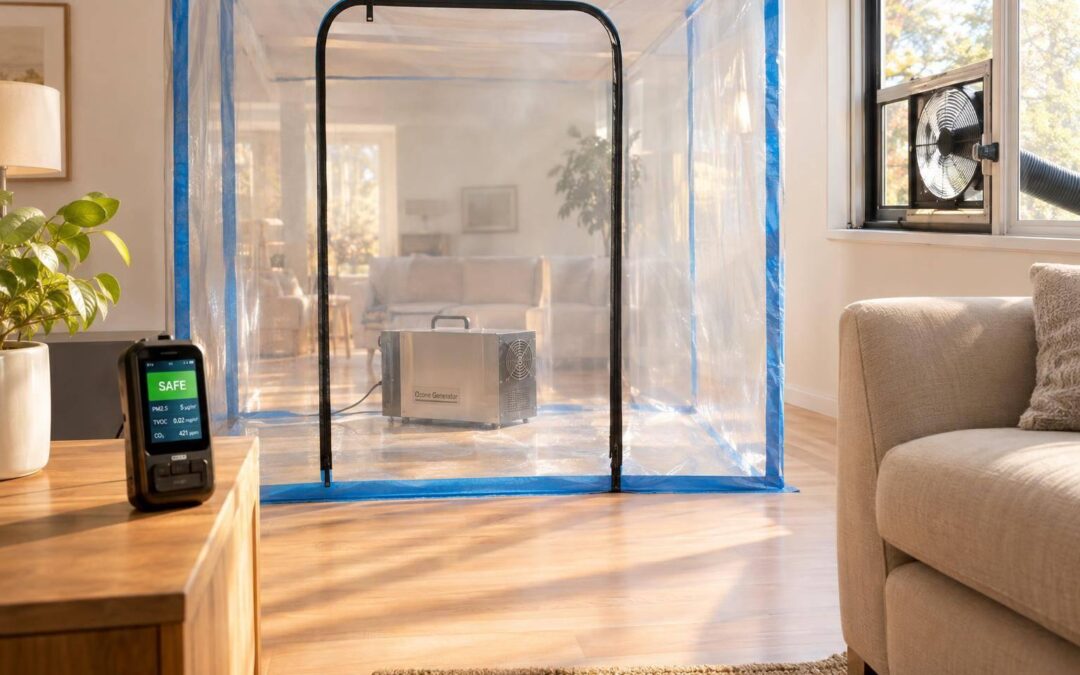
After cleaning the space and removing occupants, the provider seals it for treatment. Professional ozone treatment requires containment and controlled generator use. The EPA advises against using ozone generators in occupied spaces.
Seal Openings and Isolate Shared Airflow
Smoke odors can travel through gaps and shared air paths. Isolating the space helps limit that spread during treatment. The provider should seal gaps at thresholds, frames, utility penetrations, and other openings with materials suited to the building. Temporary seals must protect finishes and keep required exits usable.
Shared HVAC ducts and returns need controls specific to the building. A closed register is not isolation. Professionals may shut down or isolate the affected zone to keep ozone from reaching occupied rooms without disrupting required ventilation or life-safety systems.
Ask how the provider will monitor nearby spaces for ozone migration and what readings or conditions will trigger a shutdown. EPA testing found that door position and central ventilation fan operation changed ozone concentrations throughout a home.
Plan Equipment Placement and Treatment Time
Once the room is isolated, generator setup helps determine how evenly ozone reaches the space. The generator should sit on a stable, noncombustible surface, with clear space around its intake and outlet. Circulation fans should run only within the isolated zone.
Output and treatment time should account for room volume, smoke load, temperature, humidity, furnishings, and material sensitivity. Ask for a written record of the generator model, placement, planned duration, monitoring method, and shutdown conditions.
After treatment comes outside-air ventilation and clearance testing. Keep access restricted after shutdown and throughout ventilation until measurements confirm safe reentry – not just until a timer expires. Document both the shutdown time and the clearance reading.
Step 3: Air Out the Space and Verify Reentry
After treatment, ventilation and clearance testing help determine when people and pets can safely return.
Ventilate With Outdoor Air
After shutdown, keep people and pets out until outdoor-air ventilation clears the space. Create cross-ventilation through exterior openings and use exhaust fans that vent outdoors. Direct exhaust away from neighboring windows, air intakes, and hallways.
Keep shared HVAC isolated while venting. Tightly sealed properties and cold-weather conditions can slow ventilation and may call for staged air exchanges. The waiting period depends on treatment conditions and how much outdoor air moves through the space.
Once airflow has flushed the space, use monitoring – not odor alone – to verify clearance.
Check Ozone Levels and Remaining Smoke Odors
Use a calibrated ozone monitor at breathing height, in low-airflow corners, and in adjacent spaces. Smell is not a clearance test; odor sensitivity varies. OSHA’s ozone limit is 0.1 ppm over 8 hours, but the provider should state the clearance threshold used for the space, taking sensitive occupants into account.
A reading confirms the ozone level only at that location and moment. It does not prove that all by-products are safe. Persistent odors, unusual materials, or health concerns call for further assessment before anyone occupies the space.
Clearance checks reentry conditions – not whether treatment has reduced the source of the smoke odor. If smoke odor remains after clearance, look for residue rather than masking it with spray.
After clearance, inspect closets, upholstery, carpeting, cabinets, and HVAC returns for lingering smoke odor or residue. Use targeted cleaning to remove remaining residue, and replace smoke-saturated materials instead of repeating ozone treatment. Request a completion record that lists sampling locations, readings, ventilation details, concerns, reentry time, and any HVAC filter or component service.
Conclusion: Plan Professional Smoke Odor Removal
After cleaning, sealing, ventilation, and clearance testing, the last step is choosing a provider who documents the entire process.
Ozonated Cleaning LLC serves homes, businesses, vehicles, RVs, boats, and semi-trucks across Chicagoland. Request a property-specific assessment that identifies the smoke source, cleaning needed, areas to be treated, and clearance steps.
What a Professional Service Plan Should Cover
Ask for a written scope that covers the smoke source, cleaning, containment, treatment time, ventilation, and reentry criteria – without masking sprays. The provider should explain which method fits the materials, occupancy limits, and odor conditions.
Review the EPA guidance on ozone generators: ozone can harm the lungs, and concentrations used for odor treatment may exceed levels considered safe for people. Providers should never describe treatment as harmless.
What Ozone Can and Cannot Do
The plan should explain what ozone can reduce and what requires physical cleaning. Ozone can reduce smoke odor, but it cannot remove tar, nicotine, ash, or embedded residue. For issues involving mold or bacteria, see our guide to biological odor removal. It also cannot replace cleaning, ventilation, or clearance testing.
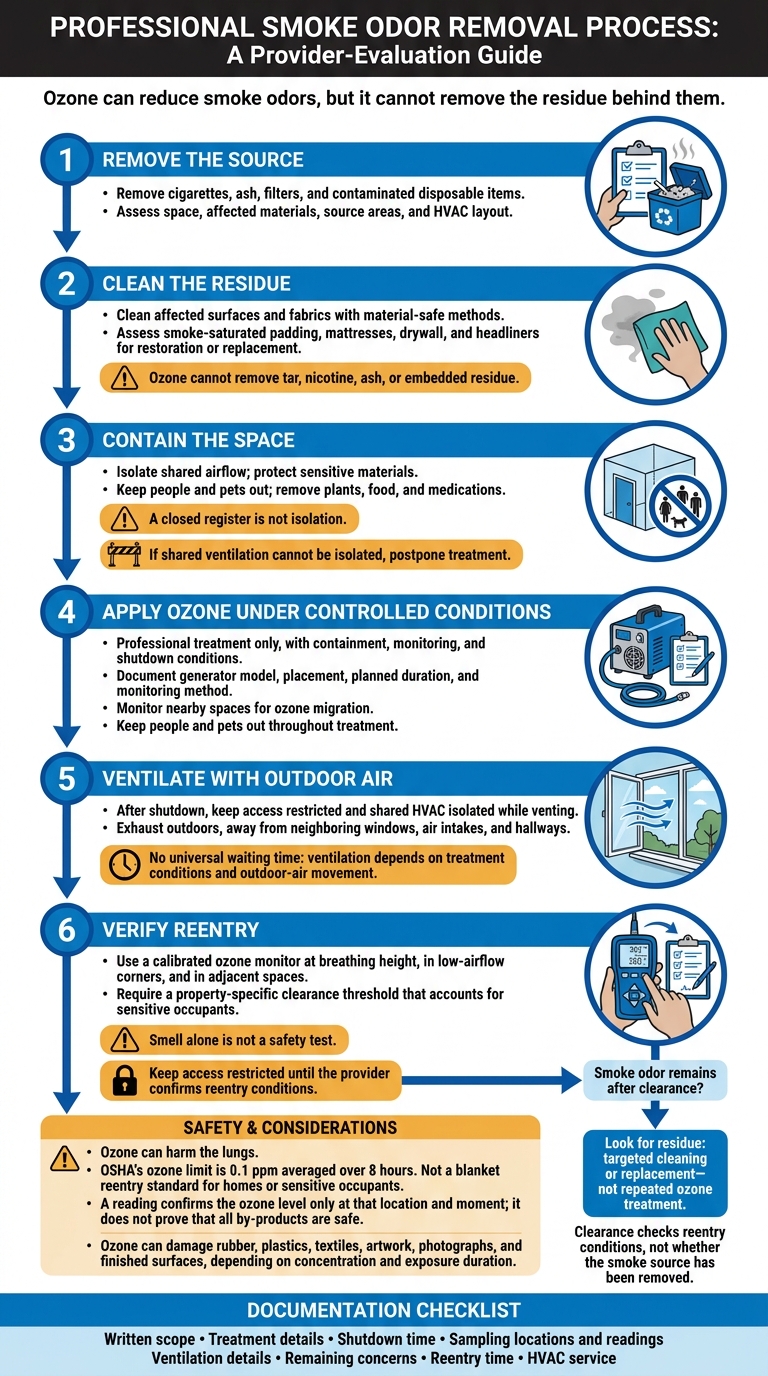
Use the full process: remove the source, clean the residue, contain the space, apply ozone under controlled conditions, ventilate with outdoor air, and verify reentry.
FAQs
How does ozone break down smoke odor molecules?
Ozone neutralizes smoke odors through a chemical reaction called oxidation. Ozone (O3) contains three oxygen atoms. One is loosely attached and reacts with smoke-related compounds, including phenols, aldehydes, and acrolein.
This reaction breaks those compounds down into simpler, odorless substances, such as carbon dioxide and water vapor. Rather than masking the smell, ozone targets its source.
Can smoke odors return after ozone treatment?
Yes, smoke odors can return if the source remains. Ozone permanently breaks down the odor molecules it contacts, but it doesn’t remove tar, nicotine, or soot trapped in porous materials. Those residues can keep releasing new odors.
For lasting results, clean thoroughly and maintain HVAC ducts before ozone treatment. Heavy contamination may also require sealing or removing saturated materials. Use ozone as the final odor-neutralizing step.
What by-products can ozone treatment leave behind?
Ozone reacts with odor molecules through oxidation – it doesn’t simply make pollutants disappear. When it reacts with indoor pollutants, cleaning products, fragrances, paints, or materials such as new carpets, it can create formaldehyde, other aldehydes, ketones, organic acids, and ultrafine particles smaller than 0.1 micrometers.
These by-products can also cause irritation. That’s why thorough ventilation after treatment is needed for safety.
Recent Comments