
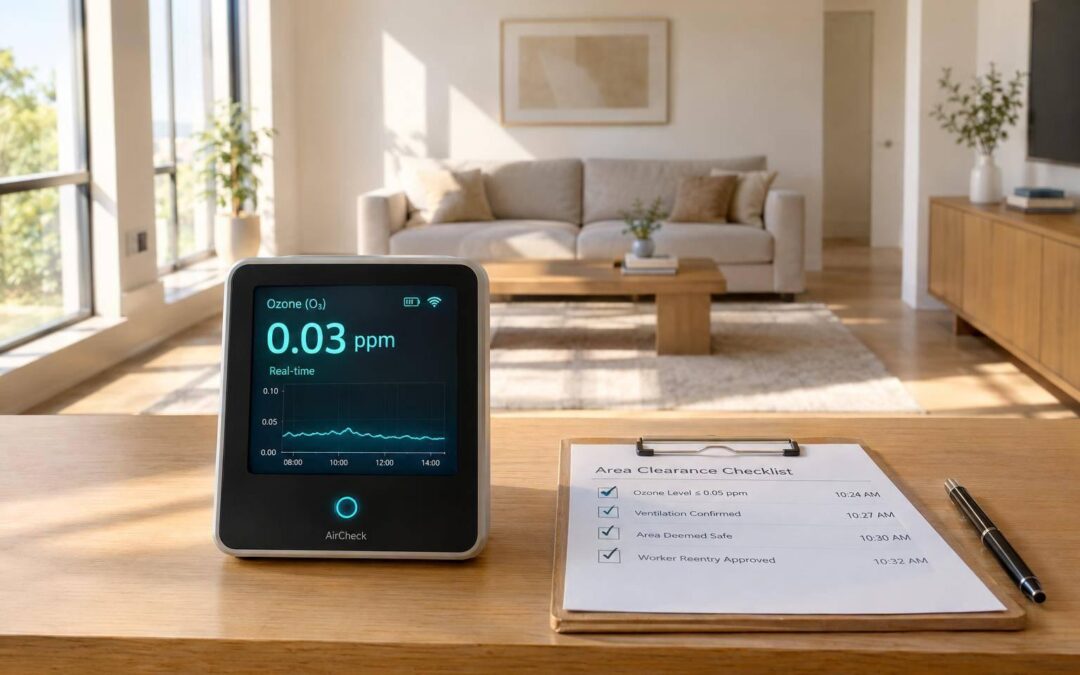
I use ozone readings – not odor or elapsed time – to guide re-entry checks. I keep the space closed until repeated measurements meet the site’s clearance criterion in every required area under normal occupancy ventilation. The NIOSH 0.1 ppm (100 ppb) ceiling is a workplace exposure reference, not a residential clearance standard.
In this guide, I cover how to:
- Check the monitor and record baseline readings with the generator off.
- Track ozone remotely during unoccupied work, including leaks, alarms, and data gaps.
- Verify falling levels after shutdown and ventilation before a qualified professional authorizes re-entry.
- Log readings, room conditions, and decisions – and assess remaining odors separately.
<u>Low ozone does not prove clean air or successful odor removal.</u> My focus here is monitoring and documentation, not instructions for applying ozone. (For those details, see our guide on how ozone removes odors safely).
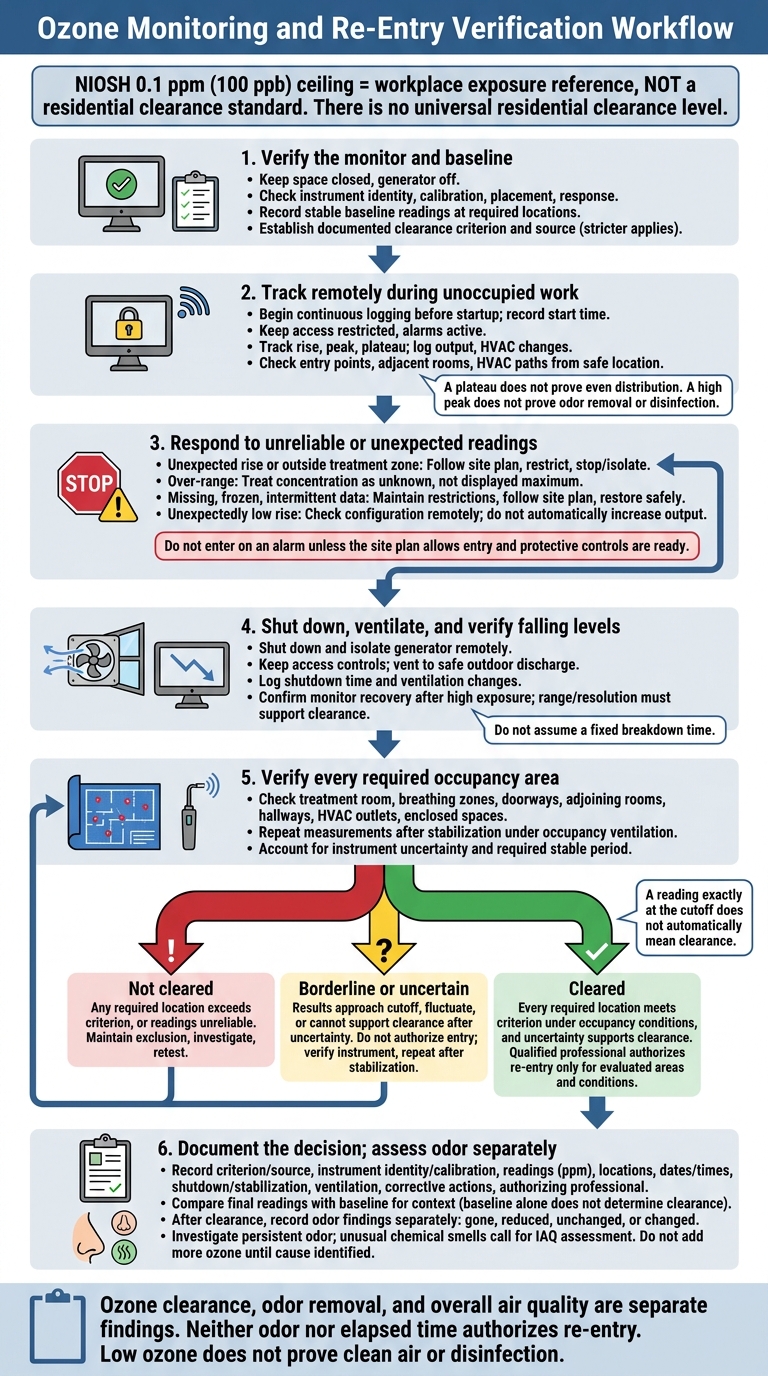
Ozone Monitoring and Re-Entry Verification Workflow
Track Ozone During Treatment
Once baseline readings are stable, begin live tracking before starting the generator.
Trained operators should monitor ozone remotely. Keep the treatment space unoccupied and off-limits, and follow the site plan and equipment manual for settings and targets.
Read the Rise, Peak, and Plateau
Start continuous logging before the generator starts, and record the exact start time. Review the trend at set intervals with alarms active. Log every change to output, timers, fans, HVAC, containment, or power.
The rise shows how fast ozone builds up at the sensor. The peak is the highest reading. A plateau means output and losses have balanced – it does not prove that ozone concentration is even throughout the room.
Before interpreting a slow rise or flat trace, check sensor placement and response time. Record any monitor relocation, and let readings stabilize before making comparisons.
Use these readings to judge control, not treatment success. A high peak does not prove odor removal or disinfection. Follow validated, task-specific procedures to assess effectiveness.
Check for Ozone Leaks and Unusual Readings
If the trend changes, check boundaries and HVAC paths next. From a safe location, monitor entry points, adjacent rooms, and HVAC transfer paths. Compare the trend with boundary readings and equipment status.
Do not enter on an alarm unless the site plan allows entry and protective controls are ready.
| Reading pattern | Possible meaning | Protective response |
|---|---|---|
| Sudden spike | Output change, airflow shift, containment breach, or sensor disturbance | Keep access restricted. Check boundary monitors and equipment status remotely, and follow the site plan. |
| Unexpectedly low rise | Leakage, active exhaust, generator fault, sensor lag, or poor placement | Check the configuration remotely. Do not automatically increase output. |
| Upper-range flatline or “over-range” | Sensor saturation; the actual concentration may exceed the display. | Treat the concentration as unknown – not as the displayed maximum. Follow the manufacturer’s over-range procedure and the site plan’s protective actions. |
| Missing, frozen, or intermittent data | Power, connection, software, or sensor failure | Maintain restrictions. Stop or isolate treatment according to the site plan, safely restore verified monitoring, and document the data gap. |
| Ozone rising outside the treatment zone | Transfer through doors, ducts, cracks, or shared HVAC | Stop or isolate generation as directed. Restrict affected areas, control airflow, and notify responsible personnel. |
| Different readings at nearby locations | Uneven mixing, obstructions, or differences in sensor response | Compare timing, placement, and instrument status. Do not assume one sensor represents the whole room. |
sbb-itb-5fea4da
Confirm Ozone Clearance Before Re-Entry
Once treatment ends and ozone readings fall, shift from tracking treatment to verifying clearance. This is the point where measurement data determines whether people can safely return.
Authorize re-entry using documented measurements – not elapsed time or odor. Set the clearance criterion in the home odor removal work plan before treatment begins. Use whichever regulatory or site-specific requirement is stricter. There is no universal residential clearance level. NIOSH’s 0.1 ppm ceiling is an occupational exposure limit, not a residential clearance standard.
Stop Generation and Track Falling Levels
After leak control and peak monitoring, confirm that ozone levels are falling everywhere occupants may return. Follow the planned procedure to shut down and isolate the generator without entering the uncleared space. Keep access controls in place, and vent to a safe outdoor discharge point as directed.
Continue logging readings, the shutdown time, and ventilation changes. Do not assume a fixed breakdown time. Temperature, humidity, surfaces, and air exchange all affect how fast ozone decays. As readings fall, begin area-by-area clearance checks.
After high exposure, confirm that the monitor has recovered and cleared any overload or error before relying on low readings. Its range, resolution, and accuracy must support assessment against the documented clearance criterion.
Retest Every Required Occupancy Area
Check the treatment room, breathing zones, doorways, adjoining rooms, hallways, HVAC supply and return outlets, and any enclosed space listed in the site plan.
Repeat checks once readings stabilize under the ventilation conditions intended for occupancy – not only while temporary exhaust is running. If an adjoining room or outlet fails the criterion, keep the affected area closed to entry and investigate how ozone reached it.
Document the Re-Entry Decision
Use the table below to turn measurement results into a re-entry decision.
| Status | Measurement finding | Required action |
|---|---|---|
| Not cleared | Any required location exceeds the criterion, or readings are unreliable | Maintain exclusion and planned ventilation. Investigate and retest. |
| Borderline or uncertain | Results approach the cutoff, fluctuate, or cannot support clearance after accounting for instrument uncertainty | Do not authorize entry. Verify the instrument and repeat measurements after readings stabilize. |
| Cleared | Every required location meets the documented criterion under occupancy ventilation conditions, and instrument uncertainty still supports clearance | Have the qualified professional authorize re-entry only for the evaluated areas and conditions. |
Record the criterion and its source, instrument identity and calibration status, readings in ppm, sampling locations and heights, dates and times, shutdown and stabilization times, and ventilation status. Include corrective actions and the authorizing professional’s name and role.
A reading exactly at the cutoff does not automatically mean clearance. Keep the space closed until the record supports re-entry.
Review Air Quality and Odor After Treatment
Once the space is cleared, review odor and indoor air quality separately from ozone verification. Ozone clearance, odor removal, and overall air quality are separate findings. A low ozone reading confirms only that measured ozone has dropped. It does not prove that odor compounds, microorganisms, surface contamination, or reaction byproducts are gone.
EPA notes that ozone can react with indoor chemicals to form aldehydes, formic acid, and other irritating byproducts.
Compare Final Readings and Assess Remaining Odors
Before occupancy, record post-ventilation ozone readings alongside the generator-off baseline for each location. The baseline provides context, but use the documented clearance criterion – not the baseline alone – to decide re-entry. Recheck the same rooms, adjacent spaces, and HVAC paths used during monitoring.
After clearance, document odors separately from instrument readings. Keep client observations distinct from operator findings. Label odors as gone, reduced, unchanged, or changed, and note each odor’s location and probable source. Inspect porous materials, drains, upholstery, damp areas, and HVAC filters.
For localized odors, recommend cleaning or source removal. For professional assistance, consider specialized odor elimination solutions. If dampness is present, recommend a moisture investigation. Persistent irritation or unusual chemical smells call for a qualified indoor-air-quality assessment. Do not add more ozone until the cause is identified. Enter these findings in the service log as air-quality observations, not ozone results.
Prepare a Time-Stamped Service Report
Use these headings in a concise service report: Job Information; Instrument and Method; Baseline Readings; Treatment Summary; Peak and Trend Data; Clearance Verification; Post-Treatment Air and Odor Review; Recommendations. Identify the property type – residential, commercial, vehicle, RV, boat, or semi-truck – and every treated room or compartment.
Attach the original log, including:
- U.S. dates and labeled local times; instrument identity and calibration status; baseline and peak readings; treatment changes; shutdown and ventilation times; clearance criteria and results; and final readings in ppm.
- Separate records of odor findings, client observations, unresolved concerns, follow-up recommendations, and the person who authorized re-entry.
Keep unusual readings rather than averaging them out. Do not present an ozone reading as proof of complete disinfection or clean air.
Conclusion: Use Verified Readings to Guide Decisions
Keep the space closed, check the monitor, and record the baseline with the generator off. Use the trend to decide when to switch from treatment tracking to clearance checks. Investigate any unexpected increase before moving ahead.
Neither a high peak nor elapsed time proves effectiveness or safe re-entry. After shutdown and ventilation, require repeated readings below the clearance criterion in every required occupancy area for the full required stable period. If readings fluctuate or increase, keep access restricted and investigate.
Allow re-entry only after the documented clearance check passes, and record the decision’s date and time. Track home odor removal outcomes separately: ozone clearance does not establish overall air quality or prove disinfection. For more on the latter, see how ozone eliminates pathogens in enclosed spaces.
FAQs
Who sets the ozone clearance criterion for my home?
Set site-specific clearance criteria using readings from a calibrated ozone monitor. OSHA and NIOSH reference 0.1 ppm as an occupational exposure limit – not a residential re-entry criterion. For homes, a more cautious target of below 0.08 ppm is recommended.
Before anyone re-enters, use a calibrated instrument to confirm that residual ozone meets the clearance criteria. Rely on measured data – not elapsed time, smell, or the absence of odor.
How can I tell if an ozone monitor is accurate enough?
Focus on verified calibration records and documented testing – not the number of decimal places on the display. Check that calibration follows the manufacturer’s instructions. Account for how humidity, temperature, and other gases can affect the sensor.
For critical safety decisions, compare readings against a regulatory-grade reference monitor or an instrument with NIST-traceable calibration. Check that the baseline stays stable after exposure to high ozone levels. If readings remain unstable or unreliable, stop using the monitor and check for possible contamination or damage.
What testing can identify post-treatment air pollutants?
Use calibrated instruments – not smell – to check post-treatment air. Ozonated Cleaning LLC uses professional, calibrated monitors to track ozone decay and verify that residual levels are below 0.10 ppm.
Removing specific odor sources or biological contaminants may require further testing to confirm. To validate disinfection claims, professionals may combine ozone monitoring with independent laboratory surface sampling or biological indicator tests. These tests help assess how well the treatment works against specific microbial targets.
Recent Comments