
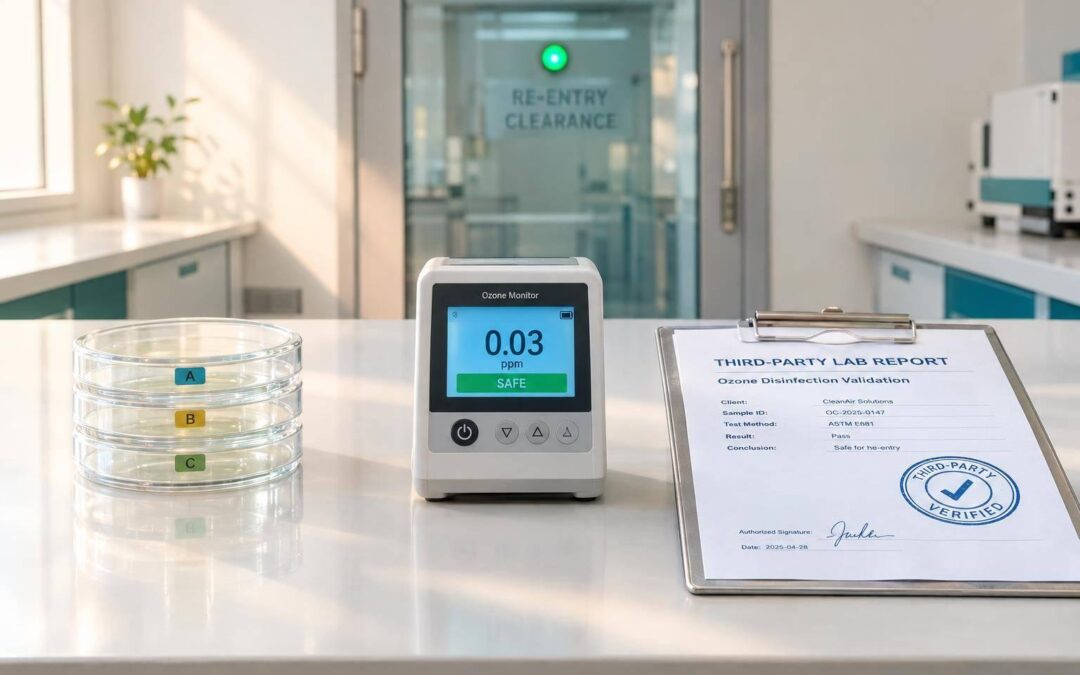
I look for proof of a tested ozone cycle – not just a cleaner smell. A 3-log reduction means 99.9% fewer viable organisms in the test, not complete elimination. Before you hire a lab, define the claim, test conditions, and pass/fail rule.
Here’s what I check:
- The test: Organisms, surfaces, controls, and sample counts that match the intended use.
- The lab: Relevant qualifications, a written protocol, clear pricing, and access to raw data.
- The records: Measured ozone levels, humidity, temperature, exposure time, and a signed report.
- The field procedure: Instructions that stay within tested limits, routine checks, and a review of validation after changes.
My bottom line: Microbial reduction and safe re-entry are separate questions. <u>Keep people and animals out during treatment</u>, and require measured clearance under site-specific safety criteria – not odor or elapsed time.
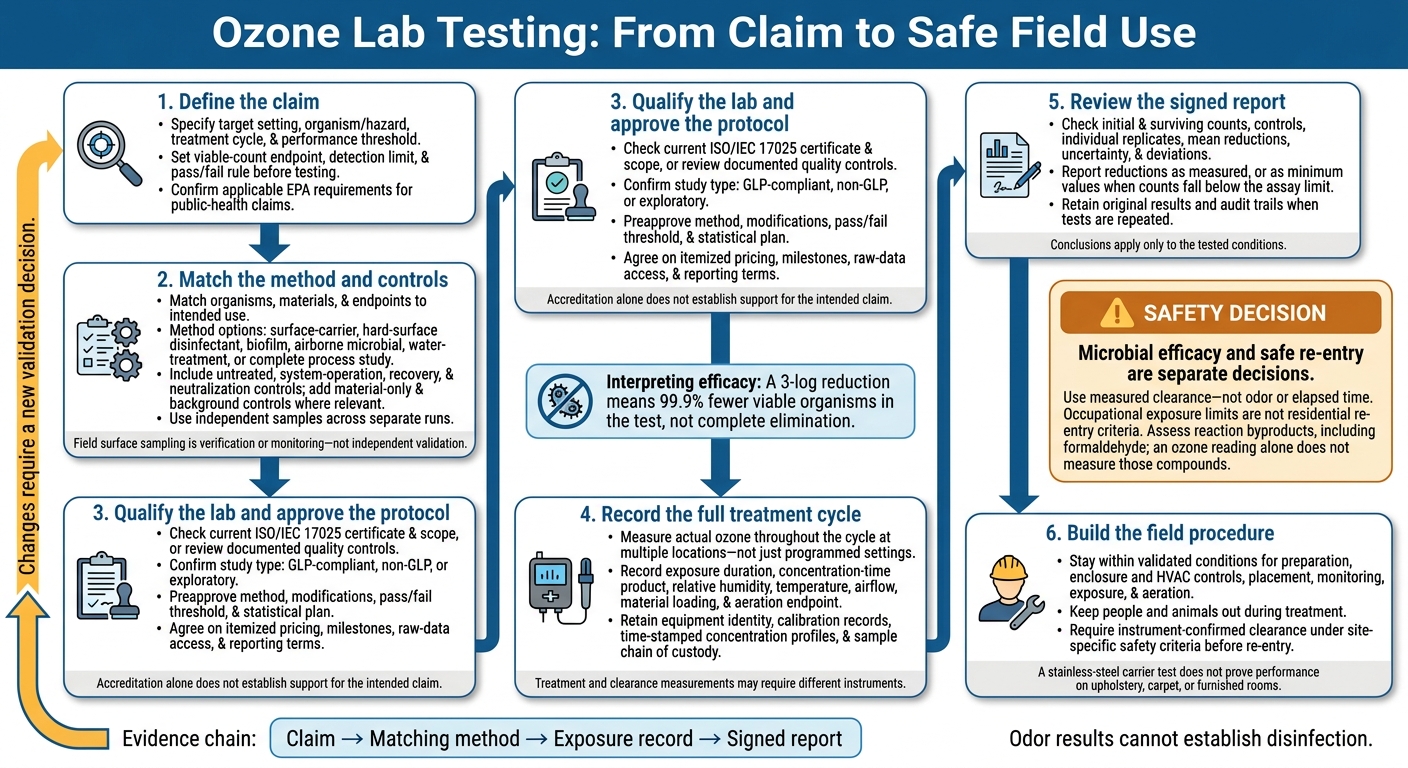
Ozone Lab Testing: From Claim to Safe Field Use
Define the Claim and Choose a Test Method
Choose a test method that measures the exact outcome your claim describes.
Write one primary claim in measurable terms: the target setting, organism or hazard, treatment cycle, and performance threshold. Match the test design, endpoints, and acceptance criteria to that claim. A lab result supports only the conditions tested – it does not, by itself, authorize a public-health claim. Confirm the applicable EPA requirements before commissioning tests for that purpose.
Match Organisms, Materials, and Results to the Claim
Choose challenge organisms and materials that reflect the intended use. For a hard-surface claim, specify representative surfaces such as stainless steel, glass, sealed tile, or painted wallboard. Don’t rely only on standardized coupons.
If you use a surrogate instead of the target organism, document the scientific basis for that choice. Address its resistance characteristics, matrix compatibility, recovery method, and relevance to field conditions. For a biofilm claim, use a defined biofilm model – not dried planktonic cells.
Set the viable-count endpoint, detection limit, and pass/fail rule before testing. The starting population must be high enough to measure the full claimed log reduction; a result below the detection limit cannot prove that reduction. Keep odor measurements separate from microbial results. Odor results cannot establish disinfection.
Compare Laboratory Test Methods
Use the methods below to validate a claim. Field surface sampling serves as a verification or monitoring tool, not an independent validation method.
| Method | Purpose | Sample type | Measurable endpoint | Strength | Limitation |
|---|---|---|---|---|---|
| Surface-carrier study | Test microbial inactivation on representative carriers | Inoculated coupons or material pieces | Log10 reduction in viable organisms | Links ozone exposure to a defined surface | May not represent irregular, porous, or whole-room treatment |
| Hard-surface disinfectant study | Support a regulated surface-disinfection claim | Standardized hard-surface carriers | Organism-specific reduction under prescribed conditions | Uses established efficacy concepts and controls | Regulatory suitability must be confirmed for ozone delivery systems |
| Biofilm study | Evaluate organisms embedded in biofilm | CDC Biofilm Reactor coupons or equivalent | Log10 reduction in culturable biofilm cells | Better represents established biofilms than planktonic testing | May not match every field biofilm or assess biofilm removal |
| Airborne microbial study | Measure reduction of suspended microorganisms | Aerosolized organisms or controlled air samples | Change in viable airborne concentration over time | Directly addresses air-treatment claims | Physical losses and chamber conditions can confound results |
| Water-treatment study | Evaluate microbial reduction in water | Defined water matrix and inoculated samples | Log reduction, residual ozone, and contact time | Accounts for ozone demand and matrix effects | Results depend on water chemistry and organic load |
| Complete process study | Validate the full treatment cycle | Defined room, chamber, vehicle, or enclosure with distributed samples | Microbial reduction alongside ozone profile and aeration endpoint | Most closely reflects performance under actual use conditions | Findings are less easily generalized to other spaces |
Confirm the current scope of ASTM E3161 and ASTM E2871 with the laboratory. Neither is a universal ozone-validation protocol.
Set Exposure Conditions and Study Controls
Define the exposure conditions in advance: measured ozone concentration, exposure duration, concentration-time product, relative humidity, temperature, enclosure volume, air movement, sample placement, surface orientation, pretreatment, and post-treatment aeration.
Measure ozone at multiple locations to confirm that the chamber is well mixed. Don’t rely on a single sensor. Record actual ozone readings throughout the cycle, not just programmed settings.
Include materials that may consume ozone. Porous contents, fabrics, dust, organic residue, and other surfaces can reduce the concentration reaching the challenge organism. EPA testing found that temperature, pH, relative humidity, and organic load can affect microbial susceptibility to ozone. Performance on actual building materials may also differ from performance on standardized surfaces.
Include untreated controls to measure natural survival, system-operation controls for fan or chamber effects, recovery controls for extraction and culturing, and neutralization controls to confirm that exposure stops without suppressing recovery. Test neutralizer efficacy and toxicity separately, and compare immediate with delayed recovery.
If aeration stops exposure, define the airflow, time, temperature, and endpoint criteria. Confirm the stop point with residual-ozone measurements. An incorrect stop point can overstate efficacy by counting killing that occurs after the stated exposure period.
Add material-only controls and, where relevant, ozone-decay or chamber-background controls. Use independent samples across separate runs – not just repeated measurements from one coupon. Randomize or balance sample positions, document failed or contaminated samples, and define exclusions before testing.
For applicable biofilm claims, EPA guidance specifies at least five treated coupons per microorganism and three control coupons. This is not a universal replication rule. EPA’s biofilm performance criterion requires a minimum mean six-log reduction in viable bacteria across five coupons, with each of six tests meeting the performance standard.
Once the protocol is fixed, choose a laboratory that can run it exactly as written.
sbb-itb-5fea4da
Choose a Laboratory and Plan the Study
Once the protocol is set, finalize the lab contract and reporting terms. Before signing, confirm the EPA pathway and whether the study is GLP-compliant, non-GLP, or exploratory.
Check Laboratory Qualifications and Report Requirements
Ask for the lab’s current ISO/IEC 17025 certificate and scope. Check that the scope covers the study’s microbiology, environmental monitoring, ozone measurement, and analytical methods. If the lab lacks relevant accreditation, review its documented quality controls.
Require a preapproved protocol that states the exact method, any modifications, the pass/fail threshold, and the statistical plan. The signed report should include replicate-level results, raw-data access, calibration records, deviations, and conclusions limited to the tested conditions. Accreditation alone does not establish that a lab can support the intended claim.
Set the Budget and Schedule
Request an itemized quote in U.S. dollars covering protocol development, laboratory or chamber use, organism preparation, carrier materials, controls, replicates, ozone monitoring, analysis, quality review, reporting, shipping, storage, and possible retesting.
Agree on sample quantities, delivery windows, data ownership, confidentiality, record retention, and who can approve deviations or retests. Set milestones for protocol approval, equipment receipt, exposure, draft review, and the signed report. Prices and turnaround times depend on organism availability, chamber capacity, calibration, and biosafety review.
Once you select the lab, require records covering the entire exposure and clearance cycle.
Measure the Full Treatment Cycle
Require traceable records of equipment identity and settings, sensor calibration, room dimensions, airflow, material loading, and soil conditions. Instruments need suitable measurement ranges and response times for both treatment exposure and clearance monitoring. An instrument suited to treatment concentrations may not work for clearance measurements.
Retain time-stamped concentration profiles. Report gaseous ozone in ppm or protocol-specified units, and dissolved ozone in mg/L where applicable. Record relative humidity as a percentage, dimensions in ft/in with metric equivalents, and temperature in °F with °C.
Plan chain of custody and raw-data handling as part of the study – not as paperwork to complete after testing.
Protect Samples and Study Records
Give each sample its own ID and maintain chain-of-custody records from receipt through disposal. Control storage conditions and record each sample’s exposure position. Require microbial recovery and documentation of recovery efficiency, incubation conditions, detection limits, and each replicate’s validity status.
When tests are repeated, keep the original results and audit trails so field use rests on defensible validation data. An unfavorable result is not automatically invalid. Follow the preapproved invalidation rules, document why each test was repeated, and retain both the original and replacement data.
Interpret Results and Use Them in the Field
Read Log Reductions and Test Limits
Check the signed report’s conclusions against its methods, dates, equipment, exposure conditions, and calculations. Review initial and surviving counts, controls, individual replicates, mean reductions, uncertainty, and deviations. Report reductions as measured, or as minimum values when counts fall below the assay limit.
Use those result limits to set operating limits in the field.
Build a Field Procedure From Validated Conditions
Use only conditions the lab validated. Turn those conditions into written instructions for preparation, removal of people and animals, material protection, enclosure and HVAC controls, equipment placement, concentration monitoring, exposure, aeration, and clearance. Any departure from the validated range falls outside the validated claim.
A stainless-steel carrier test does not prove performance on upholstery, carpet, or furnished rooms. Shielding, absorption, and uneven airflow can leave some areas with a lower ozone dose.
Microbial efficacy and safe re-entry are separate decisions. Ozone can damage lungs. Base clearance criteria on the applicable exposure limit and a site-specific safety assessment – not odor or elapsed time. Occupational exposure limits are not residential re-entry criteria.
Specify measurement locations and steps to take if monitoring fails. Require clearance confirmed by calibrated instruments before allowing entry. The assessment should also address reaction byproducts, including formaldehyde. An ozone reading alone does not measure those compounds.
Plan Verification and Revalidation
Create written schedules for sensor checks and calibration, generator maintenance, airflow checks, operator training, and treatment-record review. Investigate repeated low concentrations, unusually long clearance times, and inconsistent results.
Any change in equipment, sensors, settings, room type, material, organism, or claim requires a new validation decision. Apply the same evidence standard to local service claims.
Check Chicagoland Service Claims
Customers can ask Ozonated Cleaning LLC for evidence tied to the exact space, organism, exposure conditions, and clearance procedure. Keep ozone, hydroxyl, and odor-removal results separate.
Do not accept unsupported claims of universal pathogen elimination, FDA approval, chemical-free treatment, or harmless treatment. Laboratory validation does not replace site-specific exclusion, monitoring, aeration, and re-entry controls.
Conclusion: Match the Evidence to the Treatment
Once the protocol is complete and the report is signed, close the validation study with a clear chain of evidence: the claim, the matching method, the exposure record, and the signed report. Assess odor and disinfection separately. Use sensory or chemical testing for odor and validated microbial endpoints for disinfection.
Store the claim and signed report with the field records. Include only the tested limits in the field procedure. Follow the validated procedure, revalidate after any change, and document clearance before re-entry. Efficacy does not equal safe re-entry.
FAQs
How can I tell if a lab report applies to my space?
Check that the test conditions match your space’s volume, temperature, humidity, and airflow. These factors affect how ozone spreads and how well it works.
Also check that the testing method – including where biological indicators are placed – matches your room’s layout, surface access, and organic load. Account for crevices, HVAC paths, and enclosed compartments so the report reflects conditions at your site.
What should I do if an ozone cycle fails testing?
If an ozone cycle fails validation testing, stop treatment and investigate. Check that monitoring equipment works correctly and is calibrated. Sensor contamination or drift can skew results.
Confirm that the protocol accounted for humidity, temperature, and airflow. If biological indicators failed, verify that test organisms were placed in areas with restricted airflow.
If problems persist, contact Ozonated Cleaning LLC for professional odor removal and disinfection assistance in the Chicagoland area.
How can I verify safe re-entry for sensitive occupants?
Rely on measured ozone levels, not smell. Ozone can dull your sense of smell. Ozonated Cleaning LLC uses calibrated professional monitors to confirm that residual ozone stays below 0.10 ppm. For sensitive occupants, ventilate thoroughly, then check levels at multiple breathing-zone locations and in areas with low airflow.
Follow the site-specific clearance criteria and get professional verification. Ozone readings alone don’t confirm that secondary contaminants are gone. Chemical byproducts may remain, so thorough ventilation is still needed.
Recent Comments