
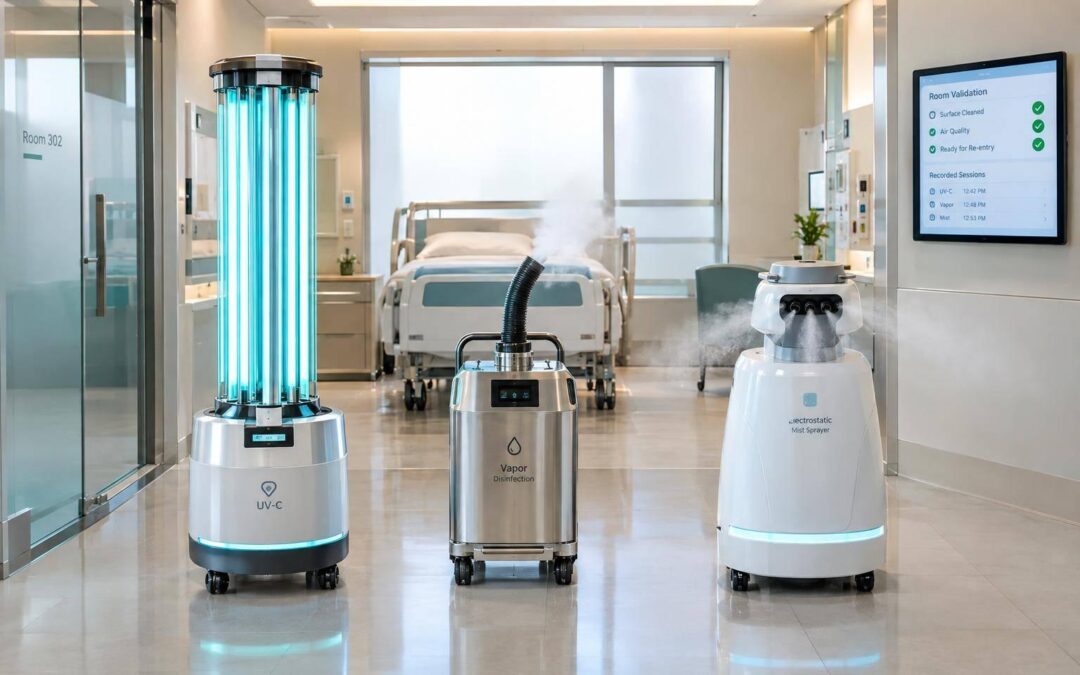
I’d choose a hospital disinfection robot by verified room coverage, cycle records, and safe reentry – not its claimed kill rate. Before a pilot, ask for room-specific test results, material limits, and total downtime from setup through release.
Here’s how I compare the three main options:
Quick Comparison
| System | Coverage | Automation to check | Safety and downtime |
|---|---|---|---|
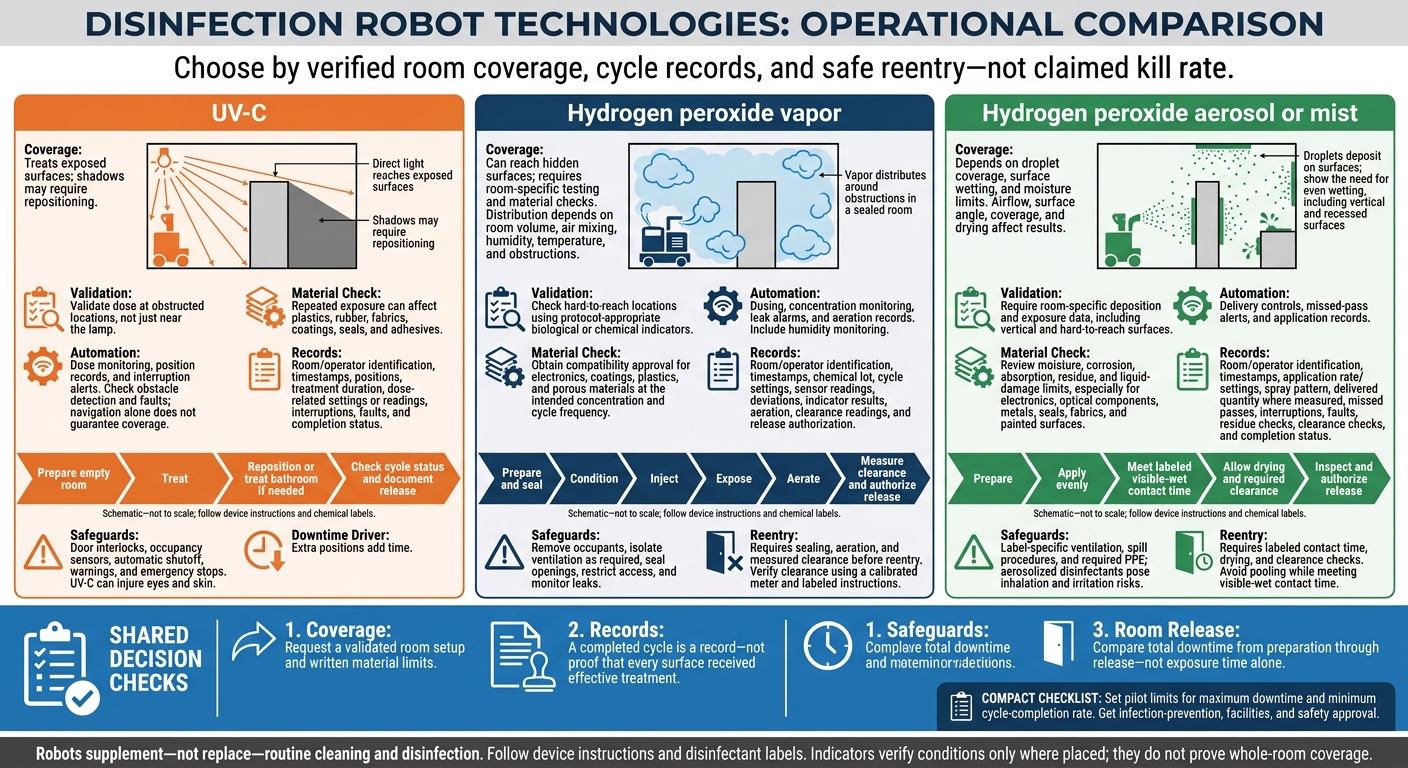
| UV-C vs. ozone | Treats exposed surfaces; shadows may require repositioning. | Dose monitoring, position records, and interruption alerts. | Requires an empty room; extra positions add time. |
| Hydrogen peroxide vapor | Can reach hidden surfaces; requires room-specific testing and material checks. | Dosing, concentration monitoring, leak alarms, and aeration records. | Requires sealing, aeration, and measured clearance before reentry. |
| Hydrogen peroxide aerosol or mist | Depends on droplet coverage, surface wetting, and moisture limits. | Delivery controls, missed-pass alerts, and application records. | Requires labeled contact time, drying, and clearance checks. |
“Hospital-grade” alone does not prove performance. One review found that 36 of 43 studies used before-and-after designs, limiting conclusions about infection reduction.
My baseline: <u>keep routine cleaning in place</u>, follow device instructions and chemical labels, and set pilot limits for downtime and cycle completion. Ozone and hydroxyl systems need separate safety reviews. A completed cycle is a record – not proof that every surface received effective treatment.
Hospital Disinfection Robots: Coverage, Records, and Safe Reentry
Autonomous Disinfection Robot in Hospital
sbb-itb-5fea4da
1. UV-C Disinfection Robots
UV-C depends more on a clear line of sight than the other options, making robot placement and room layout especially important. These robots emit germicidal light in the 200–280 nanometer range, damaging microbial nucleic acids to stop replication. Treatment effectiveness depends on light intensity, exposure time, distance from the source, and the angle at which light reaches each surface.
Coverage and Surface Compatibility
Exposed bed rails, counters, and equipment exteriors can receive treatment. But undersides, recesses, and surfaces behind curtains may receive little or no dose. Navigation alone does not guarantee coverage. Remove obstructions and check both sides of beds and connected bathrooms. Review material limits, too: repeated exposure can damage some plastics, rubber, fabrics, and coatings.
Automation and Cycle Records
Look for obstacle detection, programmable cycles, remote start, and dose monitoring. A completed timer does not prove that surfaces received enough exposure. Logs should record the room, operator, date and time, route or position, treatment duration, interruptions, and completion status. Use these records to verify performance periodically.
Safety and Room Downtime
Whole-room treatment requires an empty room because UV-C can injure eyes and skin. Safeguards should include door interlocks, occupancy sensors, automatic shutoff, warning indicators, and emergency stops. Staff also need documented training.
Measure downtime from room preparation through release, not just the light exposure period. Moving the robot between positions and running separate bathroom cycles can extend treatment. Follow the device’s requirements for room sealing and HVAC shutdown. Request validated cycle times for the actual room layout, especially when treatment involves bathrooms or multiple robot positions.
2. Hydrogen Peroxide Vapor Robots
UV-C depends on line of sight. Hydrogen peroxide vapor can reach hidden surfaces within a sealed room. These robots release a 30%–35% hydrogen peroxide solution as vapor. A cycle usually includes conditioning, injection, exposure, and aeration; some systems also add dehumidification.
Coverage and Surface Compatibility
How well vapor spreads depends on room volume, air mixing, humidity, temperature, and obstructions. Open drawers, cabinets, and equipment compartments when permitted. Then check hard-to-reach areas with biological or chemical indicators.
Before routine use, check manufacturer compatibility lists for electronics, coatings, plastics, and porous materials. Reaching more surfaces comes with stricter sealing, monitoring, and clearance requirements.
Automation and Cycle Records
Look for automated dosing, concentration and humidity sensors, leak alarms, and automatic aeration. Record the chemical lot, cycle settings, sensor readings, deviations, indicator results, and release authorization.
A room concentration reading alone does not prove coverage. Keep room-specific validation data, and reassess after major HVAC or layout changes.
Safety and Room Downtime
Remove occupants, isolate ventilation, seal openings, restrict access, and monitor for leaks. Before anyone reenters, verify clearance with a calibrated meter and follow labeled instructions.
One EPA-labeled protocol uses 55 minutes of injection, at least 3 hours of exposure, and aeration until hydrogen peroxide reaches 1.0 ppm or less.
Room turnover depends on sealing, aeration, and clearance – not just exposure time. Schedule treatment after terminal cleaning, and allow extra time in case clearance takes longer than expected.
3. Hydrogen Peroxide Aerosol and Mist Robots
Mist changes the task: instead of saturating a sealed room, robots must wet surfaces evenly. These systems disperse 5%–8% hydrogen peroxide as fine droplets. Unlike vapor, droplets must wet surfaces, so results depend on airflow, coverage, and drying. Surface angle and residue control also matter.
Coverage and Surface Compatibility
Check droplet delivery on vertical and hard-to-reach surfaces, including bed rails, overbed tables, curtains, door handles, and equipment backs and undersides. Smooth, nonporous surfaces are easier to wet evenly than porous or absorbent materials.
Follow the formulation’s restrictions to prevent residue or liquid damage, especially on electronics, optical components, metals, seals, fabrics, and painted surfaces. Avoid pooling while meeting the label’s visible-wet contact time.
Automation and Cycle Records
Look for controlled dosing, adjustable spray patterns, and route-completion logs. Logs must distinguish between finishing an application and making the room safe to reenter. Record the application rate, spray pattern, missed passes, and residue-control checks.
Repeated passes can extend contact time; one study reported 30, 60, and 120 minutes after one, two, and three cycles.
Because these systems apply liquid, reentry depends on both drying and clearance.
Safety and Room Downtime
Diluted mist still poses an inhalation risk. Aerosolized disinfectants can remain airborne and irritate eyes, skin, and airways. Account for drying time when planning room turnover.
Before reentry, follow labeled requirements for airborne-droplet clearance, pooled liquid, and visible residue. CDC does not recommend routine fogging in patient-care areas unless a labeled, controlled process supports it.
Features That Shape Hospital Use
The differences above come down to three hospital decisions: how much surface the system can reach, how reliably it runs, and when the room can reopen. Compare systems using coverage, automation, and room release.
Coverage and Surface Compatibility
Ask for a validated room setup, not a promise of complete coverage. Request tested layouts, settings, and surface positions. Before treatment, remove soil and check both manufacturers’ instructions for plastics, metals, upholstery, electronics, mattresses, coatings, seals, and adhesives. Get written limits for repeated exposure, plus instructions for anything that needs shielding or removal.
| Method | Coverage validation | Material compatibility |
|---|---|---|
| UV-C | Validate dose at obstructed locations, not just near the lamp. | Check cumulative UV effects on polymers, fabrics, coatings, seals, and adhesives. |
| Hydrogen peroxide vapor | Validate distribution at hard-to-reach locations in the actual room layout. | Obtain approval for materials at the intended concentration and cycle frequency. |
| Hydrogen peroxide aerosol or mist | Validate deposition and wetting on vertical, recessed, and hard-to-reach surfaces. Require room-specific deposition and exposure data. | Check moisture, corrosion, absorption, and residue limits. |
Lab kill data do not prove fewer infections. Keep laboratory tests, room-level validation, and clinical outcome studies separate. A systematic review found that 36 of 43 studies used before-and-after designs, which limits conclusions about patient outcomes.
Next, check whether the device can repeat the tested result – and document what happened.
Automation and Cycle Records
Repeatable delivery matters more than mobility. During evaluation, test blocked routes, cycle interruptions, low batteries, and missed targets. Make sure the device clearly flags incomplete cycles.
| Method | Failure and completion checks | Downloadable logs |
|---|---|---|
| UV-C | Confirm that blocked routes, lamp faults, and interrupted exposures prevent a false completion status. | Room ID, timestamps, lamp status, dose-related settings or readings, positions, interruptions, faults, and completion status. |
| Hydrogen peroxide vapor | Confirm that treatment-condition deviations and aeration failures are flagged. | Room ID, timestamps, concentration, humidity, exposure time, alarms, aeration, clearance readings, and completion status. |
| Hydrogen peroxide aerosol or mist | Confirm that delivery failures, missed passes, and interruptions are flagged. | Room ID, timestamps, application settings, delivered quantity where measured, interruptions, faults, clearance checks, and completion status. |
Keep operator IDs, device IDs, software versions, and maintenance records with the logs. A completion log shows what the system reported; it does not prove effective treatment of every surface. Pair those records with room-specific validation and periodic audits.
Even a complete log leaves one more question: can staff safely reopen the room?
Safety and Room Downtime
Compare total turnover time, from prep to release – not exposure time alone. Include setup, treatment, repositioning, aeration, monitoring, and inspection. EPA registration covers the labeled chemical use, not every robot or delivery method. Review device requirements separately.
| Method | Safeguards to verify | Evidence for documented room release |
|---|---|---|
| UV-C | Test door interlocks, motion sensors, and emergency stops. | Check lamp operation and exposure parameters. Use suitable UV dosimeters at challenging locations; document cycle status before release. |
| Hydrogen peroxide vapor | Verify protocol-required sealing, HVAC coordination, leak alarms, and emergency procedures. | Document treatment conditions, leak monitoring, aeration, and verified residual clearance; use protocol-appropriate chemical or biological indicators. |
| Hydrogen peroxide aerosol or mist | Verify label-specific ventilation, spill procedures, and required PPE. | Document required exposure and clearance measurements. Use protocol-appropriate indicators; do not release the room based only on elapsed time. |
Indicators verify conditions only where they are placed. They do not replace validated procedures, monitoring, maintenance, or manufacturer instructions.
Trade-Offs and Related Treatment Methods
After coverage, automation, and room release, the final comparison is what each method offers – and what it adds to the workflow.
Every method pairs a practical advantage with a different workload. Neither UV-C nor peroxide is always faster or more effective. Compare their performance in the intended room layout.
| Method | Potential advantages | Trade-offs |
|---|---|---|
| UV-C | Leaves no applied chemical residue. | Shadows can limit exposure, requiring repositioning or extra cycles. Repeated exposure can affect sensitive materials over time. |
| Hydrogen peroxide vapor | Chemical distribution can reach some areas outside direct UV-C exposure. | Requires room preparation, compatibility checks, controlled exposure, aeration, and verified clearance before reentry. |
| Hydrogen peroxide aerosol or mist | Can distribute disinfectant across many surfaces and suit some room layouts. | Requires review of droplet deposition, moisture, residue, corrosion, ventilation, and reentry requirements. |
These differences change how teams prepare, treat, and reopen a room.
Among related systems, ozone and hydroxyl are separate technologies. Ozone requires an unoccupied room, controlled concentration, ventilation, verified clearance, and a material-compatibility review. Hydroxyl systems need model-specific documentation covering occupancy, active-agent levels, exposure limits, emissions, byproducts, and compatibility.
Some hydroxyl systems may generate ozone or other reactive compounds. The hydroxyl label alone does not establish that a system is safe to use in an occupied room.
Conclusion: Choose for Verified Results and Workflow Fit
After comparing coverage, automation, and room release, choose a system with verified performance in your room type, not the highest claimed kill rate. Check how its features match your target organisms, room layout, cycle time, and safety requirements.
Before buying or starting a pilot, get approval from infection-prevention, facilities, and safety teams. Require evidence covering the intended organisms and room layouts, material compatibility, safeguards, and reentry rules. Cycle records should document the room, operator, settings, alarms, and pass/fail status.
Set acceptance limits before the pilot, including maximum room downtime and minimum cycle-completion rate. Measure total turnover time – not just active treatment time.
Robots supplement – not replace – routine cleaning and disinfection. Keep soil removal and appropriate EPA-registered disinfectants in the baseline workflow, and follow disinfectant label directions. Use robotic treatment only when it fits the room, workflow, and validation data.
FAQs
How can we measure a disinfection robot’s real-world effectiveness?
Measure microbial levels before and after treatment to determine the reduction. Ideally, use biological indicators containing highly resistant spores, placed in hard-to-reach “cold spots.” No growth after incubation indicates a pass.
Monitor exposure with calibrated portable and fixed ozone sensors that measure concentrations in ppm. Record time-stamped readings at doorways, along nearby occupied paths, and along HVAC migration routes.
Compare the measured log reduction with your target standard: 3-log = 99.9% reduction; 6-log = 99.9999% reduction.
What should a hospital disinfection robot pilot include?
Address contamination sources, including cleaning residues and HVAC issues. Create a formal intervention plan, with pharmacy or biomedical engineering staff reviewing sensitive room contents. Record the room’s volume and any paths ozone could take through ventilation systems or ceiling voids.
Relocate occupants, restrict access, and post warning signs. Before patients re-enter, verify safety with calibrated monitors and obtain formal written hospital clearance. Don’t rely on elapsed time alone.
What ongoing maintenance costs should we budget for?
When budgeting for ozone-based disinfection systems, include testing, calibration, and recordkeeping costs:
- Biological indicators: Account for single-use devices, specialized incubation equipment, and trained personnel to test and validate disinfection.
- Professional calibration: Budget for monitoring equipment calibration using ozone-free air and certified reference gases to keep sensors accurate.
- Secure recordkeeping: Allow staff time and resources to securely maintain treatment data, calibration logs, and clearance records for regulatory compliance and safety monitoring.
Recent Comments