Ozone may reduce some stubborn odors – but I’d start by removing the source and cleaning affected materials. It’s a professional treatment for empty spaces, not a guaranteed fix or a substitute for mold cleanup.
Here are 5 possible uses and limits I’d weigh before booking:
- Odor reduction: Reacts with some lingering odor compounds after cleaning.
- Hard-to-reach areas: Circulates into exposed gaps and fabrics, but may not reach odors deep inside materials.
- No added fragrance: Avoids perfume and liquid-cleaner residue, but can create harmful byproducts.
- Some microbe reduction: May affect certain microbes under controlled conditions. That does not prove disinfection.
- Different enclosed spaces: May be used in empty homes, offices, vehicles, RVs, and boats, though it can damage some materials.
My safety rule: <u>Keep people, pets, and plants out during treatment.</u> Have a trained operator control exposure, ventilate afterward, and check ozone levels with a calibrated monitor before reentry. Smell alone cannot confirm that the air is safe.
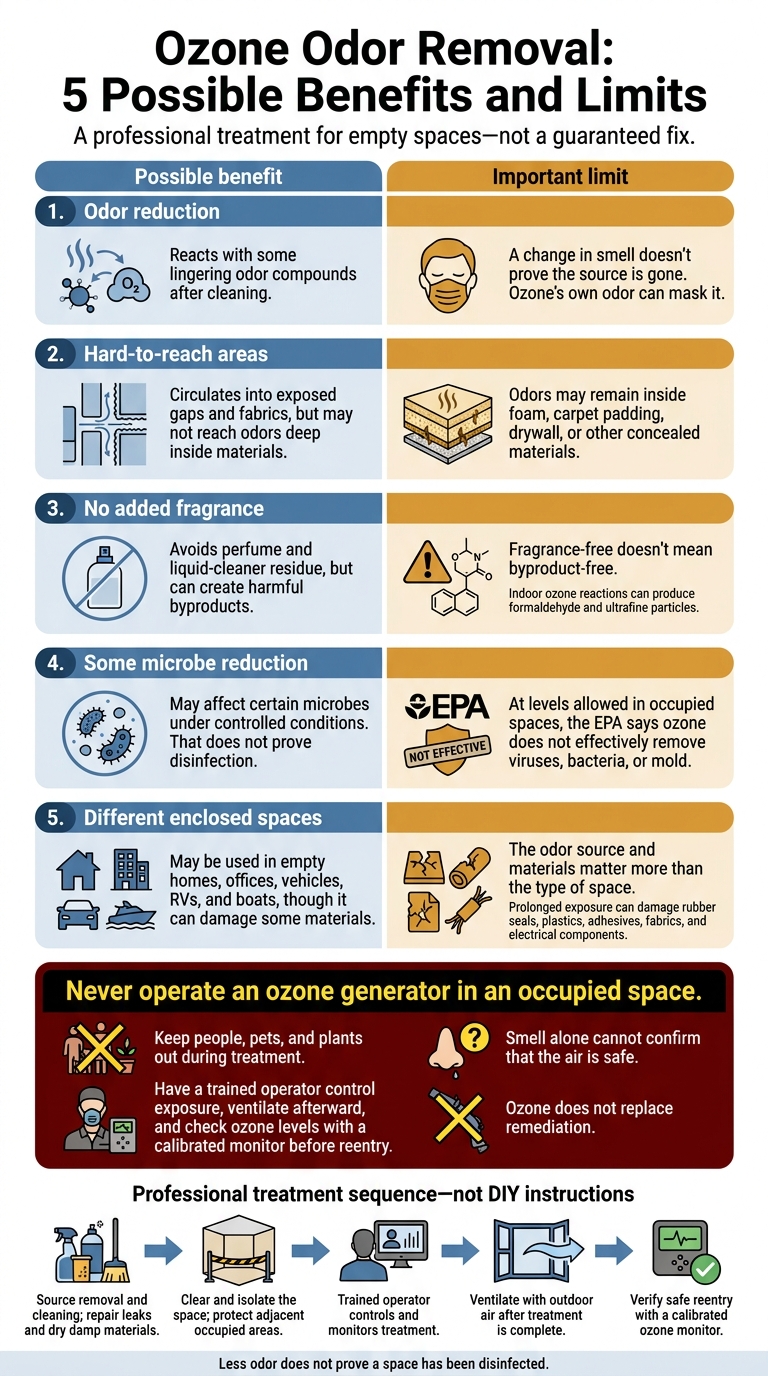
Ozone Odor Removal: 5 Possible Benefits and Limits
What Is an Ozone Generator? Uses, Risks, and How It Affects Indoor Air Quality
sbb-itb-5fea4da
How Ozone Odor Treatment Works
An ozone generator fills an empty, enclosed space with ozone (O₃), a reactive form of oxygen. Through oxidation, ozone can change some odor molecules instead of covering them with fragrance. But a change in smell doesn’t prove the source is gone. Ozone’s own odor can mask it.
Results depend on the odor chemistry, ozone level, contact time, temperature, humidity, airflow, and affected materials. Odors trapped in carpet or upholstery are harder to reach. A professional must match the treatment cycle to the space – not assume that more ozone or a longer run will work better.
The EPA notes that ozone has limited effect on many odor compounds at safe indoor levels. Some compounds react so slowly that ozone isn’t a practical treatment for them. Treatment must take place in empty spaces.
Ozone can also create new pollutants, including formaldehyde, when it reacts with furnishings, fragrances, or cleaners. Avoid adding scented cleaners before treatment, and ventilate the space thoroughly afterward.
Source removal and cleaning come first: remove contaminated items, clean washable surfaces and fabrics, repair leaks, and dry damp materials. Active mold or a moisture problem that hasn’t been fixed needs direct correction – not an ozone cycle. For more complex issues, follow a guide to biological odor removal to ensure the source is fully addressed. Ozone is most likely to help with stubborn odors in empty spaces that have been properly prepared.
1. Reacts With Some Lasting Odor Compounds
Ozone may react with some lingering smoke odor compounds, so it can serve as a finishing step after cleaning.
Smoke residue in walls, fabrics, and HVAC parts can keep releasing odors. Treat those materials first. For a complete walkthrough, see our guide to home odor removal. Ozone is most useful once visible residue has been addressed, especially when smells have seeped into hard-to-reach areas.
2. Reaches Some Hard-to-Clean Areas
Ozone gas can circulate through an empty, enclosed space to reach odors in fabrics and tight spots.
A technician can reposition cushions and open compartments to help the gas reach more surfaces. The treatment area must stay sealed so ozone doesn’t drift into occupied rooms.
The gas can reach exposed fabrics, cushions, carpeting, gaps, and seams – but not every hidden layer. Odors may remain inside foam, carpet padding, drywall, or other concealed materials. Those materials may need extraction cleaning, drying, repair, or replacement – not just more ozone treatment or alternative cleaning methods.
3. Avoids Added Fragrance and Liquid-Cleaner Residue
Ozone can reduce some odor compounds without adding perfume or leaving liquid-cleaner residue.
Before treatment, remove air fresheners, scented candles, and open cleaning products. Ozone reacts with fragrance and chemical vapors.
Fragrance-free doesn’t mean byproduct-free. The California Air Resources Board reports that indoor ozone reactions can produce formaldehyde and ultrafine particles.
4. May Reduce Some Biological Contaminants
Ozone may affect more than odor molecules. It may reduce some airborne microbes in empty, controlled spaces, but that does not mean the space is disinfected.
At levels allowed in occupied spaces, the EPA says ozone does not effectively remove viruses, bacteria, or mold.
Results depend on exposure time, humidity, and whether contaminants are airborne or inside porous materials.
Less odor does not prove microbes are gone. Microorganisms can remain in carpet fibers, upholstery, and other porous materials – even after ozone treatment.
If you see visible mold or moisture damage, fix the moisture source and remove contaminated materials. Ozone does not replace remediation. However, it can be a valuable part of ozone cleaning for homes when used correctly.
5. Can Treat Different Enclosed Spaces
Professional ozone treatment may be considered for unoccupied homes, offices, vehicles, RVs, and boats with lingering smoke, pet, food, stale air, or mildew-related odors. Its main advantage is that it can be used across different enclosed spaces, including larger or sealed areas.
The odor source and materials matter more than the type of space. Suitability also depends on how well the area can be sealed and prepared.
Vehicles, RVs, and boats need extra care. Ozone concentrations can increase quickly in these spaces, and prolonged exposure can damage rubber seals, plastics, adhesives, fabrics, and electrical components.
Safety Note: Keep Spaces Empty and Verify Safe Reentry
These benefits apply only when ozone is used in a completely empty, controlled space.
Clear and seal the space. Never operate an ozone generator in an occupied space. Ozone is a lung irritant that can cause coughing, chest discomfort, and breathing difficulty. Remove all people, pets, and plants. After the space is cleared, seal it and remove sensitive items. Remove ozone-sensitive items, including artwork and delicate textiles. Seal doors, windows, vents, and other openings. Prevent ozone from reaching occupied adjacent spaces, post warnings, and restrict access. While ozone vs. traditional cleaning methods differ in their impact on surfaces, ozone may damage materials and react with indoor chemicals to create irritating byproducts.
Monitor the treatment. A trained operator should follow the equipment manufacturer’s instructions, set the dosage and exposure time for the space, and use a calibrated ozone monitor during and after treatment. A timer alone cannot confirm safe reentry.
Ventilate with outdoor air, then verify with a monitor. Ventilate only after treatment is complete. Before allowing reentry, the operator should measure representative locations, including low-airflow and adjacent areas, document readings, and confirm they meet the safe reentry threshold. No smell does not mean safe air.
After reentry, watch for symptoms. If coughing, wheezing, or breathing discomfort starts after reentry, leave immediately for fresh air. Seek medical care if symptoms are severe, persistent, or worsening. Keep the space empty until it is ventilated and retested.
Conclusion: Results Depend on Proper Treatment and Safety
Ozone may reduce stubborn odors by reacting with some odor compounds and reaching hard-to-clean areas without adding fragrance or leaving liquid-cleaner residue. It may work in various enclosed spaces, but results depend on the odor source and treatment conditions.
Source removal comes first. Less odor does not prove a space has been disinfected. Use ozone only after cleaning and sanitizing, repairing moisture problems, and removing contaminated materials – not instead of those steps. Ozone is a fragrance-free, reactive treatment, not a chemical-free solution, and it requires safe application.
Before booking with Ozonated Cleaning LLC in Chicagoland, request a professional assessment covering expected results, source-removal needs, monitoring effectiveness, safety controls, and safe reentry.
FAQs
Will odors return after ozone treatment?
Ozone treatment uses oxidation to permanently break down odor-causing molecules. Once those molecules are broken down, they don’t return. But smells can come back if the original source remains or a new odor source appears.
For lasting results, fix underlying problems such as moisture, leaks, or debris. Regular cleaning and proper ventilation also help keep the space smelling clean and prevent new odors.
What should I ask before booking ozone treatment?
Ask your provider how long treatment will take based on your space’s size and the severity of the odor. Confirm how long the space must stay vacant and which items – such as rubber, electronics, or certain fabrics – need to be removed or protected to prevent damage.
Ask how they’ll ventilate the space afterward and verify that the ozone has fully dissipated before clearing it for re-entry.
How is safe reentry determined after treatment?
Safe reentry requires ventilation and confirmation that ozone has dissipated. Ozonated Cleaning LLC uses calibrated equipment to check that ozone levels are below 0.10 ppm. Don’t rely on smell alone: ozone can dull your sense of smell.
People, pets, and plants must stay out during both treatment and ventilation. The waiting period often ranges from a few hours to 24 hours.
Recent Comments