
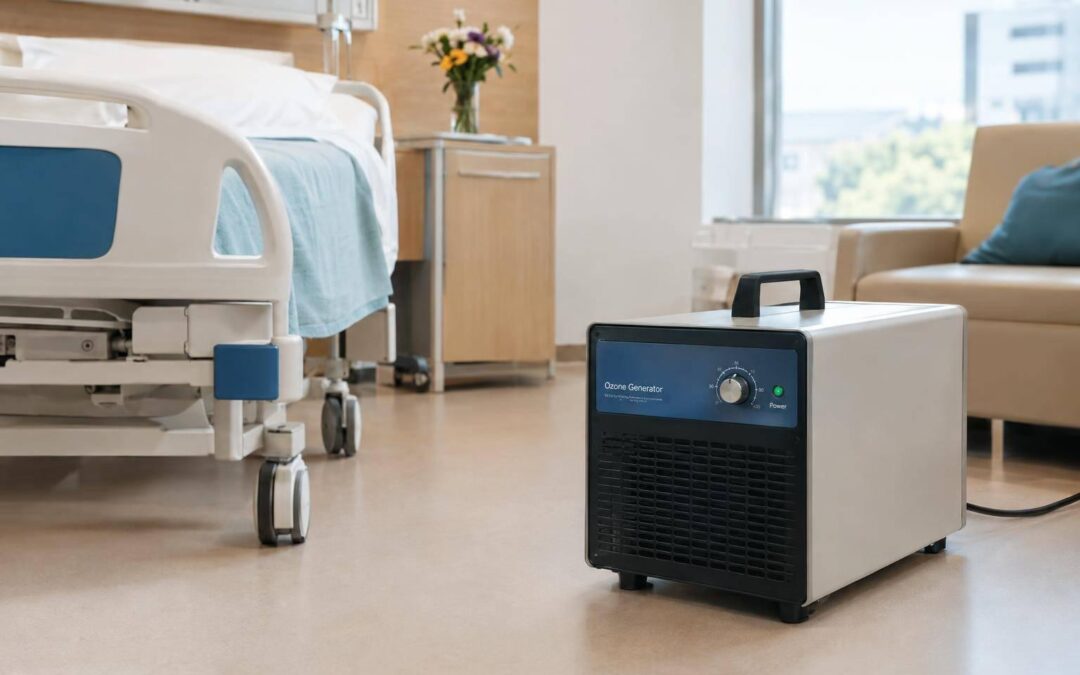
I would consider ozone for hospital odors only after the source is removed – and only in an empty, isolated space with hospital approval. It may reduce some remaining odors, but it can also harm lungs, damage materials, and create irritating byproducts.
My checklist starts with three steps:
- Fix the cause. Remove waste, clean residues, repair leaks, and address plumbing or HVAC problems. Chemical spills, sewage, mold, and decomposition need separate assessment and cleanup.
- Plan for exposure control. Require trained staff, protection for room contents, calibrated ozone monitors, and controlled ventilation. There is no universal treatment time.
- Verify clearance. OSHA’s 0.1 ppm, 8-hour worker exposure limit is not an automatic reentry standard for patients. Use the hospital’s written clearance criteria and designated approval.
<u>Ozone and hydroxyl treatments reduce odors, but less odor does not mean disinfection – or safe reentry.</u> I would keep approved cleaning and disinfection procedures in place and require any outside contractor to provide healthcare references, written procedures, monitoring records, and evidence that the treatment works for the intended use.
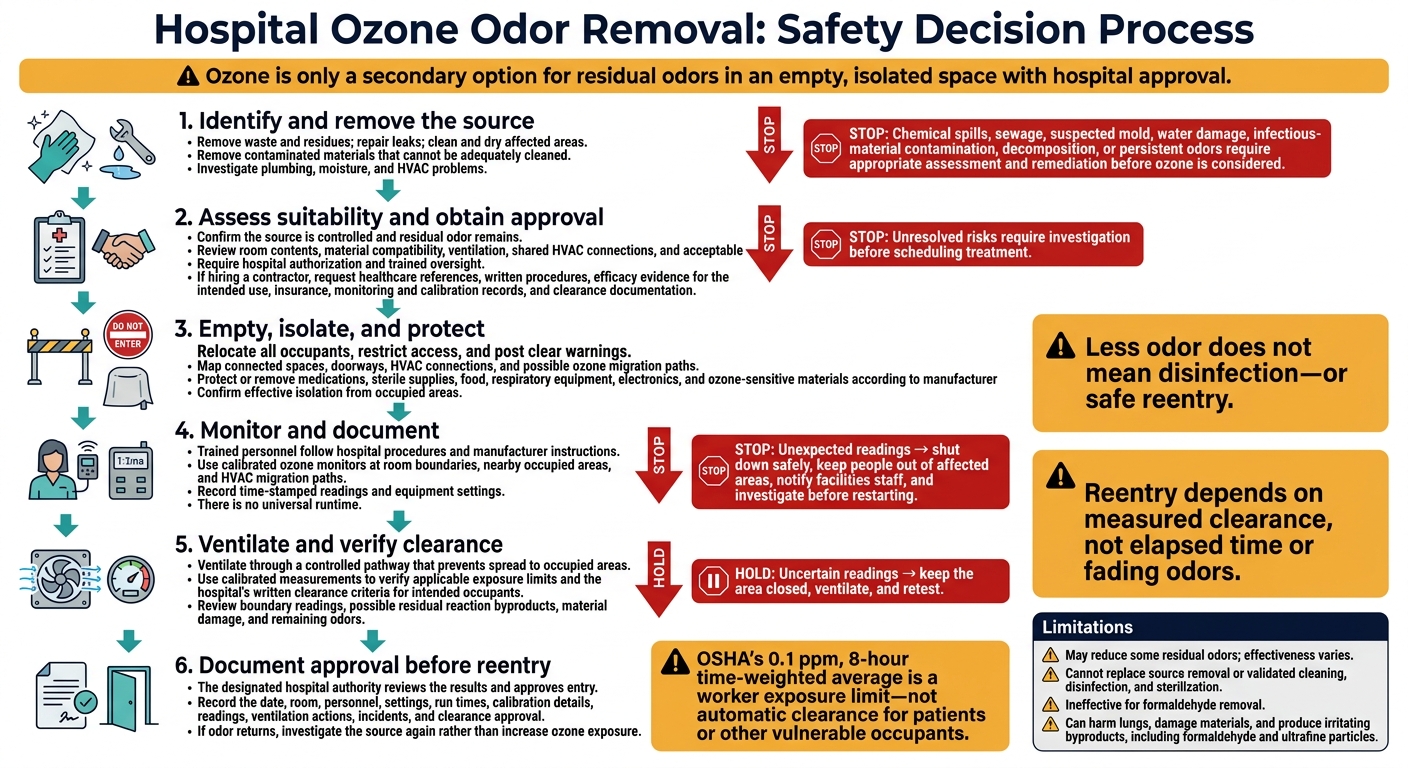
Hospital Ozone Odor Removal: Safety Decision Process
How Ozone Treats Hospital Odors
Ozone Reactions and Their Limits
Once the source is addressed, the next step is to determine whether ozone can reach and react with the remaining odor compounds.
Ozone (O₃) is a reactive form of oxygen produced by electrical discharge or ultraviolet light. It oxidizes some odor-causing compounds but leaves others unchanged. Results depend on the compound, ozone concentration, exposure time, temperature, humidity, airflow, and whether ozone reaches contaminated porous surfaces.
Some compounds react poorly with ozone, and ozone may not penetrate contaminated materials well enough to reduce odors. Increasing the concentration may exceed health-based limits. Ozone can also react with indoor chemicals and materials, producing formaldehyde, ultrafine particles, and other irritating byproducts. Less odor does not prove disinfection or sterilization.
Assessing Hospital Odor Sources
Before treatment, find where the odor starts and which materials it has penetrated. Check patient rooms after discharge, restrooms, linen and waste areas, postmortem spaces, and hospital vehicles for odors from residue, waste, smoke, chemicals, and moisture.
Record the location, suspected source, exposed materials, previous cleaning, ventilation conditions, and whether the odor returns. Treatment depends on the source, materials, contamination level, and containment – not the room type.
Chemical odors call for a spill and ventilation assessment, not ozone. Smoke residues may remain in upholstery, finishes, filters, and HVAC components. Sewage or musty odors require plumbing and moisture checks. Biological decomposition odors require trained remediation and coordination with leadership and infection prevention.
Removing the Odor Source First
After identifying the source, correct the cause before any ozone cycle. Source control means disposing of waste, cleaning residues with approved products, checking ventilation, repairing leaks, drying wet materials, and removing contaminated materials that cannot be adequately cleaned.
Ozone cannot fix saturated upholstery or a continuing waste source. Its odor can also mask remaining contamination. Recheck documented locations after full ventilation, and do not rely on smell alone.
sbb-itb-5fea4da
What Is an Ozone Generator? Uses, Risks, and How It Affects Indoor Air Quality
Hospital Safety Rules and Treatment Steps
Once the source is controlled, put a formal treatment plan in place. Treat ozone use as a planned environmental intervention – not routine housekeeping. Include pharmacy or biomedical engineering review when the room’s contents call for it.
Assess and Secure the Treatment Area
After inspection and cleaning, measure the room’s volume in cubic feet (L × W × H). Document connected rooms, doors, windows, ceiling voids, exhaust paths, supply and return grilles, nearby occupied areas, and odor sources. Facilities staff should check whether HVAC connections could carry ozone into adjacent patient-care spaces.
Relocate all occupants, restrict access, and post clear warnings. Protect or remove medications, sterile supplies, food, respiratory equipment, electronics, rubber goods, and other ozone-sensitive materials. Follow manufacturer or biomedical engineering guidance. This mapping shows where ozone could travel and where monitoring is needed.
Monitor and Document Treatment
Have trained personnel place the equipment according to manufacturer instructions and hospital procedures. Settings and treatment duration depend on room volume, materials, ventilation, and professional assessment. There is no universal runtime.
Measure ozone with calibrated ppm monitors, including at doorways, nearby occupied areas, and HVAC migration paths. Record time-stamped readings and equipment settings. If readings are unexpected, shut down safely, keep people out of affected areas, notify facilities staff, and investigate before restarting.
Ventilate and Confirm Safe Reentry
Reentry depends on measured clearance, not elapsed time or fading odors. Ventilate through a controlled pathway that keeps ozone from spreading to occupied areas. Use calibrated measurements to confirm that levels meet applicable exposure limits and hospital clearance criteria for the intended occupants. OSHA’s 0.1 ppm, 8-hour time-weighted average is a worker exposure limit – not automatic clearance for patients or other vulnerable occupants.
Before documenting approval, the designated hospital authority must review room-boundary readings, possible residual reaction byproducts, material damage, and remaining odors. Record the date, room, equipment settings, run times, personnel, calibration details, readings, ventilation actions, incidents, and clearance approval.
Weighing Benefits, Risks, and Professional Support
After controlling the source and securing the area, weigh ozone’s possible odor-control benefits against the risks of using it.
Benefits, Risks, and Required Controls
Treat ozone as a secondary odor-control tool – not a guaranteed fix. It is ineffective for formaldehyde removal.
| Consideration | Potential benefit | Limitation or risk | Required control |
|---|---|---|---|
| Odor reduction | May oxidize some odor compounds | Resistant compounds and embedded contamination may remain | Do not use ozone while the source remains |
| Exposed surfaces | May reach accessible odor residues | Soil and shielding limit contact; exposure does not establish disinfection | Keep validated cleaning and disinfection procedures in place |
| Hospital continuity | May address residual odors without demolition | Closures and relocation disrupt care | Confirm acceptable downtime |
| Human exposure | None | No benefit justifies exposing occupants | Require effective isolation or consider hydroxyl systems for occupied spaces |
| Secondary pollutants | May transform odor compounds | Reactions can produce aldehydes, formic acid, and fine or ultrafine particles; some generators may emit nitrogen oxides | Request device-specific emissions data, assess room contents, and determine testing needs |
| Equipment and materials | May reach accessible odor residues | Rubber, fabrics, plastics, dyes, and coatings may deteriorate | Obtain manufacturer guidance on material compatibility |
| Odor confirmation | May reduce residual odors | A temporary odor change does not prove source removal | Assess results after verified reentry |
| Institutional requirements | Written review supports consistent decisions | Hospital, accreditation, safety, environmental, or purchasing rules may restrict use | Document authorization and compliance |
If any listed risk is present, stop and investigate before scheduling ozone.
When Further Assessment Is Needed
Suspected mold, water damage, sewage, infectious-material contamination, chemical spills, or odors that persist after cleaning require investigation, suitable remediation, and hospital approval before considering ozone. Shared HVAC connections also require a facilities assessment.
Odor reduction does not prove disinfection. Ozone must not replace EPA-registered disinfectants used according to their labels, including contact times. It also must not replace validated hospital cleaning, disinfection, and sterilization procedures.
Professional Odor Removal in Chicagoland
If the job needs outside support, require hospital-ready documentation before approval.
For Chicagoland hospitals, request healthcare-specific references, written procedures, monitoring and calibration records, insurance, clearance records, and facility approvals before purchasing. When evaluating Ozonated Cleaning LLC, also request documented efficacy for the intended use.
Request a custom assessment and written quote that account for room contents, access, downtime, ventilation, monitoring, and testing.
Conclusion: Remove Sources and Verify Safety
Fix the source first: repair leaks, remove contaminated materials, and finish cleaning and drying before considering ozone treatment. If the odor returns, investigate the source again rather than increase ozone exposure. Ozone should enter the decision process only after the source is controlled.
Use ozone only for residual odors in a fully unoccupied, isolated space with hospital approval. It has limited effectiveness and can produce harmful reaction byproducts.
Once treatment starts, clearance depends on measurements, not smell. Require trained oversight, calibrated monitoring, ventilation, and documented clearance. Check both the room and possible migration paths, including doorways and shared HVAC pathways. If readings are uncertain, keep the area closed, ventilate, and retest.
A change in odor proves neither disinfection nor safe reentry. Release the space only when measurements meet the facility’s written clearance criteria and the designated facility representative approves entry – not when a timer ends or the odor disappears.
FAQs
How can we tell if ozone will help our hospital’s odor problem?
Match the odor – such as smoke, pet odors, or mold/mildew – to substances ozone can oxidize. Ozone breaks down odor-causing molecules rather than masking them. Results depend on ozone concentration and exposure time, known as the CT value. Performance improves at humidity levels above 80% and with proper temperature control.
Use remote or portable detectors to monitor ozone levels. Re-enter only after levels fall below 0.1 ppm. This threshold alone doesn’t guarantee safe re-entry; follow applicable safety guidance.
What testing can detect harmful byproducts after ozone treatment?
Portable ozone detectors measure residual ozone to check whether levels are safe for re-entry. They don’t measure secondary byproducts. Ozone can react with volatile organic compounds in cleaning agents or air fresheners, potentially producing formaldehyde, other aldehydes, ketones, organic acids, and ultrafine particles.
Thoroughly ventilate treated areas before occupants return. This helps clear residual ozone and any secondary contaminants that may have formed.
What should we do if odors return after treatment?
If odors return, don’t repeat ozone treatment right away. Check the source again and confirm the area was cleaned before treatment. Ozone works best on organic odors, but unresolved moisture can allow regrowth.
Ventilate thoroughly before anyone re-enters, allowing ozone to drop to safe levels. This typically takes at least 2–4 hours, or longer if needed. Odors that persist or return likely need moisture control or removal of the odor source – not ozone alone.
Recent Comments