
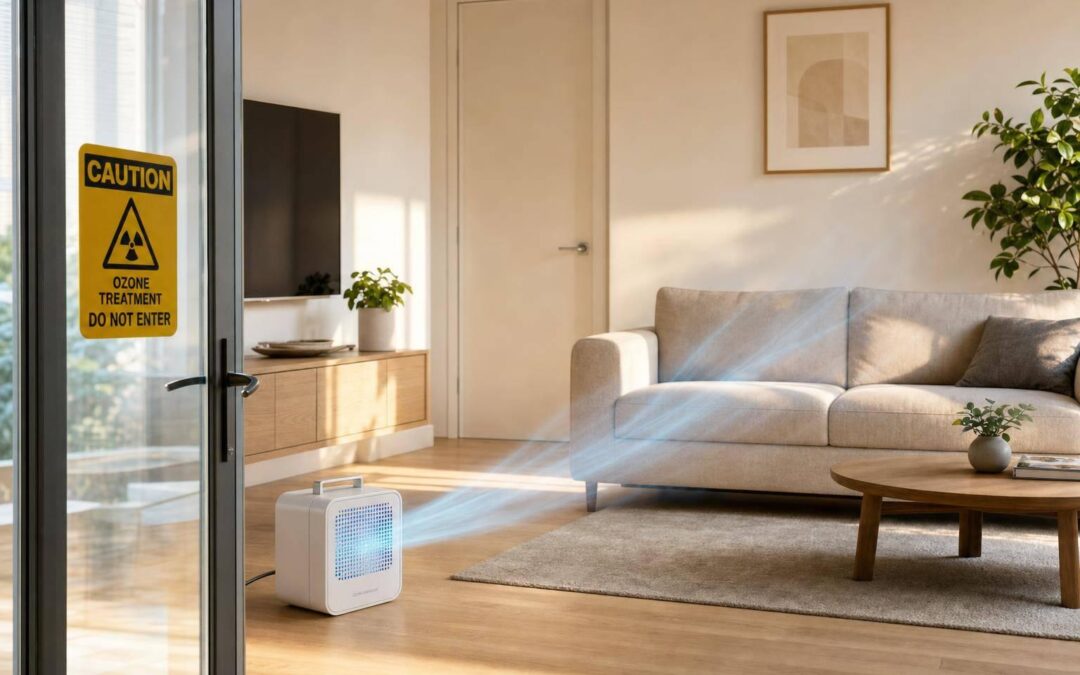
Portable ozone generators can cut deep odors, but only in empty spaces and only after you fix the source first. I’d sum it up like this: ozone attacks odor molecules through oxidation, it may help with smoke, pet, mildew, and car odors, but it also brings health risks, can damage some materials, and may create irritating byproducts like formaldehyde.
If you just want the short answer, here it is:
- Ozone does not mask smells. It changes the chemicals causing them.
- It works best after cleaning and drying the area.
- People, pets, plants, food, and medicine must be out during treatment.
- You must ventilate before re-entry, and smell alone is not a safe test.
- OSHA’s 8-hour ozone limit is 0.1 ppm, and some indoor guidance is even lower at 10 ppb.
- It may harm rubber, some plastics, leather, and coatings.
- It may not solve heavy smoke, hidden mold, or soaked-in contamination without pro help.
What stood out to me most is this: ozone can help with stubborn odors in rooms, cars, RVs, and basements, but it is not a fix for active moisture, pet urine deep in subfloors, or smoke residue buried in walls and ducts.
A few practical numbers from the article make that clear:
- A small bedroom may need about 1 to 2 hours for light odors.
- A passenger vehicle may need about 20 to 30 minutes for light odors, or up to 2 hours for heavy smoke or pet smells.
- After shutoff, many manuals call for at least 30 minutes of dwell time, then 30 to 60 minutes of ventilation before anyone goes back in.
| Topic | What I’d keep in mind |
|---|---|
| How it works | Ozone oxidizes odor compounds instead of covering them up |
| Best use | Enclosed, unoccupied rooms, cars, RVs, basements |
| Prep | Clean first, dry fully, remove people and sensitive items |
| Main risks | Lung irritation, material wear, chemical byproducts |
| When it falls short | Fire smoke, mold, wet materials, deep contamination |
| Next step | Call a pro if the odor returns or never fully leaves |
So if you’re thinking about using one, my takeaway is simple: treat ozone like a short-term tool, not an everyday air cleaner. Use it only in sealed, empty spaces, follow the device manual, and don’t skip ventilation.
Ozone Generator – Why they work and how to use one
Before operating any equipment, review our ozone treatment safety guide to protect yourself and your home.
sbb-itb-5fea4da
How Ozone Removes Odors at the Molecular Level
Portable ozone generators usually produce ozone through corona discharge or UV light. In both cases, the process starts by splitting O₂ molecules into single oxygen atoms. Those atoms then join other O₂ molecules and form O₃.
How Oxidation Changes Odor Molecules
Ozone is highly reactive. It goes after odor molecules and breaks them into smaller compounds that often smell much less. And different odor classes tend to react in ways chemists can predict.
For example, sulfur compounds like hydrogen sulfide – the classic rotten-egg smell – can be converted into sulfur dioxide. Sulfur dioxide has an odor threshold about 1,000 times higher than H₂S, so the smell can drop fast even though sulfur is still present in another form. Smoke, pet urine, and mildew odors also contain VOCs and other organic compounds that ozone can oxidize into less odorous forms.
There’s a catch, though. Ozone doesn’t always remove every molecule all the way, and some reaction byproducts can be annoying on their own. Aldehydes, for instance, may cause short-term irritation or leave behind a faint smell. When ozone reacts with household terpenes – the compounds often found in cleaning products and air fresheners – it can produce formaldehyde at yields of up to about 90%, along with ultrafine particles.
Direct Ozone Reactions vs. Hydroxyl-Based Oxidation
Direct ozone oxidation tends to target certain chemical bonds, especially double bonds in unsaturated compounds. That makes it useful for bulk odor reduction during high-concentration “shock” treatments in empty spaces. This is why it’s often used in smoke-damaged rooms and vehicle interiors.
Hydroxyl radicals (•OH) work differently. They can form when ozone reacts with water vapor or certain VOCs, and they react fast with a much broader mix of organic compounds. In many cases, they break those compounds down further into CO₂, water, and inorganic byproducts. In advanced oxidation systems, ozone may be paired with UV or other methods to generate hydroxyl radicals that can attack a broader set of VOCs.
Comparison Table: Ozone Oxidation vs. Ozone Plus Hydroxyl Oxidation
| Direct Ozone Oxidation | Ozone + Hydroxyl (AOP) | |
|---|---|---|
| Reaction style | Reacts more selectively with double bonds and certain functional groups; slower, but can penetrate odor problems well | Produces hydroxyl radicals that react fast with a broad range of VOCs in air |
| Common target odors | Smoke, tobacco, strong pet odors, musty mildew smells after cleaning and drying | Mixed VOC problems, fire damage, chemical spills, broad or unclear odor sources |
| Potential advantages | Works well for strong, localized odors; leaves no residual chemicals on surfaces; portable and often lower-cost | Faster oxidation across more kinds of compounds |
| Safety / byproduct concerns | Requires an unoccupied space; can form aldehydes and ultrafine particles when reacting with household VOCs | Needs careful setup and monitoring; intermediate byproducts have to be controlled |
With the chemistry clear, the next step is preparing the space and running the generator safely.
How Portable Ozone Generators Are Typically Used, Step by Step
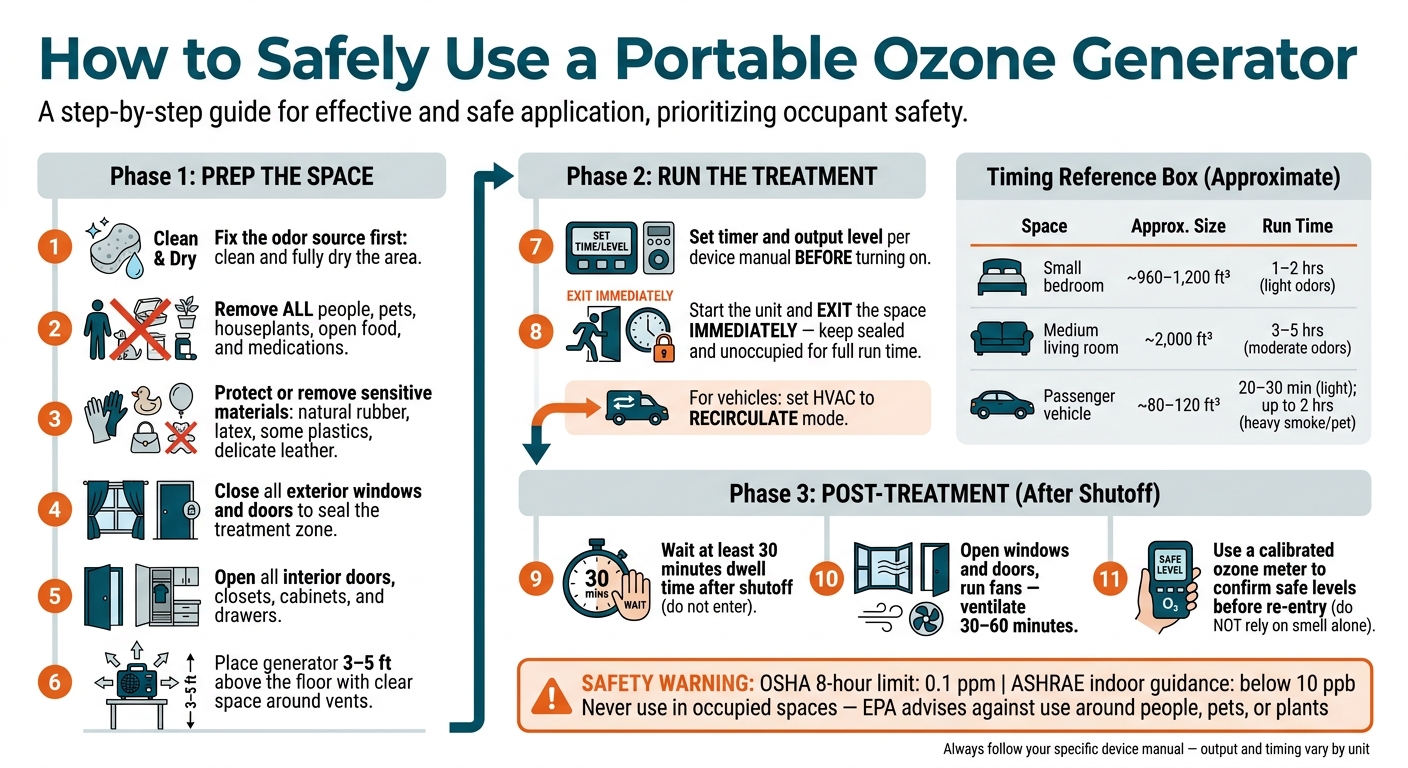
How to Safely Use a Portable Ozone Generator: Step-by-Step Guide
Using a portable ozone generator the right way comes down to three things: prep, placement, and timing. Ozone has to make direct contact with odor compounds to do its job. That means the room or vehicle needs to be sealed, empty, and dry. If the setup is off, even a high-output unit may not work well.
How to Prepare the Space Before Treatment
Clean, dry spaces tend to work best. Ozone can’t solve an active odor source, so deal with that first. After cleaning and drying the area, use this checklist:
- Clear out all people, pets, houseplants, open food, and medications.
- Protect or remove sensitive materials like natural rubber, latex items, some plastics, and delicate leather – repeated ozone exposure can degrade them.
- Close all exterior windows and doors to keep ozone contained in the treatment zone.
- Open interior doors, closets, cabinets, and drawers so ozone reaches hidden areas.
- Place the generator about 3–5 ft above the floor with clear space around the vents.
Once the space is sealed and cleared, you can start the treatment cycle.
Running the Generator in Rooms and Vehicles
Set the optimal ozone treatment time and output level before turning the unit on, based on the manual. Many portable models come with a built-in timer and more than one output mode. As soon as the machine starts, leave the space right away and keep it sealed and unoccupied for the full treatment period.
For vehicles, clean the upholstery, carpet, cargo areas, and hard surfaces first. Then make sure the interior is fully dry before treatment. Place the generator securely inside so it won’t tip over. After that, set the HVAC system to recirculate so ozone moves through the vents and cabin surfaces instead of pulling in outside air.
When the unit shuts off, don’t walk back in right away. Wait for full dissipation, then ventilate the space before re-entry. Most manuals call for at least 30 minutes of dwell time after shutoff, followed by full ventilation – open windows and doors, and run fans – before anyone goes back inside.
Timing Table: Room and Vehicle Examples
Use these examples only as a scale reference. For exact run time, stick with your device manual.
| Space | Approx. Size (ft³) | Example Run-Time Range | Key Safety Note |
|---|---|---|---|
| Small bedroom | about 960–1,200 ft³ | 1–2 hours for light odors; longer for moderate odors | Ventilate 30–60 min after shutoff before re-entry. |
| Medium living room | about 2,000 ft³ | 3–5 hours for moderate odors | Some instructions call for the HVAC fan to stay On, not Auto; the space must remain unoccupied. |
| Passenger vehicle | about 80–120 ft³ (cabin) | 20–30 min for light odors; up to 2 hours for severe smoke or pet odors | Set HVAC to recirculate; air out fully outdoors before anyone enters. |
Follow your device manual; output varies widely. These examples are approximate, and actual run times depend on your specific device’s output, the measured volume of the space, and the severity of the odor.
Ventilation, Safety Limits, and Realistic Outcomes
After treatment, clearing leftover ozone matters just as much as the run time. Ozone works in an empty, sealed space. But once the generator shuts off, the next phase is just as important. Some ozone can stay in the air, and going back in too early can put your health at risk.
How to Ventilate and Check the Space After Treatment
After the dwell period, ventilate the space before re-entry. Open windows and doors, run fans, and keep air moving for 30–60 minutes longer in larger rooms or areas with poor airflow.
Then re-enter briefly and check the space. A faint ozone smell can mean levels have dropped, but smell alone is not a safe way to confirm that. For that, you need a calibrated ozone meter. For more details on safety and process, see our odor removal FAQs. If the original odor is still there, the source may still be present. That often means lingering moisture, contaminated material, or a surface that wasn’t fully cleaned before treatment.
Health Risks, Material Damage, and Reaction Byproducts
The U.S. EPA says ozone generators should not be used in occupied spaces. Ozone irritates the lungs and can lead to chest pain, coughing, throat irritation, and shortness of breath. OSHA’s 8-hour limit is 0.1 ppm, and ASHRAE‘s Environmental Health Committee has suggested that indoor ozone should stay below 10 ppb. Children, older adults, and people with asthma face higher risk.
There’s also the issue of damage to materials. Long exposure can crack rubber, wear down plastics, and harm wire coatings. Artwork, delicate leather, and some electronics can also be affected.
Ozone can create another problem when it reacts with terpenes from cleaners, air fresheners, or building materials. In those cases, it may form formaldehyde and other irritating VOCs. In plain English: the reaction can leave behind compounds that are even more irritating than the odor you were trying to remove.
If the odor is still there after ventilation, the source hasn’t been fixed. At that point, professional odor removal is the next step.
When to Call a Professional for Odor Removal
Odor Problems That Often Require Professional Treatment
A portable ozone generator can deal with light, contained odors in one room or inside a vehicle. But when smoke, moisture, or contamination has sunk deep into materials, that’s usually a job for a pro.
If an odor is still there after proper cleaning and ventilation, the issue has often gone past what a portable unit can finish. A few cases come up again and again:
- Cigarette or fire smoke that has settled into drywall, insulation, HVAC ductwork, or upholstered furniture gets trapped in porous materials. Ozone can oxidize odor molecules in the air, but it won’t remove residue from those surfaces. After a fire, smoke from burned plastics and building materials often calls for surface cleaning and material removal before oxidation treatment is likely to work well.
- Persistent musty odors usually point to an active moisture problem. Ozone may cut down the leftover smell, but it cannot fix dampness or hidden mold.
- Vehicle, RV, and boat odors that have worked into foam, backing, vents, or bilge areas often need deep cleaning along with professional ozone or hydroxyl treatment.
- Large homes, rental properties, and commercial spaces are harder to treat safely. You have to manage vacancy timing, output levels, material safety, and post-treatment ventilation through mechanical systems that aren’t easy to handle without pro equipment and clear procedures.
Key Takeaways
The main decision points are pretty straightforward:
- Ozone oxidizes odor molecules.
- Fix the source first.
- Treat empty spaces only.
- Ventilate fully before re-entry.
- Call a professional for smoke, moisture, or embedded contamination.
FAQs
Can ozone remove odors permanently?
Ozone can deliver long-lasting odor removal, but it’s only permanent when you fix or remove the root cause first.
Here’s the simple version: ozone breaks down odor molecules in the air and inside porous materials at a molecular level. That can wipe out smells that seem stuck in place.
But there’s a catch. If the source is still there – like moisture leaks, mold, or trapped debris – the odor will usually come back.
How do I know when it’s safe to go back inside?
If you still notice a sharp, chlorine-like smell, it is not safe to go back in yet.
Wait at least 2 to 4 hours after the generator shuts off. Some treatments can take 12 to 24 hours, depending on the room size and how long the machine ran.
Before you re-enter, air out the space for 30 to 60 minutes. Open windows and doors if you can.
If you start coughing or feel irritation in your chest or throat, leave right away.
For the most accurate check, use an ozone monitor and make sure levels are 0.05 to 0.08 ppm or lower.
When should I call a professional instead?
Call a professional if the odor is severe or persistent, or if it has spread into hidden materials like drywall, insulation, carpets, or HVAC systems. The same goes for contamination from fire or smoke damage, sewage backups, black-water flooding, or widespread mold.
It also makes sense to bring in a pro for large spaces, areas that are hard to seal, repeat mildew, or jobs that are tough to size correctly. Professionals use calibrated industrial ozone or hydroxyl equipment, and they handle safety and re-entry.
Recent Comments