
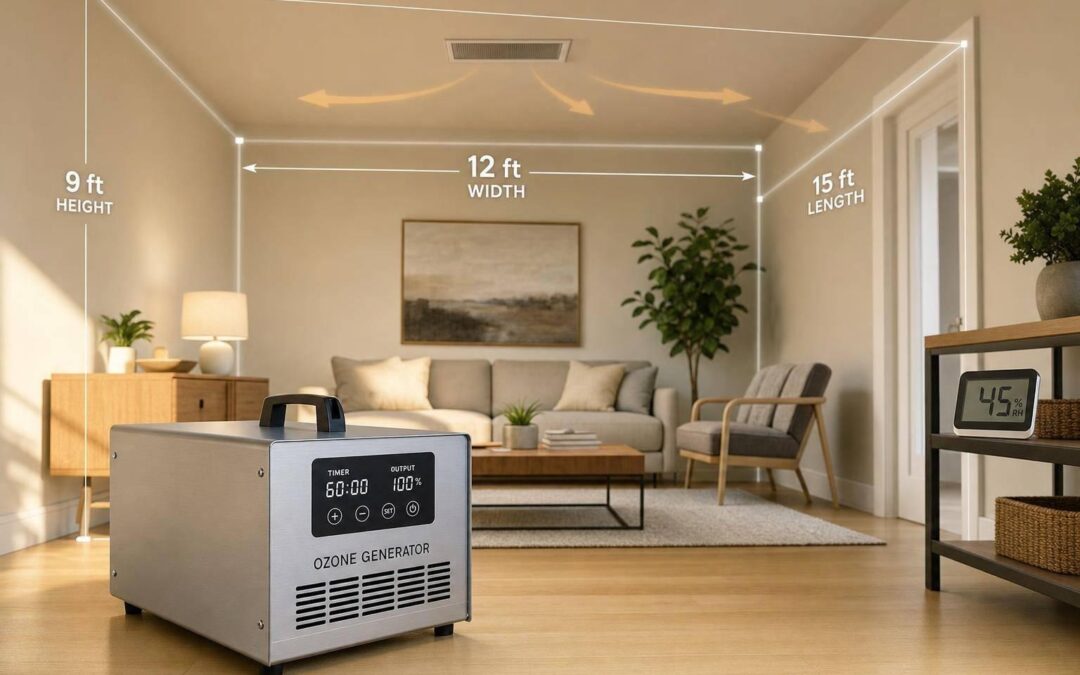
Pick the wrong ozone output, and you either waste time or add risk. If a unit is too small, it may never reach the ozone level needed to cut odors. If it is too big for a tight space, ozone can build up too fast and put more stress on materials and re-entry safety.
Here’s the short version:
- Size means output, usually in mg/hr or g/hr
- 1,000 mg/hr = 1 g/hr
- Room volume matters more than floor area alone
- You need to match output to:
- Cubic feet
- Odor strength
- Airflow and humidity
- Space type, like a bedroom, basement, car, or garage
- People, pets, and plants must be out of the space during treatment
- Heavy issues like smoke, pet urine, and mold often need more output and tighter control
A simple example: a 200 sq ft room with an 8-foot ceiling holds 1,600 cubic feet of air. The same room with a 10-foot ceiling holds 2,000 cubic feet. That difference changes the ozone dose.
I’d sum it up like this: good sizing is about hitting the right concentration for the job, not just determining the optimal treatment time. A weak unit can leave odors behind. An oversized unit can add safety and material problems without giving better results.
If you want a fast snapshot, here it is:
| Issue | What happens |
|---|---|
| Unit too small | Odors may stay in carpet, drywall, upholstery, or come back later |
| Unit too large | Ozone can build up too fast in small spaces like cars or small rooms |
| Poor room estimate | Square footage alone can lead to the wrong output choice |
| Ignoring airflow or moisture | Leaks, clutter, and damp air can cut treatment strength |
So before using any ozone machine, I’d look at volume first, then the odor source, then the space layout. That simple order helps you get better results and cut avoidable risk.
How to Choose the Right Ozone Generator
sbb-itb-5fea4da
How to size an ozone generator for a given space
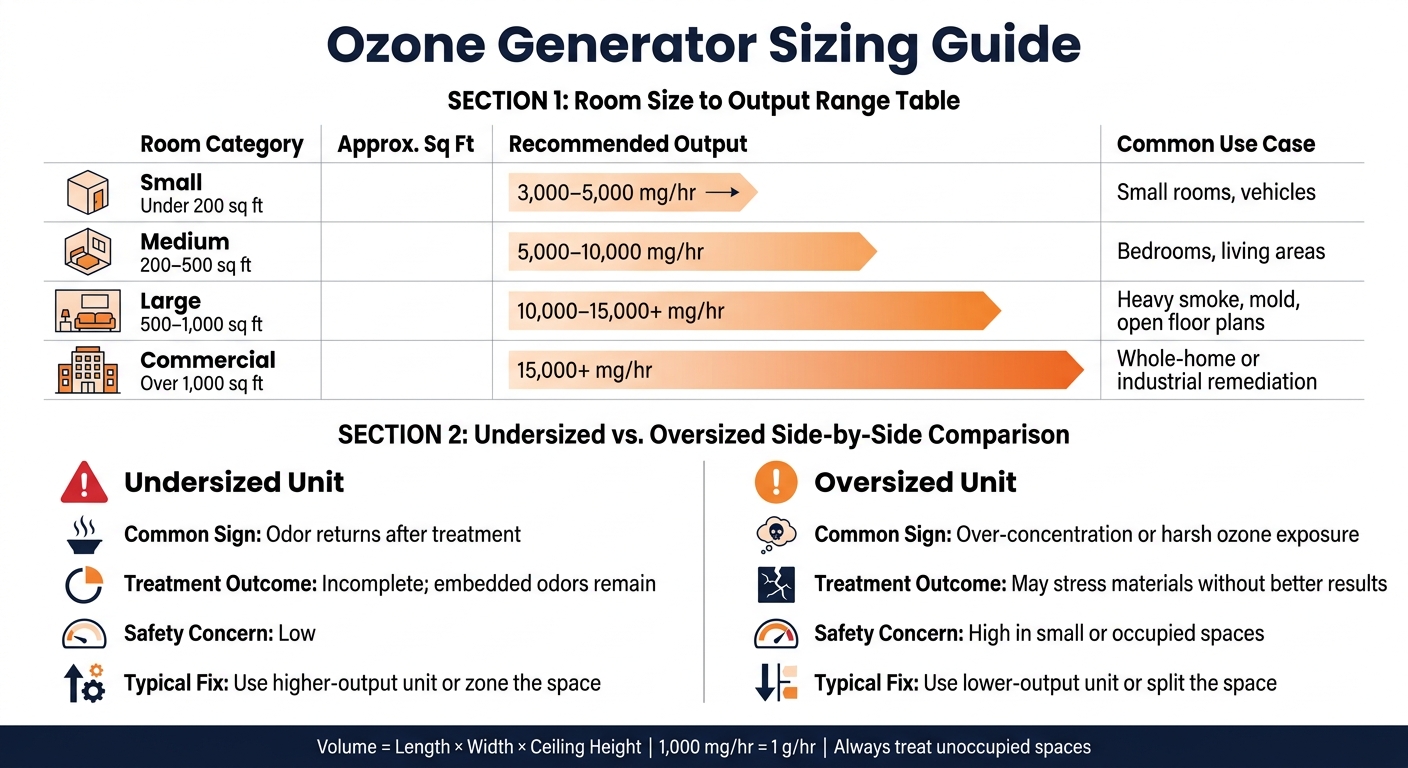
Ozone Generator Sizing Guide: Output Ranges by Room Size
Once you know the room’s cubic feet, you can match the unit’s output to the amount of air you need to treat.
Calculate room volume using square feet and ceiling height
Square footage alone doesn’t tell the whole story. Ozone spreads through cubic volume, not just floor space. To find cubic feet, multiply length × width × ceiling height.
For example, a 200 sq ft room with an 8-foot ceiling holds 1,600 cubic feet of air. That same 200 sq ft room with a 10-foot ceiling holds 2,000 cubic feet.
Output ranges for common room sizes
After you have the cubic volume, you can line it up with a fitting output range. Odor strength, room layout, and airflow can all change the numbers a bit, but the table below gives a good starting point for deep odor treatment in rooms with standard 8-foot ceilings.
| Room Size (Approx. sq ft) | Recommended Output Range | Common Use Case |
|---|---|---|
| Small (less than 200 sq ft) | 3,000–5,000 mg/hr | Small rooms, vehicles |
| Medium (200–500 sq ft) | 5,000–10,000 mg/hr | Bedrooms, living areas |
| Large (500–1,000 sq ft) | 10,000–15,000+ mg/hr | Heavy smoke, mold, open floor plans |
| Commercial (over 1,000 sq ft) | 15,000+ mg/hr | Whole-home or industrial remediation |
Use these ranges for remediation, not routine upkeep. Think of them as a baseline. From there, you’ll need to adjust for odor load and room conditions.
Adjust output based on the treatment goal
Not every space needs the same treatment level. A light odor issue takes much less output than a job dealing with cigarette smoke, pet urine, or mold. These are among the most common sources of indoor odors that require specific output levels. In many cases, runtime matters less than hitting the concentration the space needs. A higher concentration helps ozone get into odors stuck in porous materials like carpet, drywall, and upholstery.
A low-output unit can run for a long time and still fall short of that concentration. When that happens, the smell may seem gone at first, then creep back later.
Airflow, humidity, and room layout also affect the dose. So even a properly sized unit may act differently from one room to the next.
Common sizing mistakes and the problems they cause
A unit can look right on paper and still miss the mark once the room, airflow, and moisture come into play. In most cases, sizing problems go one of two ways: too little output for the space or too much output for the job. That gap matters, because ozone treatment depends on reaching the right concentration and holding it long enough to work.
Undersized units leave odors behind
A low-output unit in a large basement, open-plan apartment, or small business space may never build enough concentration to remove embedded odors. The odor may return after treatment.
This shows up a lot with cigarette smoke, pet urine, and mold. These odors sink into porous materials, so they often need sustained concentration to break down.
Oversized units can create safety and material risks
Too much output in a small space can push ozone levels past what’s needed. That can increase re-entry risk and put extra stress on rubber, fabrics, and electronics.
High-output treatments are meant for unoccupied spaces and require ventilation before re-entry. For areas that cannot be vacated, hydroxyl systems offer a safer alternative for odor removal in occupied spaces. Use an oversized unit in a small car, RV cabin, or other enclosed space without following that process, and the problem isn’t just poor results – it’s dangerous.
How ventilation, humidity, and layout affect the actual dose
Ventilation, air leaks, and open layouts can dilute ozone before it reaches the needed dose. Moisture and mold also use up ozone faster, so a damp basement can burn through the dose before treatment is complete. And if the dampness isn’t fixed, the odor can come back. Clutter and soft goods can block airflow too, which leads to uneven treatment.
Sizing mistakes at a glance: comparison table
The table below shows the most common sizing mistakes side by side.
| Undersized Unit | Oversized Unit | |
|---|---|---|
| Common sign | Odor returns after treatment | Over-concentration or harsh ozone exposure |
| Treatment outcome | Incomplete; embedded odors remain | May not improve results and can stress materials |
| Safety concern | Low | High if used in small or occupied spaces |
| Material concern | Minimal | Potential damage to rubber, fabrics, and electronics at extreme levels |
| Typical fix | Use a higher-output unit or zone the space | Use a lower-output unit or split the space |
Sizing examples and when to call a professional
These examples show how the same sizing rules shift based on the type of space and how strong the odor is.
Homes, basements, apartments, and garages
In residential spaces, room volume matters more than floor area by itself. A bedroom or kitchen will often need a mid-range unit based on the room’s cubic footage and odor load. Bigger open areas usually need more output.
Some odors are much harder to deal with than others. Smoke damage, pet urine, and mildew are common problem cases because they can settle into drywall, insulation, carpets, and HVAC systems. Basements and crawlspaces can be even trickier, since musty smells often sit deep inside porous surfaces and may need more exact sizing to treat them well.
Cars, RVs, boats, and other small enclosed spaces
Small enclosed interiors come with a different set of problems. In cars, RVs, and boats, short initial cycles are often enough because treatment concentration builds fast in a sealed space.
That speed can work against you, though. If the cycle runs too long, sensitive materials may get too much exposure. That’s why ventilation matters before anyone goes back inside.
When to hire a professional service
Some jobs are tough to size on your own. Severe smoke damage, repeat mildew issues, and large open layouts bring in extra variables like airflow patterns, cubic footage, and how deep the contamination goes.
At that point, a simple square-foot estimate stops being enough. DIY sizing can get shaky fast when the odor isn’t just in the air, but also buried in surfaces and moving through the space in uneven ways.
How Ozonated Cleaning LLC sizes its treatments
Ozonated Cleaning LLC sizes each treatment based on square footage, ceiling height, layout, odor severity, and space type. So a basement won’t get the same approach as a large open area.
The aim is simple: the right concentration for the right amount of time.
Conclusion: Proper sizing improves treatment results and reduces unnecessary risk
Getting the size right is one of the most important parts of any ozone treatment. If the output is too low, ozone may not reach the source of the contamination. If the output is too high, it can add avoidable safety and material risks when the space is not kept unoccupied during treatment.
The main factors are cubic footage, odor load, and room layout.
Severe smoke, pet urine, and mold odors need enough output to reach contamination that has settled deep into materials, not just the air in the room.
Wrong sizing wastes time and money. It can leave odors behind or create risk that could have been avoided.
For complex jobs, Ozonated Cleaning LLC sizes treatment based on the space, layout, and odor severity.
FAQs
How do I calculate cubic feet for sizing?
Multiply the room’s length × width × height to get cubic feet. A room that’s 12 feet long, 10 feet wide, and 9 feet high comes out to 1,080 cubic feet.
If the space isn’t a simple rectangle, split it into smaller rectangular sections. Measure each section, calculate the cubic feet for each one, then add the totals together. Also count connected areas like hallways or open doorways where ozone can move freely.
Does a stronger odor need a bigger ozone generator?
Not necessarily. A bigger space may need a higher-output generator to hit the right ozone level. But a stronger odor usually calls for changes to treatment time or how often you run the treatment, not just a larger machine.
Some odors are stubborn. In those cases, it may take longer sessions or more than one cycle. Ozonated Cleaning LLC uses professional equipment to balance those factors for safe, effective odor removal.
How long should I wait before re-entering treated spaces?
Wait until the ozone has fully cleared. That usually takes 2 to 24 hours, depending on the size of the room and how long the treatment ran. A common rule of thumb is 3 to 4 hours of off-gassing for every hour the generator was on.
After that, ventilate the space by opening windows and running fans for 30 to 60 minutes. If you can still smell ozone, stay out.
Recent Comments