If an odor keeps coming back, the source is still there – or the smell has soaked deep into materials. In my view, ozone can remove leftover odor molecules in air, fabric, ducts, and other hard-to-reach spots, but it only works well after the source is cleaned up or removed.
Here’s the short version:
- Ozone does not mask odors. It breaks down odor molecules.
- It works best on leftover smells from smoke, pet urine, food spills, moldy or musty spaces, and vehicle HVAC odors.
- It does not fix active problems like leaks, sewer gas, wet materials, or live contamination.
- People, pets, and plants must stay out during treatment.
- Safe re-entry matters. Many spaces need 2 to 4 hours or more of airing out, and re-entry should wait until ozone levels are 0.08 ppm or lower.
- Humidity affects results. Keeping indoor humidity at 45% or lower can help, especially in basements.
- Too much ozone can damage materials like rubber seals, some plastics, leather, and fabrics.
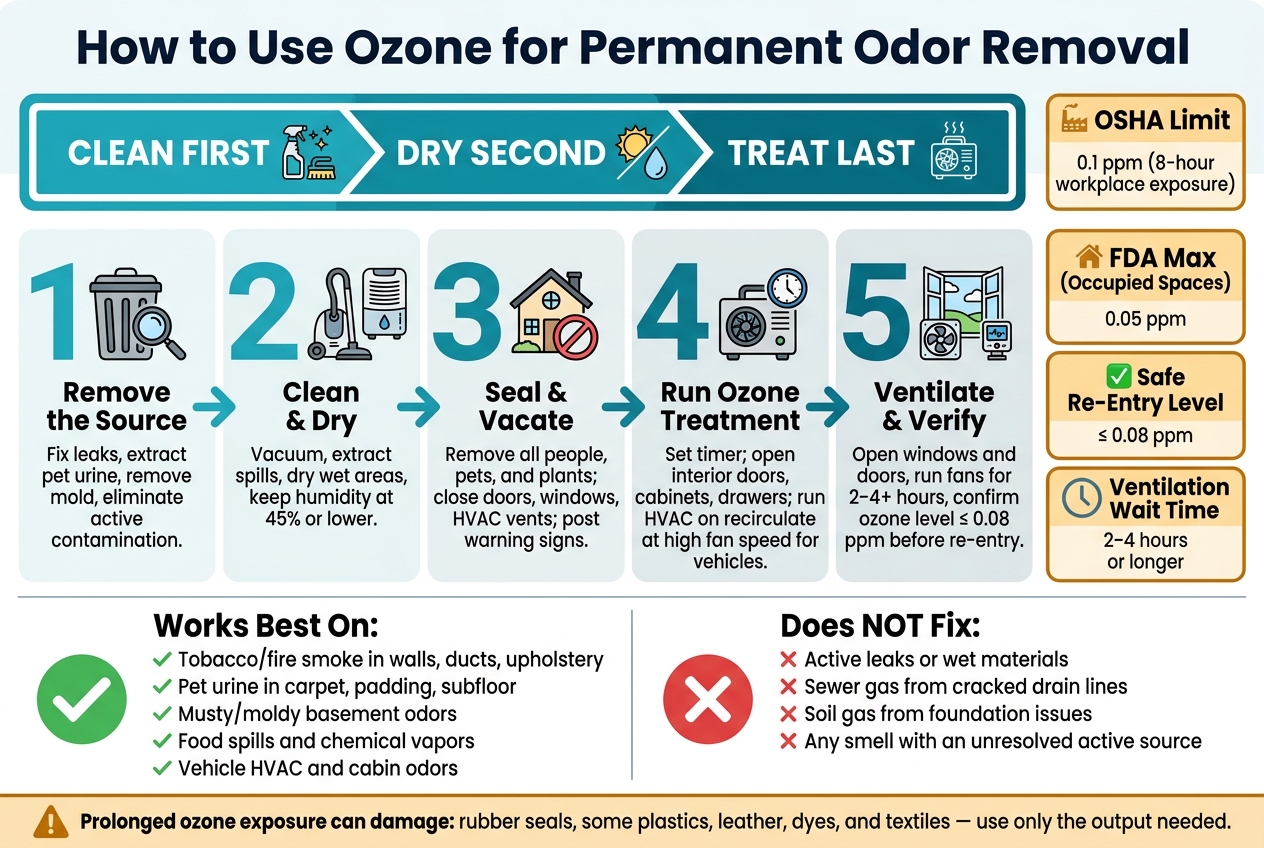
If I had to boil the whole article down to one line, it would be this: <u>clean first, dry second, treat last</u>.
A few numbers stand out:
- OSHA limit: 0.1 ppm over 8 hours
- FDA level for occupied enclosed spaces: 0.05 ppm
- Basement target humidity: 45% or lower
- Common wait time after treatment: 2–4 hours or longer
This article explains where ozone works, where it falls short, the safety rules that matter, and when hiring a pro in Chicagoland may make more sense than doing it yourself.
Ozone Odor Removal: Clean First, Dry Second, Treat Last
How Ozone Generators Remove Odors
How Ozone Oxidizes Odor Molecules
Ozone helps reach odors that surface cleaning often misses.
Ozone is O₃, which means each molecule has three oxygen atoms. When ozone comes into contact with an odor-causing compound, it breaks that compound apart at the molecular level. So the smell isn’t covered up. It’s broken down.
That’s why ozone can help with stubborn odors like smoke, pet urine, mold, burnt food, and chemical vapors. And because ozone is a gas, it can move into places liquid cleaners often can’t reach, like upholstery, air ducts, and other tight or enclosed areas. To help it spread through the space, open interior doors, cabinets, and drawers.
When Odor Removal Can Last or Become Permanent
Ozone can deliver long-lasting odor removal, but there’s a catch: the source has to go first.
If the source is still there, ozone won’t fully remove the smell. But once the source is removed, ozone can deal with what’s left in the air and on surfaces. Humidity matters too. Keep it at 45% or lower for better results. In basements, humidity above 50% can make the treatment less effective.
After treatment, a temporary ozone smell may hang around for a short time, then fade within a few hours.
Ozone Treatment vs. Sprays, Foggers, and Air Fresheners
When a bad smell shows up, most people grab a spray or air freshener first. The problem is simple: those products usually add a stronger scent over the bad one. Once that fragrance wears off, the original odor is often still sitting there.
Ozone works in a different way. Instead of competing with the smell, it breaks down the odor molecules themselves. And once the treatment is done, it doesn’t leave harmful residue behind.
| Method | What It Does | Best Use Case | Main Limit | Addresses Source? |
|---|---|---|---|---|
| Air Fresheners / Sprays | Masks odors with fragrance | Short-term scent masking | Odor returns once fragrance dissipates | No |
| Foggers | Coats surfaces with deodorizing chemicals | Large enclosed spaces | May leave residue | Partially |
| Ozone Treatment | Oxidizes and breaks down odor molecules | Persistent odors (smoke, pet urine, mold) | Space must be completely unoccupied | Yes |
That same process is why ozone is used in homes, vehicles, and commercial interiors.
sbb-itb-5fea4da
Ozone Generator – Why they work and how to use one
Ozone Treatment in Homes, Vehicles, and Commercial Spaces
The same odor-removal process plays out a little differently in homes, vehicles, and commercial spaces.
Home Odors: Smoke, Pet Accidents, and Musty Basements
Some of the most stubborn household odors come from tobacco or fire smoke, pet urine, and musty basements. Each one settles into different materials, which is why ozone helps most after the source has already been dealt with.
Smoke can sink into drywall, upholstery, and HVAC systems. That’s why the smell can hang around even after repainting and surface cleaning. Pet urine often goes deeper than people expect, soaking through carpet and padding into the subfloor, where normal cleaning may not reach. Musty basement odors usually point to moisture issues like leaks, poor drainage, or hidden microbial growth.
Once the source is fixed and the area is dry, ozone goes after what’s left behind. Put simply: clean first, dry second, treat last. For basements, keeping humidity at 45% or lower before treatment can help support better results.
Vehicles follow the same source-first logic, but tight cabins and built-in HVAC systems change how the work gets done.
Vehicle and RV Interiors: Smoke, Spills, and HVAC Odors
Cars, trucks, RVs, and boats hold odors in spots that are easy to miss:
- seat foam
- roof liners
- floor mats
- trunk liners
- HVAC evaporator coils
The HVAC system can keep pushing odors back into the cabin every time the fan turns on, even after the interior looks clean. Roof liners are another common trouble spot. They absorb odor fast and often get skipped during a standard detail job.
Before treatment, the space should be vacuumed, spills should be extracted, wet areas dried, and leaks repaired. Then, during ozone treatment, the HVAC is set to recirculate and the fan is turned to high. That helps move ozone through the intake, ducts, and evaporator housing, where odor pockets often survive a normal detail. Treatment time depends on how strong the odor is and how large the cabin is. After that, the vehicle needs full ventilation before anyone gets back inside.
Larger properties add another layer: shared HVAC systems and people coming and going.
Commercial Properties: Offices, Rentals, and Large Enclosed Spaces
Offices, rental units, hotel rooms, warehouses, and event spaces tend to have the same issue: odors settle into carpet, upholstery, storage areas, and HVAC systems. In an apartment, for example, one smoker can leave odors buried in walls, carpeting, and ceiling tiles long after a standard turnover clean.
For larger or more complex spaces, ozone treatment usually works best as part of a set process:
- inspect the property and find the main odor zones
- fix the source and clean soft surfaces
- run ozone treatment during unoccupied times, such as overnight or on weekends
- ventilate and check the space before people return
In buildings with central HVAC, fans are often run during treatment to move ozone through the duct system. After treatment, the area is aired out and checked before reoccupancy. In Chicagoland, Ozonated Cleaning LLC provides this service.
Safety Rules and Limits of Ozone Treatment
Ozone works because it reacts fast. That’s what helps it break down odors. It’s also what makes it risky if you use it the wrong way. Put simply: ozone treatment only makes sense when the space is empty, whereas hydroxyl systems are safe for occupied spaces.
Ozone Generators Must Only Run in Unoccupied Spaces
Keep people, pets, and plants out during treatment. The U.S. EPA, OSHA, and FDA all warn against using ozone generators in occupied spaces.
At higher levels, ozone can lead to coughing, chest tightness, shortness of breath, and airway irritation. OSHA’s workplace exposure limit is 0.1 ppm over an 8-hour period, and the FDA treats 0.05 ppm as the maximum acceptable level in occupied enclosed spaces.
Before you start, seal the area. Close doors, windows, and HVAC vents. If other people share the building, post a warning. Use a timer so the machine doesn’t run longer than planned.
After treatment, air the space out with open windows, open doors, and fans. Then check the ozone level with a meter before anyone goes back in. In many cases, that means waiting 2–4 hours or longer, depending on the size and layout of the space. Re-entry should only happen once the reading is at or below 0.08 ppm.
What Ozone Can and Cannot Fix
Ozone does not replace source removal. If the source is still there, the smell usually comes back.
It tends to work best on smoke, pet accidents, food spills, and other source-based odors after the main contamination has been cleaned up or removed. It’s a poor choice for sewer gas from a cracked drain line, soil gas tied to foundation issues, or any smell linked to an active source. If an odor keeps returning after treatment, that’s often a sign the root problem still hasn’t been fixed.
Key Risks, Limits, and Material Concerns
Safety isn’t the only tradeoff.
Ozone can wear down some materials, especially with heavy or repeated exposure. Natural rubber seals and gaskets are one of the main weak spots. Over time, ozone can make them crack and lose elasticity. Some plastics, dyes, leather, and textiles may also fade, yellow, or turn brittle. In vehicles, that can show up in door seals, dashboard parts, and HVAC components.
The table below sums up the main tradeoffs to weigh before treatment:
| Issue | Why It Matters | Where It Shows Up Most Often | What To Do About It |
|---|---|---|---|
| Exposure risk | Ozone is a respiratory irritant and can harm people and animals at low levels. | Homes, vehicles, small offices | Vacate all people, pets, and plants before treatment. |
| Unsafe re-entry | The space must air out before re-entry. | Any sealed treatment space | Wait several hours, ventilate thoroughly, and confirm safe levels with a meter. |
| Odor comes back | Recurring odor usually means the source remains. | Basements, rentals, older vehicles | Find and fix the source before repeating treatment. |
| Material damage | Heavy or repeated ozone exposure can degrade rubber, plastics, textiles, and finishes. | Vehicle interiors, HVAC systems, appliances | Use only the output needed and limit treatment frequency. |
That’s why bigger odor jobs – or spaces that are hard to seal – often call for professional treatment.
Professional Ozone Odor Removal in Chicagoland
When odor issues get big, messy, or hard to contain safely, bringing in a pro is often the smart move. For property owners across Chicagoland dealing with stubborn smells, Ozonated Cleaning LLC handles odor removal and disinfection with ozone and hydroxyl treatment for homes, vehicles, RVs, boats, and commercial spaces.
Services for Homes, Vehicles, and Commercial Spaces
Pricing for homes is based on square footage. Vehicles are priced per unit. Larger commercial jobs are quoted based on scope. That becomes most important when an odor has moved past what surface cleaning can fix.
When Hiring a Professional Makes More Sense Than DIY
Professional help makes sense when odor has spread into hidden materials, HVAC systems, or large areas that need controlled treatment, ventilation, and re-entry management. If you’re dealing with rental turnovers on a tight schedule, pros can manage multi-unit turnovers and help clear odors fast. And for large or multi-story spaces, these jobs often depend on correct dosing, proper sealing, and careful re-entry control.
Conclusion: The Conditions That Make Odor Removal Last
When the source is removed and ozone is used safely, odor removal can last.
FAQs
How do I know if the odor source is fully removed?
If the odor doesn’t come back soon after treatment, that usually means the source is gone.
If the smell sticks around or comes back fast, the source is still there or buried deep in the material.
Ozone can neutralize odors. But it doesn’t physically remove the root cause, like moisture, debris, or contaminants trapped in drywall, carpet padding, or insulation.
For stubborn cases, Ozonated Cleaning LLC can help find and remove hidden sources.
How long does ozone smell linger after treatment?
Ozone usually turns back into oxygen within 30 to 60 minutes. But that sharp, chlorine-like smell doesn’t always disappear on the same schedule. It can stick around longer based on ventilation, room size, and how long the treatment lasted.
In many cases, a space is safe to enter within 12 to 24 hours. Even so, the odor may linger for 2 to 3 days. Open windows, run fans, and keep the area well ventilated until the smell is gone.
Can one ozone treatment permanently remove odors?
An ozone treatment can be a permanent fix only when the source of the odor is removed or dealt with first.
Ozone does a strong job of neutralizing odor molecules. But it doesn’t solve the problem behind the smell. It won’t repair mold issues, stop moisture leaks, or remove trapped debris. If the root cause is still there, or if odors remain inside porous materials, the smell can come back.
Ozonated Cleaning LLC helps make sure the process is done the right way.
Recent Comments