If you want odor gone for good, I’d start with the source, not ozone.
Here’s the short answer: ozone can cut leftover smells, but it does not remove what is causing them. That matters because the smell often comes back if smoke residue, urine salts, mold growth, wet materials, or dirty HVAC parts are still there. On top of that, ozone can irritate the lungs, must be used only in empty spaces, and can create byproducts like formaldehyde and ultrafine particles.
So if I were choosing between the two, I’d use this simple rule:
- Use source cleanup first: wash surfaces, remove odor-soaked materials, fix leaks, dry damp areas, and change filters
- Use ventilation and filtration next: open windows, run exhaust fans, and use HEPA plus activated carbon
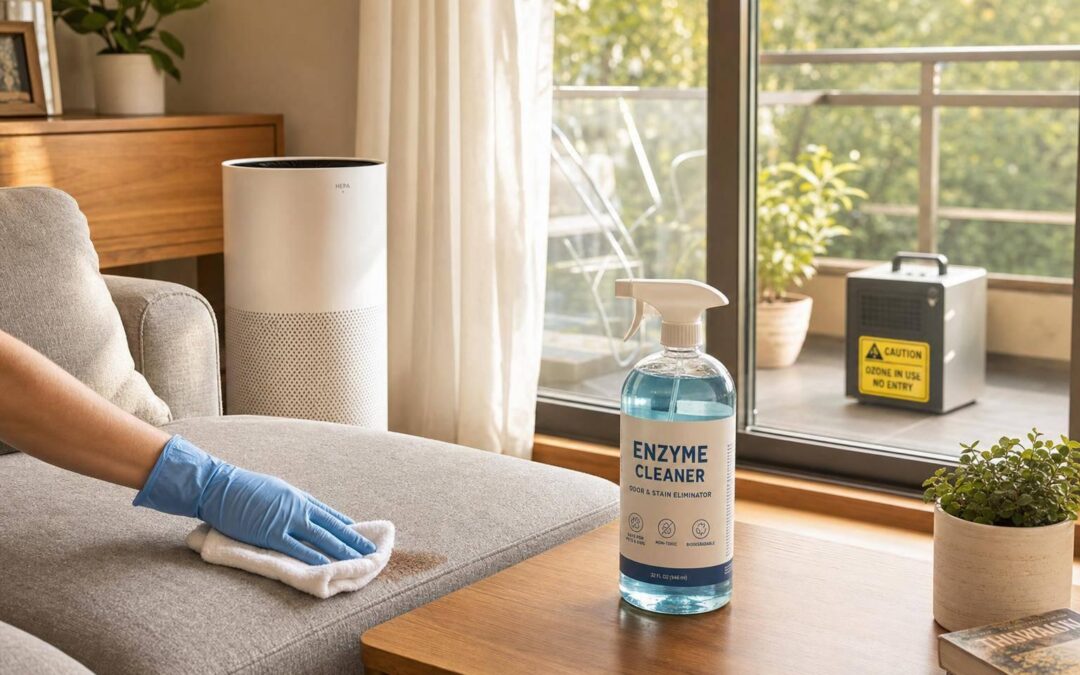
- Use enzyme cleaners for pet urine, vomit, and food messes
- Keep humidity under 50% to help stop mold and musty smells from coming back
- Use ozone only after cleanup, only for leftover odor, and only in a fully vacant home, office, car, RV, or boat
A few facts stand out fast:
- True HEPA filters trap 99.97% of particles down to 0.3 microns
- Ozone treatment levels for odor control are above safe exposure limits for occupied spaces
- Filter changes are often needed every 6 to 12 months
- Ozone may help with residual smoke or mildew odor, but it cannot pull contamination out of drywall, insulation, padding, or upholstery
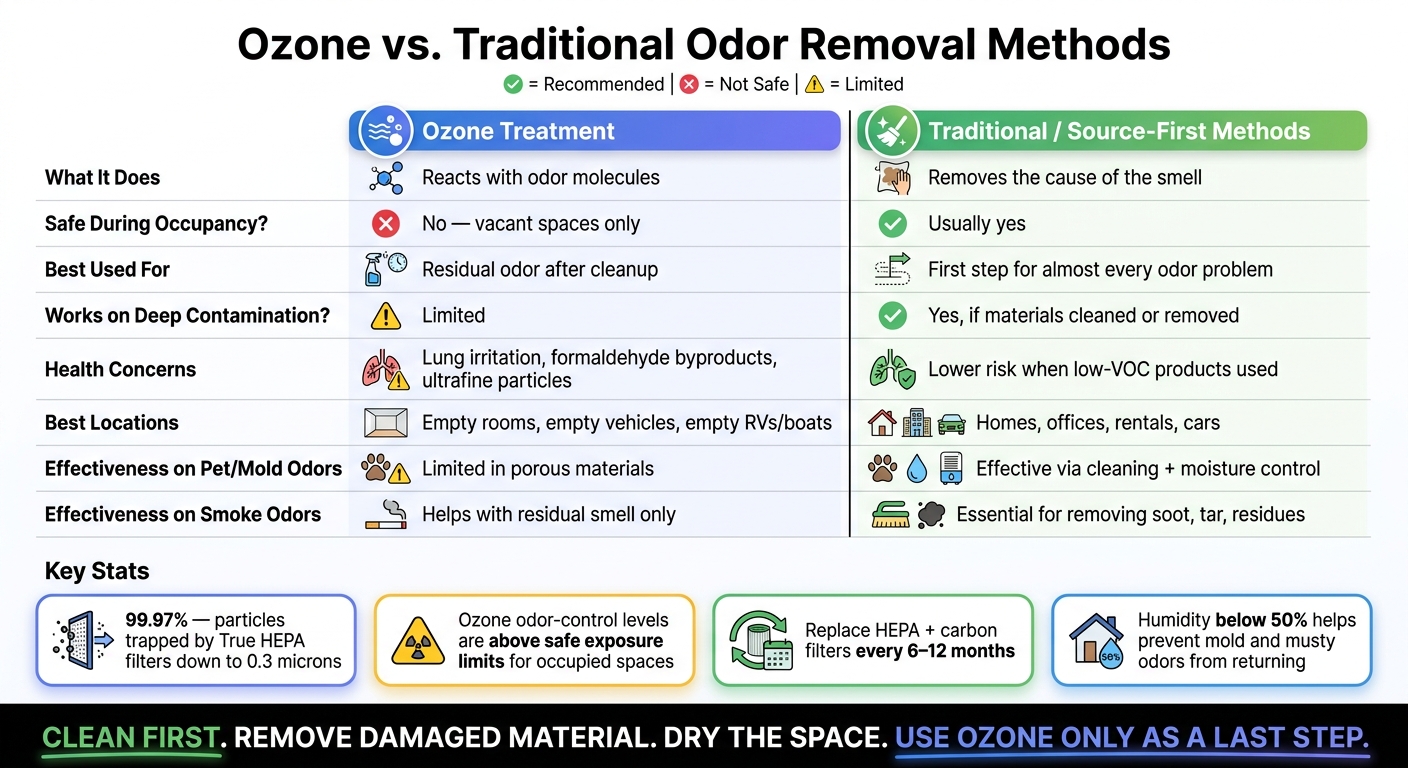
Ozone vs. Traditional Odor Removal: Effectiveness, Safety & Best Use
Ozone vs Hydroxyl
Quick Comparison
| What to compare | Ozone | Source-first methods |
|---|---|---|
| What it does | Reacts with odor molecules | Removes what is causing the smell |
| Safe during occupancy? | No | Usually yes |
| Best use | Leftover odor after cleanup | First step for almost every odor problem |
| Works on deep contamination? | Limited | Yes, if materials are cleaned or removed |
| Health concerns | Lung irritation, byproducts | Lower risk when low-VOC products are used |
| Best places | Empty rooms, empty vehicles, empty RVs | Homes, offices, rentals, cars |
If you want the plain-English version, it’s this: clean first, remove damaged material if needed, dry the space, move fresh air through it, and treat ozone as a last step, not the main fix.
Ozone for Odor Control: How It Works and When It Is Used
Ozone is a strong oxidizer that can break down some odor-causing compounds instead of just covering them up with fragrance. That’s the main reason people use it for odor control. But there’s a catch: ozone is a finishing treatment, not a replacement for cleaning the source.
In plain English, if the odor is coming from soot, mildew, smoke residue, or contaminated materials, ozone may help cut down the smell. It does not remove the thing causing it.
Low-level ozone devices don’t do much for serious indoor odor problems, while professional ozone treatment uses much higher concentrations in empty spaces. And even at low levels, these devices can still irritate the respiratory system.
When Ozone Is Used for Severe Odor Problems
Professional ozone treatment is usually saved for the tough cases: fire residue, smoke damage, long-term cigarette smoke, heavy mildew or biological contamination, and stubborn odors in vehicles, RVs, or boats – especially when the smell has sunk into porous materials like upholstery, drywall, insulation, or carpets.
That matters because porous materials tend to hold odor deep inside. A surface wipe-down may help a little, but it often won’t reach what’s trapped below.
Ozone can reduce odor intensity, while more standard methods remove the underlying contamination. It tends to work best after the physical source has already been removed or cut back – for example, after charred materials are cleaned out or contaminated materials are taken out. Since ozone does not remove the source itself, it fits best after cleaning or removal work.
Safety Limits, Byproducts, and Vacant-Space Requirements
The ozone levels needed to neutralize serious odors are above safe exposure limits for people. The EPA and OSHA both identify ozone as a respiratory hazard. It can irritate the eyes, nose, throat, and lungs, and it can make asthma and other breathing problems worse, especially for children, older adults, and people with respiratory issues.
That’s why the treatment area must be fully vacant during use and then aired out before anyone goes back in. Re-entry timing depends on how strong the treatment was, how well the space is ventilated, and what kind of odor source was being treated.
There’s another issue too. Ozone can create byproducts such as formaldehyde and ultrafine particles, so controlled dosing and proper ventilation matter. The California Air Resources Board has specifically flagged this risk with ozone-generating devices.
How Hydroxyl Treatment Differs from Ozone
Hydroxyl treatment is the lower-impact oxidative option when turnaround time matters. It uses reactive radicals instead of ozone gas and is often chosen when faster re-entry matters.
Traditional Odor Removal Methods: Start with the Source
If ozone is off the table, the old-school approach still works best: fix the source first. That matters because these methods remove the problem itself, while ozone only changes it through a chemical reaction.
Cleaning, Material Removal, and Moisture Control
Source removal is the starting point. In plain English, that means cleaning affected surfaces and taking out odor-soaked materials like carpet padding or drywall.
Enzyme cleaners are especially useful for pet urine, vomit, and food residue because they digest the mess instead of just covering it up. That detail matters. Uric acid crystals can reactivate when humidity goes up, which is why a smell often comes back after a basic wipe-down unless enzymes are used.
Moisture control is part of the same job. Keeping indoor humidity below 50% helps limit mold and bacteria growth that can lead to stubborn musty smells. Fix leaks, use a dehumidifier in damp basements, and deal with standing water before it turns into a repeat issue.
Ventilation, Filtration, and Adsorption
After the source is handled, ventilation and HVAC systems can help clear what is still floating in the air. True HEPA filters trap 99.97% of particles down to 0.3 microns, which makes them a solid choice for day-to-day air care. To keep them working as intended, replace HEPA and carbon filters every six to 12 months.
Activated carbon deals with the gaseous side of the problem, including VOCs, lighter household odors, and leftover airborne molecules. Activated charcoal bags can also help in small enclosed spaces like:
- closets
- vehicles
- areas near litter boxes
That said, filtration has limits. It can’t reach odors buried deep inside porous materials such as upholstery or carpet padding.
Product Choices That Reduce Indoor Irritants
Fragranced sprays and synthetic deodorizers can make things worse because they add VOCs. For day-to-day odor control, white vinegar can neutralize alkaline odors like pet urine, and baking soda works through chemical reactions that neutralize both acidic and alkaline odors.
The goal here is simple: use products that cut down on irritants instead of adding more.
That source-first method is the baseline, and it is not something ozone treatment can replace.
sbb-itb-5fea4da
Ozone vs. Traditional Methods: Effectiveness, Safety, and Health Impact
Which Method Removes the Source and Which Only Reduces Odor Intensity
The key difference is simple: traditional methods remove the source, while ozone goes after odor molecules. Research shows ozone removes only a limited portion of odor, and the effect can wear off after the gas clears.
That matters in practice. Ozone may help with leftover odor after cleaning, like a smoke smell that hangs around after soot and residue are gone. But it can’t pull nicotine, tar, or urine salts out of walls, insulation, upholstery, or carpet padding. If the source is still there, the smell often comes back. That’s why source removal has to happen first.
Health and Safety Tradeoffs in Occupied Spaces
Ozone is a respiratory irritant, so it should only be used in vacant spaces. That isn’t a small detail. It shapes how the method can be used from the start. To cut odor with ozone, you have to create a treatment setup where people, pets, and plants stay out until the area is fully ventilated.
Traditional methods come with a much lower health risk profile and are meant for occupied spaces. For most homes, workplaces, and vehicles, that’s a major difference. One method can be used as part of normal cleaning. The other requires everyone to clear out first.
Long-Term Indoor Air Quality Effects
There’s another issue here: ozone can create secondary pollutants, including formaldehyde and ultrafine particles. So a room may smell better while the air itself gets worse. That’s a tough tradeoff.
Traditional methods take a different path. By focusing on source removal, moisture control, and ventilation, they improve indoor air quality over time instead of just covering up or dialing down odor.
Those differences matter most when you’re deciding what makes sense for a home, workplace, or vehicle.
Pros and Cons Table: Ozone vs. Traditional Odor Removal
The table below lays out the tradeoffs in plain terms.
| Aspect | Ozone Treatment | Traditional Odor Removal |
|---|---|---|
| Speed of odor reduction | Can be fast for some residual odors at higher concentrations in unoccupied spaces | Depends on cleaning scope; often moderate |
| Smoke odors | Helps with residual smell after cleaning only | Essential for removing soot, tar, and embedded residues |
| Pet and mold odors | Limited; not effective in porous materials at safe levels | Effective via cleaning, material removal, and moisture control |
| Chemical/VOC odors | Can form secondary pollutants like formaldehyde | Ventilation and filtration reduce VOCs over time |
Choosing the Right Method for Homes, Businesses, and Vehicles
Start with source control. Save ozone or hydroxyl treatment for stubborn smells that stick around after cleanup, and only use them in vacant spaces. The basic idea stays the same across homes, workplaces, and vehicles, but the details change a bit depending on where the odor is coming from.
Homes and Rental Properties
In homes, cleanup and moisture control come first. That usually means washing or replacing soft materials, fixing leaks, and using exhaust fans to cut down damp air.
If that still doesn’t do the job – like after a house fire, years of indoor smoking, or heavy pet contamination – a vacant-space ozone or hydroxyl treatment can help cut what’s left. A short ozone treatment in a fully vacated unit can reduce residual odor after cleanup.
Commercial Spaces and Workplaces
In workplaces, the same rule applies, but HVAC maintenance handles most of the routine odor and air-quality work. Regular filter changes, coil cleaning, and keeping vents clear usually take care of day-to-day issues.
If ozone is used, it needs to happen after hours in a fully vacant space. No one should go back in until levels are checked and confirmed safe.
Vehicles, RVs, and Boats
Small cabins hold onto smells. Air keeps moving through the same tight space, so removing the source matters even more here.
Most vehicle odors can be fixed with standard detailing:
- Vacuum the interior
- Wipe down surfaces
- Replace the cabin air filter
- Dry out moisture fast
For RVs and boats, it also helps to check seals and seams for leaks and use desiccants during storage.
When detailing still doesn’t clear the smell – such as chronic tobacco smoke, mildew that lingers after water intrusion, or biological contamination – a professional ozone treatment in a fully unoccupied vehicle, RV, or boat can help. During the ozone cycle, the cabin stays sealed. After that, it needs to be aired out fully before anyone returns.
Conclusion: Matching the Method to the Odor Source and Safety Requirements
After looking at effectiveness, safety, and health impact, the choice is pretty straightforward: remove the source first.
That means starting with the basics that deal with the cause of the smell, not just the symptom. Cleaning, removing damaged materials, controlling moisture, and changing or maintaining filters should come first because those steps get rid of what’s creating the odor in the first place.
If the smell is still there after cleanup, that usually points to odor that has soaked into textiles, adhesives, or HVAC parts. At that stage, a more targeted odor treatment may make sense.
Ozone or hydroxyl treatment can help with embedded odors, but they should be used only after source removal, not instead of it.
The rule is simple: start with the source, clean what you can see, and use advanced treatment only when odor persists after cleanup.
FAQs
When should ozone be used?
Ozone treatment works best when you need fast, heavy-duty odor removal in spaces that are completely empty. That includes homes, cars, boats, and commercial properties during turnover.
It’s a strong fit for stubborn odors that have settled in deep, like smoke, pet accidents, and mildew. It can also reach places that are hard to treat by hand, including porous materials and tight areas where odor tends to linger.
First things first: remove the odor source. If the source is still there, the smell usually comes back.
Ozone can be harmful to breathe, so the space must be fully vacated during treatment and during the first round of ventilation. That means no people, no pets, and no plants in the area until it has been aired out.
Can ozone permanently remove odors?
Yes – ozone can permanently remove odors by breaking down the molecules that cause the smell instead of covering them up with fragrance.
Because ozone is a gas, it can move into spots that standard cleaning often misses, like HVAC paths, upholstery, and porous materials. That reach is a big part of why it works so well for stubborn odors.
There’s one catch: you have to remove the source of the odor first. If mold, debris, or moisture is still there, the smell can come back. Ozone can remove odors and sanitize, but it does not physically clean dirt or grime.
What works best before ozone treatment?
Before you run an ozone treatment, get rid of the actual source of the smell. Ozone can neutralize odor molecules, but it won’t solve problems like garbage, mold colonies, or decaying organic material. You also need to fix the root cause, such as leaks, moisture, or high humidity, so the odor doesn’t come back.
The space should be empty of people, pets, and plants. Remove ozone-sensitive items or cover them well. It also helps to clean the area first so there’s no visible dirt, grease, or residue left behind.
Recent Comments