
How can you improve indoor air quality without skyrocketing energy costs? The answer lies in carefully balancing pathogen control technologies like filtration, UV-C light, and ventilation. Here’s what you need to know:
- MERV 13 filters trap 85% of particles in the 1–3 µm range, cutting virus levels by 10% with just a 3% energy increase.
- UV-C systems deactivate airborne pathogens without restricting airflow, offering high disinfection rates with minimal energy demand.
- Outdoor air ventilation effectively reduces infection risks but can increase energy use by up to 24.5%, especially in extreme climates.
Filtration and UV-C are the most energy-efficient options, while relying solely on outdoor air can be costly and inefficient. Proper system design, maintenance, and tools like the ICEE index help optimize performance, ensuring clean air without excessive energy use. Let’s dive deeper into these strategies.
UVC Advantage – HVAC Air and Surface Sanitizer for Cleaner Air and Improved Energy Efficiency
sbb-itb-5fea4da
How HVAC Systems Control Pathogens
HVAC systems tackle airborne pathogens using three key technologies: mechanical filtration, ultraviolet germicidal irradiation (UV-C), and outdoor air ventilation. Each method has its strengths and energy demands, making it essential for facility managers to weigh their options carefully. Here’s a closer look at how these technologies work and their impact on energy use.
MERV Filters and Pathogen Capture
Mechanical filters are the first line of defense, trapping respiratory droplets and nuclei as air passes through. Agencies like ASHRAE and the CDC suggest upgrading to MERV 13 filters to reduce the spread of airborne viruses like SARS-CoV-2. While the virus itself is about 0.1 µm, it typically travels in respiratory droplets that are 1 µm or larger – well within the capture range of MERV 13 filters, which trap 85% of particles in the 1–3 µm range. By comparison, MERV 8 filters only capture about 20% of particles in this range. Upgrading to MERV 13 can lower indoor virus concentrations by 10%, though it also increases energy use by roughly 3%.
"Air-cleaning technologies can be combined to produce the desired MERV 13-equivalent level of air cleaning." – ASHRAE Epidemic Task Force
Before upgrading, ensure your HVAC fan can handle the added static pressure. Older systems designed for 1- or 2-inch filters may not accommodate the 4-inch depth of MERV 13 filters. In some cases, high-resistance HEPA filters may even increase virus concentrations if the fan cannot maintain sufficient airflow. Additionally, check that filters are properly sealed – air bypassing the filter remains untreated.
While MERV 13 filters cost about 25% more than MERV 8 filters and require higher labor and disposal expenses, they improve in efficiency as they load with particles. On the other hand, electrostatically enhanced filters lose efficiency within weeks as their charge diminishes.
UV Germicidal Irradiation (UV-C)
UV-C light, with wavelengths between 200–280 nm, neutralizes pathogens by disrupting their DNA or RNA, preventing replication. The most effective wavelength for UV-C disinfection is 253.7 nm. Unlike filters, UV-C systems deactivate pathogens without adding airflow resistance, making them a complementary solution.
UV-C systems come in three main types:
- Upper-room fixtures: Mounted above 7 feet, these disinfect air as it circulates.
- In-duct disinfection: High-intensity lamps installed in ductwork treat air as it flows through.
- Coil/surface irradiation: Targets cooling coils and drain pans to prevent biofilm growth.
One hour of upper-room UV-C use can provide the equivalent of 10–16 air changes per hour. Effectiveness depends on "dose", calculated as UV-C intensity multiplied by exposure time. For SARS-CoV-2, the D90 dose (needed to inactivate 90% of the virus) is about 5.99 J/m².
"UV is very efficient for killing this virus [SARS-CoV-2]." – Columbia University researchers
A hybrid setup combining a MERV 8 filter with UV-C achieves a 78% single-pass inactivation rate for SARS-CoV-2, similar to MERV 13 performance but with lower energy penalties. For in-duct systems, place UV-C lamps upstream of cooling coils where air temperatures are warmer (around 70°F) to maximize output – cold air at 55°F can reduce lamp output by 40%. UV-C also improves system efficiency, reducing coil pressure drop by 21% and boosting heat transfer by 14%.
Outdoor Air Ventilation Methods
Bringing in outdoor air dilutes indoor aerosols, reducing infection risks. However, this method has a much higher energy cost compared to filtration. Doubling ventilation can increase Energy Use Intensity (EUI) by 5–7%, while upgrading to MERV 13 filtration only raises EUI by 0.7%.
"Increased outdoor-air ventilation is effective for reducing infection risk, but it can be very costly or even infeasible depending on climate and equipment configuration." – Michael J. Risbeck, Ph.D., Senior AI Scientist, Johnson Controls
The benefits of increased air changes per hour (ACH) diminish over time. For example, raising ACH from 1.38 to 5.05 only halves infection risk. Energy demands become especially challenging in extreme climates. In New York, doubling ventilation increases annual heating energy by 20%; in Miami, it raises cooling energy by 15%.
Many HVAC systems cannot handle large increases in outdoor air, leading to issues like indoor humidity, microbial growth, and discomfort. Overloading outdoor air without balancing exhaust can also create pressure imbalances, potentially spreading contaminated air to other areas.
Energy Costs of Pathogen-Free HVAC Systems
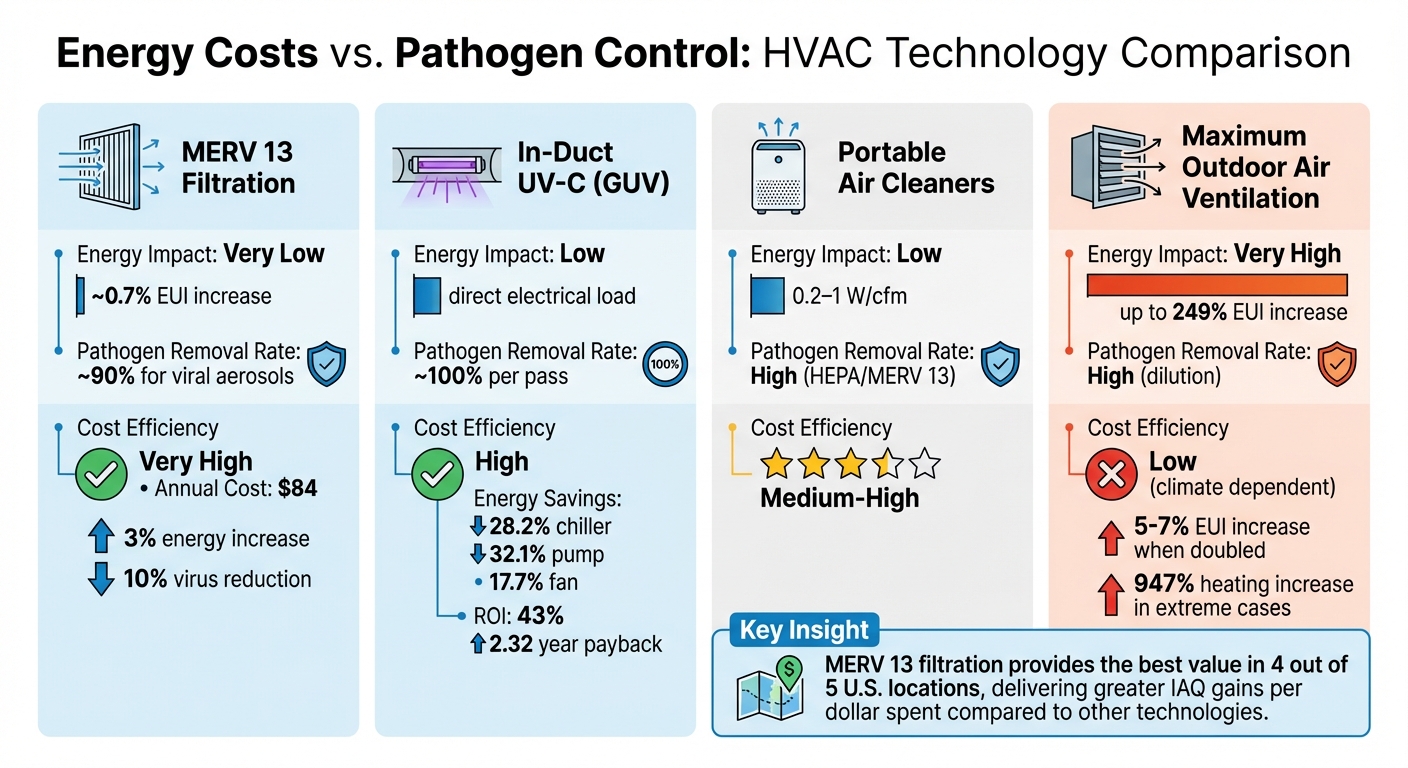
Energy Impact and Pathogen Removal Comparison of HVAC Technologies
Research Findings on Filtration and Energy Use
When managing both pathogen control and energy efficiency, filtration emerges as a practical solution. For example, upgrading from MERV 10 to MERV 13 filters increases site energy use by about 3%, while reducing virus levels by approximately 10%. On the other hand, extreme ventilation strategies – like 5 ACH (air changes per hour) with 100% outdoor air – can significantly drive up energy demands. In a low-rise New York building model, heating energy use surged by 947%, while cooling energy rose by 356% under such conditions. Even doubling outdoor air rates can increase total building source EUI (Energy Use Intensity) by 5% to 7%, whereas upgrading from MERV 9–12 to MERV 13–15 only increases EUI by a modest 0.7%.
"Improved filtration is often the most cost-effective source of equivalent outdoor air." – Michael J. Risbeck, Senior AI Scientist, Johnson Controls
Cost-wise, filters also present a balanced option. MERV 13 filters cost about $11 each, translating to an annual expense of $84 (including labor and a 4-month replacement cycle). This is just $12 more annually than MERV 10 filters. However, HEPA filters, which cost around $150 each, can strain HVAC systems due to their higher resistance (373 Pa compared to 162 Pa for MERV 13). These findings highlight the efficiency of filtration compared to other technologies, as summarized in the table below.
Energy Comparison of Pathogen Control Technologies
The energy requirements of different disinfection methods vary significantly. For instance, UV-C systems deactivate pathogens without increasing airflow resistance, unlike filters. A study at a Michigan medical center found that UV-C lamps installed on cooling coils eliminated biofilms while delivering substantial energy savings: a 28.2% reduction in chiller energy, 32.1% pump energy savings, and 17.7% fan energy savings. This system achieved over 99% pathogen removal and offered a 43% return on investment with a payback period of just 2.32 years.
| Technology | Energy Impact | Pathogen Removal Rate | Cost Efficiency |
|---|---|---|---|
| MERV 13 Filtration | Very Low (~0.7% EUI increase) | ~90% for viral aerosols | Very High |
| In-Duct GUV | Low (direct electrical load) | ~100% per pass | High |
| Portable Air Cleaners | Low (0.2–1 W/cfm) | High (HEPA/MERV 13) | Medium-High |
| Outdoor Air (Maximum) | Very High (up to 249% EUI increase) | High (dilution) | Low (climate dependent) |
Filtration and UV-C systems maintain relatively stable costs throughout the year. In contrast, the energy needed to condition outdoor air can vary dramatically depending on the weather. This contrast highlights the efficiency of filtration and UV-C technologies in achieving pathogen control with minimal energy trade-offs.
Balancing Pathogen Control and Energy Use
Using the ICEE Index
Finding the sweet spot between managing pathogens and conserving energy calls for a structured approach. That’s where the Infection Control’s Energy Efficiency (ICEE) index comes in. This metric evaluates the marginal improvement in indoor air quality (IAQ) relative to the percentage increase in costs or CO2 emissions, using Equivalent Outdoor Air (EOA) as a baseline. EOA translates various disinfection methods into the volume of outdoor air needed to achieve the same level of pathogen removal.
The "Price of EOA" sheds light on the financial and environmental costs tied to each unit of IAQ improvement. Research consistently highlights that MERV 13 filtration provides the best value in four out of five U.S. locations studied, delivering greater IAQ gains per dollar spent and per unit of CO2 emissions compared to MERV 10. Another key insight is that outdoor air ventilation has highly variable energy costs depending on the weather, while filtration systems and in-zone devices maintain steady energy demands throughout the year.
Experts emphasize that in-duct filtration strikes a solid balance between reducing risks and maintaining airflow efficiency. These theoretical findings pave the way for practical implementations, as demonstrated in simulated office building scenarios.
Office Building Case Studies
The ICEE framework isn’t just theoretical – it’s been tested in real-world simulations. Case studies from office buildings show that smart HVAC strategies can improve IAQ by 6% to 16% with only minimal increases in costs and CO2 emissions. These findings confirm that most pathogen control methods – excluding maximum outdoor air strategies – can meet ASHRAE 241 standards without compromising energy efficiency or comfort.
One particularly eye-opening discovery involves HEPA filters in systems not designed to handle them. Research led by Cary A. Faulkner at the University of Colorado Boulder found that retrofitting HEPA filters into undersized systems can actually reduce IAQ by up to 10.6% compared to MERV 13. This happens because the higher pressure drop from HEPA filters restricts airflow, highlighting the importance of choosing filtration solutions suited to the system’s capacity instead of defaulting to the highest-rated filter.
Conclusion
Creating pathogen-free indoor air is possible without driving up energy costs or causing harm to the environment. Research highlights that MERV 13 filtration is an effective starting point, increasing annual energy use in U.S. commercial buildings by just 0.8% while offering strong pathogen removal capabilities.
In addition to filtration, UV-C technology plays a key role in reducing energy use while maintaining high disinfection levels. These systems can achieve disinfection rates comparable to 10 to 20 air changes per hour, all while consuming far less energy than traditional mechanical ventilation. Upper-room UV-C fixtures, in particular, deliver excellent protection at a fraction of the operating cost of 100% outdoor air systems with similar performance.
Choosing the right pathogen control in HVAC best practices for your building’s unique requirements is essential. High-efficiency filtration and UV-C systems are reliable throughout the year, unaffected by seasonal weather changes. This tailored approach ensures effective pathogen control with minimal energy consumption, complementing HVAC optimization strategies discussed earlier. Advanced systems with real-time sensors also enhance efficiency, cutting energy use by up to 52% by activating disinfection only when pathogen levels demand it.
Regular HVAC maintenance further boosts energy efficiency. For instance, cleaning systems regularly can save 41% to 60% on fan power while increasing airflow by 10% to 46%. This demonstrates that energy efficiency and pathogen control work hand in hand, rather than in opposition. By combining filtration, UV-C technology, and smart controls, buildings can meet strict clean air standards like ASHRAE 241 without sacrificing comfort, sustainability, or financial feasibility.
FAQs
Do I need to upgrade my HVAC fan before switching to MERV 13 filters?
You don’t always have to replace your HVAC fan to use MERV 13 filters. That said, these high-efficiency filters can cause a higher pressure drop, which might lead to increased energy use by the fan. In some cases, you may need to adjust the fan or have your system checked to maintain proper performance and energy efficiency.
Where should UV-C lamps be installed for the best results?
UV-C lamps are best installed in HVAC systems either near the ceiling in occupied areas to treat the air or inside the ducts to neutralize airborne pathogens. This setup also works to limit microbial growth on coils and surfaces, helping maintain cleaner air and more effective pathogen control.
How can I estimate the energy cost of adding more outdoor air?
To figure out the energy cost of increasing outdoor air, you’ll need to consider a few key factors: your climate zone, the specific ventilation requirements, and how efficient your HVAC system is. Research, such as studies from the US EPA, shows that these variables can significantly affect both energy use and the performance of your system. Diving into energy modeling studies can also help you understand how your energy consumption might change with adjustments.
Recent Comments