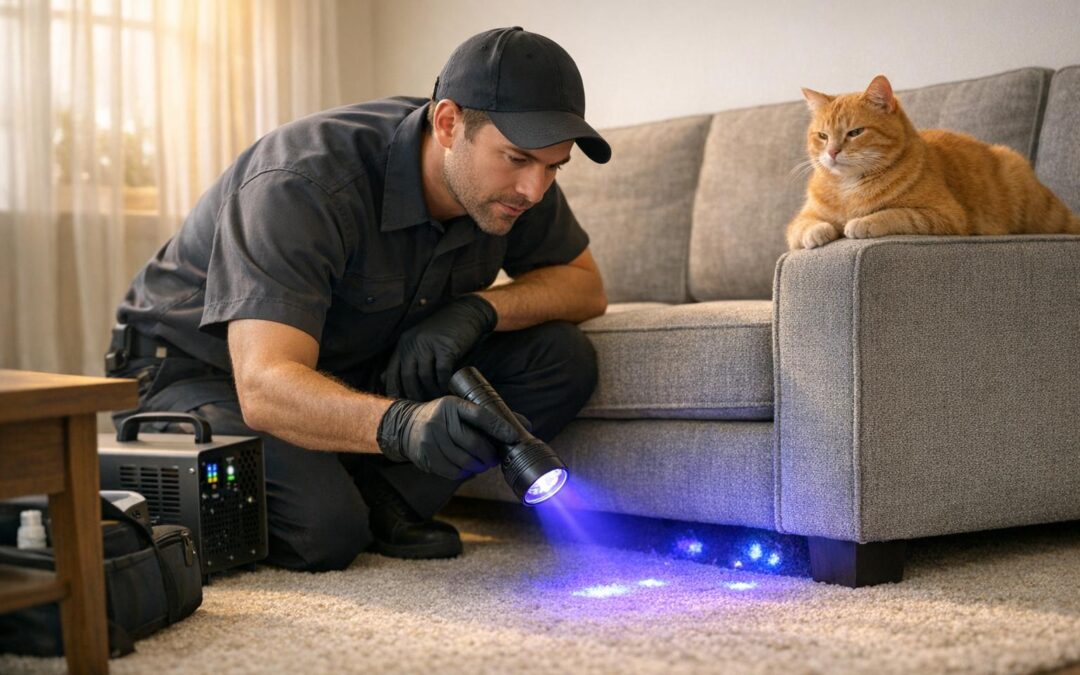
Pet odors can be tough to eliminate, especially when they seep into carpets, padding, and even subfloors. Professional pet odor removal services tackle these deep-seated smells using advanced equipment and techniques that go beyond regular cleaning. Here’s what you need to know:
- Why DIY Falls Short: Household cleaners and rental machines often fail to remove odors completely, leaving carpets overly wet and odors reactivating in humidity.
- How Professionals Work: Experts use tools like UV blacklights to locate hidden stains, enzymatic cleaners to break down odor-causing molecules, and ozone or hydroxyl generators to neutralize smells at a molecular level.
- Cost: Services typically range from $100 to $800, with an average of $350. Severe cases requiring subfloor treatment can exceed $2,000.
- Benefits: Professional treatments prevent odors from returning, protect your flooring, and improve indoor air quality.
Investing in professional services ensures long-term results and saves you from costly damage caused by untreated pet odors.
🔥Carpet Cleaner Shows How to Remove Pet Urine & Odor Like a Pro
sbb-itb-5fea4da
How Professional Pet Odor Removal Works
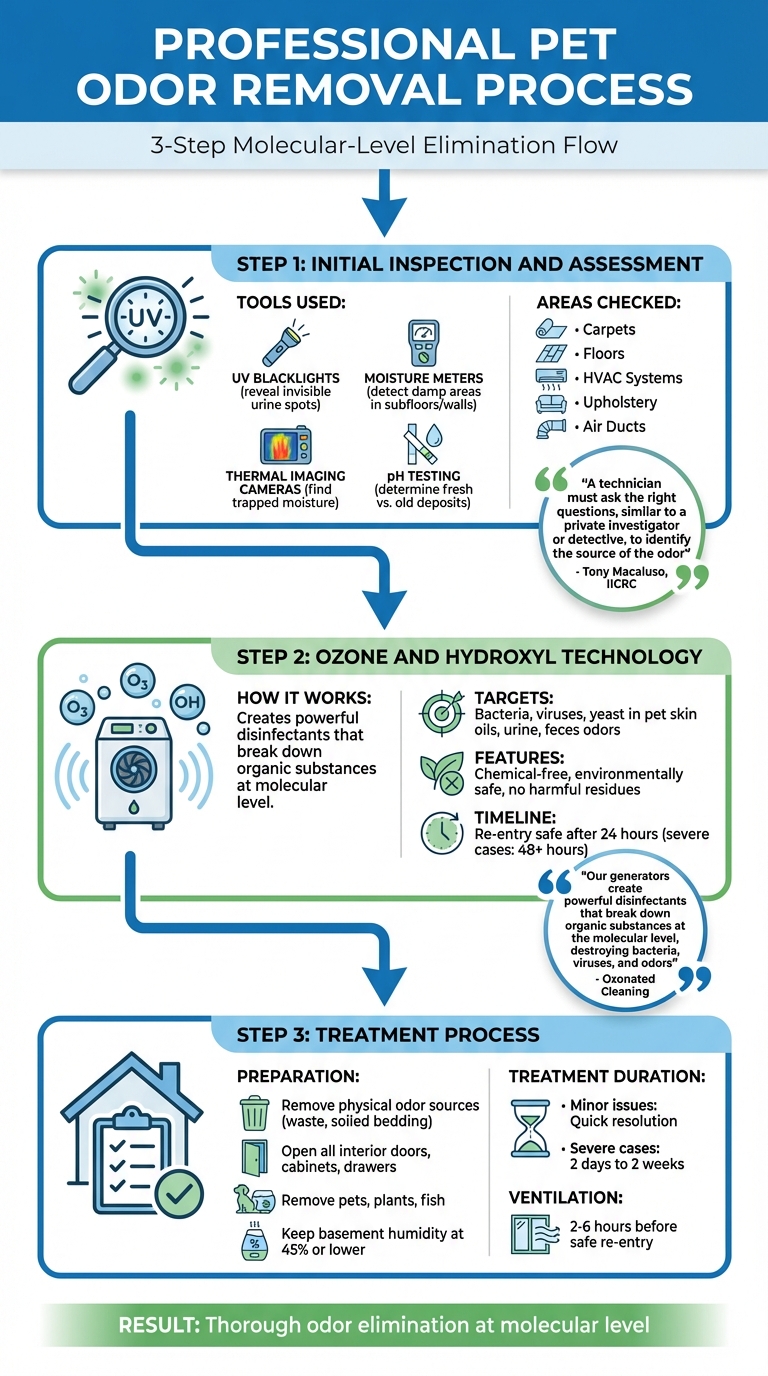
Professional Pet Odor Removal Process: 3-Step Treatment Guide
Initial Inspection and Assessment
The process begins with a thorough evaluation of your home. Professionals ask specific questions about your pets, such as how many you have, their types, and whether any are on medications that might amplify odors. They also check if you’ve tried any DIY cleaning solutions, as these can sometimes complicate the treatment.
Specialized tools help locate hidden odor sources. UV blacklights reveal urine spots invisible to the eye, while moisture meters detect damp areas in subfloors and walls. In some cases, thermal imaging cameras are used to find moisture trapped behind surfaces. pH testing also plays a role, helping determine whether a urine deposit is fresh (acidic) or old (alkaline).
Tony Macaluso from the IICRC Board of Directors explains:
"A technician must ask the right questions, similar to a private investigator or detective, to identify the source of the odor".
The inspection goes beyond carpets and floors. Experts check HVAC systems and upholstery, as odor molecules can circulate through air ducts or cling to fabrics. They also differentiate between "real" odors caused by volatile organic compounds and "psychological" odors linked to past experiences. This detailed assessment ensures the treatment is effective and customized to your home’s needs.
Ozone and Hydroxyl Technology
After the inspection, professionals use ozone and hydroxyl generators to tackle odors at their source. These devices create powerful disinfectants that break down organic substances like bacteria, viruses, and odor-causing molecules instead of just masking the smell. For example, Ozonated Cleaning LLC uses this method to target bacteria and yeast in pet skin oils, as well as odors from urine and feces.
"Ozonated Cleaning uses Ozone and Hydroxyl for odor removal and disinfection. Our generators create powerful disinfectants that break down organic substances at the molecular level, destroying bacteria, viruses, and odors".
This approach is free of chemicals and environmentally safe, relying on natural processes without leaving harmful residues. After treatment, a sterile scent might linger temporarily, and re-entry is usually safe after 24 hours, though some hydroxyl systems are safe for occupied spaces. Severe cases may require up to 48 hours or more. These technologies work by neutralizing odors at the molecular level, ensuring a deep and lasting clean.
Treatment Process Steps
The removal process is tailored to your home based on the initial assessment. The first step is to eliminate the physical sources of odors, such as pet waste, soiled bedding, or contaminated surfaces. Next, the space is prepared for treatment. This includes opening all interior doors, cabinets, and drawers and removing all pets, plants, and even fish to allow the treatment molecules to fully penetrate. For basements, humidity levels must be kept at 45% or lower, as higher humidity can interfere with the process.
During the treatment, generators run for a time determined by the severity of the odor. While minor issues might be resolved quickly, more severe cases can take anywhere from two days to two weeks. Afterward, the space is ventilated for 2 to 6 hours before it’s safe to return. This step-by-step process ensures odors are thoroughly addressed, leaving your home fresh and odor-free.
Costs of Professional Pet Odor Removal
Average Costs by Treatment Type
When considering professional pet odor removal, costs can vary widely. On average, you can expect to pay anywhere from $100 to $800, with the national average landing around $350. For moderate treatments that cover multiple rooms, prices typically reach about $650, which often includes steam cleaning two or three rooms, spot treatments, and ozone deodorization.
The pricing structure depends on the service provider. Some companies charge flat fees per room, while others opt for hourly rates ranging from $30 to $75 per hour. More specialized services, like advanced remediation, can cost $80 to $300 per hour. Ozone treatments, in particular, are calculated at roughly $0.11 per cubic foot of the treated space. Additionally, most companies have minimum service fees starting at $100.
For severe cases that require removing flooring and treating subfloors, costs can climb past $2,000. For instance, Ozonated Cleaning LLC offers home odor removal services priced between $600 and $900 based on square footage. They also charge $150 per vehicle for deodorizing and $200 per semi-truck for sanitization.
Factors That Affect Pricing
Several factors influence the cost of pet odor removal. Odor severity is one of the biggest determinants. Mild, surface-level odors typically cost between $100 and $250 to address. However, severe cases, especially those requiring deep extraction or ozone treatments, can range from $700 to $1,250. Urine-related odors are often more expensive to treat because they penetrate porous materials deeply, while feces or vomit removal is generally less costly unless left untreated for long periods.
The type of material affected also impacts pricing. Non-porous surfaces like hardwood are less expensive to clean compared to porous materials such as carpets, upholstery, or mattresses. The size of the affected area determines whether costs are calculated per room, per square foot, or as a flat rate for the entire home. Additional services, like cleaning HVAC ducts, can add $300 to $1,000 to the total cost.
You can cut costs by addressing pet accidents immediately. Quick cleanup prevents urine from seeping into the subfloor, potentially saving $500 to $2,000 in extraction or replacement costs. Bundling services – such as combining carpet cleaning with upholstery or drapery cleaning – can also help lower the per-service cost.
Cost Comparison Table
| Method | Cost Range | Best Use |
|---|---|---|
| Enzymatic Cleaning | $25–$40 per room | Breaking down organic matter (urine/feces) |
| Ozone Treatment | $200–$800 | Neutralizing airborne and embedded odors |
| Steam Cleaning | $100–$500 | Surface cleaning of carpets and upholstery |
| Thermal Fogging | $200–$1,000+ | Penetrating walls and cabinets for severe odors |
| Subfloor Extraction | $50–$200 per room | Removing urine that has soaked through padding |
| Air Scrubbing | $500–$2,000 | Filtering airborne particulates and contaminants |
Investing in professional pet odor removal ensures long-lasting results and a fresher, healthier home environment.
What to Expect After Treatment
After a thorough treatment, the final phase begins, where the results of the process start to show.
Immediate Odor Elimination
Professional treatments are designed to reduce odors quickly, though the full effects typically become clear once surfaces have dried – usually within 24 to 48 hours. Subsurface oxidizer treatments, in particular, show noticeable improvement right away, with the complete impact visible after drying.
"Subsurface Oxidizer Treatments have a more immediate impact. Significant improvement should be noticed immediately, but the full impact of the treatment may not be realized for 48 hours." – Ripley Services
It’s important to evaluate the results only after the treated areas have dried completely. Residual moisture can sometimes give a false impression of lingering odors. During this drying phase, limiting foot traffic is key to preventing deep-seated smells from reemerging.
At Ozonated Cleaning LLC, we follow these steps to ensure our treatments provide both swift improvements and safe, timely re-entry for our clients.
Once the initial odors are addressed, the long-term benefits of the treatment become more apparent.
Long-Term Results
Professional treatments tackle the root causes of pet odors, such as uric acid crystals and odor-causing bacteria, ensuring these smells are eliminated for good. Unlike store-bought air fresheners that simply cover up bad smells, these solutions ensure your home remains fresh – even during hot, humid weather, when pet odors tend to resurface.
Enzymatic treatments, in particular, continue working on bacteria for up to two weeks. For ongoing freshness, periodic maintenance every 3 to 12 months can help prevent odors from returning. This lasting freshness highlights the effectiveness of professional odor removal services.
Factors That Impact Results
While professional treatments deliver long-lasting results, several factors can influence how effective they are. Cat urine, for example, is especially tough to address because it breaks down into ammonia and other compounds that produce sour or fishy odors. The depth of the contamination also plays a role – if odors have seeped into the carpet padding, subfloors, or drywall, additional steps like sealing or extraction may be required.
Environmental conditions like heat and humidity can also reactivate old odors by drawing moisture into leftover alkaline salts. To prevent this, it’s a good idea to use dehumidifiers in treated areas and keep basement humidity levels below 45%. If any odors or stains resurface within the first 48 hours, reach out to your service provider immediately. Many companies offer free follow-up cleanings for lingering smells.
Finally, avoid using store-bought cleaners or air fresheners right after a professional treatment. These products can interfere with enzyme activity or push contaminants deeper into the fibers, reducing the effectiveness of the treatment. Giving the treatment time to work ensures thorough and lasting results.
Conclusion: Why Professional Pet Odor Removal Is Worth the Investment
When it comes to tackling stubborn pet odors, professional services consistently outperform DIY methods. Studies reveal that professionals can pinpoint odor sources over 70% of the time, delivering long-lasting results for more than 90% of their clients.
The secret lies in the technology. Advanced tools like ozone and hydroxyl systems go beyond surface cleaning, penetrating deep into materials to neutralize odors that typical cleaners can’t touch.
"Professional services can save you thousands of dollars in potential damage, along with the emotional strain that comes from living in an unpleasant environment." – My Pure Zone
Beyond just eliminating odors, professional treatments also help maintain your home’s value and improve indoor air quality. This is especially important for the 10% of Americans with asthma, as these treatments can remove hidden mold and allergens that DIY solutions often miss. Plus, you avoid wasting money on ineffective products or methods that don’t solve the problem.
Ozonated Cleaning LLC, serving the Chicagoland area, specializes in chemical-free ozone and hydroxyl treatments that target odors at their source. Pricing starts at $600–$900 for home treatments, depending on square footage, while vehicle deodorizing is offered at $150 per vehicle. For persistent pet odor problems, professional removal is a reliable and lasting solution.
Recent Comments