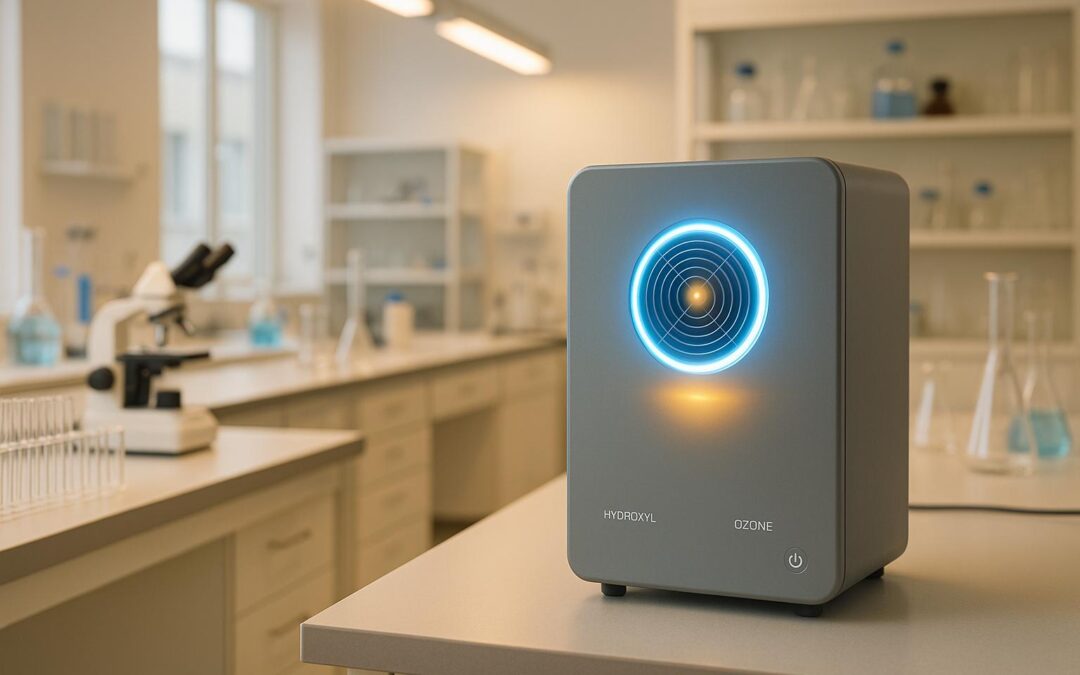
When it comes to keeping labs clean and safe, hydroxyl radicals and ozone are two leading technologies. Both provide residue-free disinfection and eliminate pathogens effectively, but they work differently and suit different needs. Here’s a quick breakdown:
- Hydroxyl radicals: Safe for use in occupied spaces, faster reaction speed, gentle on equipment, and effective for continuous air purification.
- Ozone: Requires unoccupied spaces, strong oxidizing power, ideal for deep cleaning, but can damage certain materials and requires strict safety measures.
Quick Overview:
- Hydroxyl: Works continuously, safe around people, no chemical smell, and gentle on sensitive tools.
- Ozone: Powerful for periodic deep cleaning but needs empty spaces and careful handling.
Quick Comparison Table
| Factor | Hydroxyl Technology | Ozone Technology |
|---|---|---|
| Use in Occupied Spaces | Safe for ongoing use | Requires evacuation |
| Reaction Speed | Faster reaction (10⁸–10¹⁰ L mol⁻¹ s⁻¹) | Slower reaction (1–10³ L mol⁻¹ s⁻¹) |
| Material Safety | Gentle on lab equipment | Can degrade some materials |
| Odor | No residual smell | May leave chemical smell |
| Applications | Continuous air and surface cleaning | Deep cleaning of air, water, and surfaces |
Choosing the right method depends on your lab’s needs. If you need continuous air purification without interruptions, hydroxyl is the way to go. For periodic, powerful sanitization, ozone is better suited. Both technologies help maintain high lab cleanliness standards while supporting research accuracy and safety.
Difference between Ozone and Hydroxyls
Ozone Technology for Laboratory Sanitization
Ozone technology uses oxidation-based disinfection to break down contaminants at their molecular core. This gas-phase method ensures thorough sanitization, reaching areas that traditional cleaning methods might overlook. Below, we’ll explore how ozone works, its applications in laboratories, and the safety measures necessary for effective and secure use.
How Ozone Works
Ozone works by targeting and breaking down specific molecular structures in pathogens, effectively neutralizing them.
"Ozone disinfection is an oxidizing agent that’s stronger and more effective than other disinfectants. It attacks at the molecular level to reduce dirt and bacteria before they even come in contact with surfaces." – Pentair
The oxidation process primarily focuses on breaking carbon-carbon double bonds, aromatic compounds, and non-protonated amines. When ozone interacts with these molecular targets, it disrupts the cellular integrity of bacteria, viruses, and other microorganisms. This makes it particularly effective against pathogens that can resist conventional disinfectants like chlorine. Additionally, ozone works at lower concentrations and requires shorter contact times compared to many traditional methods. Since ozone naturally decomposes into oxygen, it offers an eco-friendly alternative for maintaining clean and efficient laboratory operations.
Lab Applications for Ozone
Ozone sanitization is versatile, finding use in air and water treatment as well as cleaning specialized lab equipment. Its ability to aerosolize allows it to reach irregular surfaces, ensuring a more thorough cleaning.
One of its primary uses is in water system sanitization, especially in pharmaceutical labs requiring Water for Injection (WFI) standards. Ozone effectively disinfects water systems while preserving the purity critical for pharmaceutical processes.
Clean-In-Place (CIP) systems also benefit from ozone. Studies show that ozone-assisted CIP can lower biofilm cell populations to undetectable levels. In beer line cleaning, ozonated water outperformed chemical cleaners in reducing microbial contamination.
For laboratory glassware, ozone’s strong oxidizing properties remove organic residues and microbial contaminants, leaving no chemical residues that could interfere with future experiments. Additionally, gaseous ozone is highly effective for surface sanitation, as it can penetrate cracks and crevices that liquid sanitizers might miss.
Ozone Benefits and Safety Requirements
Ozone is highly effective at eliminating pathogens quickly. Research shows that ozone treatment achieved a 93.9% reduction in Staphylococcus aureus and an 87.5% reduction in Legionella pneumophila in water applications. During aerosol treatments at 36°F, microbial load reductions reached 70.4%.
The effectiveness of ozone is often measured using Ct values (concentration multiplied by contact time). For example, ozone’s Ct value for a 99.9% reduction of Giardia lamblia is 1.9, significantly lower than chlorine (122), chloramine (2,200), and chlorine dioxide (26). Similarly, for virus reduction, ozone has a Ct value of 1.2, outperforming chlorine (8), chloramine (1,988), and chlorine dioxide (33). These metrics highlight ozone’s exceptional performance in lab environments where precision and reliability are paramount.
Because of its high reactivity, strict safety measures are necessary. The Society for Occupational Health recommends limiting ozone exposure to 0.1 ppm over an 8-hour workday. To maintain safety, ozone generators should only be operated in unoccupied spaces, with continuous monitoring systems and proper ventilation in place to prevent accumulation. Worker training on safety protocols and emergency response is also essential.
Despite these precautions, ozone has been deemed GRAS (Generally Regarded as Safe) by the USDA and FDA and is approved for use in organic food production.
Hydroxyl Radical Technology for Laboratory Sanitization
Hydroxyl radical technology takes a unique approach to keeping labs sanitized, offering continuous pathogen control without the limitations that come with ozone systems. This method uses naturally occurring atmospheric chemistry to deliver effective sanitization in spaces where people are actively working. It tackles common lab challenges like maintaining sterile conditions while ensuring the safety of both personnel and equipment. The non-disruptive nature of this technology makes it an appealing option for labs aiming to balance cleanliness and functionality.
How Hydroxyl Radicals Work
Often called "nature’s detergent", hydroxyl radicals (OH•) are highly reactive molecules that break down volatile organic compounds (VOCs), viruses, bacteria, and mold through oxidation processes. They work by stripping hydrogen atoms from contaminants, which disrupts microbial cell structures and compromises their integrity.
The action of hydroxyl radicals is almost instantaneous, as they react within milliseconds. Their strong oxidation potential ensures quick and thorough disinfection, making them ideal for laboratory environments. These radicals penetrate viral and bacterial membranes, causing cell lysis and halting replication. They also neutralize endotoxins and pyrogens released by destroyed microorganisms, ensuring a deeper level of decontamination.
Lab Applications for Hydroxyl Radicals
Hydroxyl technology is particularly well-suited for labs where uninterrupted operation is critical. Unlike ozone systems, which require evacuation of personnel during use, hydroxyl generators can run safely in occupied spaces, reducing disruptions to research and routine activities.
This technology works effectively for both air and surface disinfection. Research shows that airborne bacteria can be reduced by 3–5 log₁₀ within 30–120 minutes, and SARS-CoV-2 can be completely inactivated within 80 minutes. For surface disinfection, pathogens like E. coli O157:H7, Salmonella, Listeria, and Staphylococcus aureus see inactivation levels of 2–4 log₁₀ within six hours of exposure. This makes hydroxyl radicals a versatile solution for a variety of lab surfaces.
In addition to microbial control, hydroxyl radicals excel at breaking down VOCs by disrupting the chemical bonds in both single and double-bond compounds. They can effectively neutralize a wide range of aliphatic and aromatic chemicals, which is a critical advantage for labs dealing with diverse chemical substances.
Real-world applications underscore these benefits. For example, a brewery running a high-speed filling line of 2,000 cans per minute managed to cut cleaning downtime from eight hours to just four hours after installing hydroxyl generators. This change not only improved efficiency but also reduced the need for other sanitizing chemicals, enhancing worker safety. The system paid for itself in under three months.
Hydroxyl Benefits and Safety Profile
Hydroxyl radical technology offers more than just effective disinfection; it also prioritizes safety and equipment preservation. One of the standout features of this technology is its strong safety record. According to the National Institute of Environmental Health Sciences (NIEHS), "There is no science or research indicating that hydroxyl radical generation is harmful to humans. This applies to both naturally occurring and man-made generation". These radicals are naturally present in the environment, with concentrations reaching 3–10 million molecules per cubic centimeter on sunny days. Humans, animals, and plants have evolved to thrive in this hydroxyl-rich atmosphere.
Unlike ozone, hydroxyl radicals are gentle on lab equipment, achieving up to 99.9% pathogen reduction without causing material degradation . This is vital for preserving the functionality of sensitive lab instruments and tools.
Hydroxyl radicals are effective against a broad spectrum of microorganisms, including bacteria, viruses, spores, and mold. Their ability to operate continuously, regardless of whether the lab is occupied, helps maintain a sterile environment without interrupting workflows. This ensures consistent air and surface quality, which is essential for both research integrity and product outcomes .
sbb-itb-5fea4da
Ozone vs Hydroxyl: Laboratory Comparison
Building on the operational and safety profiles mentioned earlier, this section takes a closer look at how ozone and hydroxyl technologies stack up against each other. When it comes to laboratory sanitization, understanding these two approaches and their differences is crucial for making the right choice. Each operates in unique ways and comes with its own set of safety protocols, making them better suited for specific lab environments.
Technology Comparison Chart
To better understand the distinctions, here’s a side-by-side look at the operational characteristics and safety profiles of ozone and hydroxyl technologies:
| Factor | Ozone Technology | Hydroxyl Technology |
|---|---|---|
| Occupancy During Use | Requires complete evacuation of personnel | Safe for use in occupied spaces |
| Safety Requirements | Maximum 0.05 ppm emission (per WHO, OSHA, FDA standards) | 0.016 ppm ozone emissions, 0.64 ppm hydrogen peroxide |
| Equipment Compatibility | Can damage natural rubber and bleach wet materials | Gentle on sensitive lab equipment |
| Reaction Speed | Faster initial odor elimination | Hydroxyl radicals react about one million times faster than ozone |
| Health Considerations | Can cause respiratory issues and lung damage | Does not penetrate the human body due to antioxidant mechanisms |
| Residual Effects | Leaves behind a chemical smell | No residual chemical odor |
| Operational Flexibility | Requires a waiting period of one hour or more after use | Offers continuous air purification |
These differences have a direct impact on how these technologies are applied in laboratory settings. Ozone generators work by intentionally releasing ozone gas for sanitization, but they require strict handling protocols and evacuated spaces during operation. On the other hand, hydroxyl generators produce radicals that prevent the buildup of organic compounds, making them safer for continuous use even in occupied environments.
This comparison highlights the operational strengths and limitations of each technology, helping lab managers make better decisions for their specific needs.
Selecting the Right Technology
Choosing between ozone and hydroxyl technology comes down to a few key factors. One of the biggest considerations is whether the lab needs continuous operation. Hydroxyl technology is ideal for labs that require ongoing air purification without interrupting daily activities, as it’s safe to use around people.
Another factor is the sensitivity of lab equipment. Ozone can degrade materials like natural rubber and bleach wet surfaces, which makes it less suitable for labs with delicate instruments. Hydroxyl radicals, however, are gentle on equipment and safe for lab personnel, thanks to the body’s natural antioxidant defenses.
Speed of sanitization is also worth considering. While ozone is quicker at eliminating odors initially, its use is limited by health-related concentration standards. Hydroxyl radicals, being far more reactive than ozone, provide a more thorough and long-term solution for controlling odors and pathogens.
Regulatory requirements and staff safety protocols further influence the decision. Labs handling biological or clinical materials often need uninterrupted air quality, favoring hydroxyl technology. Meanwhile, labs focused on manufacturing or production may find ozone systems suitable for periodic deep cleaning when spaces can be temporarily evacuated.
Ultimately, the choice depends on balancing sanitization needs with operational flexibility and safety. Hydroxyl generators are a great option for continuous purification and odor control in occupied spaces, while ozone systems are better for situations where temporary evacuation is possible. For labs in the Chicagoland area seeking expert advice, Ozonated Cleaning LLC provides tailored sanitization solutions that prioritize both safety and efficiency.
Laboratory Applications and Benefits
Ozone and hydroxyl technologies bring distinct advantages to laboratory sanitization, making them essential tools for research facilities, clinical labs, and testing environments. These methods help maintain sterile conditions while safeguarding sensitive equipment and ensuring the safety of personnel. By integrating these technologies, laboratories can protect research integrity and preserve delicate instruments.
Common Use Cases
Thanks to their unique chemical properties, ozone and hydroxyl technologies address a range of challenges across various laboratory settings.
Biocontainment and Clinical Laboratories often require stringent measures to combat high-risk pathogens. Ozone stands out in these environments. For instance, a study in a dairy plant revealed that ozone treatment reduced Listeria monocytogenes contamination rates from 15% to just 1.67% when used for disinfecting equipment and indoor air.
"Ozone treatment kills microorganisms 3,000 times faster than chlorine and is effective against E. coli, Salmonella and Listeria." – Absolute Ozone
Equipment Sterilization benefits from ozone’s efficiency and adaptability. In the beverage industry, ozone treatment removed 87% of d-limonene from EPDM gaskets within 60 minutes and achieved complete removal from silicone gaskets in just 30 minutes. This rapid sterilization process ensures equipment readiness with minimal downtime.
Water System Sanitization is critical in laboratories that depend on ultra-pure water for their operations. Studies in the wine industry demonstrated that ozone in water, at concentrations of 0.38 and 1.03 ppm, outperformed peracetic acid and other chemical treatments in sanitization effectiveness. This efficiency, achieved with lower concentrations, makes ozone an ideal choice for sensitive water systems.
Air Quality Management in occupied laboratory spaces is where hydroxyl technology shines. Unlike ozone, hydroxyl radicals are safe for humans, as noted by the National Institute of Environmental Health Sciences. They confirmed that no evidence suggests harm from hydroxyl radical generation, whether naturally occurring or man-made. This makes it a reliable option for maintaining air quality without disrupting ongoing research.
Fresh Produce and Food Testing Labs also benefit significantly from ozone applications. For example, a fresh produce facility used ozonated water to wash leafy greens, reducing microbial loads and extending shelf life by five days. This approach ensures sample integrity while preventing spoilage.
Professional Service Benefits
While the technology itself is powerful, professional implementation ensures labs achieve consistent safety and efficiency in their operations.
A case study at a major Southeastern University highlighted the advantages of transitioning from chemical disinfection to ozone systems. This shift reduced sanitization time from 3½ days to just 6–8 hours, while eliminating 8–10 hours of manual labor required for maintaining central water systems.
Safety Compliance and Risk Management are critical for ozone system operations. Strict protocols help manage risks and prevent exposure levels from exceeding OSHA’s limit of 0.1 ppm over an 8-hour period.
System Integration and Minimal Downtime are vital in active research settings. Professional service providers ensure sanitization systems are seamlessly integrated, allowing labs to upgrade their capabilities without interrupting ongoing research.
Preventative Maintenance and Monitoring play a key role in avoiding unexpected system failures that could jeopardize research. Continuous monitoring ensures optimal performance and helps identify potential issues before they escalate.
Ozonated Cleaning LLC, serving laboratories in the Chicagoland area, specializes in ozone and hydroxyl technologies. Their tailored solutions address specific sanitization challenges while adhering to the highest safety standards. With their expertise, labs can select and implement the right technologies for maximum effectiveness.
Choosing the Right Lab Sanitization Method
When deciding on the best sanitization method for your lab, it’s crucial to assess your lab’s specific needs. This choice affects not only how effectively pathogens are eliminated but also the safety of operations, the compatibility with equipment, and the smooth continuation of workflows.
Key Decision Factors
Occupancy Requirements
Some sanitization methods require empty spaces to function. For instance, ozone systems can only be used in unoccupied labs, while hydroxyl systems are safe to operate in spaces with personnel present.
Material Compatibility
Ensuring that your equipment and materials are compatible with the chosen sanitization method is critical. Ethylene oxide is widely recognized for its compatibility with many polymers. However, ozone compatibility with certain materials isn’t as well-documented. Laboratory managers should confirm that all equipment requiring sterilization is made from ozone-compatible materials before proceeding.
Disinfection Speed and Efficacy
The urgency of pathogen elimination plays a big role in choosing a method. Ozone, with its oxidation potential of 2.07 V, is 6 to 1,000 times more effective than other options based on Ct values. Meanwhile, hydroxyl radicals are even more potent – up to a million times stronger than ozone.
Processing Limitations and Residual Requirements
Evaluate the specific processing needs and the residual disinfectant levels required for effective disinfection. These factors depend on variables like the concentration of disinfectants, the natural resistance of microorganisms, exposure time, physical and chemical conditions, and the presence of organic matter or biofilms.
Economic and Operational Considerations
Cost, cycle time, and environmental impact are key considerations. Factors such as disinfection efficiency, penetration capability, safety, and implementation costs all come into play. For instance, ozone provides excellent distribution and penetration, as gaseous sanitizers have approximately four times the diffusivity of liquid options.
Once these factors are assessed, expert assistance can help ensure the best outcomes.
Working with Professional Services
Bringing in professionals can simplify the process of selecting, implementing, and maintaining a sanitization system. Experts ensure that the chosen technology aligns with your lab’s operational needs, safety standards, and regulatory requirements.
Professional services can also integrate automation, establish robust measurement and control systems, and maintain compliance documentation. This approach ensures optimal performance and long-term efficiency. Key considerations include material compatibility, effective circulation, automation scalability, and cost-effectiveness.
For example, Ozonated Cleaning LLC specializes in ozone and hydroxyl technologies for labs in the Chicagoland area. Their team evaluates your lab’s unique requirements, safety needs, and operational constraints to recommend the most suitable sanitization solution. Whether it’s rapid pathogen elimination in biocontainment facilities or maintaining air quality in active research spaces, their expertise ensures that your sanitization systems meet both immediate and long-term goals while prioritizing safety and efficiency.
FAQs
What safety precautions should be taken when using ozone technology in laboratories?
When working with ozone in a laboratory, prioritize safety by ensuring the workspace is empty and properly ventilated. It’s crucial to keep ozone levels below 0.1 ppm to safeguard health. Always use the right protective gear, like respirators, and enclose operations whenever feasible. Installing local exhaust ventilation can help reduce ozone buildup in the air.
Adhere to OSHA standards and handle ozone carefully, as overexposure can cause respiratory irritation and other health issues. Implementing strict safety measures is key to maintaining a safe and secure lab environment.
How do hydroxyl radicals purify air in labs while keeping the space safe for occupants?
Hydroxyl radicals play a crucial role in purifying the air in laboratories by breaking down airborne contaminants such as bacteria, mold, and volatile organic compounds (VOCs). This natural process works continuously, ensuring the air remains clean and surfaces stay sanitized – all without relying on filters or consumable parts.
What sets hydroxyl radicals apart from ozone is their safety for use in occupied spaces. This makes them an excellent choice for maintaining a clean and healthy lab environment without disrupting ongoing work.
When should a lab use hydroxyl technology instead of ozone for sanitization?
Hydroxyl technology is a great choice for laboratories that require continuous air sanitization while people are present. It’s safe to use around individuals and operates seamlessly without the need for interruptions, making it a practical option for ongoing air purification needs.
On the flip side, ozone technology works best for intensive treatments in spaces that are unoccupied. It’s commonly used for deep cleaning or odor removal but requires the area to be vacant during operation. When deciding between these two technologies, labs should evaluate their specific priorities, including safety considerations and operational demands.
Recent Comments