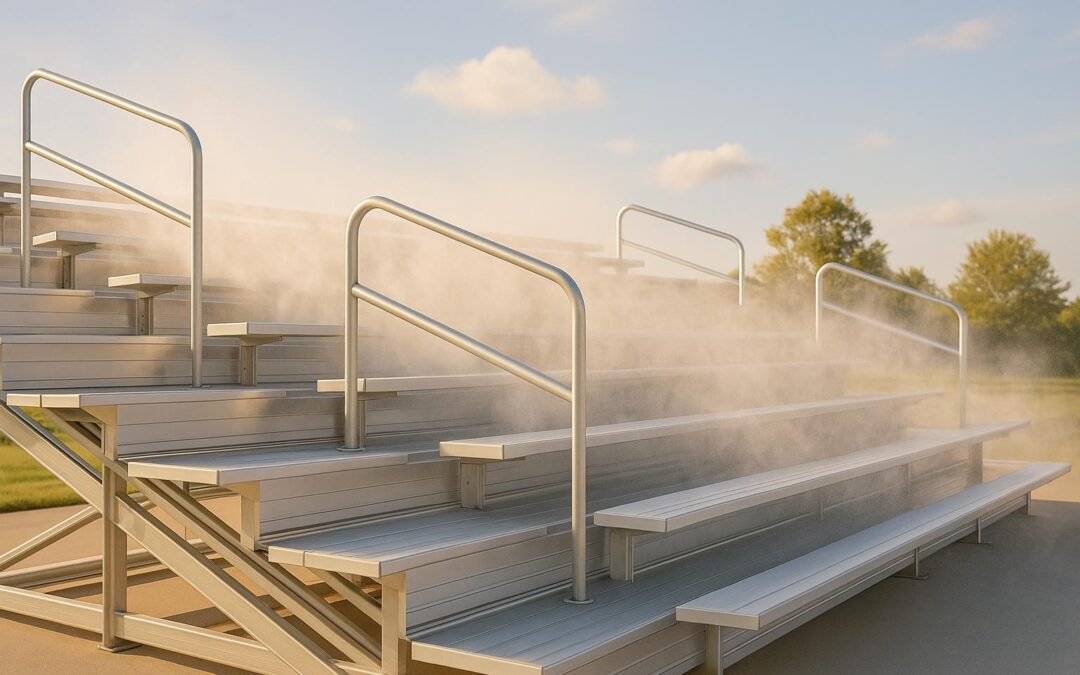
Ozone sanitization is an advanced cleaning method that uses ozone gas to disinfect bleacher surfaces in sports venues. It eliminates harmful microorganisms, removes odors, and reaches hard-to-access areas like crevices and undersides. Ozone is highly effective – 99.99% against bacteria, viruses, and fungi – without leaving chemical residues. This eco-friendly solution reduces health risks, extends the lifespan of bleachers, and cuts water and chemical usage. However, it requires strict safety protocols, such as area evacuation and ventilation, due to ozone’s toxicity. Despite its high initial costs, ozone sanitization offers a thorough, efficient cleaning process for maintaining safe and hygienic bleacher environments.
How Do Ozone Treatments Eliminate Odours? (Ozone Generators Explained)
How Ozone Disinfection Works on Bleacher Surfaces
Ozone disinfection is an effective method for sanitizing bleachers, targeting contaminants at the molecular level. Unlike traditional cleaning, which may leave hard-to-reach areas untouched, ozone disinfection uses powerful chemical reactions to neutralize harmful pathogens. This makes it particularly suited for sports venues where cleanliness is critical but challenging to achieve with manual methods.
How Ozone Targets Contaminants
Ozone’s three-oxygen structure gives it exceptional oxidizing power, surpassing that of hydrogen peroxide (1.78 V), chlorine gas (1.36 V), and oxygen (1.23 V). When ozone interacts with harmful microorganisms, it penetrates their cell membranes, disrupting enzymes, genetic material, and other vital components. This leads to cell destruction, while simultaneously oxidizing proteins, peptides, and fatty acids into harmless compounds. This multi-pronged chemical approach ensures pathogens are thoroughly neutralized.
Studies back up ozone’s effectiveness in reducing bacteria on surfaces. For instance, exposing surfaces to 9 ppm of ozone for six hours has been shown to reduce colony counts of E. coli O157 by 2.89 log, S. Typhimurium by 2.56 log, and L. monocytogenes by 3.06 log – achieving elimination rates of over 99%.
Ozone also tackles odors by oxidizing the molecules responsible for unpleasant smells. This is especially useful for bleachers, where odors from spilled food, drinks, or human activity can linger. Ozone is highly effective against stubborn compounds like ammonia and hydrogen sulfide. As the second most powerful oxidizer globally, it eliminates odors that conventional cleaning methods often fail to address.
Reaching Hard-to-Access Areas
One of ozone’s biggest advantages is its gaseous form, which allows it to reach places that liquid disinfectants or wipes cannot. Ozone gas spreads naturally, penetrating joints, crevices, and the undersides of bleachers where contaminants frequently accumulate.
This ability to flow into tight spaces ensures comprehensive coverage of intricate bleacher structures. Research shows ozone disinfection can deliver results up to 50 times better than chlorine-based methods, especially in confined or geometrically complex areas. Its ability to conform to various surfaces and microscopic irregularities makes it an ideal choice for thorough sanitization.
For venues utilizing professional services like Ozonated Cleaning LLC in the Chicagoland area, ozone disinfection ensures uniform treatment across entire bleacher systems. This reduces the risk of overlooked areas where pathogens or odors might persist, providing a safer and more hygienic environment for attendees.
Step-by-Step Guide to Ozone Sanitization of Bleachers
Here’s a straightforward guide to effectively and safely sanitize bleachers using ozone.
Preparation and Setup
Start by selecting the right ozone system for the job. For smaller sections or areas requiring frequent repositioning, mobile units are a better fit. Larger installations, on the other hand, benefit from stationary systems.
You’ll need an ozone generator, a system to distribute the gas, and safety monitoring tools. Make sure all equipment and pipelines are made from ozone-resistant materials. Before treatment begins, clear the bleacher area of debris, trash, and loose items, ensuring the ozone gas can reach every surface without obstructions. Position the generator and distribution system to provide even coverage across all surfaces.
It’s essential to evacuate the area of people, animals, and any sensitive items before starting the process.
Running the Ozone Treatment
Once everything is set up and the area is secured, begin generating ozone. The duration of the treatment will depend on the size of the bleachers, the level of contamination, and how deep the sanitization needs to go. Keep the ozone output consistent to ensure thorough surface contact. Thanks to its small molecular structure, ozone can seep into crevices, joints, and other hard-to-reach spots under the bleachers that traditional cleaning methods often miss.
Modern systems often come equipped with helpful features like ozone-compatible wands for targeted application and real-time monitoring tools to track ozone concentration levels. These tools allow for precise control, ensuring effective sanitization while maintaining safe operating conditions.
Once the treatment cycle is complete, the focus shifts to safely removing any remaining ozone.
Post-Treatment and Safety Steps
After the ozone cycle ends, it’s important to clear out any residual ozone before anyone re-enters the area. Proper ventilation is key here. Instead of simply venting ozone into the atmosphere, use approved methods like catalytic, thermal, or absorption techniques to safely break down the gas.
Re-entry should only be allowed once monitoring equipment confirms that ozone levels are within safe limits. If ozone levels exceed 0.3 ppm or if the area is confined with lingering ozone, personnel should use appropriate breathing apparatus.
Companies like Ozonated Cleaning LLC, based in the Chicagoland area, follow strict safety protocols during post-treatment. Their technicians are trained in ozone handling and safety procedures, ensuring venues can reopen safely after the sanitization process is complete.
sbb-itb-5fea4da
Pros and Cons of Ozone Sanitization for Bleachers
Ozone sanitization comes with a mix of advantages and challenges that facility managers need to carefully consider.
Comparison of Benefits and Drawbacks
Below is a detailed comparison of the key benefits and limitations associated with ozone sanitization:
| Advantages | Limitations |
|---|---|
| Chemical-free disinfection – Avoids the use of harsh chemical disinfectants, offering a more eco-friendly solution | Safety concerns – Ozone is toxic when inhaled, requiring treated areas to remain vacant during application |
| Highly effective – Works 3,000 times faster than chlorine and is 50 times more effective against microorganisms | Material damage risk – Can degrade rubber, electrical wire coatings, fabrics, and certain dyes or pigments |
| Broad-spectrum action – Targets a wide range of pathogens, including viruses and bacteria like E. coli and Listeria, without enabling microbial resistance | Monitoring needs – Requires constant ozone level monitoring with specialized analyzers, which can be costly to maintain |
| Residue-free – Breaks down into oxygen, leaving no harmful residues behind | High initial costs – Ozone generators and corrosion-resistant materials, such as stainless steel, involve significant upfront investments |
| Resource-efficient – Reduces water consumption by 20–40% and cuts hot water use by up to 90% | Regulatory restrictions – Must comply with strict exposure limits, like the FDA‘s 0.05 ppm indoor output cap and OSHA’s 8-hour worker exposure limit of 0.10 ppm |
| Thorough coverage – Reaches areas under bleachers that traditional cleaning methods often miss | Byproduct risks – Can react with organic compounds to form byproducts, some of which may pose health risks |
This side-by-side look highlights the practical and safety considerations that come with ozone sanitization. While it offers impressive cleaning power and environmental benefits, its challenges – like safety protocols and upfront costs – cannot be ignored.
For example, real-world applications of ozone sanitization demonstrate its potential. A textile factory using ozone treatment reported a 90% reduction in color contamination and a 60% drop in Chemical Oxygen Demand (COD). Similarly, an automotive plant in Spain achieved a 75% COD reduction along with substantial wastewater management savings.
Safety remains a top priority. The EPA’s National Ambient Air Quality Standard limits outdoor ozone concentrations to a maximum 8-hour average of 0.08 ppm, while NIOSH advises keeping indoor levels below 0.10 ppm. These regulations emphasize the importance of proper safety measures and continuous monitoring during ozone use. For bleachers, the ability of ozone to penetrate hard-to-reach areas often outweighs its limitations when safety guidelines are strictly followed. Additionally, its eco-friendly nature – eliminating harmful residues and reducing reliance on chemical disinfectants – makes it an appealing choice for sports facilities aiming to prioritize sustainability.
Safety Rules and Regulations for Ozone Use
Using ozone for sanitizing bleachers comes with specific safety requirements to ensure the well-being of workers and the public. Federal agencies in the U.S. have established exposure limits and guidelines that must be followed. These rules complement the safety protocols already outlined for post-treatment procedures, ensuring comprehensive protection throughout the ozone application process.
Key Safety Measures for Ozone Treatment
When using ozone, continuous monitoring is critical, and the area must be evacuated during treatment. According to OSHA, ozone exposure should not exceed 0.1 ppm over an 8-hour period. In cases where exposure could reach up to 1 ppm, workers should use ozone-rated cartridge respirators. For higher concentrations, a self-contained breathing apparatus is required. All equipment must be inspected after each use to ensure it is functioning properly .
To prevent accidental exposure, post clear warning signs and restrict access to the treatment area during ozone use. It is essential that the area remains unoccupied throughout the process – this includes ensuring no people or pets are present.
After the treatment, focus on proper ventilation to clear any remaining ozone. Pay particular attention to low-lying areas under bleachers, as ozone can accumulate there .
Since relying on human odor detection is unreliable (the threshold is approximately 0.02 ppm), high-quality ozone detectors should be used for continuous monitoring. These safety measures work in tandem with previously discussed operational guidelines, creating a well-rounded approach to managing ozone use.
Following Local and Federal Regulations
OSHA’s Air Contaminants Standard (29 CFR 1910.1000) requires facilities to implement administrative or engineering controls to keep ozone levels below exposure limits. Additionally, the Hazard Communication Standard (29 CFR 1910.1200) mandates proper worker training, along with clear labels and safety data sheets .
The EPA’s National Ambient Air Quality Standard limits outdoor ozone levels to an 8-hour average of 0.08 ppm. While the FDA restricts indoor ozone output to 0.05 ppm for medical devices, this limit does not typically apply to bleacher sanitization. However, understanding ozone’s potential health impacts remains crucial.
NIOSH advises a maximum exposure limit of 0.10 ppm and classifies levels above 5 ppm as immediately dangerous . To minimize risks, prioritize engineering controls to address hazards at their source instead of relying solely on personal protective equipment. Facilities should also maintain detailed monitoring records and regularly calibrate equipment. These practices not only ensure compliance during inspections but also promote a strong culture of workplace safety.
Conclusion: Why Ozone Works Best for Bleacher Sanitization
Ozone stands out as the go-to solution for sanitizing bleachers, thanks to its unmatched disinfecting power and eco-friendly nature. Unlike traditional cleaning agents, ozone offers a disinfection strength that’s 50 times more effective than chlorine, and it naturally breaks down into oxygen, leaving no chemical residues behind. This makes it a cleaner, safer option for both people and the environment.
Scientific research backs ozone’s effectiveness. It performs consistently across varying conditions, unlike many chemical disinfectants that falter with pH fluctuations or produce harmful byproducts. Ozone eliminates over 99% of pathogens on bleacher surfaces, ensuring a thorough and reliable sanitization process.
From a practical standpoint, ozone simplifies maintenance. On-site generation of ozone reduces the need for chemical purchases, cuts down water usage, and minimizes labor costs. It’s a solution that saves resources without compromising on cleanliness.
For schools and sports facilities, ozone sanitization addresses serious health risks, including the presence of bacteria like MRSA and other "Super Bugs", which often contaminate athletic surfaces. Ozone’s small molecules penetrate deep into bleacher materials, reaching spots that traditional methods frequently miss.
Key Takeaways
Ozone technology redefines bleacher maintenance by offering a safer, greener, and more effective cleaning process. It aligns with regulatory safety standards and provides a sustainable, long-term solution for public health protection. Jeff Koehler, Superintendent of Johnson-Brock Public Schools, highlighted the value of ozone sanitization:
"Having the option to use Sanzonate’s Aqueous Ozone solutions to clean and sanitize, will provide ‘green’ sustainable options for our staff, students, and visitors to our facilities."
For educational institutions and sports facilities, ozone sanitization delivers a combination of superior disinfection, cost savings, and environmental responsibility. Facilities in the Chicagoland area can rely on Ozonated Cleaning LLC for expert ozone sanitization services tailored to both educational and commercial spaces.
FAQs
What safety precautions should be followed when using ozone to sanitize bleachers?
When using ozone to sanitize bleachers, safety should always come first – for both people and the environment. Start by making sure the area is completely unoccupied during the treatment, as inhaling ozone can be dangerous. Afterward, ensure there’s proper ventilation to help the ozone disperse safely. It’s also crucial to wear protective equipment, like masks and goggles, to prevent direct exposure. Finally, stick closely to the manufacturer’s guidelines and keep exposure times within the recommended limits to ensure the process is both safe and effective.
How does ozone cleaning compare to traditional methods in effectiveness and environmental impact?
Ozone cleaning offers a cleaner, greener way to tackle tough cleaning jobs. Unlike chemical cleaners, it leaves no harmful residues because ozone naturally breaks down into oxygen after use – no pollutants, no lingering chemicals.
What makes ozone cleaning so effective is its ability to reach those tricky, hard-to-clean areas. It works on a molecular level to eliminate odors, bacteria, and viruses. This makes it an excellent choice for sanitizing large areas, like bleachers, without relying on harsh chemicals that could pose risks to both people and the environment.
Are there any risks to using ozone for sanitizing, and how can they be avoided?
While ozone works powerfully for sanitizing and eliminating odors, it can be harmful if mishandled. Improper use may lead to respiratory irritation, lung damage, or aggravation of asthma symptoms. To minimize these risks, it’s crucial to use ozone at safe levels, maintain good ventilation in the treated space, and ensure the area is unoccupied during the process. When safety protocols are followed, ozone sanitization can deliver effective results without compromising well-being.
Recent Comments