
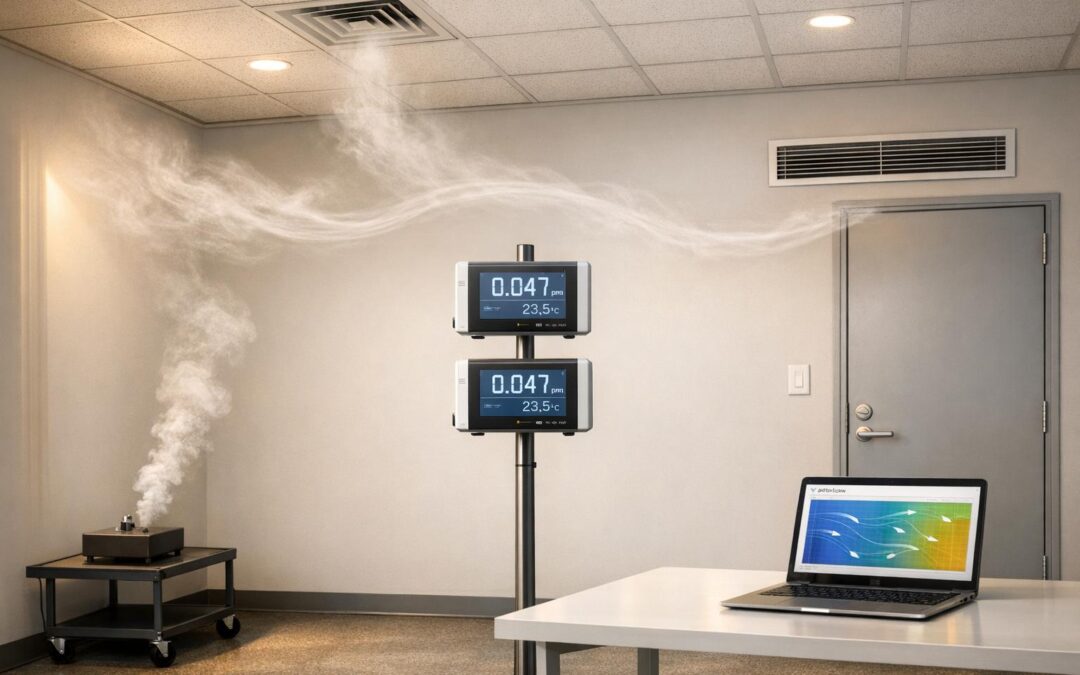
Proper airflow is critical for effective ozone disinfection. Without it, ozone can cluster in some areas and leave others untreated, reducing its ability to eliminate pathogens. Since ozone is heavier than air, it naturally sinks, requiring active circulation to distribute it evenly. Uneven ozone levels not only compromise disinfection but also lead to inaccurate measurements, as single sensors may not capture variations across a space.
Key takeaways:
- Airflow ensures even ozone distribution, preventing untreated "dead zones."
- Ventilation impacts ozone levels; high ventilation dilutes ozone, while stagnant air creates uneven pockets.
- Monitoring ozone at multiple heights improves accuracy, as levels vary from floor to ceiling.
- Stable airflow and sealed spaces are essential for maintaining consistent ozone concentrations.
- Tools like CFD simulations and tracer gas tests help identify and fix airflow issues for better results.
For successful ozone treatments, controlling airflow, sealing spaces, and using precise monitoring methods are essential steps to ensure thorough and effective disinfection.
Airflow Problems That Affect Ozone Distribution
Ventilation Causes Uneven Ozone Levels
High ventilation rates can significantly reduce the effectiveness of ozone treatments by diluting the ozone before it has a chance to disinfect properly. As the World Health Organization notes, "the higher the ventilation rate, the lower the indoor concentration". This happens because ventilation systems replace ozone-rich air with fresh outdoor air, cutting down the time ozone has to react.
The effect of ventilation depends on what the ozone is interacting with. For surface reactions – like when ozone interacts with walls, furniture, or fabrics – the airflow speed isn’t as critical because these reactions are limited by how quickly molecules reach the surface. However, for gas-phase reactions, where ozone neutralizes airborne particles, ventilation plays a much larger role. Christian Mark Salvador from the University of Göteborg explains, "surface reactions are relatively insensitive to ventilation rates while the gas-phase reactions compete with ventilation". In tests conducted in controlled chambers with stainless steel walls, ozone removal rates ranged from 0.15 h⁻¹ to 0.16 h⁻¹. When reactive surfaces, such as soiled fabrics, were introduced, the removal rate jumped to 1.37 h⁻¹.
These ventilation dynamics create uneven ozone levels across different spaces and times.
Ozone Levels Change Across Space and Time
Ozone concentrations vary depending on location and timing. The ratio of indoor-to-outdoor ozone levels typically falls between 0.1 and 0.7, largely influenced by how much outdoor air enters the building. For example, studies in homes show that indoor ozone levels rise from 21.2 μg/m³ when windows are closed to 35.3 μg/m³ when windows are open.
Vertical positioning also plays a role. In taller buildings, upper floors tend to have higher ozone levels due to better airflow and more outdoor air infiltration. Human activity further impacts ozone levels. Skin oils, particularly squalene, react strongly with ozone, accounting for 30% to 55% of indoor ozone removal. Given ozone’s short indoor half-life – just 7 to 10 minutes under typical conditions – its concentration can change rapidly as environmental factors shift.
These fluctuations not only make ozone levels inconsistent but also complicate accurate measurement.
Changing Airflow Disrupts Measurement Accuracy
Variations in airflow make it difficult to measure ozone levels accurately, as the environment takes time to adjust to new conditions. In climate-controlled chamber tests, it took roughly 3 hours for ozone and its reaction products to reach 95% of a steady state after a change in conditions. During this adjustment period, sensors may provide misleading readings that don’t represent the actual disinfection happening throughout the space.
Intermittent ventilation – turning systems on and off – makes the situation worse. This practice delays the formation of reaction products and causes ozone levels to fluctuate, further clouding the effectiveness of the treatment. Charles J. Weschler from Telcordia Technologies highlights that "indoor ozone concentrations can vary significantly from hour-to-hour, day-to-day, and season-to-season, as well as from room-to-room and structure-to-structure". Single-point measurements often miss these shifts, potentially leaving untreated "dead zones" where disinfection is insufficient. This instability undermines the overall success of ozone-based treatments.
sbb-itb-5fea4da
ECMI2021 Talk Sam Rolland "Modelling Ozone Disinfection Process for Creating Covid-19 Secure Spaces"
How to Improve Airflow During Ozone Treatments
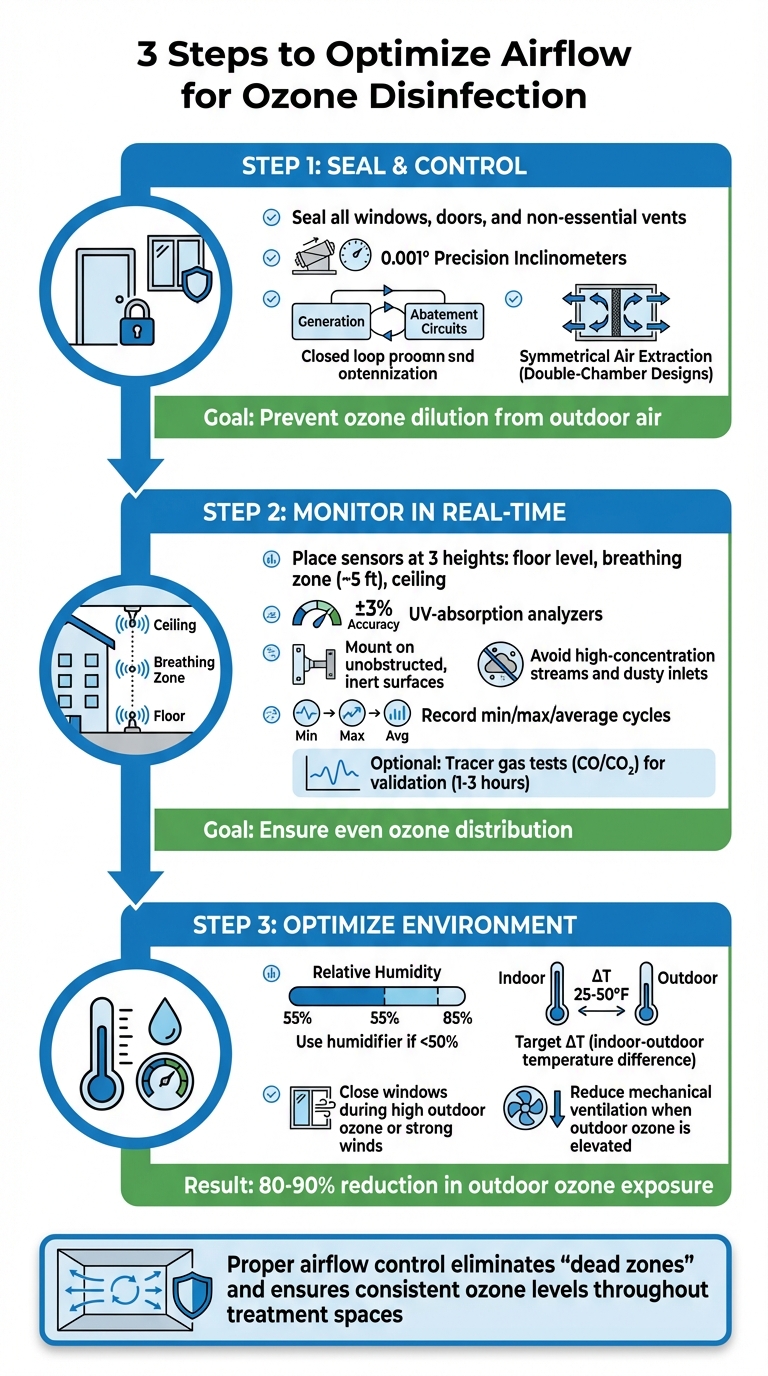
Airflow Management Process for Effective Ozone Disinfection
Seal Spaces and Control Ventilation
To maintain stable ozone levels during treatment, it’s crucial to seal all windows, doors, and non-essential vents. Allowing untreated outside air to enter a space dilutes the ozone concentration, weakening its ability to disinfect effectively.
Ventilation control is another key factor. Using precise damper management, with inclinometers capable of measuring angles to 0.001°, helps regulate indoor and outdoor airflow accurately. In closed systems, a generation and abatement circuit can contain ozone entirely within the target area, eliminating the need for external exhaust. For better airflow, symmetrical air extraction – such as double-chamber designs in cylindrical spaces – provides more even ozone distribution compared to standard cubic setups.
These steps ensure a stable environment, paving the way for precise, real-time monitoring of ozone levels.
Monitor Ozone Levels in Real Time
Once airflow is stabilized, continuous monitoring becomes critical to ensure proper ozone distribution. Since ozone naturally tends to settle, sensors placed at multiple heights are necessary for accurate readings. UV-absorption analyzers, with an accuracy of ±3%, can provide continuous data throughout the treatment process. Many modern systems are easy to install, offering plug-and-play convenience.
To get the most reliable readings, mount sensors on unobstructed and inert surfaces. Avoid placing them in high-concentration ozone streams or near dusty air inlets, as reactions with dust and oils can skew the data. Monitors that record min/max/average cycles help smooth out fluctuations caused by air movement. For further validation, tracer gas decay tests using CO or CO₂ can measure air change rates, though these tests may take 1 to 3 hours in a typical household setting.
With accurate monitoring and environmental adjustments, ozone treatments can be carried out more effectively.
Account for Weather and Environmental Conditions
Humidity, temperature, and outdoor ozone levels play a significant role in the success of ozone treatments. If the relative humidity is below 50%, using a humidifier to raise it to between 55% and 85% can speed up the disinfection process.
Pay attention to the indoor–outdoor temperature difference, as a ΔT of 25°F to 50°F is ideal for optimizing airflow calculations. During periods of high outdoor ozone levels or strong winds, keep windows closed and reduce mechanical ventilation to maintain consistent indoor concentrations.
"Exposure to noxious products of ozone/human chemistry can be reduced by decreasing ventilation during periods with high outdoor ozone levels" – Christian Mark Salvador, University of Göteborg
Closing windows and staying indoors can cut exposure to outdoor ozone by 80% to 90%.
Measurement Methods for Airflow Challenges
When tackling airflow issues, precise measurement techniques are essential to confirm ozone distribution and improve treatment effectiveness.
CFD Simulations for Airflow Prediction
Computational Fluid Dynamics (CFD) simulations are a powerful tool for mapping how ozone moves through complex spaces before treatment begins. These simulations help identify key problems like "dead zones" where ozone fails to reach, recirculation areas where air loops back on itself, and short-circuiting where airflow bypasses intended treatment zones entirely , a common challenge when planning ozone disinfection for event spaces.
Standard CFD models often fall short for ozone applications since typical ozone concentrations stay below 10 ppm. For better accuracy, professionals turn to specialized methods like the Discrete Phase Model (DPM) for tracking ozone particle movement and Species Transport (ST) methods to confirm concentration levels. For instance, in November 2024, researchers used ANSYS/FLUENT 2023R1 with both DPM and ST techniques to optimize airflow in a workwear drying cabinet. Empirical testing confirmed the simulation’s predictions, leading to uniform ozone distribution and better energy efficiency.
"CFD predicted flow fields showed that recirculation zones and short circuiting existed… Installation of four additional baffles in the second chamber would significantly improve contactor mixing performance." – Jianping Zhang, NSERC Chair in Water Treatment, University of Waterloo
One notable example comes from the Charles DesBaillets Water Treatment Plant in Montréal, Canada. A three-dimensional CFD model exposed significant airflow issues in existing ozone contactors. By recommending the addition of four baffles, the simulation predicted enhanced mixing and more consistent disinfection. These adjustments led to disinfection efficiency improvements of up to 34.6% compared to the original design.
While CFD simulations provide valuable predictions, real-world validation through experimental testing is essential to confirm airflow performance.
Tracer Gas Tests for Measurement Validation
To validate airflow patterns and ozone levels, tracer gas tests use harmless gases like CO₂ or CO. These tests are particularly effective for measuring air change rates, which directly influence ozone concentration stability.
The most common approach is concentration decay testing. Here, a tracer gas is released into the space, and its dissipation is monitored over time. In simple, single-room setups, this method provides clear results. However, in multi-zone buildings, a single tracer gas test achieves only about 33% accuracy. Using two tracer gases or running multiple tests can improve accuracy to around 8%.
A typical decay test involves releasing the gas for 1–10 minutes, followed by at least 20 minutes of monitoring. The entire process takes 1–3 hours, during which the space must remain unoccupied if CO₂ is used (to avoid contamination from human respiration). Combustion sources like candles or heaters must also be turned off. Environmental factors like wind and temperature can influence results, so conducting tests under varying weather conditions provides a more comprehensive understanding of the space’s airflow behavior.
While simulations and tracer tests offer insights into overall airflow, monitoring ozone levels at different heights provides additional clarity.
Vertical Monitoring at Multiple Heights
Ozone distribution within a room is rarely uniform, especially from floor to ceiling. Thermal stratification, where warm air rises and cool air sinks, can create layers with varying ozone concentrations. This phenomenon often results in a "lock-up layer", where ozone accumulates at specific heights, such as the breathing zone, instead of spreading evenly throughout the room.
"The ozone concentration in the human breathing zone can be notably lower than the bulk room level due to the ozone reaction with human skin and clothing." – Donghyun Rim
To capture these variations, sensors should be placed at floor level, the breathing zone (around 5 feet), and ceiling height. High ceilings or displacement ventilation systems, which push air from floor to ceiling, can reduce infection risks by 12% to 21% compared to standard mixing systems. However, these systems also introduce greater variability in ozone levels at different heights. Additionally, ozone reacts with surfaces like human skin, hair, and clothing, as well as flooring materials, causing concentrations in occupied breathing zones to drop below overall room levels.
How Ozonated Cleaning LLC Handles Airflow Issues

Airflow Assessment Before Treatment
Before starting any treatment, Ozonated Cleaning LLC carefully evaluates the space for potential airflow challenges. Their process includes sealing critical ventilation points and shutting down HVAC systems. This helps prevent ozone from escaping and ensures consistent ozone levels throughout the treatment.
The team also focuses on strategic generator placement tailored to the room’s layout. A study from Dr. Ivo Pedišić General Hospital in Sisak, Croatia, highlights how placement impacts effectiveness. For example, bacterial reduction in a 32.4 m³ room ranged from 33% at a sink to 61% at a window sill, depending on the generator’s exhaust direction. By adjusting equipment placement, the company addresses natural airflow patterns to maximize disinfection.
This careful preparation lays the groundwork for more effective and thorough treatments.
Combining Ozone with Hydroxyl Technology
Once airflow stability is established, Ozonated Cleaning LLC incorporates advanced reactive technologies to enhance disinfection. By combining ozone with hydroxyl technology, they tackle distribution challenges that ozone alone might not address. When ozone interacts with water vapor at relative humidity levels of 50%–70%, it produces hydroxyl radicals – highly reactive molecules known for breaking down bacteria and mold. This dual approach ensures even hard-to-reach areas receive effective treatment.
"Ozone, even when used at a low concentration, is a powerful disinfectant for airborne viruses and other microorganisms if combined with a high RH level." – Technical Note, MDPI
Maintaining relative humidity between 60% and 80% allows ozone concentrations as low as 1.0 ppm to achieve 99.9% viral inactivation within just 60 minutes.
Custom Services for Different Spaces
With its thorough airflow evaluations and advanced treatment methods, Ozonated Cleaning offers tailored services for a variety of environments. For home odor removal, prices range from $600 to $900, depending on the size of the space. These treatments are designed to address specific residential airflow challenges, such as thermal stratification in multi-story homes. Vehicle treatments are priced at $150, while semi-truck sanitization costs $200 per unit.
Serving the Chicagoland area, the company also provides custom pricing for commercial spaces, RVs, and boats. Each type of space undergoes a unique airflow assessment to ensure effective treatment. By combining cutting-edge technology with tailored protocols, Ozonated Cleaning ensures that ozone treatments thoroughly penetrate surfaces and fabrics, regardless of ventilation complexities.
Conclusion: Achieving Better Ozone Distribution
Effective ozone disinfection hinges on managing airflow with precision. Without proper control of ventilation and air circulation, ozone levels can become uneven, leading to "dead zones" where pathogens might survive. Eliminating stagnant areas while maintaining biocidal ozone levels ensures thorough treatment. Thoughtful room design can also improve both disinfection effectiveness and energy use.
Environmental factors, like humidity, also play a key role in how well ozone disinfection works. When relative humidity exceeds 55%, it speeds up microbial destruction by promoting radical formation. Pre-treatment cleaning is equally important, as organic matter can shield pathogens from ozone’s oxidative effects. Combining optimal humidity levels with a carefully calculated ozone dose – such as 112 min[ppm] (1.6 ppm over 70 minutes) – enhances disinfection efficiency.
These principles are central to Ozonated Cleaning LLC‘s approach. The company tackles these challenges by conducting detailed airflow assessments, strategically placing equipment, and integrating hydroxyl technology. By fine-tuning ventilation, adjusting airflow, and maintaining ideal humidity levels, they ensure ozone reaches every surface. Their methods blend Computational Fluid Dynamics (CFD) modeling with hands-on testing to deliver precise results.
The outcome? Reliable and consistent disinfection. From large multi-story homes with thermal layering to compact commercial spaces, controlled airflow transforms ozone into a dependable disinfectant. By mastering airflow dynamics, complete pathogen elimination is achievable through ozone cleaning for homes, businesses, and vehicles throughout the Chicagoland area.
FAQs
How can I tell if my space has ozone ‘dead zones’?
To spot ozone "dead zones", you need to measure ozone levels across different areas and heights within the space. Ozone tends to settle and cling to surfaces, which can create uneven distribution. If you notice consistently low ozone readings in certain spots, it could signal that ozone isn’t effectively reaching those areas.
Where should ozone sensors be placed for accurate readings?
For the most accurate readings, place ozone sensors at breathing height, roughly 3 to 6 feet above the ground, as this is where people generally occupy the space. It’s also important to position the sensors in spots where ozone is likely to gather, such as near lower levels or surfaces where it tends to settle. This approach helps ensure reliable measurements of ozone levels in the area.
What humidity and ventilation settings help ozone work best?
Ozone works best when the relative humidity is high, ideally between 80% and 90%. Ensuring proper ventilation is equally important – especially thorough airing after the treatment. This step is key to maintaining both the effectiveness of the disinfection process and the safety of the environment.
Recent Comments