
Hydroxyl generators are powerful tools for eliminating odors and sanitizing spaces, but using them safely requires attention to detail. These devices produce hydroxyl radicals, which neutralize contaminants like VOCs and odors quickly and effectively. Unlike ozone vs hydroxyl comparisons, are safe for use in occupied spaces when operated correctly. However, some generators may emit ozone, so following safety guidelines is crucial.
Key Takeaways:
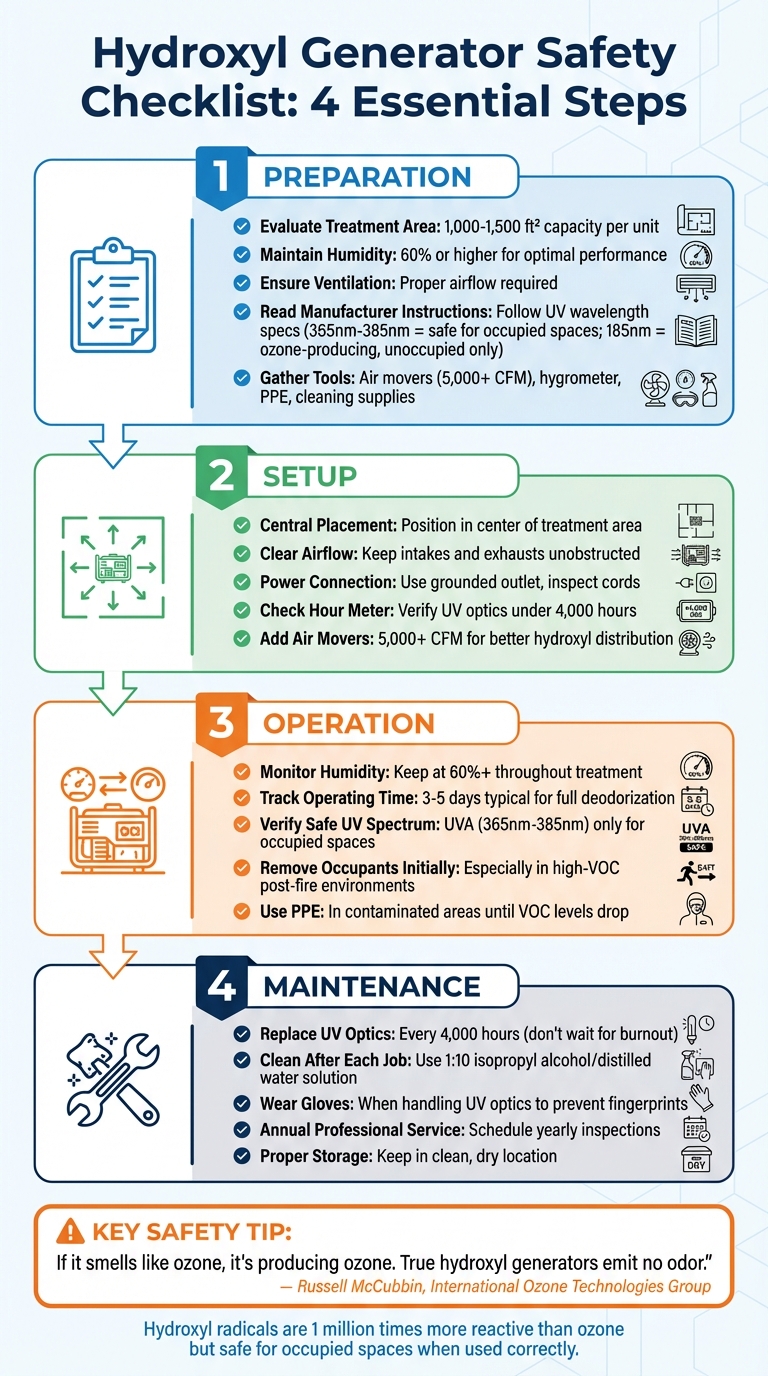
- Preparation: Assess the treatment area, ensure proper ventilation, and maintain humidity at 60% or higher.
- Setup: Place the generator centrally, keep intakes and exhausts clear, and use air movers for better distribution.
- Operation: Monitor ozone levels, follow manufacturer instructions, and use PPE in high-contamination areas.
- Maintenance: Replace UV optics after 4,000 hours, clean the unit after each job, and schedule annual servicing.
By following these steps, you can safely and effectively use hydroxyl generators to tackle odors and sanitize spaces without risks.
Safe Hydroxyl Generator Operation: 4-Step Checklist Guide
Preparation Steps Before Operation
Evaluate the Treatment Area
Before starting, assess the treatment area to ensure it matches the generator’s capacity, which is typically designed for spaces around 1,000–1,500 ft². Using a generator that’s too small for a large room or too powerful for a small, poorly ventilated area can lead to uneven oxidant concentrations or even safety risks. Proper ventilation is also a must to help disperse oxidants effectively. Michelle Blevins, Former Editor-in-Chief of Restoration & Remediation Magazine, emphasizes:
"Choosing the right generators and properly spacing them is important to not just be effective, but also to avoid high concentrations of oxidants in small occupied spaces with no ventilation".
Ambient humidity also plays a big role. Hydroxyl generators rely on a reaction between UV light, oxygen, and water vapor, so keeping humidity levels at 60% or higher is ideal. In drier environments, you might need to add moisture to ensure the technology works as intended.
The type of contamination matters, too. Whether it’s fire smoke, mold, VOCs, or pet odors, each scenario requires specific strategies for generator placement and treatment times. For example, in areas with high VOC levels after a fire, occupants should either leave the space or wear protective gear until the generator has reduced contaminants to safe levels. A 2016 study by Michael Pinto of Wonder Makers Environmental highlighted that hydroxyl generators could lower VOC levels in fire-damaged areas to parts-per-billion ranges within eight hours – well below OSHA standards.
Once you’ve evaluated the space, consult the manufacturer’s guidelines for any operation-specific details.
Read the Manufacturer Instructions
Take time to review the manufacturer’s instructions carefully. This ensures you’re meeting all operating requirements and keeping ozone levels within OSHA’s permissible exposure limits. Michelle Blevins notes:
"Following the manufacturer’s operating instructions and safety labels will ensure ozone levels produced by the hydroxyl generators are always below the OSHA permissible exposure levels, and thus, safe for occupancy".
Pay attention to the UV wavelength specifications in your manual. Generators with 185nm lamps produce significant ozone and should only be used in unoccupied spaces, while those with 365nm to 385nm (UVA) lamps are safer for spaces where people are present. Russell McCubbin, President of International Ozone Technologies Group, Inc., offers a simple test:
"If the hydroxyl generator you are looking at smells like ozone, it is likely making ozone. A true hydroxyl generator emits no odor at all".
Check for any state-specific regulations, especially if you’re in California or regions with strict air quality rules. Some states require special labels for portable air cleaning devices regarding ozone emissions.
Maintenance is another key detail. Most UV optics should be replaced after 4,000 hours of use, even if they continue to light up for longer. This ensures the machine operates at peak performance. Tom McArdle, Vice President of Odorox Hydroxyl Group, points out:
"The UV optics inside the machines should be replaced after being used for 4,000 hours… do not wait for the optics to burn out".
Collect Necessary Tools and Supplies
Once you’ve evaluated the area and reviewed the instructions, gather all the tools and supplies you’ll need to avoid interruptions during operation. Air movement equipment is crucial – high-volume air movers with 5,000+ CFM (cubic feet per minute) are far more effective at distributing hydroxyl radicals than smaller fans with 500–600 CFM.
A hygrometer is also essential to monitor humidity, ensuring it stays at or above 60% for optimal generator performance.
For safety, personal protective equipment (PPE) is non-negotiable. When handling UV optics, wear latex gloves to avoid leaving fingerprints or oils that can damage the bulbs. UV-rated eye protection is also necessary when checking if the optics are lit. In contaminated areas like post-fire sites, use standard restoration PPE until VOC levels are reduced to safe ranges.
Prepare cleaning supplies as well. A 1:10 mix of isopropyl alcohol and distilled water with lint-free cloths works well for cleaning UV optics and the machine chamber, preventing cross-contamination between jobs.
If you need to create concentrated treatment zones, have plastic sheeting and tape handy to build containment barriers around specific areas or items.
Finally, keep the manufacturer’s manual and unit key within reach. Before starting, check the machine’s built-in hour meter to confirm the UV optics haven’t exceeded their 4,000-hour limit. This ensures the generator will perform as expected.
sbb-itb-5fea4da
How to Set Up the Hydroxyl Generator
Place the Generator in the Right Location
Start by positioning your hydroxyl generator in a central spot within the treatment area. This ensures the hydroxyl radicals can evenly spread throughout the space. Since these radicals have a lifespan of less than two seconds, they need to reach all corners quickly before dissipating. Typically, one unit can handle spaces ranging from 1,000 to 1,500 square feet with ceilings up to 10 to 15 feet high.
Keep both the intake and exhaust areas clear of any obstructions. Blockages can interfere with airflow and reduce the generator’s ability to distribute the radicals effectively. If you’re working in a space with a tricky layout, like a hallway connecting multiple rooms, place the generator at one end and use high-volume air movers to help direct the radicals where they’re needed.
For areas with particularly strong odors, place the unit closer to the source or consider isolating the space using plastic sheeting. As Tom McArdle, Vice President of Odorox Hydroxyl Group, notes:
"Jobs can be streamlined when the contractor is able to deodorize while drying, cleaning and demoing. Both contents and structure can be treated at the same time".
Once you’ve positioned the unit, the next step is to ensure proper electrical connections.
Connect to Power Correctly
Before plugging in the generator, inspect its power cord for any signs of wear, such as fraying or exposed wires. The generator runs on standard household power, with an internal transformer converting it to the high voltage required for UV operation. A secure and grounded power connection is just as important as proper placement for optimal performance.
After checking the cord, plug the unit into a grounded outlet. According to Tom McArdle:
"When setting up the machines, it is as simple as plugging them in and turning them on".
Before powering on the unit, check the built-in hour meter to confirm that the UV optics haven’t exceeded their 4,000-hour lifespan. If they have, replace them to ensure the generator functions effectively.
Add Optional Equipment for Better Results
Once the generator is powered, you can enhance its performance by incorporating additional equipment. High-volume air movers (capable of 5,000+ CFM) can help distribute the hydroxyl radicals more efficiently. As Russell McCubbin, President of International Ozone Technologies Group, Inc., explains:
"Since hydroxyls live less than two seconds, it is necessary and beneficial to have as much air movement as possible to move the hydroxyls out of the machine and as far away as possible".
In dry environments, adding a humidifier can improve hydroxyl production by raising the humidity level to around 60%. For confined spaces like attics or crawl spaces, flexible ducting can direct the hydroxyl-rich air into these hard-to-reach areas. Additionally, running air scrubbers alongside the generator can help capture solid particulates while the hydroxyl radicals work to neutralize odors.
Safety Rules During Operation
Once you’ve completed the preparation and setup, following these operational safety rules is crucial for effective and secure hydroxyl treatment.
Remove People and Pets from the Area
Although hydroxyl generators are generally safe for occupied spaces, there are times when the treatment area should be empty at the start. For instance, post-fire environments often contain high levels of volatile organic compounds (VOCs), making it unsafe to occupy the space without personal protective equipment (PPE). These machines can, however, reduce VOC levels significantly in under 8 hours, creating a safer environment for remediation work.
In smaller rooms with limited ventilation, proper equipment spacing becomes critical to prevent high concentrations of oxidants. If treating a confined area or using several units, it’s best to keep people and pets out during the initial treatment phase until ventilation is confirmed.
Next, it’s essential to monitor operational parameters to maintain the generator’s performance.
Track Humidity Levels and Operating Time
To maximize hydroxyl production, maintain humidity levels at 60% or higher. Most units include built-in monitors to track operating hours, and it’s important to replace UV optics after 4,000 hours of use to ensure consistent output.
Keep in mind that hydroxyl generators take longer than ozone units to achieve similar deodorization effects. A task that might take one day with ozone could require three to five days with hydroxyls.
Stay Away from Direct Hydroxyl Exposure
Hydroxyl generators that use UVA light (365nm to 385nm) are safe for occupied spaces. However, some units rely on UVC lamps in the 185nm spectrum, which generate large amounts of ozone and aren’t safe for use in occupied areas. Russ McCubbin, President of International Ozone Technologies Group, Inc., emphasizes:
"UVC lamps in the 185nm spectrum produce large amounts of ozone… these units are nothing more than ultraviolet ozone generators and should be avoided".
To ensure safety, verify that your generator operates within safe UV wavelengths. Additionally, ventilate AOP (Advanced Oxidation Process) models to prevent harmful byproduct buildup, which can reach dangerous levels in enclosed spaces if not properly managed.
Shutdown and Post-Treatment Steps
After completing a treatment cycle with your hydroxyl generator, following proper shutdown and post-treatment steps is essential for ensuring the job is done effectively and safely.
Turn Off the Generator
Begin by switching off the generator and unplugging it. This step is critical for accurately assessing the treatment’s success. Tom McArdle, Vice President of the Odorox Hydroxyl Group, highlights the importance of shutting down all machines before evaluating odor levels:
"When you think the project is done, you need to turn off all of the machines. Use your nose, put it directly on the materials you’re testing, and smell. That’s it. If the smell is not noticeable at all, you’re good."
Once the generator is off, clean the machine to maintain its performance for future use.
Air Out the Treated Space
Allow fresh air to circulate through the treated area by opening windows or using fans for 1-2 hours. If there’s a lingering "sanitizing smell" upon re-entry, continue ventilating until the space feels completely clear. While hydroxyl-treated spaces are generally safe to re-enter immediately – unlike ozone-treated areas – airing out enhances comfort for occupants. After ventilation, you can proceed to check the results of the treatment.
Check the Treatment Results
Cleared air alone doesn’t guarantee the job is finished. Porous materials, such as cushions or fabrics, can still trap residual odors. To confirm success, test these surfaces directly. As McArdle suggests, use your sense of smell: place your nose close to the material and check for any lingering odor. If you detect any, extend the treatment duration as needed.
Hydroxyl generators often require three to five days to fully address odors, depending on their severity. However, they cannot eliminate odors permanently if the original source – like charred wood or soaked flooring – hasn’t been removed. If you’re having trouble finding the cause, use an odor source identifier tool to pinpoint the issue. Ensure you eliminate the source of the odor to achieve lasting results.
Maintenance and Equipment Care
Keeping your generator clean after every job is crucial for maintaining its performance and avoiding cross-contamination. This step works hand-in-hand with proper setup and shutdown routines to ensure safety and efficiency over time. Tom McArdle, Vice President of the Odorox Hydroxyl Group, stresses this importance:
"We recommend cleaning the machines after each job. This helps to ensure that the machines are always performing at their best, they look clean and professional, and it prevents any cross-contamination from the previous project".
Check and Replace Worn Parts
To keep the generator running at its best, replace UV optics after 4,000 hours of use. Most professional units come with an hour meter, making it easier to track usage. Tom McArdle highlights why this is critical:
"In the disaster restoration industry where you’re dealing with moderate to severe odors, and time is critical, 4,000 hours is the best time to replace [optics] to guarantee optimal performance – do not wait for the optics to burn out".
Routine inspections should also include checking external covers, connectors, and tubes for any signs of wear. When handling UV optics, always use latex or nitrile gloves. Fingerprints or smudges can create hot spots, which can lower the machine’s efficiency.
Clean and Store the Generator Properly
After powering off and unplugging the unit, clean it using a 1:10 solution of isopropyl alcohol and distilled water applied with a lint-free cloth. Store the generator in a clean, dry space to protect it from damage. If you’re working in challenging environments – like fire restoration sites with heavy smoke or high particulate levels – more frequent internal cleanings may be required to prevent dust buildup on the UV lamps.
Get Professional Service Annually
Even with regular cleaning and part replacement, scheduling annual professional servicing is essential. Trained technicians can inspect internal components, test electrical connections, and address potential issues before they escalate. This yearly maintenance not only extends the generator’s lifespan but also ensures it continues to meet safety standards for both residential and commercial applications. This is particularly important when addressing complex issues like HVAC odor sources, which often require specialized equipment and maintenance.
Conclusion
Performing safe and effective hydroxyl treatment calls for a clear, step-by-step approach. Start by evaluating the space, reviewing the manufacturer’s instructions, and gathering the necessary tools. While maintaining the right conditions can improve performance, eliminating the odor source is critical. Hydroxyl radicals – known to be about a million times more reactive than ozone – cannot fully neutralize odors if the physical source, such as burnt wood or waterlogged flooring, remains in place.
Once optimal conditions are set, focus on removing the odor source to achieve lasting results. After treatment, verify success by turning off the generator and inspecting porous materials for any lingering smells. As Tom McArdle, Vice President of Odorox Hydroxyl Group, highlights:
"The air will be the first area where the odor is eliminated. The structure and contents are the key areas to determine completion".
To keep your equipment running smoothly and extend its lifespan, clean it regularly and replace UV optics every 4,000 hours.
FAQs
What steps should I follow to safely use a hydroxyl generator in occupied spaces?
To use a hydroxyl generator safely in spaces where people or pets are present, it’s essential to stick to the manufacturer’s guidelines and follow established best practices. These devices are designed to neutralize odors and contaminants by mimicking natural processes, making them safe for occupied areas without leaving harmful residues behind.
Here are some tips to ensure safety and effectiveness:
- Position the generator correctly to maximize airflow and ensure thorough coverage of the area.
- Perform regular cleaning and maintenance to keep the device running efficiently and to prevent any buildup.
- Operate the generator continuously during the treatment period, which may last several days depending on the severity of the odor or contamination.
While hydroxyl generators are generally safe for use around people and pets, always assess the specific needs of your space and consult the manufacturer’s instructions for any additional precautions. Proper usage and attention to safety will help you get the most effective results.
What should I do if the humidity levels in the treatment area are not ideal?
If the humidity in your treatment area isn’t between the ideal range of 30–50%, you’ll want to make adjustments to ensure your hydroxyl generator operates efficiently.
When the air is too dry, using a humidifier can help add the needed moisture. On the other hand, if the air is too humid, a dehumidifier can remove the excess moisture. To keep tabs on the humidity levels, a hygrometer is a simple and effective tool.
Maintaining proper humidity doesn’t just optimize your hydroxyl generator’s performance – it also helps prevent problems that can arise from air that’s either too dry or overly damp.
How can I tell when the UV optics in my hydroxyl generator need replacing?
To keep your hydroxyl generator running smoothly, make it a habit to inspect the UV optics regularly. Look for signs of wear or damage, and replace them if needed – especially if you notice a drop in the generator’s performance. Checking the optics after each use can help you spot problems early and ensure everything operates at its best.
Recent Comments